Working with processes of translocation enabled Edward Said to point out interdependence and complementarity across geographical borders and disciplinary boundaries while recognizing cultural difference and the distinct historical experiences of colonizer and colonized. This book brings into focus Said's politics of reading, from his literary criticism in English to his political columns in Arabic. The international contributors—from Britain, Egypt, France, Germany, India, Switzerland, and the United States—investigate his intellectual legacies without necessarily identifying themselves with the critical positions these involve. Instead of treating his work as a unitary theoretical system, the various arguments explored offer a critical assessment of those situations in which his writing has entered into a productive relationship with other theoretical positions and interlocutors. The collection considers location, which has always been a central category in and for Said's writing; readings, which designates the acts by which, according to Said, the world comes to be constituted; and legacies, which pertains to the many fields across the boundaries of established academic disciplines that have taken up Said's challenges. The critical positions visited in this book include critical and cultural theory, postcolonialism, literary studies, theatre and performance studies, and visual and music studies.
eBook - ePub
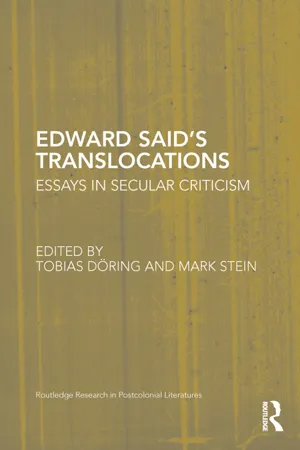
Edward Said's Translocations
Essays in Secular Criticism
- 240 pages
- English
- ePUB (mobile friendly)
- Available on iOS & Android
eBook - ePub
About this book
Information
1 Edward Said
Opponent of Postcolonial Theory
Introduction: Foundation and Unbelonging
Few academics or intellectuals can claim to have formed a discipline or a field in the manner in which Marx founded Marxism, Durkheim sociology, or Freud psychoanalysis. Founding a new discipline or field of study attests at the highest level to the originality of someone’s work and to the ways in which his or her work has transformed previous understandings of the world, reconceptualized its very epistemology. This is not something anyone does by decision or fiat, unlike the mythical heroes who found a city or a dynasty. Rather, as Foucault argues in ‘What is an Author?’, it is something that grows as a response to the way that someone’s new theories or concepts have fundamentally changed people’s understanding.1 In the eyes of many within the academy, one of the most remarkable achievements of Edward Said was that his book Orientalism founded a whole field. So if you google Said you will come to the Wikipedia entry on Said which begins:
Edward Wadie Said (1 November 1935, Jerusalem–25 September 2003, New York City) was a well-known Palestinian-American literary theorist and outspoken Palestinian activist. He was Professor of English and Comparative Literature at Columbia University, and is regarded as a founding figure in post-colonial theory.2
Pleased to have found my basic thesis confirmed by the end of the second sentence of this entry, I have to admit that, when I looked to the bottom of the page for the reference to the statement that Said ‘is regarded as a founding figure in post-colonial theory’, I found that the authority cited was in fact—myself. Initially often referred to as ‘colonial discourse analysis’, then ‘postcolonial theory’, by the early 1990s the field came to be known more simply as ‘postcolonial studies’. Today, there is scarcely an English department in North America, Europe, Asia, or Australasia that does not have at least one person working in this area; its effects have been felt not only across all the different periods of English studies, but also in many other disciplines: not only, most noticeably, in comparative literature, but also in many other literatures, such as French, German, Hispanic, Italian, in translation studies, as well as in other disciplines like anthropology, geography, history, media studies, political science, and, most recently, Christian theology. You can take a degree in postcolonial studies, there are many specialist journals in the field, endless conferences and symposia dedicated to it taking place all over the world, it is an official division of the Modern Language Association of America, and it is even recognized by the British Higher Education Funding Council as a specific field in which the research performance of British universities should be assessed. All this is commonly held to have been initiated by Edward Said, in his book written more than thirty years ago.
The oddest thing about this remarkable achievement, however, was that Said himself was indifferent, in fact sometimes hostile, to the appearance of a whole field founded on his work. After the Essex conference ‘Europe and Its Others’, held in the summer of 1984, which was really an initial response to Orientalism and effectively marked the ansatzpunkt of the institutional formation of postcolonial studies, and in which Said in his keynote gave the paper ‘Orientalism Reconsidered’, he rarely appeared at postcolonial studies conferences, often showed impatience with the work of postcolonial academics in the field, and refused invitations to allow his name to appear on the masthead of postcolonial journals. There is not a single book of his in which the term ‘postcolonial’ even appears in the index. Although he continued to support his students who generally worked within the field of postcolonial studies, after Orientalism Said’s own work shifted towards a different mode. When theory was at its high point in the 1970s, Said’s profile was that of a theorist—his strangely subjectless book Beginnings was reviewed in Diacritics, the leading theory journal of the day, alongside Derrida’s Glas.3 In later years, Said became impatient with theory on account of its abstractness and opacity, summarily dismissing it:
I have no time for that. That’s the answer to that question. What does it mean? And Baudrillard! It’s just nauseating, it’s just gobbledegook…. Both Baudrillard, and what’s the name of that other guy—Lyotard, it’s a kind of provincial atavism of a very very unappealing sort, and I feel the same way about postmodernism. I think it’s the bane of Third World intellectuals, if you will pardon the expression.4
Said’s dislike of postmodernism can in part be explained by his desire to distinguish himself from the man who had introduced postmodernism to North America—that other Egyptian-American literary theorist, Ihab Hassan, also from Cairo, and ten years his senior.5 It might have been assumed that postcolonial studies by contrast would have escaped his criticism, given that Said did set up through the example of his work—particularly Orientalism and Culture and Imperialism—the fundamental paradigm for the general postcolonial methodology, namely a largely thematic reading of literature focusing on its representation and mediation of a particular social and historical imperial moment, as well as an analysis of the effects of its use of a Eurocentric discursive framework. He did not involve himself overmuch in questions of form or aesthetics, and neither does postcolonial criticism. But Said was no more enthusiastic about that and seemed unwilling to take most of it seriously. In 1997, when asked a question about postcolonial studies, he had said simply: ‘I would rather not myself talk about it because I do not think I belong to that.’6 On occasion, he was publicly critical of some of its other practitioners, such as in his presidential plenary forum at the San Francisco MLA convention in 1998 when he dismissed the paper of his co-panelist Homi K. Bhabha.
Why was this the case? I want to open up this issue by making some suggestions as to why it might have been, and in doing so try to initiate discussion about this difficult question, which, on the face of it, is counterintuitive. One possible answer can be found in Timothy Brennan’s provocative argument that Said did not really found the field of postcolonial studies at all and that postcolonial studies has little to do with his work. Even he, however, admits that ‘supporters and critics [of Orientalism] alike are unified around the claim that Orientalism has an altogether causal relationship to postcolonial studies’.7 Against this consensus, Brennan seeks to prove that Said did not found postcolonial studies, by arguing that Orientalism is not Foucauldian—against the evidence of the book itself in which Foucault (or rather a certain concept of Foucault, ‘discourse’) is certainly invoked to describe its methodology.8 Brennan argues that postcolonial studies was a misreading of Said, and that ‘a good deal of postcolonial studies drew on Orientalism without being true to it’.9 One wonders though whether anyone, in fact, could be ‘true’ to Orientalism. We find, for example, Brennan himself claiming that ‘Said does not argue …that there is no such thing as a “real” Orient’, which seems somewhat at odds with Said’s own statement in Orientalism: ‘It is not the thesis of this book to suggest that there is such a thing as a real or true Orient.’10 The paradoxical arguments and methods of the book that have made it so generative will always mean that it is very hard to be true to Orientalism. No subsequent book of Said’s, as Brennan himself notes, was entirely true to Orientalism. No field, indeed, is likely to be entirely ‘true’ to a single text, even of founding status. Surely, Said did not dislike postcolonial studies simply because it did not turn the method of Orientalism into a repetitive orthodoxy. The question remains, why did he dislike it? Postcolonial studies has never really confronted this issue. What can we learn from it?
Postcolonial Critiques of Said
One reason why Said disliked postcolonial studies was something in the character of the field itself, which in its early years involved a certain initiation ritual of criticizing Said. A few years ago I described it as follows:
The production of a critique of Orientalism even today functions as the act or ceremony of initiation by which newcomers to the field assert their claim to take up the position of a speaking subject within the discourse of postcoloniality. It goes without saying that, as Terry Eagleton has remarked, the statutory requirement of this initiation rite is that the newcomer denounces one or preferably several aspects of the founding father’s text, criticizes the very concept of the postcolonial and then asserts that he or she stands completely outside it in a position of critique…. Only by doing this do you demonstrate that you are discursively ‘in the true’, as Foucault put it, with the postcolonial.11
Said himself, who was very sensitive to criticism and tended to lump together even his mildest critics with what he called ‘my enemies’, evidently did not enjoy this situation. Given the larger situation of his life, it is very understandable. It was undoubtedly Aijaz Ahmad’s attack in In Theory that he most resented. This was so in part because it characterized Said as a cosmopolitan Westerner while presenting Ahmad himself as coming from outside the Western academy, when, as the other topics discussed in the book attest, Ahmad was himself clearly working from within a Western framework, having taught in the English Department at Rutgers with Said’s friend and mentor Richard Poirier for many years, ...
Table of contents
- Cover
- Halftitle
- Title
- Copyright
- Dedication
- Contents
- Preface
- List of Figures
- Introduction: Edward Said’s Translocations
- PART I. Part I
- PART II. Part II
- PART III. Part III
- Index
Trusted by 375,005 students
Access to over 1.5 million titles for a fair monthly price.
Study more efficiently using our study tools.
Frequently asked questions
Yes, you can cancel anytime from the Subscription tab in your account settings on the Perlego website. Your subscription will stay active until the end of your current billing period. Learn how to cancel your subscription
No, books cannot be downloaded as external files, such as PDFs, for use outside of Perlego. However, you can download books within the Perlego app for offline reading on mobile or tablet. Learn how to download books offline
Perlego offers two plans: Essential and Complete
- Essential is ideal for learners and professionals who enjoy exploring a wide range of subjects. Access the Essential Library with 800,000+ trusted titles and best-sellers across business, personal growth, and the humanities. Includes unlimited reading time and Standard Read Aloud voice.
- Complete: Perfect for advanced learners and researchers needing full, unrestricted access. Unlock 1.5M+ books across hundreds of subjects, including academic and specialized titles. The Complete Plan also includes advanced features like Premium Read Aloud and Research Assistant.
We are an online textbook subscription service, where you can get access to an entire online library for less than the price of a single book per month. With over 1.5 million books across 990+ topics, we’ve got you covered! Learn about our mission
Look out for the read-aloud symbol on your next book to see if you can listen to it. The read-aloud tool reads text aloud for you, highlighting the text as it is being read. You can pause it, speed it up and slow it down. Learn more about Read Aloud
Yes! You can use the Perlego app on both iOS and Android devices to read anytime, anywhere — even offline. Perfect for commutes or when you’re on the go.
Please note we cannot support devices running on iOS 13 and Android 7 or earlier. Learn more about using the app
Please note we cannot support devices running on iOS 13 and Android 7 or earlier. Learn more about using the app
Yes, you can access Edward Said's Translocations by Tobias Doring,Mark Stein,Mark U Stein in PDF and/or ePUB format, as well as other popular books in Literature & Literary Criticism. We have over 1.5 million books available in our catalogue for you to explore.