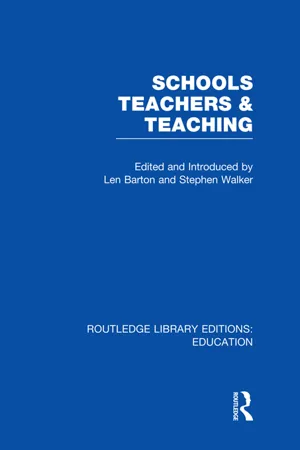
This volume considers how various sociological approaches to the exploration of the conditions of teachers' might be co-ordinated so as to produce a more penetrating and reliable understanding of the main dimensions of teachers' work. Three dimensions are selected for special attention: historical, institutional and interactional contexts in which teachers operate. In different way the papers in this collection explore the contribution such an investigation of these contexts can make to our understanding of wider educational concerns.
- 368 pages
- English
- ePUB (mobile friendly)
- Available on iOS & Android
eBook - ePub
Schools, Teachers and Teaching (RLE Edu N)
About this book
Information
1
Contemporary Concerns
in their Historical
Context
in their Historical
Context
Introduction
The relationship between different levels of sociological explanation and the desirability of reaching some kind of synthesis has been, as was noted in the preface, a vital focus for debate in the sociology of education. However, discussion about synthesis in the discipline has not been restricted to questions of perspective differences. Two concerns which have an important place in the history of the discipline are, first, a concern with linking explanation at the theoretical level with the empirical conditions to which these explanations refer and, secondly, an enduring concern of all applied sciences, the question of linking research findings with policy formulation. Both of these ‘linkage’ issues are given detailed consideration in this section of the book. A key criticism established and defended in all six papers is that not only is theory so often separated from evidence but also that, frequently, such theorizing is presented in a form so abstract and inaccessible as to defy substantiation. The pressure exerted during the last decade for increased consistency and precision at the theoretical level in the sociology of education has led to the construction of more sophisticated and elaborate accounts in the discipline. But it has also meant that the language sociologists of education use, the issues they debate and the interpretation they offer have moved further and further away from the ‘real’ world of educational experience. This separation has unfortunate consequences, one of these being the creation of barriers betwen social scientists and policy makers. If the theories proposed in an academic context have little substantive support it is not surprising that practitioners and policy-makers either misunderstand them or treat them as irrelevant to their everyday interests.
If sociologists of education are to halt this rather dangerous drift into isolation then there would seem to be a need for careful inspection of current tendencies in the discipline in the practice of theorizing with a view to identifying causes. This need is given serious consideration in this section. Three particular trends in contemporary theorizing are isolated and the difficulties these create for any attempt to develop more grounded theory in the sociology of education (and, moreover, theory with a practical relevance) are pinpointed. These are the a-historical nature of a great deal of currently available explanations, the too ready use of untested conceptual and descriptive apparatus and, thirdly, the reluctance of theory-builders to undertake regular and detailed scrutiny of empirical conditions as part of a conscious struggle towards theoretical modification, elaboration or, even, falsification. There are, of course, many possible reasons which could be found to explain why these tendencies emerged. However, surely one of the most basic and common constraints has been the difficulty of establishing a distinguishable, definable and manageable sphere of educational activity which theory-builders, empiricists and practitioners alike recognize and accord significance. It is our belief that the development of a sociology of teachers’ work – that is a sustained investigation of the peculiar interaction between those conditions, cultural relevances and creative responses which make up the activity ‘teaching’ – will provide such a unificatory framework. The temptation to be avoided however, is to imagine that in the development of such a sociology we have to jettison existing descriptions and explanations. This error is precisely the one which both Hargreaves and Whitty, albeit from different perspectives, identify as a major cause of the separations between explanation and evidence and theory and practice described above. To put it in a few words, the error involves a failure by sociologists of education to develop a strong sense of their own academic history. Although Hargreaves is concerned with one aspect of teachers’ work, that of the relationship between teaching and social control, whilst Whitty is concerned with a broader discussion of the differences between various radical explanations of schooling and teachers, both writers regret the fact that the development of new or alternative theories or approaches is given priority in the discipline over the equally essential task of subjecting existing work to vigorous evaluation.
The writers of the other four papers in this section are similarly motivated by a desire to promote greater theoretical continuity and cohesion, by a wish to grant clarification of a historical context for sociological work a higher priority. They also share, however, a more specific concern. This is a determination to explore the relationship between changing historical circumstances and the ways in which teachers’ work is to be conceptualized, on the one hand, and the consequences of these changes for teachers’ work, on the other. Discussion ranges over historical changes and notions of teachers’ professional identity and practices (Lawn and Ozga); the impact of government intervention and teachers’ careers (Hunter); the forms social relationships in schools take within differing geographical environments (Williamson); and the ways in which aspects of schooling reflect dominant ideologies (Purvis). Nevertheless, we are reminded in each paper of the unique contribution a more developed understanding of the history of teachers’ working conditions can make to a particular concern which many teachers are beginning to consider more frequently these days. Certain events in the world of education, such as redeployment and cut backs in expenditure, greater state interest and involvement in the curriculum and organization of schooling and moves aimed at making teachers more publically accountable, are serving to make the question of the extent of teachers’ personal and professional autonomy rather more than a largely academic puzzle. The relevance the papers in this section have for teachers struggling with this concern is two-fold. First, by identifying those aspects of life in school which can be seen to persist over time and those which do not, they contribute to our capacity to specify just exactly what it is which constitutes certain situational and institutional constraints. Secondly, and relatedly, by illustrating how, throughout their historical development, the subtle and complex patterns and processes of schooling can be seen as both serving and frustrating particular interests and objectives and, by so doing, as establishing certain spaces for resistance, they provide support for that perspective of teachers which depicts them as possessing creative capabilities rather than as passive recipients of influences beyond their control.
Schooling for Delinquency
The history of any substantive topic within any one of the many branches of the sociology of education is always, in part, also a history of the sociology of education as a whole. Every substantive topic has its own distinctive features, certainly, but no contributor to the field is ever wholly free from those wider forces and influences which shape the discipline as a whole. The fact is useful, for no speaker can assume that every member of his audience has a deep and genuine interest in his chosen theme. Since some of the audience may have but the most slender of commitments to the topic of schooling for delinquency – some of you may, in David Matza’s terms, simply have ‘drifted into delinquency’ – my paper seeks to be not merely a modest contribution to that substantive area, but also an exemplification, within one selected area, of some much more general problems which affect many branches within the sociology of education in Britain today. That seems entirely proper at a Westhill conference, to which so many of us now turn as an annual opportunity to consider the wider horizons of our discipline. Although this is hardly an occasion in which to attempt a judicious appraisal of British sociology of education in general, I want to refer to four general issues which in recent times have come to give me cause for concern.
The first issue is the proliferation of theories within the sociology of education. In Britain we have come to see Basil Bernstein as our most significant theorist. More recently we have come to admire the writings of Pierre Bourdieu, and at present most of our theoretical interests are focused on various neo-Marxist theoretical positions, associated with the name of Althusser, Gramsci, Habermas, Bowles and Gintis, and so on. The majority of the most popular theoretical positions are notable for one feature: their extremely weak link to supportive empirical evidence. Most of them were initially propounded at a fairly high level of abstraction. Almost never are they stated in a testable form, so that any reader can specify quite clearly what would constitute a falsification or confirmation of the theory. When, on those relatively rare occasions, empirical evidence is brought against the theory, the theorist rarely responds directly to, or engages in, debate with the empirical critic. Rather, the theoretical position is elaborated, and usually in a form which renders the theory yet more abstract and thus less open to empirical test. There are two important consequences, both of which are especially serious at the level of the student who aims to achieve a basic mastery of our discipline. The first is that the theories tend to be treated as well-established, empirically grounded theories which are true; and the second is that the competent student is quite unable to perform the elementary task of specifying what would constitute an adequate test of the theory. As a result, most students in the sociology of education are provided with an exceptionally poor training as social scientists, for they become unable to distinguish between theory and evidence, and to learn the important skills of theory testing.
The second issue is the atheoretical nature of so much empirical work in the sociology of education. Because the theorists are so reluctant to state their theories in a testable form, most empirical work is not directed to theory testing at all. Instead, the empirical work is conducted on a very crude theoretical base – and is then held to be ‘exploratory’ – and the theory is added on to the empirical work as a means of making sense of it and of locating it within the field as a whole. By this means a researcher legitimates his work and renders it attractive to professional colleagues. But this is no substitute for theory testing, which is one of the best methods by which a discipline can be advanced. In practice, the researcher is selective in two ways. First, he is carefully selective in the theories on which he draws. Usually more than one theory could be used to make sense of the data, but the researcher rarely treats the different theoretical positions as competitors which might be used to make conflicting predictions. Normally the researcher simply attaches to his work the most fashionable theoretical position with virtually no criticism or analysis of the theory. In so doing, of course, the researcher denies himself one of the greatest values of theory, that of sharpening and focusing the empirical questions he asks. Second, the researcher tends to be selective in the data he reports; a preference is shown for the data that ‘fit’ theory, and the rest is assigned to a peripheral position in, or even excluded from, the published work. It is thus that both theorists and researchers in the sociology of education conspire to sustain theories without subjecting them to adequately rigorous tests.
These first two issues might imply to the casual reader that I am pleading for a return by sociologists of education to a narrowly ‘positivist’ approach to the creation and testing of theory. That would, of course, be an entirely unwarranted inference. There is nothing that I have said so far which is incompatible with the views of some of the most influential figures in ‘interpretive’ sociology, such as Max Weber, Alfred Schutz and Glaser and Strauss (1967), as a careful reading of their works shows.1 But it is beyond the scope of this paper to illustrate the failings with reference to recent interpretive – or neo-Marxist – writing by British sociologists of education. More to the point is the fact that during the 1970s British sociology of education was rich in conflict and polemic between different sociological perspectives. By the end of the decade – as was so well illustrated at the first Westhill conference in 19782 – our attention was moving towards reconciliation and the need to synthesize these different perspectives. It is at the crux of my argument that this synthesis will be superficial if it does not include, as part of its task, the careful formulation and testing of theories in the light of empirical evidence.
The third issue, which is a direct consequence of the first two issues, is the non-cumulative nature of both theory and research. As time goes by, theories do not become better, by which I mean broader in scope and more economical in content, either as a result of careful testing or as a result of subsuming earlier theories. Theories simply ‘lie around’ in the field, relatively vague and relatively untested. Empirical research fares no better. Very few studies actively seek to build on the work of earlier researchers, confirming or disconfirming earlier findings to put our knowledge on a sounder basis. Too often research evidence is inconsistent or incompatible. It is thus that many of the introductory text-books to the sociology of education inevitably end up as catalogues of theory and research, for there is no way that a reviewer can integrate the field into a coherent whole. There are very few areas in our discipline where we can confidently say that either theory or research is much better established th...
Table of contents
- Cover
- Half Title
- Title Page
- Copyright
- Contents
- Preface
- 1. Contemporary Concerns in Their Historical Context
- 2. Contemporary Concerns and the School System
- 3. Contemporary Concerns and the Work of Teachers
- Contributors
- Index
Trusted by 375,005 students
Access to over 1.5 million titles for a fair monthly price.
Study more efficiently using our study tools.
Frequently asked questions
Yes, you can cancel anytime from the Subscription tab in your account settings on the Perlego website. Your subscription will stay active until the end of your current billing period. Learn how to cancel your subscription
No, books cannot be downloaded as external files, such as PDFs, for use outside of Perlego. However, you can download books within the Perlego app for offline reading on mobile or tablet. Learn how to download books offline
Perlego offers two plans: Essential and Complete
- Essential is ideal for learners and professionals who enjoy exploring a wide range of subjects. Access the Essential Library with 800,000+ trusted titles and best-sellers across business, personal growth, and the humanities. Includes unlimited reading time and Standard Read Aloud voice.
- Complete: Perfect for advanced learners and researchers needing full, unrestricted access. Unlock 1.5M+ books across hundreds of subjects, including academic and specialized titles. The Complete Plan also includes advanced features like Premium Read Aloud and Research Assistant.
We are an online textbook subscription service, where you can get access to an entire online library for less than the price of a single book per month. With over 1.5 million books across 990+ topics, we’ve got you covered! Learn about our mission
Look out for the read-aloud symbol on your next book to see if you can listen to it. The read-aloud tool reads text aloud for you, highlighting the text as it is being read. You can pause it, speed it up and slow it down. Learn more about Read Aloud
Yes! You can use the Perlego app on both iOS and Android devices to read anytime, anywhere — even offline. Perfect for commutes or when you’re on the go.
Please note we cannot support devices running on iOS 13 and Android 7 or earlier. Learn more about using the app
Please note we cannot support devices running on iOS 13 and Android 7 or earlier. Learn more about using the app
Yes, you can access Schools, Teachers and Teaching (RLE Edu N) by Len Barton,Stephen Walker in PDF and/or ePUB format, as well as other popular books in Education & Education General. We have over 1.5 million books available in our catalogue for you to explore.