This book is the first full-length analysis of the theory and practice of Persian singing, demonstrating the centrality of Persian elements in the music of the Islamic Middle Ages, their relevance to both contemporary and traditional Iranian music and their interaction with classical Persian poetry and metrics.
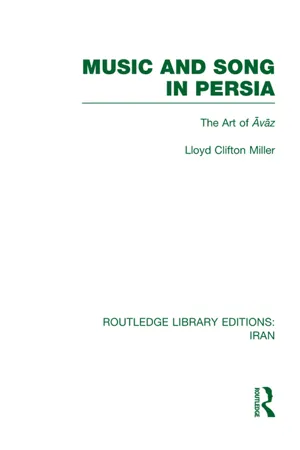
- 396 pages
- English
- ePUB (mobile friendly)
- Available on iOS & Android
eBook - ePub
About this book
Information
ONE
HISTORICAL BACKGROUND OF PERSIA AND PERSIAN MUSIC
Historical Background of Persia
There are various theories about the early history of the Iranian plateau and about how the Aryans or Indo-European speaking tribes migrated to the area and from whence they came. Without deciding whether the various writers, scholars and theorists on the subject are correct or not in their theories, a general look at the background of the geographical area will be helpful.
According to the Bible, Noah’s ark landed in the mountains of Ararat. This would be near the present day village of Doğubayzit in what is now Turkey not far from the northwestern Iranian border station of Bazargan. The legends of the Armenians, who have considered Ararat as their national heritage, link their ancestors to Noah and one of his descendants, the hero Haik.1
According to Mellaart, the earliest settlements on the Iranian plateau were in the Zagros mountain zone.2 Clair Goff Meade seems to agree that some of the oldest settlements on the plateau were in Luristan.3 T. Cuyler Young Jr. writes that late second millennium ceramics found in Azerbāijān show that settlements had also existed for some time in that area.4
As for cultural interchange and links between peoples of the area, Young states that there are indications of connections between tribes on the east and west of the Iranian plateau from before Achaemenian times (559–331 B.C.).5 Mohammed Bagher presents the idea that cultures of early Persia and the Indian subcontinent were continually linked from early times.6
Seifeddin Ghammaghami presents an interesting theory that deals with ancient megalithic monuments. He claims that, through dating, the megaliths indicate a line of cultural influence starting from Iran and spreading eastward, westward and northward.7 His theory of migration of megalithic cultures from Azerbāijān to Europe and the Far East may agree with the Noah story.
As for the Indo-European speaking tribes that came to the Iranian plateau and from whence they migrated, Indo-European linguist Emile Benveniste, in his classes at the Sorbonne and Collège de France, taught that Indo-European speakers came to the plateau from the north, from an area somewhere between present-day Lithuania and the Urals.8
Ghirshman suggested that the Indo-European speakers broke up into two branches which he classified as western and eastern (not to be confused with the general classification of Western or Centum and Eastern or Saturn (Indo-European linguistic groups). Ghirshman thought that the western branch, including the people commonly known as the Hittites, migrated around the Black Sea, crossing the Balkans and the Bosphorus to Asia Minor and subsequently replaced the Asiatic inhabitants. The Hittites extended their influence as far as Babylonia, Syria and Palestine. The eastern branch, he thought, moved eastward around the Caspian over the Caucasus and spread to the Euphrates, settling among the Asiatic substratum peoples of the area.9 The tribes in the east may have crossed the Oxus and stayed a short time on the Bactrian plain. From there, certain tribes seem to have come west while others crossed the Hindu Kush to descend along the Kabul and Pandishir plateau.10 The earliest evidence of Indo-European speakers coming to the Iranian plateau, according to George Cameron, is dated at the beginning of the second millennium B.C.11 Ghirshman postulated that in the first millennium B.C. another wave of Indo-European speakers moved southward. This group consisted of Phrygians, Balkan peoples, Armenians, Thracians, Mycenaens and Philistines. They destroyed the Hittite empire and some of them, with a powerful cavalry, chariots and navy, moved on to Egypt. Ramses II (1290–1224 B.C.) held them off and they were forced to move across Syria and Asia Minor where they established neo-Hittite states at Aleppo, Hama, Carchemish and Malatia.12 Ghirshman thought that Iranians coming from Transoxiana were unable to move south of the Hindu Kush since related tribes had already settled there during the previous invasions. Consequently, they turned west from Bactria into Iran. Iran was not as fertile as India and this gave rise to contention with Vedic tribes.13
Finally, after the Iranians took over towns and became powerful, two civilizations emerged, those of the Medes and Persians.14 According to Olmstead, the Medes and Persians were first mentioned in written annals in 836 B.C.15 Other wilder, more destructive tribes, the Cimmerians and Sythians, it is thought, moved from the north toward Asia Minor. The Cimmerians took over the Southern Black Sea area and the Scythian kingdom including most of modern Azerbāijān.16 Silver trays from the Scythian era bear designs not unlike modern Persian trays.17
By the reign of Cyrus the Great (550–529 B.C.), Iranians and non-Iranians occupying the area from the Caspian to the Indian Ocean had come under the jurisdiction of the Persian Empire. Cyrus took over Media, then Greece, and went all the way to the Jaxartes in the east and in the west to Babylon which he took without a battle.18 After the death of Cyrus, his son, Cambyses (529–522 B.C.) extended the realm to Egypt.19 Darius the Great (521–486 B.C.), the next ruler of the vast empire, was faced with revolts on all sides which he sternly quelled. Once the empire was resolidified, it stretched from modern Pakistan through Southern former USSR to Greece and down through Iraq, Syria and Egypt.20 It was during the Achaemenian era that the Mazdaen religion, reformed by the prophet Zoroaster, spread throughout the empire, further unifying the area.21
It seems that during the sixth and fifth centuries B.C., trade in the East became more extensive than before and with it obviously came cultural exchanges. Ghirshman claimed that navigation became widespread, with Scyla sailing from the mouth of the Indus to Egypt, and Sataspes going far beyond Gibraltar. Greeks, Phoenicians and Arabs seemed to have carried on commerce connecting India, Persia, Babylon, Egypt and other Mediterranean port countries. Commerce may also have spread to the Danube and the Rhine during this period.22 Some suggest it even reached the New World.23
From what information is available in written sources and oral tradition, Persian traditional music had already developed by the Achaemenian period and was perfected during the later Sasanian era (224–652 A.D.). The Arab conquest and advent of Islam served to spread Persian instrumental and vocal music along with music theory throughout the Islamic world. The later Mongol invasion served to carry Persian musical concepts eastward. Selected periods of history and key poets, some of which will be cited in the later section on the historical background of music, are listed in Table 1.
Table 1 Periods in Persian History
| B.C. | Periods |
| 5,000 | Copper first smelted on the Iranian plateau |
| 2,000 | First Aryan migration |
| 1,000 | Second Aryan migration |
| Zoroaster | |
| 900–550 | MEDIAN |
| 559–331 | ACHAEMENIAN (see map, Figure 1, p. 5) |
| 331–129 | SELUCID & HELLENIC |
| 249–224 | PARTHIAN |
| (130 B.C.-) | Saka and Yueh-Chih invasions |
| A.D. | |
| 224–652 | SASANIAN |
| (460 –) | White Hun invasion |
| (565) | Turks defeat white Huns |
| (637) | Islamic Arab invasion |
| 650–1037 | EARLY ISLAMIC |
| 814–973 | TāHIRID in Khorasān |
| 819–999 | SAMANID DYNASTY |
| 864–1029 | BUYID DYNASTY |
| (993–1030) | Sultān Mahmud |
| (1006–1089) | Khwāja Abdullāh Ansāri |
| (d. 940) | Rudaki |
| (941–1006) | Ferdosi |
| 1037–1194 | SELJUKS |
| 1220–1385 | MONGOLS AND SUCCESSORS |
| 1258 | IL KHāNID |
| (d. 1273) | Rumi (Molāvi) |
| (d. 1292) | Sa‘di |
| (1300) | Travels of Marco Polo |
| (d. 1325) | Amir Khosro |
| (1320–1389) | Hāfez |
| 1370–1501 | TIMURID |
| (1404 –) | Shāh Rukh, Herāt golden age of arts |
| 1501–1734 | SAFAVID |
| (1505) | Babur captures Kabul |
| (1501–1524) | Shāh Ismā‘il |
| (1524–15... |
Table of contents
- Cover
- Halftitle
- Title
- Copyright
- Contents
- List of Figures
- List of Tables
- Transliteration of Persian Letters
- Preface
- 1. Historical Background of Persia and Persian Music
- 2. Music, Islam, Mysticism and Proper Performance
- 3. Preservation and Propagation of Persian Music
- 4. The Theory of Persian Music
- 5. Persian Vocal Music
- 6. Background of Perso-Arabic Poetic Structure
- Conclusion
- Appendix A. Attributes of the Beloved in Persian Poetry
- Appendix B. Radif Texts and Translations
- Appendix C. Metric Analysis of Karimi’s Radif
- Appendix D. Sequence of Gushe From Four Main Sources
- Appendix E. Persian Instruments
- Appendix F. Notation and Transcriptions
- Epilogue
- Bibliography
- Glossary Of Terms And Persons
- Index
Trusted by 375,005 students
Access to over 1.5 million titles for a fair monthly price.
Study more efficiently using our study tools.
Frequently asked questions
Yes, you can cancel anytime from the Subscription tab in your account settings on the Perlego website. Your subscription will stay active until the end of your current billing period. Learn how to cancel your subscription
No, books cannot be downloaded as external files, such as PDFs, for use outside of Perlego. However, you can download books within the Perlego app for offline reading on mobile or tablet. Learn how to download books offline
Perlego offers two plans: Essential and Complete
- Essential is ideal for learners and professionals who enjoy exploring a wide range of subjects. Access the Essential Library with 800,000+ trusted titles and best-sellers across business, personal growth, and the humanities. Includes unlimited reading time and Standard Read Aloud voice.
- Complete: Perfect for advanced learners and researchers needing full, unrestricted access. Unlock 1.5M+ books across hundreds of subjects, including academic and specialized titles. The Complete Plan also includes advanced features like Premium Read Aloud and Research Assistant.
We are an online textbook subscription service, where you can get access to an entire online library for less than the price of a single book per month. With over 1.5 million books across 990+ topics, we’ve got you covered! Learn about our mission
Look out for the read-aloud symbol on your next book to see if you can listen to it. The read-aloud tool reads text aloud for you, highlighting the text as it is being read. You can pause it, speed it up and slow it down. Learn more about Read Aloud
Yes! You can use the Perlego app on both iOS and Android devices to read anytime, anywhere — even offline. Perfect for commutes or when you’re on the go.
Please note we cannot support devices running on iOS 13 and Android 7 or earlier. Learn more about using the app
Please note we cannot support devices running on iOS 13 and Android 7 or earlier. Learn more about using the app
Yes, you can access Music and Song in Persia (RLE Iran B) by Lloyd Miller in PDF and/or ePUB format, as well as other popular books in Social Sciences & Regional Studies. We have over 1.5 million books available in our catalogue for you to explore.