- 220 pages
- English
- ePUB (mobile friendly)
- Available on iOS & Android
eBook - ePub
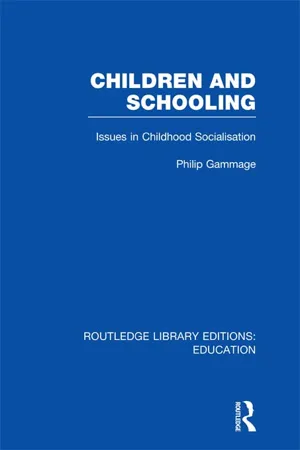
Children and Schooling
About this book
The book provides a synthesis of a broadly-based social-psychology of education and bridges the gap between theory and practice in education by emphasising the relationship between research and actuality. The author discusses the major issues in childhood socialisation relating to schooling, achievement and the curriculum, and in so doing makes a sensitive and well-argued case for the social-psychological perspective.He presents a social-psychologist's view of the interaction between child, school and curriculum, and summarises mainstream psychological contributions to current thinking on achievement, self-esteem and education. He covers areas of social learning and attribution theory not commonly dealt with in education texts, showing that there are major fields of research which have until now been neglected. Children and Schooling is constructed so that its chapters can be used as independent study-guides to specific subjects or read in sequence, each subject inter-related. The text can be treated as an introduction, particularly in view of the notes and comprehensive and apposite scholarly apparatus: and as a spring-board for serious study at advanced level.
Information
Chapter 1
Perspectives of Childhood:
Historical Overview
RELIGIOUS BELIEF AND ROMANTIC IDEOLOGY
Presumably, any recognition that education is an institutionalised form of socialisation, and one specifically designed by the state, must itself take cognisance of the ‘state of childhood’ and of the states towards which those children must be directed. Thus, when a society decides, presumably collectively, or through the medium of some government decision, that the time is ripe for a national system of education, its first thoughts are usually to distil some overall purpose and to set this out in the form of specified aims and objectives for the total system. What is thought most desirable for children is, however, rarely the sole factor guiding such a declaration. Expediency in terms of market forces, in terms of feasibility, in terms of political stability may also be a crucial factor for consideration. In particular it is usual for such a distillation to take very clear soundings not merely of the dominant values, but of the political and financial conditions current in that society.
The state's aims and objectives are made public and are then reified to some degree, becoming the principles of action. In England the Education Act 1944 is concerned with the education of all citizens ‘to the full extent of their interests and capacities, from cradle to grave, to participate in a democratic and technological society and to serve their country loyally’1; and many English people, even today, see such a statement as epitomising the major objective of schooling. As well as ensuring that these principles are fulfilled in respect of subsequent national and local organisation of state schooling, they are usually implicit in the selection of knowledge regarded as important for presentation at different ages of schooling. Bernstein has referred to this – the curriculum – as ‘what counts as valid knowledge’.2 Clearly, the nature of that curriculum will itself be affected both by ideologies current in the culture, and by the persons responsible for their presentation and selection. Likewise, the ideologies are not only in part reflected in the organisation and content of teacher education and training, but will also affect the selection of personnel considered suitable for teaching and overall viewpoints about the teacher's role. What is often forgotten is that the learners themselves will have a critical effect upon the nature of the information presented within that curriculum and that, moreover, different ideologies will often lead to very different views concerning what is appropriate for children of different ages and levels of ability. In short, what the culture deems to be the characteristics of children will often critically affect the content and nature of the transactions made between one generation and another. Curricular transactions within the school are no exception to this rule, except in so far as one must take account of the processes of institutionalisation and, consequently, of a sometimes slower rate of change in the nature of the transactions than may be exhibited in society generally. Different perspectives of children, different assumptions about their ‘character’, lead to different views of knowledge and different views concerning appropriate modes of presentation.
There is no current dearth of written advice upon the upbringing and education of young children, nor was there in the past. During the seventeenth, eighteenth and possibly the first half of the nineteenth centuries, however, perspectives on child-rearing were clearly linked with what the Newsons call, ‘expectation of death, rather than with the hope of a balanced and integrated life’.3 Such perspectives were for the most part related to two main features of life; the one consisting of the reality of high infant mortality, the demographic actualities of an age which (almost of necessity) followed practices of ‘hardening’ the child; the other concerning a viewpoint of ultimate salvation which has some of its origins in Calvinism, Pietism and Methodism, and which are often loosely categorised as Protestant or Puritan belief. Certainly, children were often treated with what we would nowadays regard as unwarrantable harshness: ‘Severity was doubtless hallowed by puritan and stoic traditions; but the quasi-medical practice of hardening had been advocated by the physician, John Locke, and found ready acceptance in an age which discovered the principle of innoculation.’4 Clearly, where education and child-rearing are inseparably linked, as indeed they were prior to the mid-nineteenth century, one must take account of pronouncement and tract, religious letter and medical advice, since such statements formed the background to family opinion and to the socialisation of the child in Europe and North America.
As Sunley remarks, it followed from such advice as that of the Protestants that many parents tended to regard all children as inherently sinful, to believe that play might well be the device of the devil and that strict discipline resulting in perfect obedience and seriousness was the only possible route to salvation.5 Such views clearly sprang from what might be regarded as an earlier generic protestantism, and while it would be simplistic in the extreme to regard them as representing the only coherent view of children during the sixteenth, seventeenth and eighteenth centuries, they were certainly extremely pervasive in Europe and America and, moreover, were common well into the nineteenth century. One should, of course, bear in mind the fact that most education prior to the nineteenth century was informal rather than institutionalised, and that the comments of Crispus (see below) and others were often couched in the form of advice to mothers or to parents on the upbringing of their children generally. But formal education and its curriculum were certainly thought of in like vein, in terms of religious and moral training. Lesson content and transactions were imbued with the Protestant Ethic. The dominant cultural ideology largely dictated the reactions of the older generation to the younger. Child characteristics were thought to be those of sinfulness, with ever-watchful death looking for a chance to clutch the pranksome idler to his bosom before salvation had been assured. As has been said earlier, such a view was at any rate highly realistic as regards infant mortality. Many a ‘pretty bud’ was doomed to an early grave. Thus considerations of material suitable for learning, whether at home, at Sunday school, or school proper, were based upon adults’ beliefs that the child should rapidly acquire a desired moral state, rather than upon any real under-standing of the immediate needs of children.
The essential distillation from a Calvinist view of child-rearing is well illustrated in Crispus's (pseud.) On the Education of Children, written in 1814:
The root and foundation of misconduct in children is human depravity; depravity in the parent and depravity in the child. This ought never to be overlooked, nor forgotten in any of our systems of education, but should be perpetually kept in view. Corrupt ourselves, we look with a more favorable eye upon the faults of our children, and feel a reluctance in conveying a censure to them which will recoil upon ourselves.6
There is much to suggest, therefore, that the Protestant Ethic, as it is often loosely termed, had a profound effect upon seventeenth-, eighteenth- and early nineteenth-century views of children. But to pretend that the Protestant Ethic can be seen as some unified whole and a cohesive force would be to flout the historical evidence. Undoubtedly, the combination of high infant mortality, the emphasis upon salvation and notions of predeterminism (springing from Calvinism), and what Weber referred to as the subtle combination of the ‘four principal forms of ascetic Protestantism’, namely, Calvinism, Pietism, Methodism and the Baptist movement,7 all produced views of childhood which were remarkably consistent in Europe and North America for well over two centuries. The represented nature of childhood was one of wilfulness and idleness, one which was inherently sinful; thus education was usually heavily weighted in favour of the inculcation of humility, industry and obedience. The nineteenth-century Protestants were, however, much more open than many to the impact of Darwinism during the latter half of the century and also to pressures from emerging intellectuals and scientists. This later led to different positions within protestantism, from which in part emerged such totally polarised viewpoints as fundamentalism and positivism.
The admittance of differing and evolving ‘creeds’ within protestantism was possibly one of the vital aspects which later distinguished some of the mainstream evolutionary modernists from their forebears and may have been gradually responsible for the shift in emphasis from faith to good works. In part, of course, this shift from faith to the striving, competing ambience of the nineteenth century, is one of the central issues discussed in Weber's famous essays of 1904-5. Very approximately the effect upon views of childhood (especially during the latter half of that century) was to increase the emphasis upon industriousness as a desirable learning experience during childhood, a change of emphasis from mere passive obedience to that of effective outcome, or as Little remarks of puritanism: when it appears, ‘the moral pressure will be on for the voluntary, self-initiated economic behaviour’.8 (This theme is discussed again in the context of socialisation and achievement in Chapter 5).
One must reiterate, however, that much of this ethos is more concerned with the socialisation and upbringing of children in the home than in formal educational institutions. For in England at least, schemes of national education were relatively late on the scene and even the Forster Act of 1870 was not fully implemented until the local government acts of 1880-6. Consequently, much of nineteenth-century English education was dependent upon religious foundation and philanthropy. (Up to 1833 there was no grant by Parliament for education and schools were financed by religious foundations and by charity support.) Such religious foundations, while often motivated by the highest ideals, were not necessarily capable of viewing childhood with any sort of objectivity. Moreover, many such foundations had their roots in the Calvinism of the past and still regarded children and childhood as the battlefield between the forces of good and evil.
Thus it can be said that, however described, the Protestant-cum-Puritan traditions of Christian nurture held considerable sway over the ideas of many concerned with the upbringing of children between the mid-seventeenth and mid-nineteenth centuries in England, North America and non-Catholic Europe. Such traditions, though, were not the only ones, and, while by the 1850s a transformation was slowly coming about in the writings of the Christian advisers in part hastened by the impact of Darwin, a transformation epitomised by the term ‘romantic’ was also slowly gaining ground. Many might argue that Rousseau, writing in the second half of the eighteenth century, was the father of such an ideology, but in part its origins lie back in such diverse roots as Aristotle's ‘learning by doing’ and in the deist theories of natural goodness. Rousseau, however, gave it life and immediacy. He was an impassioned and articulate critic of his society and in his writing on education saw possibilities for reform through the education of children. In Emile he proposed that the child should be nurtured ‘naturally’, growing up as Nature intended, free from the corrupting influence of urban France and residing in a southern French village where his learning, under the watchful eye of a tutor, would be true learning unadulterated by the sophistications of society. The tutor's task was not so much to teach as to enable Nature to work her miracle for him. Society, full of unnatural and harmful influences, must be kept from the child. It is heady stuff, powerful and persuasive. Moreover, it has had a continuing influence – in part good, in part bad – upon perceptions of child-rearing and the relationship between the development of the child and the cultural context. It contributed to the closer observation and understanding of children and to a greater recognition of their real state and development. It laid useful emphasis upon the corrupting evils of a society moving towards increasing urbanisation and industrialisation. But it was dangerous in so far as it led to an oversimplification of the relationship between child development and culture. It was good in that it helped lay the foundation for the great interest in childhood shown later by such people as Darwin, Preyer, Froebel, Watson, Hall, Thorndike and Freud; an interest which can be thought of as being centrally concerned with the ‘original’ nature of man through observation and understanding of the child. It gave strength and purpose to the eloquence of some of the romantic poets (notably Wordsworth), as well as heart to those impoverished Chartists who saw education as part of the way to establish greater dignity for all men and women.9 But like the so-called Protestant Ethic, it should not be represented as some single, consistent and dominant ideology; it, too, is a ragged and fractionated conglomerate of ideas from a variety of sources, which happened to push very roughly in the same direction. And, for much of the first half of the nineteenth century, the two dominant ideologies of child-rearing – those of the ‘free and the un-free child’ – ran side b...
Table of contents
- Front Cover
- Half Title
- Title Page
- Copyright
- Title Page
- Copyright
- Contents
- Acknowledgements
- Introduction
- 1 Perspectives of Childhood: Historical Overview
- 2 Schooling
- 3 Psychology and Education
- 4 Language, Communication and the Curriculum
- 5 Socialisation and Achievement
- 6 Constraints on the Curriculum: Social-Psychological Issues
- 7 Self-Esteem and Social Learning
- Appendix A: A Rough Linguistic/Cognitive Socialisation Chart Showing Changes in Conceptual Growth and Development
- Appendix B: The CARALOC Pupil Questionnaire
- Appendix C: Twenty Official Rules of the Schools in the USSR
- Index
Trusted by 375,005 students
Access to over 1.5 million titles for a fair monthly price.
Study more efficiently using our study tools.
Frequently asked questions
Yes, you can cancel anytime from the Subscription tab in your account settings on the Perlego website. Your subscription will stay active until the end of your current billing period. Learn how to cancel your subscription
No, books cannot be downloaded as external files, such as PDFs, for use outside of Perlego. However, you can download books within the Perlego app for offline reading on mobile or tablet. Learn how to download books offline
Perlego offers two plans: Essential and Complete
- Essential is ideal for learners and professionals who enjoy exploring a wide range of subjects. Access the Essential Library with 800,000+ trusted titles and best-sellers across business, personal growth, and the humanities. Includes unlimited reading time and Standard Read Aloud voice.
- Complete: Perfect for advanced learners and researchers needing full, unrestricted access. Unlock 1.5M+ books across hundreds of subjects, including academic and specialized titles. The Complete Plan also includes advanced features like Premium Read Aloud and Research Assistant.
We are an online textbook subscription service, where you can get access to an entire online library for less than the price of a single book per month. With over 1.5 million books across 990+ topics, we’ve got you covered! Learn about our mission
Look out for the read-aloud symbol on your next book to see if you can listen to it. The read-aloud tool reads text aloud for you, highlighting the text as it is being read. You can pause it, speed it up and slow it down. Learn more about Read Aloud
Yes! You can use the Perlego app on both iOS and Android devices to read anytime, anywhere — even offline. Perfect for commutes or when you’re on the go.
Please note we cannot support devices running on iOS 13 and Android 7 or earlier. Learn more about using the app
Please note we cannot support devices running on iOS 13 and Android 7 or earlier. Learn more about using the app
Yes, you can access Children and Schooling by Phillip Gammage in PDF and/or ePUB format, as well as other popular books in Education & Education General. We have over 1.5 million books available in our catalogue for you to explore.