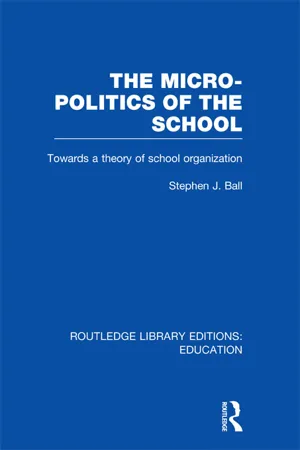
Stephen Ball's micro-political theory of school organization is a radical departure from traditional theories. He rejects a prescriptive 'top down' approach and directly addresses the interest and concerns of teachers and current problems facing schools. In doing so he raises question about the adequacy and appropriateness of the existing forms of organizational control in schools. Through case studies and interviews with teachers, the book captures the flavour of real conflicts in schools – particularly in times of falling rolls, change of leadership or amalgamations – when teachers' autonomy seems to be at stake.
- 4 pages
- English
- ePUB (mobile friendly)
- Available on iOS & Android
eBook - ePub
About this book
Information
1
Orthodoxy and alternative
Over the last twenty years there has been a massive growth in writing and research in British sociology of education. In a whole variety of substantive areas considerable advance has been achieved in our understanding – theoretical and empirical – of educational processes. However, the sociology of school organization is one area where little or no progress has been made. Theories and concepts have changed and developed very little since the 1960s. Neither organizational theorists nor educational researchers have had much of use or import to contribute.
It is my contention that organizational analyses – I include both work in the organizational theory and the ‘sociology of organizations’ traditions (Albrow, 1973; King, 1984) – have had little of any significance to tell us about the way in which schools are actually run on a day-to-day basis. Indeed, a great deal of the writing in this field has actually tended to bypass and obscure the realities of organizational life in schools. To a great extent organizational theorists have remained locked, explicitly or implicitly, within the stultifying parameters of systems theory and have tended to neglect description in favour of prescription or to move uncertainly between the two. They prefer the abstract tidiness of conceptual debate to the concrete messiness of empirical research inside schools. Sociologists of education, using case studies of schools, have tended to concentrate their attention, with some success, on what might be called the technical aspects of schooling – grouping practices, pastoral care, the curriculum – or have focused on conflict between pupils and teachers in the classroom (Hargreaves, 1967; Lacey, 1970; Sharp and Green, 1975; Edwards and Furlong, 1976; King, 1978; Woods, 1979; Ball, 1981a; Turner, 1983; Burgess, 1983; Delamont, 1983; Evans, 1985; Griffin, 1985). Although a number of these writers, Woods and Burgess in particular, provide some very useful and insightful sidelights on school organization (Burgess on the role of headteachers, Woods on staffrooms), as Davies puts it:
in such work we find the stultifying pressure of the focus of educational research upon variation in pupil achievement insufficiently embedded in a multi-level organizational and administrative framework. This has left us with attention at the organizational level by default and the door wide open for system and ‘ought’ theorists of every hue. (1981, p. 54)
Furthermore, sociologists of education in Britain interested in school processes, teachers’ work or curriculum innovation have seemed reluctant to take account of the work done by sociologists of organization in other substantive fields. The work of Salaman, Clegg and Dunkerley and Silverman have had little impact on research on schools.
King is one of the few commentators who seems satisfied with the current state of affairs. He believes that ‘we now have a body of theoretical and research studies, covering substantive matters as grouping practices, the distribution of authority and school size, which are the makings of a decent sociology of school organizations’ (1984, p. 61). However, his view of school organization is almost exclusively pupil-centred and also theoretically parsimonious (e.g. the unreflexive use of the concept of ‘authority’). He can offer little insight into teachers’ experience of work in schools, and almost nothing in the way of relevant conceptual development.
In this book I shall be concentrating wholly upon organizational aspects of the school. What is meant by ‘organizational’ in this context is grounded in the empirical chapters which follow, but my major focus is upon the control of work and the determination of policy. My definition of an organization follows Barr-Greenfield (1975). Like him I reject the notion of ‘a single abstraction called organization’ but begin rather with ‘the varied perceptions by individuals of what they can, should, or must do in dealing with others within the circumstances in which they find themselves’ (Barr-Greenfield, 1975, p. 65). I intend to provide a set of analyses based closely upon the experiences of teachers as they are involved in the day-to-day running of schools. I shall offer some exploratory but I hope pertinent insights into the ways that schools are managed, changed, organized and defended that will both articulate the views and perspectives of teachers and contribute to the development of a coherent theory for describing and explaining schools as organizations. I believe this to be an important and worthwhile exercise, not simply as an end in itself or as a necessary tidying up of some loose ends in the sociology of education. An understanding of the way that schools change (or stay the same) and therefore of the practical limits and possibilities of educational development, must take account of intra-organizational processes. This is particularly crucial in examining developments which are related to the achievement of more equal, more just, as well as more effective education.
The sociological analysis of educational change in recent years has, for the most part, been focused either on the all-embracing effects and implications of structural movement (be it cultural or economic in origin) or on the responses, adaptations and strategies of individual actors. Indeed, the past fifteen years have been dominated in the sociology of education by the continually regurgitated motifs of macro versus micro, structure versus action, free will versus determinism, teachers versus the mode of production. In important ways this has led to both an under-emphasis on and a misrepresentation of other major arenas of analysis in sociological study – the work group and the organization – what might be called the meso-level. The first has been left to social-psychologists, the second to the tender mercies of organizational theory.
As suggested already, organizational theorists have failed to offer any sensible and comprehensive analysis of schools. Their work has tended to be fundamentally handicapped by a reliance upon theoretical models and empirical insights gleaned from and developed almost exclusively in relation to studies of industrial and business concerns or large-scale bureaucracies. The emphasis upon systems analysis in attempts to make sense of the working of schools has produced nothing more than a set of abstract descriptions which are conceptually arid and lack meaning and validity for teachers. In Britain Wilson (1962), Sugarman (1967), Turner (1968), Hoyle (1975, 1982) and King (1983) are typical examples of this genre.
In particular, British organizational theorists seemed to have been attracted to Parsons's (1951) pattern variables analysis, which involves the identification of particular aspects of the school organization with the appropriate functional prerequisite (goal attainment, adaptation, integration and pattern maintenance). Such an approach, as is the case with other versions of system theory, ‘starts with a view of society and social life as inherently ordered and searches for shared agreements and convictions through an analysis of apparently mutually interlocked and adjusting systems and structures’ (Salaman and Thompson, 1973). Furthermore, ‘The systems notion posits an organizational force or framework which encompasses and gives order to people and events within it. The system – unseen behind everyday affairs – is real; it is the organization’ (Barr-Greenfield, 1975, p. 65). As has been pointed out ad nauseum, systems theories provide only a limited and naive account of the possibilities of change and have no real capability for explaining or describing intra-organizational conflict or contradiction. Conflict is not necessarily totally ignored in this work but is regarded, within the logic of the paradigm, as aberrant and pathological. The emphasis is upon remediating or managing conflict, treating it as though it were a disease invading and crippling the body of the organization. Hannan says of Richardson's (1973b) study, ‘Conflict or disagreement is interpreted as deviation from the task prompted by emotional reaction rather than the oppositon of those who define the task of the school differently’ (Hannan, 1980, p. 6). The reason for this kind of conceptualization is only partly a matter of theory; it also lies in the historical relationship between the development of systems theories and the development of administrative control in organizations.
In a profession of administration based upon organizational science, the task of the administrator is to bring people and organizations together in a fruitful and satisfying union. In so doing, the work of the administrator carries the justification of the larger social order … since he works to link day-to-day activity in organizations to that social order. (Barr-Greenfield, 1975, p. 60)
This type of relationship between ‘organizational science’ and administration is currently being reforged in Britain via the increasingly widespread provision of training in school management by university and polytechnic departments of education. The dominant theories in ‘organizational science’ thus come to reflect the particular interests and needs of administrators. They are top-dog theories; they contain a view of the organization looking down from the position of those ‘in control’. They are inherently biased and distorted by this partiality. Furthermore, as the requirements and effects of training and consultancy bite, there is the tendency to slip casually from analysis to prescription. This is noted by Silverman as the tendency, when trying to explain the organization:
to glide, imperceptibly, from the description of a possible model and definition of its various parts, to statements concerning the conditions and relationships necessary and existing if a certain system is to be stable and then assertions about phenomena and their relations as they actually exist. (1970, p.71)
In this way theories of organization actually become ideologies, legitimations for certain forms of organization. They deploy arguments in terms of rationality and efficiency to provide control. The limits that they impose upon the conception of organizations actually close down the possibility of considering alternative forms of organization. This is nowhere more clearly evident than in the current application of management theories to schools. They are widely accepted by administrators and teachers as the ‘one best way’ of organizing and running schools. As a result of this acceptance a whole variety of non-compatible concepts are set aside and condemned. Such theories marginalize empirical studies of school practice and dismiss the ‘folk-knowledge’ of teachers as irrelevant (these are the two bases for my own analysis). They are as significant for what they exclude as for what they include:
a work is tied to ideology not so much by what it says as by what it does not say. It is in the significant silences of a text, in its gaps and absences, that the presence of ideology can be most positively felt. (Eagleton, 1976, pp. 34–5)
In the longer term the prescriptive approach to organizational research has been particularly strong in the United States, and understandably so for it articulates very well with a longstanding concern in that country with measuring and improving educational efficiency. This relationship is apparent from the very earliest stages of the development of organizational theory when Frederick ‘Speedy’ Taylor's work on scientific management was imported into schools. In particular, in the years between 1911 and 1925 educational administrators responded in a variety of ways to the demands for more efficient operation of the schools:
Before the mania ran its course various ‘efficiency’ procedures were applied to classroom learning and to teachers, to the program of studies, to the organization of schools, to administrative functions, and to entire school systems. Most of the actions before 1916 were connected in some way by educators to the magic words ‘scientific management’. (Callahan, 1962, p.95)
History repeats itself.
I am by no means the first to point out the disappointing achievements of the organizational analysis of schools. Bidwell bemoans the fact that ‘Few students or organizations have turned their attention to schools, and few students of schools have been sensitive to their organizational attributes’ (1965, p. 971). Abrahamson is appalled to find that ‘There is no coherent sociological theory of the school as an organization and there is not even any systematized conceptual apparatus which could be used as a natural working basis’ (1974, p.297). And Davies suggests: ‘The arrival of a decent sociology of school organization has now been so long delayed that we must begin to suspect either that it has come already without our noticing it, or that there is something wrong with the news delivery system’ (1981, p.47). Such complaints, however, only serve to highlight the problem. We need to go beyond the analysis of the failure of the existing attempts to develop an alternative sociology of school organization. What follows is an attempt at a wholesale escape from the dominant paradigm of ‘organizational theory’ rather than a piecemeal critique of its weaknesses. I will be offering new starting points, concepts and axioms and trying to rethink those aspects of school organization currently embedded in the taken-for-granted assumptions of systems-related theories. However, I regard none of the issues addressed here as closed: this is only a beginning.
Towards an alternative view
There are two basic problems with existing attempts to map out a coherent sociology of school organization. First there has been a continuing failure to recognize the peculiar nature of schools as organizations. Second, as noted already, there is a drastic lack of basic research into organizational aspects of school life. Clearly, these two problems are interrelated in a number of ways. As I have suggested, much analytical work on school organization has been founded upon the assumption that schools can be fitted, more or less unproblematically, into a conceptual apparatus derived from studies of factories or formal bureaucracies. This a priori approach has tended to bypass the need for thorough and open-ended studies of schools themselves. As a result much of the writing on schools as organizations has been based upon ‘what we all know about school’ as, more or less, informed outsiders. The views and experiences of the actors involved have been rarely sought and taken into account. It has failed to come to grips with all that we do not know about schools. This is recognized by Bell when he suggests that ‘individuals often discover that they work in schools which are, organizationally, more complex, less stable, and less understandable than they have previously assumed and than the sociology of education literature might suggest’ (1980, p. 186). The future of the organizational analysis of schools, I intend to demonstrate in this book, lies in the area of what we do not know about schools, in particular in an understanding of the micro-politics of school life : what Hoyle calls the ‘dark side of organizational life’ (1982, p.87).
My objective here is to sketch out a schema for the analysis of school organization which is derived from and grounded in data. In the remaining chapters of the book I hope to elaborate this schema by the presentation and discussion of the evidence collected from schools. Thus some of the arguments adumbrated and concepts introduced in this section will be taken up and explored more fully later.
The analysis of data has highlighted a set of concepts, presented in Table 1.1, that can be counterposed to those of ‘organizational science’. They provide a major difference in emphasis and axiomatic primacy. (They are not mutually exclusive.)
Table 1.1 Key concepts
| Micro-political perspective (explicit adherence) | Organizational science (explicit or implicit adherence) |
| Power2002 | Authority |
| Goal diverisity | Goal coherence |
| Ideological disputation | Ideological neutrality |
| Conflicts | Consensus |
| Interests | Motivation |
| Political acitvity | Decision-making |
| Control | Consent |
In the sections below, under the headings of control, goal diversity, ideology and conflict, I initiate discussion of the concepts listed in the lefthand column of Table 1.1. Contrasts are drawn with those concepts listed in the right-hand column of Table 1.1.
Control
One of the problems involved in attempting to fit schools into existing categories of organizational type is that schools contain within them diverse and contradictory strategies of control. Collins (1975), following conventional practice, discusses the matters of structure and control in relation to three ‘types’ of organization: hierarchic organizations (essentially production, commercial or bureaucratic), membership-controlled organizations (e.g. political parties and trades unions) and professional communities. He suggests that teaching may be considered as a profession ‘offering mostly organizational and ritual skills; these are important for members of society to learn to the degree that teachers have been able to advance their interests in making school important parts of careers’ (Collins, 1975, p. 345). It is important, however, not to confuse a discussion of teaching as a profession with the consideration of schools as organizations. Realistically, schools, of virtually all varieties, contain elements of all three of Collins's types of organizations. In this respect they contain confusing messages both for the analyst and for their members (pupils and teachers and other school workers). At different times, in different sectors or in relation to different activities schools may be considered as hierarchic or membership-controlled or professional organizations. An analysis which relies on one of these typifications to the exclusion of the others risks distortion. In particular, schools occupy an uneasy middle ground between hierarchical work-organizations and member-controlled organizations (with individual schools differing from one another according to emphasis) and for that matter between product producing systems and public service institutions. The ordinary member (teacher) retains at least some control over the organization and the conduct of their work in it.
My argument here is not simply that as professional practitioners teachers retain a last-ditch control of their own activities in the privacy of their classroom. I am using control in a more general sense to refer to the organization as a whole. At times schools are run as th...
Table of contents
- Front Cover
- Half Title
- Title Page
- copyright
- Title Page
- Copyright
- Contents
- Acknowledgement
- Introduction
- 1 Orthodoxy and alternative
- 2 The politics of change: some case studies
- 3 Age and gender: rancorous change
- 4 The politics of leadership
- 5 Headship: opposition and control
- 6 Doing headship: leadership succession and the dilemmas of headship
- 7 The politics of career
- 8 Women’s careers and the politics of gender
- 9 Resources and relationships
- 10 Inside/out: the school in political context
- Notes
- Appendix
- Bibliography
- Index
Trusted by 375,005 students
Access to over 1.5 million titles for a fair monthly price.
Study more efficiently using our study tools.
Frequently asked questions
Yes, you can cancel anytime from the Subscription tab in your account settings on the Perlego website. Your subscription will stay active until the end of your current billing period. Learn how to cancel your subscription
No, books cannot be downloaded as external files, such as PDFs, for use outside of Perlego. However, you can download books within the Perlego app for offline reading on mobile or tablet. Learn how to download books offline
Perlego offers two plans: Essential and Complete
- Essential is ideal for learners and professionals who enjoy exploring a wide range of subjects. Access the Essential Library with 800,000+ trusted titles and best-sellers across business, personal growth, and the humanities. Includes unlimited reading time and Standard Read Aloud voice.
- Complete: Perfect for advanced learners and researchers needing full, unrestricted access. Unlock 1.5M+ books across hundreds of subjects, including academic and specialized titles. The Complete Plan also includes advanced features like Premium Read Aloud and Research Assistant.
We are an online textbook subscription service, where you can get access to an entire online library for less than the price of a single book per month. With over 1.5 million books across 990+ topics, we’ve got you covered! Learn about our mission
Look out for the read-aloud symbol on your next book to see if you can listen to it. The read-aloud tool reads text aloud for you, highlighting the text as it is being read. You can pause it, speed it up and slow it down. Learn more about Read Aloud
Yes! You can use the Perlego app on both iOS and Android devices to read anytime, anywhere — even offline. Perfect for commutes or when you’re on the go.
Please note we cannot support devices running on iOS 13 and Android 7 or earlier. Learn more about using the app
Please note we cannot support devices running on iOS 13 and Android 7 or earlier. Learn more about using the app
Yes, you can access The Micro-Politics of the School by Stephen J. Ball in PDF and/or ePUB format, as well as other popular books in Education & Education General. We have over 1.5 million books available in our catalogue for you to explore.