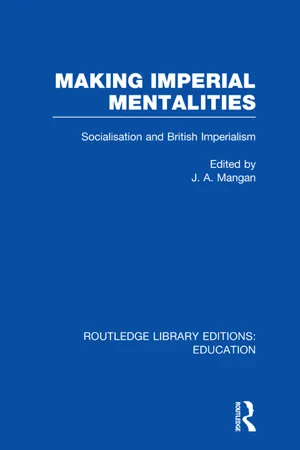
This book discusses the way in which those born into the British empire were persuaded to accept it, often with enthusiasm. The study compares the perceptions of people at 'home', in the dominions and in the colonies. Across the diversity of imperial territories it explores themes such as the diverse nature of political socialisation, the various agents and agencies of persuasion, reaction to the 'experience of dominance' by dominant and dominated, the paradoxical impact of the missionary and the subversive role of some women. It also considers the significant issues of colonial adaptation, resistance and rejection, and the post-imperial consequences of imperialism.
- 4 pages
- English
- ePUB (mobile friendly)
- Available on iOS & Android
eBook - ePub
About this book
Information
CHAPTER ONE
Slavery, social death and imperialism:
the formation of a Christian black
élite in the West Indies, 1800–1845
Slavery constitutes an original imperialism whose roots grew, twisted and warped, long before the pious and patriotic clamouring heard at Exeter Hall, before the map was painted red, and before the jingoism, anthems and flag-waving that accompanied the late Victorian age. If imperialism is, as A. P. Thornton states, ‘the image of dominance, of power asserted’ – an attitude towards the world founded on a moral relationship of power and powerlessness – slavery is the archetype for all subsequent forms of imperialism.1 Slavery, the ultimate colonisation of individuals, is the most potent means by which the powerless are kept subordinate.
Christianity presented imperialism's most humane face to British West Indian slaves and emancipees.2 At one level its symbolic power enriched the psychic lives of slaves, while at another level it seemingly offered a legitimate entry into the dominant white culture: first by assimilating a large social structure, Christianity itself, and second by broadening that world to include imperialist sentiments. Unexpectedly, the world of the master seemed accessible, a possibility that caused a serious disjuncture in the ordering of West Indian slave society.
This chapter examines three aspects of Protestant evangelisation and missionary education in the Caribbean slave colonies and during the first years of freedom.3 The first part analyses the significance of Christianity as synonymous with ‘civilisation’, that is, as a support system intrinsic to British imperialism. The second draws out the relationship of Christianisation to ‘slavery as social death’, elaborated in Orlando Patterson's comparative study of that name. The third part concludes with a discussion of the ambiguities involved in slaves and former slaves transferring their allegiances and orienting themselves to a social group and moral order other than their own – a moral order which demanded conformity as the price of admission but provided little real opportunity to realise these aspirations.
Christianising slaves, 1800–1834
As a cultural and emotional currency which is readily appropriated and manipulated, religion has always accompanied imperialistic expansion. It often resulted in a successful transplantation of values, because it is seen as the epitome of the moral culture of a given society. Normally it adapts in part to the ‘inferior’ culture even as it modifies and intrudes upon it. Islam and hellenism have been no less thorough in this respect than Christianity. However, the norms, precepts and axioms of Christianity are peculiarly suited to imperial ideology in that it is a religion comprised of dichotomous notions of superiority and inferiority, for example, the elect/heathen, redeemed/damned, saints/sinners, and so on, and all of this premised on a command to go forth and preach the gospel to all nations. In this sense, and perhaps in this sense alone, it is a paternalistic belief system that has justified its role in the subjugation of other peoples ‘for their own good’. Moreover non-Christians in the European colonies found the distinctions between religious and secular attitudes blurred, as indeed did Europeans themselves. Nevertheless, if imperialists, as the trustees of civilisation – a future controlled by themselves and their own kind – insisted on their sense of mission, then missionaries became accomplices merely by perpetuating the idea of Christianisation as synonymous with that of civilisation. This is evident in that a ‘superior attitude towards the alien culture was an intrinsic part of the missionary's equipment; he could hardly have claimed a vocation had he not possessed this’.4
However, it will be seen that for slaves Christianity was a matter more of seduction than of subjugation, more of volition than of indoctrination. Herein lay the secret of the successful transplantation of imperial values.
The conversion of the West Indies by Protestant missionaries in the nineteenth century was premised on the firm conviction that Christianisation and civilisation were synonymous and that religious instruction could not fail to improve the civil and social life of the colonies. The General Objectives of the Church Missionary Society (CMS) as early as 1812 stated that Christianity infused a ‘mild and equitable spirit’ into ‘legislation and government’ and that ‘rulers [became] the fathers of their people’ while ‘subjects cheerfully yield[ed] obedience’.5
All evangelical missionaries agreed that Christianity could not be taught ‘without imparting the grand regulations of social life’ and that it ‘effectually, though incidentally, produces civilisation by reducing the heart to the operation of benevolent and holy principles’.6 For example, the Reverend John Hampden in 1824 put forward the view that if slaves were released from their bondage without knowing first the restraints of religion they would become more ‘licentious’ and ‘intractable’ than savages, while John Wray of the London Missionary Society (LMS) in Demerara argued that only a religious education would prepare the negroes for freedom and that this in turn would ‘encourage industry’.7 In short, religious instruction exercised an ‘irresistible influence’ on those who appeared to be ‘incapable of culture’ by bringing with it incalculable blessings of civilisation, morality and piety.8 Missionaries, immediately before and after emancipation, reiterated in various forms the sentiments of a Methodist on circuit in Tortola: ‘Yes, Christianity is THE means of civilisation. The man who is taught his duty to God is being made acquainted with the duties which he owes to himself ... and to his neighbour.’9
However, what was obvious to missionaries and their British patrons during slavery was far less so to colonists and planters. Initially, they did not appreciate the usefulness of Christianisation as a tool for controlling slaves in its inculcation of virtues such as sobriety, industry, loyalty, obedience and submission. Indeed this was beyond their presumptive mentality given that slavery, as a system, guaranteed absolute power and the tantalising possibilities of manumission (freedom for oneself or another legally bought, given or bequeathed) no matter how remote, proved a more potent tool for social control than baptism. Moreover West Indian colonists – planters, managers, attorneys, overseers and clergymen alike – saw the processes, or morphology of ‘seasoning’ into slavery, as a perfectly adequate form of socialising slaves into their condition. Under these circumstances nothing could be further from their minds than the idea of ‘civilising’ bondsmen. There was no surer way of creating ‘upstarts’, and as West Indian colonial society clearly differentiated between whites and free coloureds, there was no reason to believe that slaves would be encouraged to enjoy any of the cultural advantages of civilisation usually denied otherwise free persons. Tyranny was necessary though not always sufficient in maintaining a slave economy. John Smith, a missionary who later died in a Demerara prison after the 1823 insurrection, concluded:
Generally speaking the colonists do not publicly declare themselves enemies of religion (though some of them do not scruple at that) but, say they, The colony is in danger – to teach slaves is an impolitic measure. The missionaries will, if not checked, prove subversive to good order and due subordination. The slaves will be made too wise.’10
At the same time as the planters came to concede the value of Christianising slaves (that is, when emancipation was perceived as inevitable) the clergymen of the Established Church – always favoured by the planters – became more involved in instruction and conversion. Previously they had been conspicuously uninterested in evangelisation until the mandate of the 1824 Melioration Act specifically provided for the practice. They were often content with catechising and, with few exceptions, left the field wide open to their more zealous evangelical brethren from other denominations. In Trinidad one Methodist remarked in 1818 that not a single congregation of slaves could be found on the island; while this was exceptional, a missionary from St Vincent's nevertheless observed that nothing was ‘more foreign to his mind’ than the likelihood of ‘a clergyman propagating the Gospel to a negro congregation’. Yet another in Berbice observed only that planters preferred to meet clergymen in the billiard room rather than in the estate chapel.11
While planters and clergy of the Established Church generally agreed that Christianity was appropriate only for whites and free people, other missionaries responded rather more generously to the evangelical imperatives of their religion. In 1821 a Wesley an in St John's, Antigua, proposed an auxiliary missionary society in support of the Methodist Society in London, while boasting that ‘the map of the habitable globe’ was spotted by Methodist missions alone. It seems that Daniel Garling saw no more irony than any of his evangelical brethren in the fact that Christian slaves would contribute to the conversion of ‘the uncultivated Hottentot, the savage New Zealander, and the abandoned convict’, and for that matter ‘the native Irish’.12
Christianity provided a compelling logic for slaves to be good servants just as it provided the foundation for their becoming good citizens and British subjects within a colonial framework.13 Because proprietors, absentee planters, colonists and free coloureds and even manumitted slaves (who frequently held and hired slaves themselves) had actively opposed emancipation, the slave population readily identified with Britain's role in freeing them and providing some of the benefits of civilisation such as schooling. A missionary from Tobago reported that when apprenticeship ended in 1838 slaves attending his mission chapel cried, ‘God bless de Missus [Queen Victoria]’ and ‘if we know where the Buckra [European masters] woman live we make he eat fowl eggs till he weary’.14 That is, the emancipated slaves would give their former owner and royal mistress a grand feast to demonstrate their gratitude. All proclamations at the conclusion of slavery and apprenticeship capitalised on this sentiment by requesting good conduct and industrious habits from former slaves as evidence of such gratitude for Britain's ‘gift’ of emancipation.
Missionaries as mediators, 1800–1838
Initially in slave societies ‘the master was the only mediator’ between the viable community to which he belonged and the socially marginal milieu of the slave.15 However, a startling disjuncture occurs in West Indian slave society with the introduction of evangelical missionaries into this environment. While marginal to the dominant society, missionaries, outside its collective interests and norms, were concrete representations of the colonial and imperial belief system at its most profound and symbolic level. Thus the master no longer had the monopoly over his slave's sensibility and identity as the ‘only mediator’ in the society. The dynamics of the master–slave relationship changed subtly. And not only did the dynamics between slaveowner and bondsmen alter but the new situation filtered down and affected relationships between slaves and non-slaves, free coloureds and the manumitted.
Therefore we observe two striking ambiguities. First, the presence of missionaries neutralised the absolute power of slaveholders as sole mediators per se; and second, they interfered with the ‘natural’ order of slave society by asserting the spiritual equality of slaves (which is in no way to be confused with political or economic equality) with masters and freedmen, with slaveowners and non-slaveowners, with whites and coloureds. Not surprisingly, a threatened dominant social class persecuted and ostracised the missionaries, who were frequently ridiculed and resented by the free coloureds and manumitted slaves for eroding their hard-won and precarious social identification with the planter class.16 As coloureds and former slaves, who were also marginal to the dominant white culture, sought solidarity and identity with slaveholders, ‘vis à vis the dishonoured slave’,17 it is not difficult to imagine the reaction to criticisms such as John Wray's that slaves ‘could be flogged by an ignorant il...
Table of contents
- Front Cover
- Half Title
- Title Page
- Copyright
- Title Page
- Copyright
- Contents
- General introduction
- Introduction: Making Imperial Mentalities J. A. Mangan
- 1 Slavery, social death and imperialism: the formation of a Christian black élite in the West Indies, 1800–1845 Patricia Rooke
- 2 Sisters under the skin: imperialism and the emancipation of women in Malaya, c.1891–1941 Janice N. Brownfoot
- 3 Drill and dance as symbols of imperialism Anne Bloomfield
- 4 ‘Mothers for the Empire’? The Girl Guides Association in Britain, 1909–1939 Allen Warren
- 5 Victorians, socialisation and imperialism: consequences for post-imperial India T. V. Sathyamurthy
- 6 Christian imperialists of the Raj: left, right and centre Gerald Studdert-Kennedy
- 7 White supremacy and the rhetoric of educational indoctrination: a Canadian case-study Timothy J. Stanley
- 8 ‘A part of Pakeha society’: Europeanising the Maori child J. M. Barrington and T. H. Beaglehole
- 9 Processes of colonial control: the Bermuda school question, 1926–1954 Robert Nicholas Bérard
- 10 Examinations and Empire: the Cambridge Certificate in the colonies, 1857–1957 A. J. Stockwell
- Index
Trusted by 375,005 students
Access to over 1.5 million titles for a fair monthly price.
Study more efficiently using our study tools.
Frequently asked questions
Yes, you can cancel anytime from the Subscription tab in your account settings on the Perlego website. Your subscription will stay active until the end of your current billing period. Learn how to cancel your subscription
No, books cannot be downloaded as external files, such as PDFs, for use outside of Perlego. However, you can download books within the Perlego app for offline reading on mobile or tablet. Learn how to download books offline
Perlego offers two plans: Essential and Complete
- Essential is ideal for learners and professionals who enjoy exploring a wide range of subjects. Access the Essential Library with 800,000+ trusted titles and best-sellers across business, personal growth, and the humanities. Includes unlimited reading time and Standard Read Aloud voice.
- Complete: Perfect for advanced learners and researchers needing full, unrestricted access. Unlock 1.5M+ books across hundreds of subjects, including academic and specialized titles. The Complete Plan also includes advanced features like Premium Read Aloud and Research Assistant.
We are an online textbook subscription service, where you can get access to an entire online library for less than the price of a single book per month. With over 1.5 million books across 990+ topics, we’ve got you covered! Learn about our mission
Look out for the read-aloud symbol on your next book to see if you can listen to it. The read-aloud tool reads text aloud for you, highlighting the text as it is being read. You can pause it, speed it up and slow it down. Learn more about Read Aloud
Yes! You can use the Perlego app on both iOS and Android devices to read anytime, anywhere — even offline. Perfect for commutes or when you’re on the go.
Please note we cannot support devices running on iOS 13 and Android 7 or earlier. Learn more about using the app
Please note we cannot support devices running on iOS 13 and Android 7 or earlier. Learn more about using the app
Yes, you can access Making Imperial Mentalities by J. Mangan, J. A. Mangan in PDF and/or ePUB format, as well as other popular books in Education & Education General. We have over 1.5 million books available in our catalogue for you to explore.