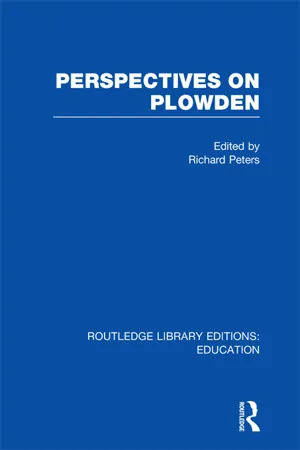
The Plowden Report, Children and their Primary Schools (1967), had a huge impact on education in the latter 20th century, but at the time was labelled as left-wing, and of no practical use to the problems of education in the 1960s. The contributors to this volume were all concerned with the educational thinking of the Plowden Report, and its appropriateness or otherwise to the educational needs of the day. In quarters where the Plowden Report was treated as an authoritative textbook, the views in this volume provide a valuable critique.
- 120 pages
- English
- ePUB (mobile friendly)
- Available on iOS & Android
eBook - ePub
Perspectives on Plowden (RLE Edu K)
About this book
Information
1
‘A Recognizable Philosophy of
Education’: A Constructive Critique
RICHARD PETERS
Professor of Philosophy of Education,
University of London Institute of Education
Introduction
It was understandable about forty years ago that reformers should proclaim that ‘education is growth’ or that children should be encouraged to learn from experience; for there was a great deal wrong, both morally and psychologically, with the old elementary school tradition. Children were, on the whole, instructed in rather an authoritarian manner with too little respect for their dignity as potential persons and with too little regard to facts about stages of their development, interests, and individual differences. The Hadow Report, in certain celebrated passages, bore witness to this more child-centred approach to education, the intellectual battle for which has now largely been won.
If, however, an educational theory is developed decades later out of such a corrective emphasis without due account being taken of other aspects of the educational situation, a very one-sided and misleading set of beliefs can emerge. My contention is that this has happened with the Plowden Report. I do not refer, of course, to the concrete recommendations which it was the proper business of the committee to make, and do not propose to discuss the case for or against them. I am referring to the little vade-mecum of educational theory to which its readers are gratuitously treated and to which no important recommendations are attached.
Aims – explicit and implicit
The Committee were chary of committing themselves to an explicit statement of aims though they perhaps were not quite clear about the reasons which ‘a number of distinguished educationists and professors of educational philosophy’ had for cautioning them about them – namely that they must either be highly general and therefore not very informative, such as ‘self-realization’, or more specific and therefore plural in a society like ours where there are many different convictions about what is important in education. This caution, however, did not save them from blatant contradictions – as when they begin the chapter with a statement of ‘one obvious purpose’, which is to fit children for the society into which they will grow up, and go on to say later that a school is ‘a community in which children learn to live first and foremost as children and not as future adults’. Perhaps this contradiction was not so apparent because it was not in a passage referring explicitly to aims but in one beginning ‘A school is ...’ in which a whole ideology is intimated, and called a ‘recognizable philosophy of education’. ‘Aims’ are, by definition, attempts at precision, at explicit emphasis. They involve explicit value-judgments which invite discussion because they are abstracted to guide action. A much more subtle and insidious way of influencing people's attitudes and endeavours is to conceal value judgments in descriptions such as ‘the school is .. .’. Another good example of this technique is the loaded and rather saccharine statement which launches Chapter 2: ‘At the heart of the educational process lies the child.’
A ‘recognizable philosophy of education’
As this section at the end of Chapter 15 on the school contains, in summary form, the implicit ideology of the Report, it is worth quoting in full:
A school is not merely a teaching shop, it must transmit values and attitudes. It is a community in which children learn to live first and foremost as children and not as future adults. In family life children learn to live with people of all ages. The school sets out deliberately to devise the right environment for children, to allow them to be themselves and to develop in the way and at the pace appropriate to them. It tries to equalize opportunties and to compensate for handicaps. It lays special stress on individual discovery, on first-hand experience and on opportunities for creative work. It insists that knowledge does not fall into neatly separate compartments and that work and play are not opposite but complementary. A child brought up in such an atmosphere at all stages of his education has some hope of becoming a balanced and mature adult and of being able to live in, to contribute to, and to look critically at the society of which he forms a part. Not all primary schools correspond to this picture, but it does represent a general and quickening trend. (Plowden, 1967, Vol. 1 pp. 187-8.)
My contention is that this summary of a ‘recognizable educational philosophy’ proliferates in important half-truths that are paraded as educational panaceas. It is necessary, therefore, to separate out its various components and to attempt to place them in a more adequate perspective. They are as follows:
(a) That the child has a ‘nature’ which will ‘develop’ if the appropriate environment is provided. What will he develop into? Presumably a ‘mature adult’ who can ‘be himself and be critical of his society.
(b) Self-direction is very important in this development. ‘The child is the agent of his own learning’ (Para. 529). ‘Sensitivity and observation are called for rather than intervention from the teacher’ (Para. 527). Children have an intense interest in the world around them together with powers of concentration which will ensure learning if they are provided with materials for which they are ‘ready’ (Paras. 533, 534).
(c) Knowledge cannot be divided into separate compartments. Self-chosen activity within an ‘integrated curriculum’ is desirable.
(d) The teacher must be a guide, an arranger of the environment, rather than an instructor.
At several places in the Report the statement of this dominant ideology is followed by some qualifications – for instance on the importance of ‘the older virtues’ (Para. 188) or on the dangers in ‘discovery methods’ (Para. 549, 550). But these read very much like attempts to deal with awkward objections while retaining the main emphasis; they do not add up to an attempt to present a properly thought out educational theory. However, let us look at the details of it under its four main headings, and see to what extent it can form part of a more adequate synthesis.
A constructive critique
Development. What is to be made of the notion that children have a ‘nature’ or that the individual has a ‘self which will emerge if the right environment is provided? This raises, of course, a host of old questions about what is innate and acquired; but it also raises equally crucial questions about the concept of ‘development’. Sometimes, when people talk about ‘development’, they have in mind a norm which is statistically determined as characterizing children at a certain age in a given society. Stages of physical growth, as plotted by Gesell, can be studied; so can stages of other sorts of ‘growth’, but the notions of ‘growth’ and ‘development’ immediately begin to collect valuative overtones when we pass out of the realm of the purely physical. For is there not lurking even in the fairly colourless notion of ‘mental development’ some concept of what a man ought to be? Has not a type of norm different from a purely statistical one begun to intrude itself? It manifestly has when words like ‘mature’ and ‘balanced’ are introduced.
How is such development to be conceived? In most books on child-development ‘development’ is divided into physical, intellectual, social, moral and emotional aspects, as if social and moral development were devoid of ‘intellect’, as if morality and the use of the intellect were free from passion, and as if emotional development was separable from thought and social awareness. This indefensible type of classification should surely be scrapped and replaced by a more logical division into forms of thought and awareness, each of which has its affective aspect. This would include scientific, mathematical, moral, historical, inter-personal, aesthetic, and religious forms of awareness; proper attention should also be paid to the developmental aspects of various forms of skills – ‘basic’ and linguistic ones included.
What is urgently needed is a new approach to child-development in which the logical aspects of these forms of awareness and the values inherent in them are more closely related to facts about the learning processes of young children. This would imply abandonment of the absurd practice, which is prevalent in Colleges of Education, of curriculum courses being taught either by subject specialists who have little experience of young children or by education lecturers who have experience of young children but only an embryonic knowledge of the subjects. If anything calls for team teaching and the pooling of knowledge, curriculum courses do. Some of the more enlightened Colleges of Education are already moving in this direction.
But even if one tidied up these various aspects of ‘development’ how would this help to determine the emphasis of education? Is a man more ‘developed’ if he is highly trained scientifically but aesthetically insensitive or if he is aesthetically sophisticated but a scientific ignoramus? Is a man more developed who is ‘well-rounded’ but with a thorough knowledge of nothing, than one who is a brilliant mathematician and musician but ignorant of most other things? Was Lenin more ‘developed’ than Gandhi? And what about the needs of the nation for men suitably trained for the professions, industry, the forces, and the land? How are these pressures to be reconciled with those of ‘self-development’, however conceived? And what is one to make of this emphasis on being oneself? It is rather like the Existentialist plea that one should be ‘authentic’. Out of a context it is a vacuous recommendation which is consistent with any form of development; for presumably the Marquis de Sade was being himself as much as St. Francis. They just had different selves to develop.
There was a time, of course, when forms of awareness were comparatively undifferentiated and when the religious one, in the form of various brands of Christianity, provided some kind of unifying ideal of man against which a man's development could be roughly measured. But those times have passed. We now live in a pluralistic type of society without any such unifying ideal, and as educators we must come to terms with this. Those who stress the importance of individual self-realization as an educational aim are, perhaps unwittingly, lending their support to a pluralist conception of the good life.
As a matter of fact those, like Gesell, who were largely responsible for the ideology of ‘growth’ and ‘development’, explicitly linked their doctrine with the democratic ideal of the value of the individual, and contrasted it with alternatives such as Fascism which devalued the individual. In this they were at one with English theorists such as Sir Percy Nunn. Dewey's concept of ‘growth’, too, was very closely connected with the adventurous initiative of an expanding individualistic society. Nowadays the emphasis on ‘growth’, and ‘self-actualization’ by people like Rogers and Maslow is connected very much with the attempt to free the individual from the pressures of social conformity in an ‘other-directed’ type of society. It is a plea for the individual in a changed social setting.
But what tends to be forgotten by those who identify themselves with this type of ideology is what Dewey called the ‘shared experience’ which such individual development presupposes. On the one hand there are high-level moral principles such as toleration, respect for persons, fairness, and consideration of people's interests which underpin democratic institutions and which provide the interpersonal framework within which individuals can be encouraged to pursue a variety of interests that are thought to be worth-while. Without some such consensus, into which children must be initiated, the pluralist pursuit of value would be impossible. On the other hand all the different options open to individuals are inescapably social in character. No individual can embark on science, singing or tool-making without being introduced to a vast body of knowledge and skill that has gradually been accumulated, and in most of them he will share a form of life with others who are also engaged on them. Furthermore when we encourage children to be themselves we surely take for granted a vast array of activities and forms of awareness that we think worthwhile within which we encourage children to find the ones to which they are particularly suited. As teachers we must make value judgments when we think of any sort of curriculum; for we do not offer blowing up live frogs with bicycle pumps or bingo as possible options. Talk of ‘development’, like talk of children's ‘needs’, is too often a way of dressing up our value-judgments in semi-scientific clothes. I will not enter into the difficult discussion of how such value-judgments can be justified; I am only drawing attention to their unavoidable presence. I am arguing that any educator who subscribes to this type of ideology must think that certain types of things are more worthwhile than others, though he may be unwilling to commit himself to comparative judgments within the field of what he thinks is worthwhile. The plea for the development of selves is always to be understood within a framework of shared valuations.
Considerations such as these have led me to wonder more and more whether there is any field of study called ‘child development’ which can be clearly distinguished from ‘education’. Of course there is the physical and physiological side of ‘development’ with which teachers are not so directly concerned as are doctors and paediatricians. But is mental development distinguishable from ‘education’? There was point, at one time, in stressing the separate study of child development because the psychology of children was sadly neglected in decisions about what and how they should be taught. But there is little danger of that nowadays. It will be worthwhile, therefore, to pause a minute to spell out how closely these concepts overlap in order to substantiate my questioning of the case for ‘child development’ as a separate study.
‘Education’, as I have argued elsewhere (Peters, 1966, Chs. 1, 2), involves initiation into what is thought to be worthwhile. In stating ‘aims’ of education we select aspects of what is thought to be worthwhile which we think require special emphasis. The concept of ‘development’, I have argued, also presupposes value-judgments about what man should be. A study of different developmental theories – e.g. those of Freud, Gesell, or Piaget – reveals slightly different presuppositions about what man should be. They are not ‘value-free’.
‘Education’, secondly, suggests a selection, from what is valuable, of activities and states which involve some depth and breadth of understanding. It is incompatible with passing on a mere know-how and with narrow specialization. ‘Education is of the whole man’ is a conceptual truth because the concept of ‘education’ rules out too one-sided development. Now, descriptively speaking, ‘development’ as an evolutionary concept, involves some degree of differentiation and integration. What else, therefore, can ‘mental development’ suggest than some differentiation of forms of understanding together with some integration of them? And in what could such ‘differentiation’ consist if it is not in those forms of understanding which mankind has evolved in order to make sense of the world, to appreciate its many manifold aspects, to control and canalize his inclinations, and to come to terms with his predicament?
Thirdly there is a perennial debate in education theory about the extent to which education comes about through the efforts and influence of teachers, parents, and the peer-group and how much is due to the learner's self-originated activity. Similarly in developmental theories there is a constant debate concerning the respective importance of nature and nurture. It is only if one holds some kind of ‘unfolding’ theory of development that social influences can be discounted. It is probably because the authors of the section on educational theory in the Report incline towards some kind of ‘inner ripening’ theory of development that they talk so much about development and children's learning and so little about education and the role of the teacher. And this brings me to the next feature of their ‘recognizable philosophy of education’ – their stress on the self-direction of the learner.
Self-direction. Obviously enough the stress on self-direction and self-chosen activities is closely connected with the ideal of individual self-development. But it incorporates additional doctrines, one proclaiming a value judgment, the other relating to theories of learning. I will briefly consider each of them in turn.
(i) Autonomy as a moral principle. On the one hand a powerful plea is being made for the value of individual autonomy, for the importance attached in a democratic society to individual choice, independence of mind, and to more recondite virtues such as creativeness and originality. I need not expatiate on the importance of this in a pluralist society. But three types of comment are in place. Firstly this, like any other value, must surely be asserted not absolutely but with an ‘other things being equal’ clause. How far are we going to press the value of self-chosen activities if young people overwhelmingly reject scientific subjects in a highly industralized society which needs increasingly a vast array of technicians and technologists? We may be moving towards such a situation – and it is no good comforting ourselves on the number of young people who seem to be ‘choosing’ sociology in higher and further education. For we may soon be turning out too many people who can talk knowledgeably in a reformist way about society but too few who can contribute decisively to its economic base. If we think, too, that education is incompatible with narrow specialization how far are we justified in pushing young people into a variety of subjects and activities if they would rather specialize?
Secondly too little is known about how such autonomy independence, and ‘creativeness’, is developed. It may well be that a very bad way of developing this is to give children too many opportunities for uninformed ‘choices’ too young. One thing, however, is obvious enough – that the notion of ‘autonomy’ makes very little sense unless a child first has a grasp from the inside of what following rules means and has taken rules into himself between which he has to choose. Similarly general talk of ‘creativeness’ is cant; for there is no such general faculty. One can be creative in science without being a creative cook. And to be ‘creative’ in any sphere presupposes some mastery of the skills and body of knowledge appropriate to it. As Whitehead wisely put it, the stage of ‘generalization’ or autonomy comes after the stage of precision. The implication of all these points is that it is essential for children to be initiated into skills and bodies of knowledge which are part of our public heritage, before they can sensibly strike out on their own.
Thirdly, if we accept that there are many ways in which an individual can strike out on his own in a pluralist type of society, and if we think that children should be encouraged to stand on their own feet and find their own way, then we must think seriously about equipping them to do this effectively. This means not only taking them a certain distance in the various options so that they may have ...
Table of contents
- Front Cover
- Half Title
- Title Page
- Copyright
- Title Page
- Copyright
- Contents
- Preface
- 1 ‘A Recognizable Philosophy of Education’: A Constructive Critique
- 2 The Aims of Primary Education
- 3 Other Aspects of Child Psychology
- 4 Some Sociological Comments on Plowden
- 5 The Positive Roles of Society and the Teacher
- Bibliography
Trusted by 375,005 students
Access to over 1.5 million titles for a fair monthly price.
Study more efficiently using our study tools.
Frequently asked questions
Yes, you can cancel anytime from the Subscription tab in your account settings on the Perlego website. Your subscription will stay active until the end of your current billing period. Learn how to cancel your subscription
No, books cannot be downloaded as external files, such as PDFs, for use outside of Perlego. However, you can download books within the Perlego app for offline reading on mobile or tablet. Learn how to download books offline
Perlego offers two plans: Essential and Complete
- Essential is ideal for learners and professionals who enjoy exploring a wide range of subjects. Access the Essential Library with 800,000+ trusted titles and best-sellers across business, personal growth, and the humanities. Includes unlimited reading time and Standard Read Aloud voice.
- Complete: Perfect for advanced learners and researchers needing full, unrestricted access. Unlock 1.5M+ books across hundreds of subjects, including academic and specialized titles. The Complete Plan also includes advanced features like Premium Read Aloud and Research Assistant.
We are an online textbook subscription service, where you can get access to an entire online library for less than the price of a single book per month. With over 1.5 million books across 990+ topics, we’ve got you covered! Learn about our mission
Look out for the read-aloud symbol on your next book to see if you can listen to it. The read-aloud tool reads text aloud for you, highlighting the text as it is being read. You can pause it, speed it up and slow it down. Learn more about Read Aloud
Yes! You can use the Perlego app on both iOS and Android devices to read anytime, anywhere — even offline. Perfect for commutes or when you’re on the go.
Please note we cannot support devices running on iOS 13 and Android 7 or earlier. Learn more about using the app
Please note we cannot support devices running on iOS 13 and Android 7 or earlier. Learn more about using the app
Yes, you can access Perspectives on Plowden (RLE Edu K) by R Peters in PDF and/or ePUB format, as well as other popular books in Education & Education General. We have over 1.5 million books available in our catalogue for you to explore.