This volume emphasizes the necessity for arts teachers to nurture the personal development of their students by expanding their artistic understanding and creativity. In aiming to provide a broader understanding for the effective teaching of the arts, the author provides powerful reasons for seeing the arts as agents of learning, understanding and development. The volume also demonstrates that whilst the arts are centrally concerned with feeling, they are as fully open to objective reasoning as any other subject discipline such as science, but the dichotomy between 'scientism' and 'subjectivism' is all-pervading in a curriculum which marginalises the teaching of the arts.
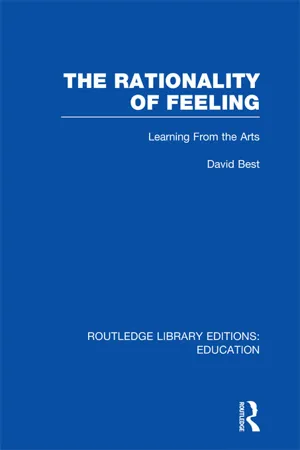
- 232 pages
- English
- ePUB (mobile friendly)
- Available on iOS & Android
eBook - ePub
About this book
Information
Chapter 1
The Rationality of Feeling
This chapter is pivotal for the argument of the whole book. It examines the most widely accepted and convincing of the many guises of the subjectivist conception, and one which has probably been the source of greater and more pervasive confusion than any other. I refer to the misguided assumption that emotional feelings in general, and the kinds of feeling most centrally involved in the creation and appreciation of the arts, are purely subjective.
Chapter 1 will, I hope, provide readers with at least a clear outline of the central features of the thesis of the whole book. The filling out of this outline, in later chapters, may require more careful, reflective thought. But they will, I hope, be more readily comprehensible if this chapter is clearly understood. Moreover, I hope that Chapter 1 will convince readers at the outset just how revolutionary and crucial for arts education is the whole thesis of this book, perhaps especially at this critical time when the arts are under such threat. A largely contributory factor to that threat, and to the prevalent dismissive regard for the arts, is precisely the subjective conception of feeling which is so very commonly assumed and proposed as central to artistic experience. Ironically, it is that conception which is most commonly adduced in support of the arts in education, yet it is that very conception which destroys the case for the arts as genuinely educational.
Consider the following quotation, about the arts in higher education, from an editorial in The Times Higher Education Supplement a few years ago:
It is thought that such subjects do not need to be taken seriously, since it is stated quite explicitly that creativity is an inspirational and even anarchic activity rather than a cognitive and disciplined process. As a result, the arts are often regarded as of low academic content, and hopelessly subjective …
How have the arts reached this position in Western societies? By far the most influential source of this dismissive intellectual regard – even contempt – for the arts, is the traditional subjectivist doctrine, and especially that aspect of it which is the principal concern of this chapter. It is one of the reasons why some arts subjects in schools are regarded as the province of those students who are not very intelligent. These wounds to the intellectual regard for the arts are largely self-inflicted, by those arts educators, for instance, who insist that the arts are essentially a matter of subjective feeling, rather than cognition or reason. The three major stages of the argument of this chapter are to show that:
1 Artistic feelings necessarily involve understanding or cognition: they are expressions of certain kinds of understanding. An artistic feeling is identified and its character determined by its direction on to an object; the feeling cannot be identified independently of a certain interpretation, conception or understanding of an art object.
2 Interpretative reasoning, of the kind discussed more fully in Chapter 3, is of central importance, and not only in the arts, for giving understanding and evaluation.
3 Thus, reasoning can change understanding, and with it, feeling. It is in this sense that artistic feeling, like emotional feelings generally, is rational in kind, in that it is answerable to reason: it is always, in principle, open to the possibility of change, as a consequence of reflection, or of reasons offered by someone else for a different conception of the object, and therefore a different feeling.
It is crucial to recognise that I am emphatically not arguing that, on the one hand, feeling, and on the other hand, reason/understanding, are very closely related, or interdependent. To put the point in that way would be a version of the subjectivism which I am exposing as radically confused and educationally disastrous. On the contrary, artistic feelings are rational and cognitive in character. There are not two things, but only one, rational/cognitive feeling. This shows that the arts can be as fully educational, because they as fully involve rationality and understanding, as any other area of the curriculum. Moreover, because of the vital human possibilities of the kinds of learning involved in the arts, there is a strong case for arguing that the arts should be in the centre of the curriculum, but only if we reject subjectivist conceptions of feeling.
The Dangers of Subjectivism
It is impossible to learn anything in the arts. The arts are just a matter of having a non-cognitive experience.
Is this a typical statement by one of the many these days who regard the arts as unnecessary frills in education – one of the enemies of the arts in education? On the contrary, this is precisely what teachers of the arts, arts educators, and theorists of arts education say, and have been saying for years. That is, as their attempt to support the case for the arts in education, many arts educators are continuing to insist that the arts, by their very nature, cannot involve learning at all.
In case it be thought that I exaggerate, let me cite an influential arts educator in the UK, who has stated explicitly that teachers who see drama in terms of learning are distorting the nature of the art form. I have every reason to believe that he holds similar views about the other arts. However, I do not want to pick on any individual in particular, because the conception to which I am drawing attention is widely prevalent, although it is far more usually an implicit consequence of what arts educators say and write than stated explicitly.
Subjective Feeling
The root of the trouble is the largely unquestioned conviction that the creation and appreciation of the arts is a matter of subjective feeling, in the sense of a ‘direct’ ‘inner’ subjective feeling, ‘untainted’ by cognition, understanding or rationality. Hence, Robert Witkin (1980) wrote that in order to achieve this ‘pure’ feeling for art, one needs to erase all memories. The idea seems to be that cognition, understanding and memory will prejudice and limit the capacity for direct feeling-response; that they will prevent pure artistic feelings. Yet the opposite is true. Only if we recognise the crucial place of understanding and cognition can we give an intelligible account of education in the arts; and only in that way can we see how individual freedom is possible. Yet even to question the central place of subjectivism often raises such immediate hostility that arts educators cannot really listen to the rest of one's argument.
The Myth
The misconception I am criticising, and which must be rejected if we are to have any hope of providing an educational justification for the arts, is based on, or part of, the common assumption that there is necessarily an opposition between, on the one hand, feeling, creativity and individuality, and on the other hand, cognition and reason. For instance, it is frequently said that the arts are a matter of feeling, not of reason or cognition. This is part of the subjectivist Myth of the human mind as consisting in two distinct realms – the Cognitive/Rational realm, and the Affective/Creative realm. It is of the utmost importance to recognise the manifestations of this Myth, because it is one of the most plausible, yet most damaging, persistent and pervasive, of the various guises of the subjectivist/metaphysical doctrine. Moreover, not only is it disastrous for the educational credentials of the arts, but it expresses a complete distortion of the character of other disciplines, such as the sciences.
For example, in the influential Gulbenkian Report, The Arts in Schools (1982), in the chapter which is supposed to offer the philosophical foundation for the rest of the Report, the authors define the area of the curriculum with which they are concerned, i.e. the arts, as ‘the aesthetic and creative’. This not only confuses and conflates the aesthetic and the artistic – an issue which we shall consider in Chapter 12 – but mistakenly implies that creativity is exclusively the province of the arts. (The Gulbenkian Report also sometimes denies this, but it is so confused and self-contradictory about creativity that it is impossible to be clear what it does mean.) This common mistake seems to stem from the Myth, mentioned above, of distinct mental faculties. Yet if, for instance, the development of creative attitudes is not central to the teaching of mathematics and the sciences – and regrettably often it is not – that is an indictment of the educational policy. Creativity is not in a closed mental box, along with the arts. It can and should apply to every area of the curriculum (and even to personal relationships). In some schools science-learning is far more creative than arts-learning. The Myth connives at an attitude to education in general which ought to be dead and buried. Both arts and sciences require creativity and imagination.
There are numerous other examples. For instance, a discussion document of the Scottish Committee on Expressive Arts in the Primary School (1984) states: ‘The main curricular emphasis is still upon cognitive learning, with other areas – physical, emotional, affective – coming off second best. We maintain that a better balance should be found …’ This clearly implies that whereas the sciences and mathematics are cognitive, the emotional and affective areas, such as, primarily, the arts, are not cognitive. Again, the assumption is that the arts involve feeling, as opposed to cognition and reason.
The Myth often underlies talk of a balanced curriculum. The suggestion is that the cognitive, rational faculty of the human mind is well catered for in, for instance, mathematics and the sciences, but in order to achieve balance we need to give more time to the non-cognitive, affective, emotional faculty, by giving greater emphasis to the arts. But again, formulating the argument in this way is disastrous in the damage it does to the case for the arts in education.
I certainly agree that there should be a better balance achieved, by giving greater opportunity for the arts. However, this kind of argument, common though it be, is self-defeating, in that it destroys the case for the arts. For how can it be seriously claimed that the arts should have a central place in the curriculum if those who are supposed to be supporting the arts themselves insist that there is no place for learning and education in the arts? And let us be quite clear that that is the inevitable consequence of denying the place of cognition and rationality. My point is that in rightly insisting on the importance of feeling in the arts, we must not be denying the importance of reason and cognition.
This confused Myth is sometimes given a pseudo-scientific dress by reference to the different functions of brain hemispheres. It is said that one hemisphere is concerned with the affective/creative, the other with the rational/cognitive. The ‘balance’ argument is then formulated in terms of developing each hemisphere equally, i.e. it is argued that the current and traditional emphasis in education is to develop the rational/cognitive hemisphere, at the expense of the creative/affective hemisphere. But without even considering the philosophical confusion involved in this way of thinking, I hope that, on reflection, one can see immediately how utterly bizarre it is as an educational justification for the arts. It would be on a par with arguing that a justification for painting in the curriculum is that holding paint brushes develops arm muscles. (The misguided attempt to justify the arts in education by reference to functions of the brain is further discussed later in the chapter.)
Let us return to the main argument. It is, as we have seen, an expression of the Myth of the Separate Faculties that the arts are a matter of feeling, not of reason or cognition. It is important to recognise clearly that in that case there could be no grounds for the notion of education in and through the arts. For how can there be education if understanding or cognition have no place?
The most that could be claimed taking this subjectivist view is that emotional feelings can be induced, as in the case of sensations such as pain. This is an inevitable consequence of insisting that the arts are concerned solely with experience, not understanding or rationality. Moreover, this subjectivist conception cannot give sense to the crucial notions of individual freedom, and integrity of feeling, which are, or can be, such significant contributions of the arts. It can no more allow for freedom than can the feeling induced by hitting one's finger with a hammer. Yet that is how the subjectivist construes emotions, as induced effects on a passive recipient. This assumption of the essentially passive nature of emotions runs deep in empiricist philosophy, and is still prevalent in psychology and arts education. It is certainly manifest in the assumption that artistic creation and appreciation are matters of feeling not of cognition, and thus that the arts consist in having non-rational, non-cognitive experiences, as opposed to progressively developing understanding. There can be no freedom, no individual artistic development, no education, on this subjectivist basis, but only something like conditioned responses.
There clearly has to be a far richer relationship between the person and the work of art, between one's emotion and the work, to make sense of education in the arts, and to make sense of the idea of progressive achievement of individual freedom. Let me emphasise again that this is not in the least to deny the importance of feeling in the arts. It is to point out that we need a much richer conception of what an emotional experience is than is offered by the oversimple, severely limiting, and ultimately unintelligible, subjectivist account.
Feeling
Can such a conception be provided, which will allow in the fullest sense for a rational, cognitive content of emotional experience? That is, can a conception be provided which can show that the commonly assumed antithesis between feeling and reason is fundamentally misconceived? It certainly can be provided, and indeed, it will be shown that it is a serious distortion to regard the emotions and artistic feelings as non-rational, non-cognitive experiences. Let me emphasise that I am not arguing even for the close relation of feeling and reason, but rather that artistic feelings are rational in kind. It is an instance of what I sometimes call the disease of the dichotomous mind that my arguing for the crucial rationality of involvement with the arts so frequently provokes the hostile reaction that I ignore feelings. Because the Myth is so commonly held, I shall have to pursue much of my argument in terms of it. But let me repeat that my argument is for the essentially rational character of emotional experience of the arts.
In order to bring out fully the strength of this argument, and the dangerous weakness of the subjectivist Myth, both philosophically and educationally, let us approach the issue from another direction. According to the subjectivist, an emotion is a purely private ‘inner’ mental event which may emerge in various ways. Wordsworth captures this notion aptly: ‘All good poetry is the spontaneous overflow of powerful feelings.’ According to this view, an emotion wells up inside and overflows into artistic expression. One might refer to this version of subjectivism as the ‘Hydraulic Theory’ of the Emotions whereby emotions well up, burst out, and are dammed up or released by opening floodgates etc.
There are at least two major mistakes involved in the Hydraulic Theory. First, it fails to recognise that there is a logical connection between the emotion and its object. Second, according to this view, no understanding is necessary in order to have emotional feelings. Let us consider both these points together, since they are really impossible to separate. Why do I imply that there has to be a logical connection between an emotion and its object? It is fairly generally recognised in philosophy these days that a central feature of emotions is that they are directed onto objects of certain kinds – one is afraid of X, angry at Y, joyful about Z. But the object has to be understood in a certain way. For example, since I am afraid of snakes, my feeling will be very different if I take an object under my desk to be a rope from what it would be if I take it to be a snake. There is a logical relation between my feeling, and my understanding or cognition of the object. It would make no sense to suppose that I could experience that kind of fear – of snakes – if I take the object to be a rope. If I believe it to be a snake I shall want to get away from it rapidly. It would make sense to suppose that I could experience that kind of feeling – fear of snakes – only if I believe it to be a snake. That is, it makes no sense to suppose that one could normally have a certain kind of emotional feeling about a wholly inappropriate object. Yet, the subjectivist Hydraulic account construes the feeling as an ‘inner’ event, which can be characterized entirely independently of any external circumstances. On this basis, it would have to make sense for normal people to be terrified of ordinary currant buns. But if one understands it as an ordinary currant bun, if one has that conception or cognition of it, then no sense can be made of being terrified of it.
It can be seen, then, that the subjectivist view is based upon a radically oversimple conception of emotional feeling. The subjectivist construes emotions on the model of sensations. Since it is true that certain kinds of understanding or cognition are not relevant to sensations such as pain, the subjectivist assumes, wrongly, that the same is true of emotional feeling. Yet it is important to recognise that it is precisely the crucial role of cognition which distinguishes emotion-feelings from sen...
Table of contents
- Front Cover
- Half Title
- Title Page
- Copyright
- Title Page
- Copyright
- Contents
- Dedication
- Further Thoughts
- Acknowledgements
- Introduction
- Chapter 1 The Rationality of Feeling
- Chapter 2 Natural Response and Action
- Chapter 3 Reasoning
- Chapter 4 Questions
- Chapter 5 Differences
- Chapter 6 Free Expression
- Chapter 7 Creativity
- Chapter 8 Feeling
- Chapter 9 Artist and Audience
- Chapter 10 Two Attitudes
- Chapter 11 The Particularity of Feeling
- Chapter 12 The Aesthetic and the Artistic
- Chapter 13 Art and Life
- References
- Index
Trusted by 375,005 students
Access to over 1.5 million titles for a fair monthly price.
Study more efficiently using our study tools.
Frequently asked questions
Yes, you can cancel anytime from the Subscription tab in your account settings on the Perlego website. Your subscription will stay active until the end of your current billing period. Learn how to cancel your subscription
No, books cannot be downloaded as external files, such as PDFs, for use outside of Perlego. However, you can download books within the Perlego app for offline reading on mobile or tablet. Learn how to download books offline
Perlego offers two plans: Essential and Complete
- Essential is ideal for learners and professionals who enjoy exploring a wide range of subjects. Access the Essential Library with 800,000+ trusted titles and best-sellers across business, personal growth, and the humanities. Includes unlimited reading time and Standard Read Aloud voice.
- Complete: Perfect for advanced learners and researchers needing full, unrestricted access. Unlock 1.5M+ books across hundreds of subjects, including academic and specialized titles. The Complete Plan also includes advanced features like Premium Read Aloud and Research Assistant.
We are an online textbook subscription service, where you can get access to an entire online library for less than the price of a single book per month. With over 1.5 million books across 990+ topics, we’ve got you covered! Learn about our mission
Look out for the read-aloud symbol on your next book to see if you can listen to it. The read-aloud tool reads text aloud for you, highlighting the text as it is being read. You can pause it, speed it up and slow it down. Learn more about Read Aloud
Yes! You can use the Perlego app on both iOS and Android devices to read anytime, anywhere — even offline. Perfect for commutes or when you’re on the go.
Please note we cannot support devices running on iOS 13 and Android 7 or earlier. Learn more about using the app
Please note we cannot support devices running on iOS 13 and Android 7 or earlier. Learn more about using the app
Yes, you can access The Rationality of Feeling (RLE Edu K) by David Best in PDF and/or ePUB format, as well as other popular books in Pedagogía & Educación general. We have over 1.5 million books available in our catalogue for you to explore.