This book comes strongly to the defence of educational theory and shows that it has a structure and integrity of its own. The author argues that the validity of educational theory may best be judged in terms of the various assumptions made in it. His argument is illustrated by a review and critique of some particularly influential theories of education: those of Plato, Rousseau, James Mill and John Dewey. He stresses the need for an on-going, contemporary, general theory of education and examines the ways in which the disciplines of psychology, sociology and philosophy can contribute to a general theory of this kind.
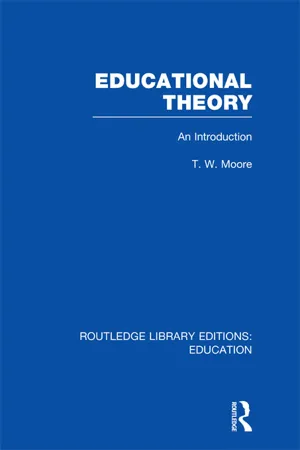
- 120 pages
- English
- ePUB (mobile friendly)
- Available on iOS & Android
eBook - ePub
About this book
Information
1
Educational theory
i Introduction
Educational theory has seldom been a popular subject, with teachers in training or with established teachers. It is not difficult to find reasons for this. There persists a conviction that educational theory is unnecessary. It is often thought that all the would-be teacher requires is a knowledge of his subjects and a confident manner. Academic knowledge can be won by study; the confident manner can be assumed. Pedagogical skill can be acquired, if at all, in the classroom, by watching more experienced teachers work and by using one's common sense. Nothing more is needed. So when training colleges insist on some theoretical work in education as well as practical training this is often seen as an unrewarding addition to the student's burden.
Another reason for its unpopularity is that, until quite recently, student teachers were usually required to study, under the heading of educational theory, historical accounts of the work of the ‘great educators’, often with little guidance as to the contemporary relevance or practical value of this study. This led students to ask what it all had to do with their immediate problems, with the schools they had to teach in and the children they had to teach. Plato and Comenius seemed to have little to say on these matters. Questions like these are easier to ask than to answer, as college lecturers soon discover, and these pertinent questions were not always satisfactorily answered. Consequently a general uneasiness about the whole subject has grown up. The elementary psychology which was included in it could usually be shown to have some relevance to teaching, but this apart, educational theory always seemed to be on the defensive and in need of apologetic justification. Not surprisingly it has usually been studied, and sometimes taught, with some indifference, and tends nowadays to be written off as out-of-date, or irrelevant.
Practising teachers as a rule have little enthusiasm for it. They often remember it as an uncongenial college subject, and if they meet it again in their professional work they may regard it as something which has been wished on them by ‘experts’ remote from their workaday classrooms and having to do with proposals which may conflict with well-tried ways. So it is often dismissed by them as ‘mere theory’, as opposed to common sense practice.
Quite apart from this teacherly lack of enthusiasm, there have been in recent years reservations about its academic integrity. It has been suggested that educational theory, especially as it has been traditionally understood, is something of a fraud, that there really is no such thing as educational theory. What collects under this heading, it is alleged, is often very little more than the pronouncements of the more imaginative of those who have been concerned with practical pedagogy, mixed up with some psychology and sociology and some philosophising of a vague and uplifting sort, but having no underlying discipline or unity of structure. Educational theory is contrasted with scientific theory and it is observed that whereas scientists formulate theories which can be shown to be valid or invalid by publicly-agreed procedures, this is not the case with those who offer so-called theories of education. There are, it is suggested, no such procedures for showing an educational theory as such to be sound or unsound. At most, scientific stringency applies only to that part of it which comes under the heading of psychology and sociology, but educational theory usually contains a good deal more than this. The implication here is that in an educational theory, apart from the psychology and sociology contained in it, almost anything can be said, since this extra material is not likely to be amenable to any rigorous checking. (7, Ch. 2)* So, it is claimed, such theories are not really theories at all. The term ‘educational theory’ should be used to refer only to those parts of psychology and sociology which have a bearing on educational practice; any other use of the term is a misnomer. (28, Ch. 5)
Educational theory, then, is generally under attack. This book tries to come to its defence. The enterprise will be conducted in three stages. In Chapters 1 and 2 there will be an attempt to restore educational theory to academic respectability. It will be maintained that educational theory is theory and that an educational theory, taken as a whole, may be open to criticism of a sufficiently stringent kind as to warrant its status as a candidate for confirmation or reasoned rejection. It will be suggested that it is not the case that in an educational theory as such anything can be said. The point will be made, however, that it is educational theory which is at issue and not something else, and that educational theory should be judged for what it is and not as though it were a fraudulent version of another kind of theory. In Chapters 3 and 4 some of the more influential theories of education of the past will be outlined and discussed. The case will be put that these theories, however imperfect, do qualify as theories and that despite their shortcomings they have something to offer to teachers which is not irrelevant, impractical or even, in important respects, out of date. Finally, in Chapters 5 and 6 it will be argued that a grasp of educational theory is an important part of a teacher's professional equipment and suggestions offered about the way in which an adequate on-going theory might be developed.
ii Theory
To understand the nature of educational theory we must be clear about what, in general, a theory is. This is a complicated matter and we shall try so far as possible to simplify it rather than dwell on its complexities. In everyday talk we may use the word ‘theory’ to cover a number of different though related situations. We might say, ‘I have a theory that . . .’ and mean that we can give a tentative explanation of some puzzling state of affairs. A householder might say he has a theory that the condensation on the living-room wall was caused by the room being too cold. A passenger waiting on a railway station might put forward the theory that it was fog which was making the train late. Sherlock Holmes, in the story called ‘The Speckled Band’, formed a theory that the lady died because someone pushed a poisonous snake through the ventilator, on top of her, during the night. In each case, ‘theory’ refers to an attempt to explain how things have come to be as they are—the damp walls, the late train, the victim. The word is also used to cover attempts to explain what is likely to happen in the future. In the eighteenth century, Thomas Malthus formed a theory that population tended to increase more rapidly than food supplies, and that certain social consequences would follow if the two rates were not brought artificially into line. Here the theory was, at least partly, predictive; an attempt to explain what might be expected to occur.
In a different though related sense we may speak of ‘theory’ as a contrast to ‘practice’. The apprentice plumber thinks of ‘theory’ as what he does at evening classes, as distinct from what he does during his working day. He does his ‘theory’ on paper, whereas his ‘practice’ involves the use of materials and tools. Similarly we could talk about the theory of foreign exchanges, as contrasted with what financial operators do in their offices. In these cases, too, ‘theory’ could be said to cover explanations of how things come to be as they are, in the world of plumbing or finance, and also of what might be expected in the future.
What links up all these examples is that there is in each case a reference to a body of knowledge or belief. The householder has some knowledge about the effects of temperature on humidity; the railway passenger knows that fog often holds up trains. Sherlock Holmes had a belief about the motives and methods of Dr Roylott. The apprentice plumber, doing his ‘theory’, acquires knowledge which explains the functioning of cisterns and pipes. Malthus based his predictions on his beliefs about the growth of population and food supplies. The financial expert knows about the movement of currency rates. In each case this body of knowledge or belief is the basis of an attempt to explain some state of affairs, past, present or future. Here then we have one important aspect of the nature of theory: its role as explaining, on the basis of some assumed belief, what happens, has happened, or is likely to happen. This aspect points to the central or paradigm sense of the term ‘theory’, that is, an instrument for reasoned explanation and prediction. We find ‘theory’ used like this in what is comprehensively called ‘science’. Science is an activity which tries to explain in general terms what happens in the world of phenomena. People tend to think of ‘theory’ as being primarily connected with activity of this kind, hence the popular view that the ‘proper’ sense of theory is ‘scientific’ theory.
We may now set out some characteristic features of a scientific theory so that we can compare educational theory with it. Scientific theory, we said, is an attempt to give a general explanation of something that goes on in the world. What we loosely call ‘the world’ is a complicated network of things, events and situations. These elements tend to occur in patterns. There are discernible uniformities in our experience. The scientist is interested in these uniformities. His task is to make sense of our world by taking account of them. He tries to establish the existence of such uniformities where they are not obvious and to plot the connections between one set of uniformities and another. In this way he can explain what happens and predict the future course of events. Strictly we ought here to make a distinction between a scientific ‘hypothesis’ and a ‘theory’. A ‘hypothesis’, in the scientific sense, is a statement of some supposed uniformity in nature: that gases expand when they are heated, or that unsupported material objects fall towards the earth. A hypothesis, when established, becomes a ‘law of nature’, a general statement of uniformity observed in nature. The term ‘theory’ in its strict scientific sense is perhaps best understood as an attempt to account for a number of hypotheses or laws of nature by bringing them under a more general explanation still. An example of this was Newton's attempt to explain the movements of matter by saying, in effect, that every instance of such a movement might be brought under a general law that objects attract each other according to their relative mass and in some proportion to the distance between them. This ‘theory’ helps to explain such different phenomena as the falling of the rain, the incidence of tides and the orbits of planets, by bringing several separate explanations under one more comprehensive law. Another example is the work of the geophysicist Wegener who was struck by various continuities in the rock structures of different land masses and tried to explain these coincidences by suggesting that there had been a drift of continents from a central land-mass. Newton's theory of gravity, Wegener's theory of continental drift, Darwin's theory of natural selection are all examples of this higher-order explanation of established uniformities, (1, Ch. 12)
Now, although this distinction between hypothesis and theory can be made, the term ‘theory’ is often used, even in popular scientific writing, in a less strict way than this, and the two terms are often used synonymously. Since this book is about educational theory rather than scientific theory we shall not complicate our account by insisting on this distinction, and we shall, when talking about the scientist, follow the less strict form, and use the term ‘theory’ to cover both hypotheses which may amount to laws of nature and those higher-order theories which try to fit together generalisations into still more general laws. Little turns on this point so far as we are concerned.
It is important for a scientific theory that it should square with the known facts, that the explanation it offers should be a correct one. The scientist, when he is trying to establish his theory, looks for evidence available to him in the empirical world. This will involve him in systematic observation and experiment. If the theory is found not to fit all the known facts it has to be amended or discarded. If it does account for and explain the relevant facts it is taken as confirmed and it becomes part of the wider body of natural laws.
iii Explanatory theories and practical theories
If we look at educational theory in the writings of the ‘great educators’ of the past, we find that it does not agree very closely with the account of scientific theory given above. Plato, Rousseau, Froebel and the others did not, in their educational theorising, go about their task in the way that a scientist would go about his. Their theories contain very little reference to observations or experiments of a systematic kind, about children, for example, and the way they develop, or about teaching methods and their effectiveness. What we usually find is that the writer begins with certain assumptions about what can be done or ought to be done in education, and on the basis of these assumptions makes some recommendations about what teachers and others should do. Not all these assumptions are of the kind which would be amenable to scientific investigation, but even in the case of those that are, we do not generally find that these writers try to arrive at them as a scientist would try to do. Assumptions about the nature of children, for example, are often adopted unargued, or derived from other assumptions not themselves established empirically. Nor are the conclusions arrived at in the theories such as can be checked against the facts of the world, as the conclusions of a scientific theory would be. It is because of this that Plato, Froebel and Rousseau have been accused of not really being educational theorists at all. Their pronouncements and recommendations, it is alleged, are not the kind which can be tested by reference to the observable world, nor are they always based on evidence which can be checked in this way. There is some truth in this, but rather more needs to be said. It is one thing to show that educational theorists in the past have made assumptions and pronouncements which are not empirically testable, but quite another to conclude that educational theory as such is not theory at all. The shortcomings of the traditional theorists certainly tell against their particular theories, but the question still remains whether educational theory itself can be defended against the charge that it is not really theory at all, or theory only by courtesy. This charge now needs to be examined.
It is important to recognise a difference between scientific theories, and another class of theories, amongst which we will include theories of education. Science is fundamentally a matter of explanation. The main point of doing science is to learn the truth about the world and to express this truth as laws of nature. It is true that such laws, once established, can be used not only to explain what happens, but also to enable us to predict and to some extent to control the future. But it is not the scientist's job as such to recommend what use shall be made of the knowledge he makes available. How we can control future events may be a scientific matter, but the decision to exercise this control, and the particular form it should take, is not. Malthus may have been giving a scientific theory when he maintained that population tends to outstrip food supplies and that the balance is naturally restored by famine and disease; but when he used the theory as the basis for counselling against early marriages or poor-relief, he was not doing science but something else. He was offering practical advice to administrators and others. Thus we can make a distinction between explanatory theories, like those of Newton and Wegener, and practical theories. We shall deal with the details of practical theories later on. Here we may note that the scientist's job, as scientist, is not primarily practical but explanatory. His job is to find out. Education, however, is primarily a practical enterprise. What sort of practical enterprise it is needs to be looked into more closely, but essentially it involves getting something done, changing the attitudes and behaviour of people, usually those of children. The task of the educationalist, the teacher, is to get something done in the world.
This distinction is important. For whilst scientific theory is basically descriptive and explanatory, educational theory, it can be argued, does not set out to explain what the world is like. Rather, as P. H. Hirst has maintained, its primary function is to guide educational practice. (20) (22) Its function is primarily prescriptive or recommendatory. The difference may be put simply by saying that whereas scientific theory tries to tell us what is the case, educational theory, like theories in morals, medicine and politics, tries to tell us what we should do. This does not mean that in some circumstances educational theory could not be used to explain what is happening, in, say, a lesson, but education is primarily practical in function, and educational theory is primarily practical theory. We can perhaps now see that one possible objection to educational theory, that it doesn't operate in all respects like scientific theory, is misplaced. It isn't a valid objection to educational theory that its conclusions can't be, in all respects, checked against the facts of the empirical world, since educational theories do not try to give an explanation of the way the world is. Educational theory doesn't operate like scientific theory, and isn't altogether amenable to the tests of scientific method. This doesn't mean that we have saved educational theory from all the objections which might be raised against it. There remains the problem of how its pronouncements are to be validated. The point is, however, that educational theory is not to be denied the title of theory simply because it doesn't conform in all respects to a scientific theory. The fact that the word ‘theory’ is most commonly understood in a scientific context doesn't mean that when it is used in other senses it is used wrongly or mis-leadingly. It would be wrong to suppose that the only reliable or authentic theories are scientific theories. This would be like supposing that chess wasn't really a game because no ball is used, or that ‘Patience’ isn't a proper game because the player has no opponent. Games are no less games because they are played on boards or without a ball or by oneself. (43, s. 66) And, as there are different kinds of activities called games, so there are different kinds of theories. Scientific theory, descriptive and explanatory, is one kind; practical theories, where the point is not explanation but prescription, are another. The fact that these predominantly practical theories are not ‘scientific’ in the central sense, does not warrant their being excluded as theories. Nor are they inferior sorts of theories. They are theories of a different kind.
iv Educational theory and philosophy of education
We can now give a preliminary picture of the nature and role of an educational theory. To do this we make use of what might be called a ‘model’, a device which enables us to comprehend a complicated situation by seeing it in simplified terms. Let us think of education as involving an interrelated set of activities going on at different levels, something like a building with more than one floor occupied. On the ground floor there go on various ‘educational activities’—teaching, learning, training, demonstrating, punishing—the sort of activities to be found in classrooms anywhere. At the next higher level, say at the first-floor level, there is educational theory, which may be understood as a body of connected principles, counsels and recommendations, aimed at influencing what goes on at the ground-floor level. At a higher level still there is philosophy of education, which has for its main tasks the clarification of the concepts used at lower levels, concepts like ‘educating’ and ‘teaching’ for example, and an examination of theories which operate there, testing them for consistency and validity. The differences in level are to be understood as ‘logical’ difference...
Table of contents
- Front Cover
- Half Title
- Title Page
- Copyright
- Title Page
- Copyright
- Contents
- Acknowledgements
- 1 Educational theory
- 2 The structure of educational theory
- 3 Historical theories of education
- 4 A critique of the historical theories
- 5 The groundwork of educational theory
- 6 A contemporary model
- Further reading
- Bibliography
Trusted by 375,005 students
Access to over 1.5 million titles for a fair monthly price.
Study more efficiently using our study tools.
Frequently asked questions
Yes, you can cancel anytime from the Subscription tab in your account settings on the Perlego website. Your subscription will stay active until the end of your current billing period. Learn how to cancel your subscription
No, books cannot be downloaded as external files, such as PDFs, for use outside of Perlego. However, you can download books within the Perlego app for offline reading on mobile or tablet. Learn how to download books offline
Perlego offers two plans: Essential and Complete
- Essential is ideal for learners and professionals who enjoy exploring a wide range of subjects. Access the Essential Library with 800,000+ trusted titles and best-sellers across business, personal growth, and the humanities. Includes unlimited reading time and Standard Read Aloud voice.
- Complete: Perfect for advanced learners and researchers needing full, unrestricted access. Unlock 1.5M+ books across hundreds of subjects, including academic and specialized titles. The Complete Plan also includes advanced features like Premium Read Aloud and Research Assistant.
We are an online textbook subscription service, where you can get access to an entire online library for less than the price of a single book per month. With over 1.5 million books across 990+ topics, we’ve got you covered! Learn about our mission
Look out for the read-aloud symbol on your next book to see if you can listen to it. The read-aloud tool reads text aloud for you, highlighting the text as it is being read. You can pause it, speed it up and slow it down. Learn more about Read Aloud
Yes! You can use the Perlego app on both iOS and Android devices to read anytime, anywhere — even offline. Perfect for commutes or when you’re on the go.
Please note we cannot support devices running on iOS 13 and Android 7 or earlier. Learn more about using the app
Please note we cannot support devices running on iOS 13 and Android 7 or earlier. Learn more about using the app
Yes, you can access Educational Theory (RLE Edu K) by Terence Moore,Terence W. Moore in PDF and/or ePUB format, as well as other popular books in Education & Education General. We have over 1.5 million books available in our catalogue for you to explore.