- 160 pages
- English
- ePUB (mobile friendly)
- Available on iOS & Android
eBook - ePub
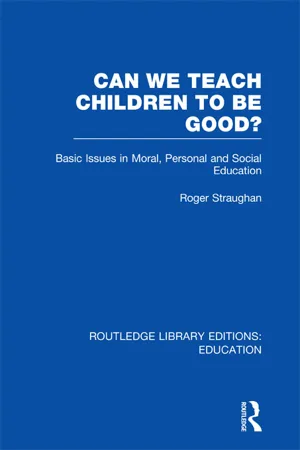
Can We Teach Children to be Good? (RLE Edu K)
About this book
The apparently straightforward question 'Can we teach children to be good?' cannot be properly understood without a great deal of careful thinking about the philosophical issues involved. Teachers and parents often assume that what the question means and how it should be answered are self-evidently matters of plain 'commonsense', but the dangers of such assumptions are laid bare by the probing approach of this book. After reflecting on the terms 'goodness' and 'teaching' it proceeds to describe and critically examine a number of attempts to define the nature of morality in terms of its form or its content, thereby teasing out the many conflicting views of moral education which follow from these theories. No one account of morality or 'moral education' is found to be wholly satisfactory and a synthesis is offered in the final chapter, which suggests a variety of practical teaching strategies.
Information
1: What Are the Problems?
Most people, if asked what the main job of teachers is, would probably give an answer like ‘To pass on knowledge’, or ‘To develop children's intellectual abilities’, or ‘To prepare youngsters for future employment’. At times like the present, therefore, when there are allegations of falling educational standards, teachers are likely to be blamed for failing to deliver these particular goods: children, it may be argued, do not know as much as they should, or do not know the right things, or are failing to achieve certain basic levels of skill and competence, or are ill-equipped to earn a living when they leave school.
But these are not the only grounds on which charges are made, rightly or wrongly, about falling standards in schools, and teachers are criticized for not doing their job properly. For many people, talk of falling standards brings to mind standards of behaviour and conduct rather than of intellectual attainment, and to judge from such hallowed barometers of public opinion as Any Answers or radio ‘phone-in’ programmes teachers are to be held largely responsible for this kind of decline also; they should teach children not only to be knowledgeable, but also to be good.
Let us try to spell out in more detail the precise failure of duty of which teachers are here being accused. The argument usually goes something like this. Modern society is becoming increasingly more lawless, violent, undisciplined and permissive, and this trend is most apparent among the younger generation. Statistics show that vandalism, violent crime, drug-taking and sexual activity have risen and are rising among teenagers. Less sensational but equally significant, it is claimed, is a general decline in such things as respect for authority, politeness and good manners, resulting in children today being ruder, using more bad language and caring less about their appearance and dress than ever before. Schools must be held in part to blame for this state of affairs, for it is their products which are failing to come up to the desired standard. Teachers are not doing enough to impart the right values to children, and to ensure that their behaviour is socially acceptable.
Decreasing interest in religion generally, and in religious education in particular, is often picked out in this kind of argument as an important contributory factor to our alleged moral malaise. Christian teaching used to provide clear answers to questions about right and wrong, and left children in no doubt about these answers. Nowadays, not only has the number of church-going parents steadily fallen, but the emphasis upon religion in schools has also diminished, it is claimed, to the point where in practice it is often difficult to detect anything that could count as ‘religious’ in many schools. So, the argument goes, a moral vacuum has been created in the classroom, and consequently it is even more vital that teachers should now make plain to pupils of all ages what is the right way to behave both in and out of school. Indeed, in view of the virtual eclipse of religion in schools, should not a place now be allocated on the timetable to ‘moral education?
Let us rather grandly label this set of claims and opinions ‘the moralistic argument’. We hear versions of it voiced quite frequently in many quarters, and it tends to gain support and approval from a wide variety of people because it somehow ‘sounds right’. Surely standards of behaviour among the young have fallen, and schools have therefore opted out of providing a clear moral lead; not enough time and attention are being devoted to the business of teaching children to be good.
But arguments which ‘sound right’, and which may have a strong emotional appeal for many people, should not be swallowed whole. Before any such set of views is accepted, it must be subjected to critical scrutiny and probing, especially if, as in this case, its implications are so serious. If we do decide that this argument is valid, we are agreeing that a particular, undesirable state of affairs exists among children, that that state of affairs can be remedied, and that teachers are failing in their moral, social and educational obligations by not remedying it. It is especially important for those preparing to become teachers to have worked out where they stand on these issues, as this will radically affect their attitude towards teaching, and will help to determine what sort of teachers they will become. A strong sense of missionary zeal and a vocational commitment towards reforming the young, for example, would be the likely characteristics of entrants to the teaching profession who assented to this ‘moralistic argument’. If, then, a teacher's response to the question of whether we can and should teach children to be good is going to have a direct and practical pay-off, in terms of how he actually sees his job and behaves in the classroom, it is essential that he at some time gives that question careful, rational consideration, and does not base his classroom practice merely upon unexamined assumptions about his teaching role.
How can we ensure that these assumptions do not go unexamined? One way is to try to do some philosophical thinking about the basic issues, for it is one of the main functions of philosophy to do just that – to take our existing intuitions and beliefs, and expose them to a particular kind of testing. The tests that philosophers use are designed to probe the language in which our intuitions and beliefs are expressed, and to point out possible confusions, ambiguities, inconsistencies and blurred distinctions – to clarify the concepts we use in formulating statements and arguments, and to examine the justifications we offer for them.
This sounds rather vague and abstract, so let us bring this description of philosophy down to earth, by showing how we can test out the ‘moralistic argument’ by aiming some philosophical questions at it. If this gives us a clearer picture of what the argument is exactly claiming, how valid it is and what sort of assumptions it rests upon, then philosophy will already have been practically useful in helping us to work out our attitude towards an issue about which teachers cannot avoid holding an opinion.
First, then, what can be said about the claim that standards of behaviour are falling? What sort of a claim is this? It sounds like a factual claim – something that we can test empirically by going out, collecting data and looking to see if the claim is in fact true. But claiming that standards of behaviour are falling is not like claiming that the temperature, or the birth rate, or inflation is falling. These are empirical matters of fact; even if it may be difficult at times for various reasons to ascertain whether a fall is actually occurring, we know in principle how to find out and what would make the claim true or false. But what precisely is meant by the claim that standards of behaviour are falling? ‘Standards’ can mean different things in different contexts: they can, for example, refer either to what is achieved or to what is expected, so ‘standards of behaviour’ might indicate either the way in which children are actually behaving, or the way in which adults expect them to behave (Straughan and Wrigley 1980, pp. 12–17). But in either case, what precisely constitutes a ‘rise’ or a ‘fall’ in such standards? Is there a universally agreed measure which we can apply to children's behaviour to discover whether its ‘standards’ are rising or falling?
The difficulty may become more obvious if we take an imaginary example. Suppose that a research project studied a large sample of teenagers in 1978 and a parallel sample in 1988. It observed their behaviour in a variety of contexts, and also set up a battery of tests of the most devious kind (which some psychologists love to use), for example, placing the subjects in situations where they can choose whether or not to cheat, tell the truth, obey instructions, help strangers in apparent distress, and so on. The results of this study, let us imagine, are as follows: the teenagers in 1988, compared with those in 1978, used more bad language, cheated less in examinations, helped fewer old ladies across roads, collected more money for the RSPCA but less for OXFAM, drank more, smoked less, took fewer drugs and were more experienced sexually. Have ‘standards of behaviour’, then, risen or fallen?
What this example shows is that, when deciding whether such a rise or fall has occurred, we have first to judge what counts as a rise or fall, and not everyone will come to the same conclusion. We can all agree whether the temperature has risen or fallen by observing the thermometer, but mere observation will not settle the question about rising or falling standards of behaviour. This is because we have to make a moral judgement in order to give an answer to the latter question, not just attend to the facts of the matter. If, for example, we judge bad language to be a more serious moral issue than cheating, we may decide that standards of teenage behaviour had fallen by 1988; if we judge drugtaking to be morally more reprehensible than ignoring old ladies at kerbsides, then we are likely to conclude that standards had risen. So there can be no simple, empirical method of determining whether standards of behaviour have risen or fallen; it all depends on what one holds to be morally desirable or undesirable, praiseworthy or blameworthy. Yet the temptation remains to equate morality with one specific type of behaviour, and to draw general conclusions about children's moral standards and values by observing the frequency of that behaviour; as was well exemplified in a letter to the Radio Times, complaining about an allegedly ‘obscene’ programme: ‘If the BBC want to corrupt the young, they are going the right way about it. Is there no one in the BBC with a sense of moral values? No wonder there are so many children using bad language and having no sense of morals.’
Now this brings us face to face with some of the most fundamental and most difficult questions which philosophers try to tackle. What exactly are ‘moral values’? How do we make ‘moral judgements’? How can we justify calling a particular action right or wrong, good or bad? Are all moral questions a matter of personal opinion, or can we base our moral decisions on more objective grounds? These questions, which the ‘moralistic argument’ ignores, but which cannot be avoided if we are concerned about ‘teaching children to be good’, we shall return to in later chapters, but we must at this point briefly note some of the difficulties they create for the ‘moralistic argument’, which, you will remember, claimed that teachers should take a positive lead in trying to remedy the supposed ‘moral vacuum’. This implies that there is an agreed set of answers to all moral questions, and that it is the duty of teachers to ensure that children learn these answers and behave accordingly. Is this an acceptable view?
Clearly, on a number of counts it is not. To begin with, as a matter of sheer fact there is, of course, no general agreement on many important moral issues, such as euthanasia, abortion, capital and corporal punishment, civil disobedience, homosexuality, pre-marital sex, and so on. As we have already seen, there seems to be no way of arriving at the ‘correct’, undisputed answer to a moral question just by looking at the facts of the matter (though this will be examined in much greater detail in Chapter 5).
But even if all or most teachers were in agreement over a particular moral issue, would it necessarily follow that their educational duty was to ensure that their pupils acted in accordance with those views? Supposing that a majority of teachers believed that pre-marital sex was wrong, must it be their job as moral educators to teach this belief, and to try to get their pupils to refrain from pre-marital sex? One objection to this sort of approach is that, although it may have various socially desirable effects (in this case, for example, a reduction in teenage abortion and sexually transmitted diseases), its success will depend largely upon pupils conforming and submitting to the consensus view of the teachers, rather than upon them grappling with the moral problem themselves, and gaining a greater understanding of the issues involved.
To put this objection at its simplest, nothing is ever made right by someone saying that it is right; moral problems are not solved (morally, at least) by asking someone else what to do, or by merely obeying some authority. Some teachers have difficulty in grasping this point, perhaps because teachers as a group tend to place value upon obedience, compliance and conformity. This is quite understandable, for all teachers need to exercise a considerable degree of social control in doing their job; a teacher's self-confidence and, to some extent, his effectiveness are derived from his belief that the children will do as he tells them, and will conform to the rules of the school. But teaching children to be good is not the same as teaching them to do as they are told; obedience to authority is strictly irrelevant to the business of making moral decisions. Another example should make this clear.
An American psychologist conducted a series of experiments in which members of the public volunteered to take part in what they thought was a study of the effects of punishment upon learning (Milgram 1974). The ‘learner’, who was in fact an actor, was strapped to a chair and told to learn a list of word pairs. The ‘teacher’, who was one of the unsuspecting volunteers, was seated in front of what appeared to be an electric shock generator, and was told to administer increasingly severe shocks to the ‘learner’ each time he gave a wrong answer. The ‘learner’ in fact received no shocks at all, but pretended to react and protest more and more frenziedly as the level of the shocks apparently increased. If the ‘teacher’ objected at any point, the person in charge of the experiment would say (in sequence), ‘Please continue’, or ‘The experiment requires that you continue’, or ‘It is absolutely essential that you continue’, or ‘You have no other choice, you must go on’. In some of the experiments 65 per cent of the ‘teachers’ obeyed the experimenter, and went on to inflict what they thought were highly dangerous shocks of 450 volts. It appears, therefore, to be surprisingly and frighteningly easy to induce people to obey an authority, but surely we would not want to say that the 65 per cent of subjects who did as they were told were morally better and more mature than the 35 per cent who refused. Doing something just because you are told to do it, then, has nothing to do with acting morally – a point which will be further amplified in later chapters.
A similar point can be made about the authority of religion, the lack of which, according to the ‘moralistic argument’, has contributed to the present moral vacuum among youngsters. Rules, commandments and pronouncements which emanate from any religion cannot be morally right just because that religion says so. There is, of course, the further problem that different religions prescribe different rules, drawn from different sacred texts and traditions which purport to reveal the divine will. These often conflict, so how do we decide which particular set of religious prescriptions is morally right? Not by referring back to the religious authority which prescribes it, for that does not solve the difficulty of choosing between conflicting religious authorities. We can only test the moral worth of religious prescriptions by exercising our own moral judgement upon the issue in question, and making a moral decision about it for ourselves. If we try to short-cut the problem by saying ‘It must be right because the Bible says so’ (or the Koran, or the Pope, or the Chief Rabbi, or the local witch-doctor, or the guru, or any other religious authority), we are again equating the making of a moral decision with doing as we are told.
So it must be mistaken to assume that the so-called ‘moral vacuum’ can be filled simply by schools placing more emphasis upon religion in order to provide children with authoritative answers about how they ought to behave. That sort of approach might or might not change children's behaviour in various ways, but the result could not be called moral behaviour if the children were merely conforming to the ‘right answers’ laid down by an (in this case religious) authority. Much more, however, needs to be said about the precise characteristics of moral behaviour and moral reasoning, and this will form a major part of the following chapters.
To conclude this introductory chapter, let us now turn our attention to another very hazy aspect of the ‘moralistic argument’. If teachers are expected to take more of a ‘moral lead’ in schools, what exactly will this amount to, in terms of actual teaching activities and methods? The ‘moralistic argument’ seems to assume that all problems will disappear as soon as teachers become sufficiently concerned about ‘falling standards of behaviour’. But even if teachers do consider it part of their job to teach children to be good, there then arise not only questions about what to teach, as we have already seen, but also questions about how to teach it, whatever it is.
What sort of teaching is the teacher here being expected to do? Is he being asked to teach children that certain things are true (as the geography teacher might teach that Rome is the capital of Italy)? Or to teach children how to do certain things (as the mathematics teacher might teach a class how to solve quadratic equations)? Or to teach children to do certain things (as the science teacher might teach pupils to be careful when handling dangerous chemicals)? The answer will depend upon what the appropriate subject matter of ‘moral education’ is considered to be, and we have already seen how the complexities of that question were ignored in the ‘moralistic argument’. In fact, a case can probably be made for the inclusion of all three types of teaching, as will be shown in Chapter 6, which suggests that there may well be no simple, unitary method of ‘teaching children to be good’.
Moreover, by failing to recognize the different forms of teaching which may be involved in moral education, the ‘moralistic argument’ blurs another distinction, which results in the teacher's difficulties being further underestimated. Teaching children to do X is directly related to the particular behaviour (X) which results; for example, I can claim that I have successfully taught a child to tell the truth at all times, only if the child, as a result of my teaching, does in fact tell the truth at all times. But teaching that. . .and teaching how. . . are not so directly tied to the child's behaviour in this way (Scheffler 1960, ch. V) If I successfully teach a child that it is wrong to steal, he will have learned that it is wrong to steal, but that is no guarantee that he will not steal on some future occasion. Similarly, if I teach a child how to handle fireworks safely, he will have learned how to handle fireworks safely, but again there is no guarantee that he will handle his fireworks safely on Bonfire Night. Not all forms of teaching and learning, then, necessarily lead to the required pattern of behaviour, for the propositions and skills that are taught and learned (in the ‘that’ and ‘how’...
Table of contents
- Front Cover
- Half Title
- Title Page
- Copyright
- Dedication
- Title Page
- Copyright
- Dedication
- Contents
- Foreword
- 1 What Are the Problems?
- 2 What Are the Main Approaches to Moral Education?
- 3 What Does It Mean To Be Good?
- 4 What Is the Form of Morality and Moral Education?
- 5 What Is the Content of Morality and Moral Education?
- 6 So Can We Teach Children To Be Good?
- Further Reading
- References
- Index
Trusted by 375,005 students
Access to over 1.5 million titles for a fair monthly price.
Study more efficiently using our study tools.
Frequently asked questions
Yes, you can cancel anytime from the Subscription tab in your account settings on the Perlego website. Your subscription will stay active until the end of your current billing period. Learn how to cancel your subscription
No, books cannot be downloaded as external files, such as PDFs, for use outside of Perlego. However, you can download books within the Perlego app for offline reading on mobile or tablet. Learn how to download books offline
Perlego offers two plans: Essential and Complete
- Essential is ideal for learners and professionals who enjoy exploring a wide range of subjects. Access the Essential Library with 800,000+ trusted titles and best-sellers across business, personal growth, and the humanities. Includes unlimited reading time and Standard Read Aloud voice.
- Complete: Perfect for advanced learners and researchers needing full, unrestricted access. Unlock 1.5M+ books across hundreds of subjects, including academic and specialized titles. The Complete Plan also includes advanced features like Premium Read Aloud and Research Assistant.
We are an online textbook subscription service, where you can get access to an entire online library for less than the price of a single book per month. With over 1.5 million books across 990+ topics, we’ve got you covered! Learn about our mission
Look out for the read-aloud symbol on your next book to see if you can listen to it. The read-aloud tool reads text aloud for you, highlighting the text as it is being read. You can pause it, speed it up and slow it down. Learn more about Read Aloud
Yes! You can use the Perlego app on both iOS and Android devices to read anytime, anywhere — even offline. Perfect for commutes or when you’re on the go.
Please note we cannot support devices running on iOS 13 and Android 7 or earlier. Learn more about using the app
Please note we cannot support devices running on iOS 13 and Android 7 or earlier. Learn more about using the app
Yes, you can access Can We Teach Children to be Good? (RLE Edu K) by Roger Straughan in PDF and/or ePUB format, as well as other popular books in Education & Education General. We have over 1.5 million books available in our catalogue for you to explore.