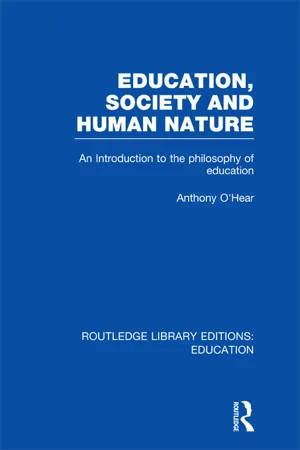
Intended primarily for education students this book provides an introduction to the philosophy of education that tackles educational problems and at the same time relates them to the mainstream of philosophical analysis. Among the educational topics the book discusses are the aims of education, the two cultures debate, moral education, equality as an ideal and academic elitism. It examines the limitations of a purely technological education, and suggests the shape of a balanced curriculum. It critically analyses important educational theses in the work of Rousseau, Dewey, R S Peters, P H Hirst, F R Leavis, Ronald Dworkin and G H Bantock, among many others, and considers the philosophical copics of relativism, the nature of knowledge, the basis of moral choice, the value of democracy and the status of religious claims.
eBook - ePub
Education, Society and Human Nature (RLE Edu K)
An Introduction to the Philosophy of Education
- 192 pages
- English
- ePUB (mobile friendly)
- Available on iOS & Android
eBook - ePub
Education, Society and Human Nature (RLE Edu K)
An Introduction to the Philosophy of Education
About this book
Information
1 OBJECTIONS TO
LIBERAL EDUCATION
LIBERAL EDUCATION
There is a standard view of education which is (or was until recently) enshrined in many of the educational practices and institutions of most western countries, as well as of countries influenced by the west. I do not wish to identify this view with any particular writer, because its assumptions are so widely held that many would take them almost for granted. Moreover, what I am interested in at this point is not elaborating a comprehensive theory of education so much as identifying a set of extremely influential assumptions. These assumptions have been attacked vehemently by their critics, while on the whole they have been unreflectively accepted by their supporters, so it is right to see how they might be defended against criticism. For the sake of brevity and simplicity, I shall refer to these assumptions under the title of liberal education, but nothing hangs on my use of this description, nor on whether other people think of liberal education in different ways.
Education, or the part of overall education which counts as liberal education, on the view being considered consists in initiating students into disciplines such as those of mathematics, science, history, literature and the arts. These disciplines exist in their own right, and there are people expert and authoritative in them. Students are to be taught by teachers who have some claim to authority in what they teach. All involved, students and teachers, are to be guided by the standards of excellence inherent in the disciplines concerned, wherever these standards might lead, even into conflict with church or state. It follows from this commitment to excellence that the disciplines are essentially open, and not to be closed to any competent voice by people either inside or outside the discipline. Students are to be assessed in the light of their achievements in reaching the standards involved. Some, it is to be expected, will be able, under encouragement, to achieve high degrees of excellence in what they study. Some of them will be able eventually to make contributions of their own to the disciplines, continuing and adding to the traditions. On the whole, the disciplines are taught and engaged in for their own sake, because they are recognized to be valuable in their own right and a part of any fully civilized existence. Liberal education, then, is not primarily vocational or practical. Finally, it recognizes expertise, and works through the recognition of expertise and strives ultimately for work of exceptional quality in the subjects concerned, which by definition is not generally attainable.
The criticisms of liberal education which I wish to consider here fall into five main groups, although, as will be seen, there are connections between them. In the first place, I consider the idea that liberal education really only alienates man from his natural existence and thereby promotes unhappiness. What is taught in a liberal education is actually instrumental in taking people away from a genuinely good life. Then, second, there is the religious viewpoint which sees the proper role of education as being subservient to religion. The good life does not consist in studying things for their own sake, but only for the sake of the faith. Moreover a secular education, which a liberal education will be, may actually conflict with religious truth and values. Third, there is the idea that what I have described as liberal education would be inherently undemocratic and hence undesirable. Then, following on from this, there is the point made by a group of radical sociological writers who argue that liberal education is not only undemocratic and inegalitarian in itself, but that it is actually a direct reflection and reinforcement of western middle-class values, and thus an instrument of social and political control. Finally, there is the general objection to liberal education which is implicit in many of the other objections, that it is bound to fail because what is characteristically taught and learned in a liberal education is irrelevant to the lives of most of those being educated.
I do not claim that the objections I consider in this chapter are the only important attacks that can be made on the liberal concept of education. There is also, and above all, the idea that education and learning should serve particular socioeconomic ends and be directed primarily at producing the producers (scientists and technicians) needed by society. I do not consider this position in detail in this chapter because much of the book is a criticism of this view and a defence of non-vocational elements in education. Also, in the next chapter I consider more directly what the proper role for vocational training in education might be. At this point it will be enough to say that advocacy of a purely vocational type of education presupposes that one believes that the lives and jobs that children are being prepared for by their education will be satisfactory for them, whereas I shall argue that one of the main functions of education is to help children extend the range and possibilities of their life choices, and that one of the main functions of learning is to enable people to get more insight into just what a satisfactory way of life might be. Purely vocational education and learning assumes that questions concerning choices of the ends of human activity and choices of role have been settled, and settled satisfactorily.
LIBERAL EDUCATION IS UNNATURAL
One of the aims of this book is to show how what one thinks about education cannot be separated from what one thinks about life generally. What we will examine in this section is the feeling that there is something unnatural, over-complicated and unbalanced about the life of a man who has undergone a liberal education, because the values of such an education typically serve only to alienate men from each other and from nature. The reflectiveness and commitment to lonely study and to the critical attitude which characterize at least the higher reaches of liberal education are seen in stark and unfavourable contrast to the virtues typically (if ideally) associated with a more natural or peasant-like life: simplicity, fraternity, honour, hospitality, self-sufficiency, manual work, closeness to nature. The liberal intellectual, because of the way his mind has been developed, is cut off from the instinctive roots of his existence, and from the fundamental understanding of life and goodness which the peasant, for example, naturally possesses. The intellectual is clever, but not wise. Isolated as he is from the common people, he is a prey to pride and arrogance. He is full of theories and pseudo-science, but he understands nothing of importance about life. He lives his life in self-serving groups of people like himself, and sees himself (falsely) as a member of an elite, elevated above the rest. But, in fact, the society in which he lives is decadent and corrupt, politically, morally and culturally. Its decadence is in part constituted by the flourishing within it of self-seeking intellectuals and academics, while one of the chief means by which it corrupts originally innocent children is its system of education, through which the values and standards of the intellectual are forced on their initially reluctant minds.
The picture of liberal education corrupting innocent children, and the associated preference for a simple country life over a refined urban civilization, will be familiar to readers of the writings of Rousseau and also of Tolstoy, who derived a great deal in his views on education from his study of Rousseau (cf. Berlin, 1978, p.240). According to Rousseau (1762, p. 16), in what I am calling a liberal education teachers teach everything ‘except self-knowledge and self-control, the arts of life and happiness’. They do not attempt to prepare children to live well, by remaining close to nature and by building on their natural good instincts, which they would do if they taught them how to live in harmony with nature by bending their efforts to the necessities imposed on them by nature. Instead, teachers, by their own elitism and contempt for the unlearned, introduce children to the world of vanity, in which men do not direct their lives towards providing the necessities for themselves and their families, but more towards gaining the esteem of others. The world of urban civilization is in fact a world whose motive force is vanity, and, according to Rousseau, the vain man can never be fully satisfied because he will always want more and more recognition from others. The simple peasant, on the other hand, can satisfy his material needs, and do so by his own efforts, without needing either to exploit the labour of others or to have the admiration of others. The peasant does not need the useless facts and dead knowledge of liberal education. Presumably only a sort of vanity and elitism could ever motivate a man to spend his life studying uselessly in libraries or laboratories.
Tolstoy, in similar vein, records in his ‘A Confession’ (1882) how in his youth he had believed in progress and how he had wanted to enlighten the ignorant. But he had not at that time known what to teach, believing as he did that ‘the narrow circle of rich, learned and leisured people’ (p.45) to which he belonged formed the whole of humanity. Only gradually had he come to see that it was precisely this parasitic, superfluous existence that was blocking for him the genuine understanding of life that simple people, in harmony with nature and its demands, possess instinctively. An education which enfeebles one's natural understanding of life and desire for virtue by inculcating the standards and vanity of a corrupt society should not, then, be imposed on others.
Rousseau's own educational prescriptions in ‘Emile’ (1762) very largely consist in outlining the sequence of what he calls ‘negative education’, in which a tutor will prevent a child from being corrupted by society and its ways by keeping him isolated from all undesirable influences, including, on the whole, other people. Education should not enfeeble a person's spirit by exciting unrealizable desires. In the sense advocated by Rousseau and Tolstoy, a natural life is an intellectually restricted one, and to that extent dull and mediocre. But this is not something Rousseau, at least, is afraid of. In fact, he explicitly advocates it: ‘The world of reality has its bounds, the world of imagination is boundless; as we cannot enlarge the one, let us restrict the other’ (1762, p.45). He also urges us to ‘desire mediocrity in all things, even in beauty’ (1762, p.372). So Rousseau is quite prepared to sacrifice excellence for a life that appears to him closer to our natural roots.
It is easy to criticize Rousseau and Tolstoy for their conception of natural innocence, for their idea that a pupil can develop free from social influence and for their idealization of the supposedly simple life of the country against that of the city. At the same time, they do raise a question which educators ought to consider seriously. Suppose it were the case that liberal education produced no appreciable gain in goodness or happiness on the part of those educated, or that it actually interfered with one's intuitive sense of goodness and Tightness, as Rousseau and Tolstoy claim. Should it then be imposed (or inflicted on) children? We no longer share Socrates's confidence in the equation of virtue and knowledge. At the very least we have to face Mill's question as to the comparative merits of the lives of a satisfied fool or pig and a dissatisfied Socrates or man. But there is more to it than that. We are also, in effect, being asked to provide a justification for transforming traditional role-oriented peasant societies into open societies based on liberal educational ideals, bearing in mind that Tanzania, Libya, Iran, Algeria and China, among others, may right now be opting against a western-style liberal education (and the advances in technology which may depend on such an education) and in favour of an alternative closer to the spirit of Rousseau – at least in an emphasis on fraternity and simplicity as opposed to individual excellence, choice and the free play of the mind. To this problem the standard counter to Mill's question, that only a Socrates or man could be in a position to answer the question, is obviously no rejoinder, as we are now considering what is to be done for children, who, as yet, are in neither the high nor the low category.
The challenge presented to the liberal educationalist is to defend the pursuit of excellence in learning for its own sake, against the view that learning is to be valued and pursued only to the extent that is necessary to enable people to play their part in the good and natural life. In the case of Rousseau and Tolstoy, this challenge is posed in a particularly dramatic way, because they both see the end to which learning should be subject as the living of a simple, uncompetitive, peasant-like existence. A natural reply to the challenge would be to say that men are naturally competitive, and that even peasants desire bigger farms. The fraternity and equality Rousseau seeks can be achieved only by laws, probably repressive ones. To this, Rousseau might reply that the laws would seem repressive only to those who were used to a life of competition: to those brought up in a different ideology, such laws might well appear entirely just and natural.
To reply effectively to the challenge, I think we have to look less at the uncompetitive nature of a society guided by Rousseauian principles and more at the nature of learning itself. Rousseau and Tolstoy place their faith in an understanding of life which they believe to be open to even the simplest readers of the book of nature. While it is true that unreflective goodness may be met with in simple, inarticulate people, it is by no means clear that we can base any general conception or understanding of the good life directly on such examples, precisely because of the unreflectiveness of the people involved (cf. Murdoch, 1970, p.53). Without some more articulated view of human nature, and nature itself, we are hardly in a position to say what is good or natural for man, particularly (but not only) when we are, as now, in a period of rapid social change and the disintegration of traditional social structures. In other words, to criticize liberal education as unnatural for man is to presuppose a correct understanding of what is natural for him and what a good life would be. But it is precisely here that knowledge is essential, in order to avoid mistakes, illusions, false enlightenment and dangerous oversimplification. Nietzsche's (1881, § 48) words are worth pondering: ‘ “Know thyself” is the whole of science. Only when a man shall have acquired a knowledge of all things will he be able to know himself. For things are but the boundaries of man.
To aim at that excellence in learning for which a liberal education is a preparation is in part to aim at understanding how things are with man and the world. To say, as the liberal educationalist says, that learning is to be pursued for its own sake is in part to say that what is studied cannot properly be controlled or anticipated by outside influence. For the outside influence to be justified in doing that it would have, itself, to be in possession of the truth. We should certainly be sceptical of any claims on the part of political authorities to have this knowledge, or to be able enthusiastically to articulate people's unreflective sense of goodness, and wary of the totalitarian and repressive implications of political attempts to dissect or curtail learning, even in the name of ideals such as fraternity or traditional goodness and stability. What Herzen said over a century ago, on attempts to restrict or control learning in favour of the Utopian ideals of a society based on peasant or folk virtues, remains valid as a defence of liberal attitudes to knowledge, and his prophecies have turned out only too true:
One cannot stop intelligence because the majority lacks understanding, while the minority makes evil use of it... Wild cries to close books, abandon science and go to some senseless battle of destruction – that is the most violent and harmful kind of demagoguery. It will be followed by the eruption of the most savage passions (quoted in Berlin, 1978, p.299).
In other words, ignorance, especially enforced ignorance, is a valuable ally to repression, while knowledge and learning and the critical attitude that it is to be hoped a liberal education will foster remain the best defences against false enlightenment.
So, even if intellectuals are not happier than others, and even if as a class they are prone to the failings of silliness and vanity, exposed so ruthlessly by Tolstoy and Rousseau, there is a strong argument for saying that a society in which intellectual life is flourishing and free, and in which its ideals and discoveries are part of education generally, is likely to be more desirable than an intellectually closed one, in which there is a strong likelihood of false ideology and disastrous oversimplifications being imposed on people, which can hardly lead to happiness or natural goodness. The point to stress here is that any present-day attempts to produce the sorts of society approved of by Rousseau and Tolstoy must inevitably involve enforced restriction of intellectual activity, and while this could perhaps be tolerated during a state of emergency (as in war-time Britain), it is unlikely to be acceptable as a basis for social reconstruction. The innocence Tolstoy and Rousseau value is past, if it ever existed. Modern attempts to revive it would inevitably lose the very unrefleetiveness and naivety that is longed for, because they will involve the conscious imposition on society of some radical blueprint and the suppression of contrary views. I shall explore this point further later on, in the next chapter, but we will turn now to arguments directed against liberal education by adherents of dogmatic religions.
LIBERAL EDUCATION IS IRRELIGIOUS
The claim by religious dogmatists that liberal education is irreligious is closely connected to the claim that it is unnatural. Both claims presuppose that there is a correct understanding of the nature of man and human life, an understanding which should guide and dominate other human activities in general and intellectual activities in particular. To an extent, the rejoinder made to the arcadian romantic in the last section can also be made to the dogmatic critic of liberal education, but further light can be thrown on the undesirability of attempts to suppress free enquiry and the education system that goes with it by considering religious claims in their own right.
For the religious dogmatist, thought and study which goes beyond what is necessary for the practice of religion is regarded as worldly and an irrelevant distraction, while cases of conflict between religion and secular learning are regarded as showing the evil nature of the unrestrained intelligence. Children, whose minds are impressionable, should be shielded from such examples of intellectual pride. In general, too, there is the idea that education should take place in a religious rather than a secular atmosphere, in which the prevailing attitudes are in conformity with the spirit of religion.
This attitude to education is by no means an irrational one, given the original premises – that the world and its practices are basically corrupt and that the truth about the world, man and God has been revealed in religion. One can indeed sympathize with the attitude of religious-minded parents who wish to shield their children from what they see as contamination by a worldly education. In extreme cases, what may arise is a conflict between two sets of rights, the rights of parents to bring children up as they conscientiously see fit, and the right of the children to a general education and educational opportunities equal to those of their peers, a right defended on their behalf by the state. This conflict is of its nature irresolvable by peaceful compromise when, as in the case of the Protestant Amish sect in the United States, the demands of the parents are extreme from an educational point of view.
The Amish, whose forebears left Holland in the seventeenth century in search of religious frecdom, believe that separation from the contemporary secular world is essential for salvation. They live in communities of their own, life being regulated by biblical and religious texts and local community rules. Some communities even refrain from the use of modern technological aids to work and life, such as electricity, cars and telephones. They also avoid involving themselves with the machinery of the state, refusing insurance, social benefits, military service and even litigation. (The cases involving them have been brought by others on their behalf.) At the same time, they are highly efficient farmers, well able to support themselves and their families. They are extremely law-abiding, except in the matter of education. Here, though, they do come into conflict with the state, for they believe that formal education for their children should stop at the eighth grade (age thirteen to fourteen). At this point, they believe that their children will have mastered the basic skills of reading, writing and arithmetic necessary to lead peaceful and fruitful lives in the community as a whole. Education, as they see it, then begins to concentrate on ‘worldly’ subjects such as literature, art and music. Such education is believed to militate against ‘humility, obedience to Christ, and submission to the will of God’ (Prance, 1971, p.833). As a result of this, the stricter Amish communities have increasingly come into conflict with the state authorities, as the latter begin to take a closer interest in educational standards and practices even in private, rural schools. Amish brethren have (on the whole unsuccessfully) attempted to circumvent state insistence on public school education for their children (or education deemed to be equivalent in standard) by setting up their own schools or simply leaving one area for another. Some compromises have been reached with more moderate Amish, ...
Table of contents
- Front Cover
- Half Title
- Title Page
- Copyright
- Title Page
- Copyright
- Contents
- Preface
- Introduction: Philosophy and education
- 1 Objections to liberal education
- 2 A modern education and its justification
- 3 Learning and teaching
- 4 The curriculum
- 5 Moral education
- 6 Education and society
- Conclusion: Education and philosophy
- Bibliography
- Index
Trusted by 375,005 students
Access to over 1.5 million titles for a fair monthly price.
Study more efficiently using our study tools.
Frequently asked questions
Yes, you can cancel anytime from the Subscription tab in your account settings on the Perlego website. Your subscription will stay active until the end of your current billing period. Learn how to cancel your subscription
No, books cannot be downloaded as external files, such as PDFs, for use outside of Perlego. However, you can download books within the Perlego app for offline reading on mobile or tablet. Learn how to download books offline
Perlego offers two plans: Essential and Complete
- Essential is ideal for learners and professionals who enjoy exploring a wide range of subjects. Access the Essential Library with 800,000+ trusted titles and best-sellers across business, personal growth, and the humanities. Includes unlimited reading time and Standard Read Aloud voice.
- Complete: Perfect for advanced learners and researchers needing full, unrestricted access. Unlock 1.5M+ books across hundreds of subjects, including academic and specialized titles. The Complete Plan also includes advanced features like Premium Read Aloud and Research Assistant.
We are an online textbook subscription service, where you can get access to an entire online library for less than the price of a single book per month. With over 1.5 million books across 990+ topics, we’ve got you covered! Learn about our mission
Look out for the read-aloud symbol on your next book to see if you can listen to it. The read-aloud tool reads text aloud for you, highlighting the text as it is being read. You can pause it, speed it up and slow it down. Learn more about Read Aloud
Yes! You can use the Perlego app on both iOS and Android devices to read anytime, anywhere — even offline. Perfect for commutes or when you’re on the go.
Please note we cannot support devices running on iOS 13 and Android 7 or earlier. Learn more about using the app
Please note we cannot support devices running on iOS 13 and Android 7 or earlier. Learn more about using the app
Yes, you can access Education, Society and Human Nature (RLE Edu K) by Anthony O'Hear in PDF and/or ePUB format, as well as other popular books in Education & Education General. We have over 1.5 million books available in our catalogue for you to explore.