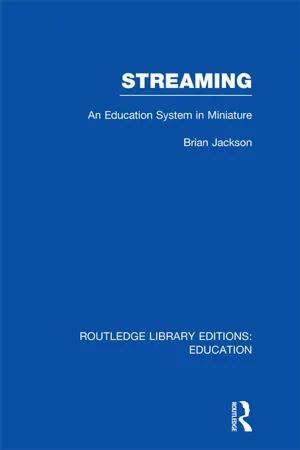
In this volume a streamed school is studied in detail and parents' responses are recorded. Eleven plus is (and has been) under criticism, but many children are selected by a 'seven plus' because they are streamed into A, B or C classes. Few children escape the label once it is pinned on them – less than six in one hundred change their stream. The study shows that on a national sample the date on which a child is born – irrespective of his ability – affects his or her stream at the age of 7 and his results at eleven plus. Finally ten streamed schools are compared, academically and socially, with ten unstreamed schools. In the final chapters the author makes practical proposals by which primary schools could recognise and increase the flow of gifted children.
eBook - ePub
Streaming (RLE Edu L Sociology of Education)
An Education System in Miniature
- 4 pages
- English
- ePUB (mobile friendly)
- Available on iOS & Android
eBook - ePub
About this book
Information
1
PROLOGUE:
IN THE CLASSROOM
LET me begin with a personal story. It may help to clarify the impulse from which this enquiry stemmed.
My first experience as a primary school teacher was a series of practice lessons in what had been my old ‘council school’. I started with a much-prepared lesson on the mediaeval ballad, Sir Patrick Spens.
The King sat in Dunfermline town
Drinking the blood-red wine.
O whare will I get a skeely skipper
To sail this new ship o’ mine.
Drinking the blood-red wine.
O whare will I get a skeely skipper
To sail this new ship o’ mine.
The children mimed it as first myself—and then, after practice, a small girl with tight blonde pigtails—declaimed it. The teacher's chair became the royal throne of Scotland, desks were pushed back to reveal Leith sands, and blackboard and bookcase built the ship that had to sail the winter seas and fetch back the Princess of Norway.
They hadna sail'd a league, a league,
A league but barely three,
When the sky grew dark and the wind blew loud,
And gurly grew the sea.
A league but barely three,
When the sky grew dark and the wind blew loud,
And gurly grew the sea.
Hunched groups moaned and whistled the storm from the classroom corners: a tallish boy stood by, switching the electric light on and off as if lightning flickered, almost dancing as he did so. And so the ship sank, the Scottish nobles drowned, and only their feather beds floated on the foam.
And lang, lang may the maidens sit
Wi’ their gowd kames in their hair,
A-waiting for their ain dear loves
For them they'll see nae mair.
Wi’ their gowd kames in their hair,
A-waiting for their ain dear loves
For them they'll see nae mair.
Crop-haired Yorkshire girls, swept imaginary combs through imaginary tresses . . .
It didn't last. The children tired and the lesson ended untidily. I was more excited than they were, looking forward to term after term keyed at this pitch. It had begun suspiciously easily. But I was far too pleased with myself to note that.
Twelve years before when I left this school myself there had been one class of fifty children for each year from seven to eleven; after that some passed their ‘scholarship’ to the grammar school and classes of thirty children for each year from twelve to fourteen were left behind. This was the old type of all-age school that has been gradually disappearing since the 1944 Education Act. That Act created the separate primary school for children from five to eleven. My old school turned into a primary, and its intake increased to fill the extra space. It now had three classes of children for each age group. Children were placed in their class according to ability, the idea being that the brightest children should be taught altogether in the ‘A’ class, the average ones in the ‘B’ class, and the weakest children in the ‘C’ class. They were ‘streamed’.
This was the first time I encountered the streaming of young children, and far from being delighted or outraged, I must admit that I hardly noticed it. This is what I mean by saying there were questions I didn't ask. Those practice lessons that pleased me so much were all taken with ‘A’ stream classes. The boys and girls were eager, apt and docile: they presented few problems of order or apathy. Perhaps behind them were home backgrounds helpful to schooling, sanctions from parents and friends supporting their teacher, years of training at home and at school preparing them to attend to classroom work. Their habits, ambitions and needs intertwined and went along with what the teacher offered. A great deal of what I imagined I had done in taking Sir Patrick Spens with them—the creation and exploitation of an atmosphere of ‘learning readiness’—was done, long before my arrival, by many people from fellow teachers to parents and even grandparents, and the schools, colleges and teachers that they had known long ago.
Glancing back at such lessons I wonder if they went quite as deep as I thought. Did the children accept, enjoy and dismiss them as ‘holiday’ periods remote from the important work of morning arithmetic and eleven plus intelligence tests? Were they perhaps more peripheral and decorative than I realised?
If I didn't learn from apparent success I should have done from apparent defeat. I didn't. Yet there was certainly one defeat in those first practice lessons. For a single period I was given what must have been the ‘B’ or ‘C’ stream—I imagine the ‘C’, but it is characteristic that I didn't know. With them I was taking a geography period on ‘Rivers of Africa’ and had begun by reading them Kipling's story of ‘How the Elephant got its trunk’ with its refrain of
the great, gray-green, greasy Limpopo river
and its tale of the Elephant Child who, in the days when elephants had no trunks, was scolded, pushed, bullied, and beaten by every animal in the jungle—and all for asking the harmless question ‘What does the crocodile have for dinner?’ My lesson was supposed to lead out from the refrain of the great Limpopo river. But I was as chagrined by its blank reception at each repetition, as I was taken aback at the shout of delight when I told how Elephant Child, with his tiny nose stretched out into the very first elephant trunk by a hungry crocodile, had returned to the jungle and spanked and bashed parents and relations, friends, enemies and neighbours. Instead of always being pushed around and pressed to the bottom, Elephant Child with his new trunk thrashed the whole adult world until it learned to treat him with a fresh respect.
That might have set me thinking about the natural ‘subjection’ of children, and the further subjection, necessary or unnecessary, involved in being a ‘C’ stream child. Perhaps it did, but at the time and for some while after, I gave over much more thought to the way this lesson crumbled into pieces. I put down Kipling, and drawing a map of Africa on the blackboard I began my set story-question-and-answer on African rivers . . . Limpopo, Niger, Congo, Nile.
I had completely lost my hold on that class before I became aware of it. After five or ten minutes I realised that I was the only one interested in African rivers. Not that boys were breaking windows or girls dancing on the top of desks: nothing like that. All the children were in their seats and looking at me, most of them were smiling but none of them was listening. I introduced the subject of the Niger as vividly as I could, but when I paused and asked questions, it was clear that no one had heard a word. A small boy with a pink eye-shield over his left eye sat in the front row, and as I moved on from Niger to Congo he grinned quite broadly and swaying his head almost rhythmically from side to side shot out grins to left and right that rippled back through his classmates. The tensions of the class circled round him—I don't know why—and they were ranged behind him, united as a group against the teacher. The lesson soon slipped past this point of amused uninterest: the smiles (except for the boy in the eye-shield) all faded, feet began to shuffle, unplaceable whispers flickered across the room. I began watching the clock. A worn tennis ball came slowly rolling down the middle aisle towards my feet. Should I demand to know from whom and where and why? I picked it up; then put it on the desk and returned to the Nile, the Blue Nile, the White Nile, the Mountains of the Moon. The class moved inevitably towards eruption; and then the lunchtime bell rang, slightly late. I rapidly dismissed them, and with a great clatter, boys and girls surged out, over desks and chairs, through the writhing squash at the door, through the corridor race, and with a final burst, out into the yard and the open air.
Immediately I was furious: angry that I hadn't called them back and had them file out properly. I don't suppose I'd ever seen a ‘C’ class burst out of school before, and I was baffled. Since then I've several times seen a ‘C’ class, when for some reason restraint has been lifted, thrust its way forward and almost explode into the playground whilst the ‘A’ class had gradually sauntered out behind it.
I consulted the ‘C’ stream teacher about my lesson. He thought it had been too fancy, not bread-and-butter enough. I should have made the children chant the names of the rivers after me, until more could repeat the list than couldn't. That would take most of the time, and then I might have filled up by telling them one thing about each river. And I should certainly have stopped the lesson, seized on a scapegoat, read the Riot Act, and inflicted as punishment four or five minutes total silence—and then back to the chant. He strongly advised me to learn the importance of simulating a towering rage: stamp, bang, slam, shout. At the time I was impressed by much of his advice.
Fortunately I did not have to face another such challenge until I had been teaching for two years, and by then I had other reserves to call upon. My first full-time post was in a much smaller village school that had only one class to each year group: so of necessity the children were unstreamed. Whether I took arithmetic, history, religious instruction, or games the same children sat side by side in the same classroom. Of course they didn't do the same work or move at the same pace. To begin with I placed them in three or four groups for subjects such as reading and arithmetic: ‘streaming’ within the class, if you like. Ivan might be in the top group for arithmetic and the bottom group for reading, Christine was the other way round. But I must admit that most children tended to be in similar groups for all subjects: the home and personality that had helped or hindered them in reading, had also helped or hindered their mastery of numbers. Gradually, as skill and confidence developed, the groups dropped away and I found that 35 different children could each move at his own speed and still remain a class. If it had been a question of 45 or 55 this might never have happened.
Naturally there were behaviour problems. My first class contained one of the few very naughty girls I've met in school. She wasn't malicious but she was a considerable nuisance along traditional lines. The trouble was she had a fussily house-proud mother whose cramping demands for cleanliness, tidiness, neatness and propriety made home miserable for her. One morning after she'd crept in during playbreak and placed tin tacks on almost everyone's seat, I asked her ‘Jenni, what's the most wicked thing you've ever done?’ and she replied, The day I wasn't looking and spilled my raspberry jam on Mummy's best carpet.’ There were also the more unsavoury thefts and meannesses of Gordon, but his was an equally pitiful situation. The local policeman was watching him, and Gordon knew he was watching him, because of his friendship with a convicted homosexual who lived alone on a nearby caravan site. And there was Roger too who mutinied, bullied, and destroyed, and who loved a knife in the way most boys love food. The point about these more difficult children, whether they were aggressive or recessive, was that their misdeeds were cushioned by the good behaviour and positive attitudes of the others. In that class I had time to see their troubles in perspective, to think of them in individual terms. I suppose that the presence of contented, busy children around them helped Jenni and Gordon and Roger to come to some terms with life. Yet what would a classful of Jennis and Gordons and Rogers be like, I wondered? Would they have helped each other?
But I can't say that I gave any thought during the next two years to ‘streaming’. I was far to absorbed developing classroom methods, far too fascinated by individual relationships to stand back and survey classrooms from a distance. I was caught up by the great advance there'd been in teaching method since I was a boy. Even the three Rs—reading, writing and arithmetic—were quite different. I had myself been taught to read by phonetic methods—‘b’ as in bat, ‘c’ as in cat, ‘d’ as in dad, and no doubt there is still a place for such techniques. But it is common experience that a child of five or six can be taught to read quite long words—‘elephant’, ‘aeroplane’, ‘blackboard’, if they are meaningful to him, and especially if they have a memorable shape. Indeed there is a famous ‘long word’ in the opening of Beatrix Potter's The Tale of the Flopsy Bunnies that very tiny children learn to read, because it is highly memorable, and looks distinctive.
‘It is said that the effect of eating too much lettuce is “soporific”. . .’
The method that is developed out of this way of learning to read is called ‘look and say’, and like every other teacher I had to work out that combination of phonetics and ‘look and say’ which best matched for my classes the irregular logic of the English language. And then there were skills to be developed concerning the measurement of ‘reading ages’, the detection of backward readers, and the discovery of ways to help them overcome weaknesses. This knowledge, and the ability to apply it, was extremely important and very rewarding, though not the slightest bit of use to me until the human relationship and the classroom atmosphere were right. Even so, I often couldn't get adequate reading books for boys such as Brian and Gordon (the ‘C’ children if you like). They needed books whose vocabulary was suited to a very beginner of five or six, and yet whose story would fully engage the attention of a lusty ten year old—books which were far more lavish and colourful than usual. There are very few such books on the market, and the ideal tools I required would certainly have been costly to produce. I sometimes grumbled that publishers who were drawing £10,000 a year from the sale of eleven plus crammers in English and arithmetic ought to be obliged to provide this basic equipment too.
Arithmetic was just as absorbing. It was astonishing to discover how the grading of the many different steps in a division sum could open up elementary mathematics to boys and girls who in my own school days would have been dismissed to deliver the milk crates and tidy the rabbit hutches with the obscure tag ‘number blind’. Again it was a question of marrying the old and the new. The old held dominance in the classroom on my far right, where children chanted their tables from two-times-two to twelve-times-twelve, forwards and backwards, morning after morning. The children built their own primitive music out of it, but logic insisted that it was an unnecessarily complicated way of learning a limited number of facts. Through the partition to my left came the tap and clatter of coloured blocks, rods and beads where a younger class was learning arithmetic not by rote, but by doing. It was startling to see very tiny children approaching numbers in terms of concepts and relationships, and watch them successfully multiplying fractions by moving around bright, coloured strips of wood.
There was a great deal else to learn and master too, especially in the teaching of English, of physical exercise, of dance, drama and elementary science. It was evident that more could be done in the primary school than had been realised in previous years: my sense of the young child's potentiality was enormously enhanced—given the ideal environment, what were its limits? I'm not thinking in terms of what mountains of factual knowledge an apt and docile child can absorb, of how early it can start French, or use the semi-colon, or tackle simultaneous equations. Some, no doubt, will never do any of these things. But I'm thinking of the all-round development of the personality, not so much of skill and pace as of the deeper quality of growth underlying them—imagination and self-awareness. The right words are hard to find.
It is a mark of my inexperience that I was so fully absorbed in this work that I was barely conscious of the fact that what many teachers would have called ‘work’ was almost totally absent from the school. What I seldom took into account was the fact that the school was in a country village and had so little success in the eleven plus examination that those papers were a very minor event indeed. It was far from the pressures of any rival school, ambitious parents sent their children elsewhere, the headmistress was moving towards retirement and she was long past the vanities of promotion and ‘name’.
When the time came to move to a new school, I took a post in a large streamed establishment in the city. Platt Grove was usually big enough to have three classes to a year—‘A’ stream, ‘B’ stream, and ‘C’ stream. Whilst I was there, I spent only a minority of my time with ‘A’ children, most of it was with ‘B's and ‘C's. By now I had developed teaching resources which caught some of the interest and met some of the needs of the children placed in lower streams; and I found new fascination in offering fresh modes of teaching to classes which contained a good share of the rebellious, the apathetic and the weak. Let me take you around one such class of ten-year-old ‘C’ stream boys.
Here is Philip. He is small for his age, and came into the classroom crying this morning. A boy from the ‘A’ class, equally small, had been pushing him, not very hard. Philip has been filling in his diary: ‘Last night I had my tea and watched TV and went to bed. The End.’ The spelling is correct because he has asked me for every second word. Above the writing is a feeble pencil drawing showing Philip (very large), his mother, father and brother (rather small) and their television set (very large). He has a reading age of six, but in recent weeks this has begun to rise. Pinned to the wall above him is a painting, two foot by three foot, of a rainbow over the ocean. A pencil is too fine an instrument for him to control, but given a large sheet of paper, a thick brush, vivid jars of colours and lots of elbow-room, he has painted a clumsy yet oddly beautiful picture. Underneath it I've stuck one of the little gold stars of merit with which I make rather free. Philip now and again glances up at his painting and smiles at it quite openly. Yesterday he sneaked in at lunchtime ‘to see the drawing pins hadn't fallen out of it’. Philip has a younger brother who is both cleverer and taller than he is. I have never seen their father or mother.
Behind Philip sits Jan. Jan's father is Polish, and Jan's English, though adventurous, is highly idiosyncratic. Jan has quarrels out of school with th...
Table of contents
- Cover Page
- Half-Title Page
- Title Page
- Copyright Page
- Original Title Page
- Original Copyright Page
- Dedication
- Table of Contents
- Tables
- Acknowledgements
- Prologue: In the classroom
- 660 Schools
- What the teachers wrote
- Honey bell: A streamed school
- What the parents said
- Schools, streamed and unstreamed
- Proposals
- Epilogue: Children of gold
- Appendices
- Index
Trusted by 375,005 students
Access to over 1.5 million titles for a fair monthly price.
Study more efficiently using our study tools.
Frequently asked questions
Yes, you can cancel anytime from the Subscription tab in your account settings on the Perlego website. Your subscription will stay active until the end of your current billing period. Learn how to cancel your subscription
No, books cannot be downloaded as external files, such as PDFs, for use outside of Perlego. However, you can download books within the Perlego app for offline reading on mobile or tablet. Learn how to download books offline
Perlego offers two plans: Essential and Complete
- Essential is ideal for learners and professionals who enjoy exploring a wide range of subjects. Access the Essential Library with 800,000+ trusted titles and best-sellers across business, personal growth, and the humanities. Includes unlimited reading time and Standard Read Aloud voice.
- Complete: Perfect for advanced learners and researchers needing full, unrestricted access. Unlock 1.5M+ books across hundreds of subjects, including academic and specialized titles. The Complete Plan also includes advanced features like Premium Read Aloud and Research Assistant.
We are an online textbook subscription service, where you can get access to an entire online library for less than the price of a single book per month. With over 1.5 million books across 990+ topics, we’ve got you covered! Learn about our mission
Look out for the read-aloud symbol on your next book to see if you can listen to it. The read-aloud tool reads text aloud for you, highlighting the text as it is being read. You can pause it, speed it up and slow it down. Learn more about Read Aloud
Yes! You can use the Perlego app on both iOS and Android devices to read anytime, anywhere — even offline. Perfect for commutes or when you’re on the go.
Please note we cannot support devices running on iOS 13 and Android 7 or earlier. Learn more about using the app
Please note we cannot support devices running on iOS 13 and Android 7 or earlier. Learn more about using the app
Yes, you can access Streaming (RLE Edu L Sociology of Education) by Brian Jackson in PDF and/or ePUB format, as well as other popular books in Education & Education General. We have over 1.5 million books available in our catalogue for you to explore.