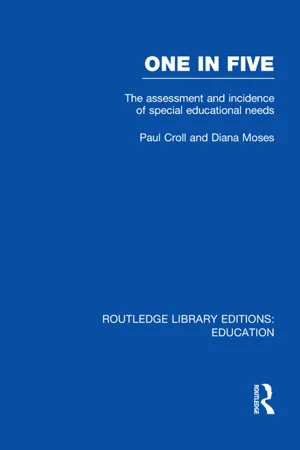
At the time of its original publication this book was the first major survey of the nature of the difficulties that children with special educational needs experience in the classroom context of mainstream junior schools. The book is based on research involving interviews with heads and teachers, and on extensive observation of children in junior classrooms. The research is related to the report of the Warnock Committee and to problems of definition and assessment in the area of special education. The book describes the views which junior school teachers have of special educational needs and the numbers of children and types of difficulty they regard as falling into this category. It discusses the classroom behaviour and interactions of children with special needs, and some of the consequences of different teaching strategies. It also presents information on patterns of provision for special needs, assessment in the junior classroom and the teachers' own views on integration.
eBook - ePub
One in Five (RLE Edu M)
The Assessment and Incidence of Special Educational Needs
- 16 pages
- English
- ePUB (mobile friendly)
- Available on iOS & Android
eBook - ePub
One in Five (RLE Edu M)
The Assessment and Incidence of Special Educational Needs
About this book
Information
1 Introduction
The Warnock Report
The publication of the Warnock Report in 1978 was a major landmark in the development of thinking about special education in Britain. The ideas and recommendations contained in the Report have informed all subsequent debate in the area and are fundamental to the research reported here. Through the incorporation of many of the Warnock recommendations in the 1981 Education Act they have also influenced the statutory framework within which the education system operates. The content of the Report is best seen as part of a development of current thinking rather than a new departure in the field of special education. It incorporates much of current thinking in the area, and many of the suggestions in the Report embody the best of current practice. What is new in the Warnock Report, however, is the way that special education is extended in scope and is made of central concern to the educational system generally. It is seen as something relevant to all schools and all teachers, rather than as a separate part of the system and the concern of a limited number of specialists. This wider concept of special education provides the context of the research reported here.
The title of the Committee, ‘Committee of Enquiry into the Education of Handicapped Children and Young People’, derives from the traditional notion of special education as involving a small, distinct and relatively easily identifiable group of handicapped children. These were children who fell into one of the ten statutory categories of handicap; blind pupils, partially sighted pupils, deaf pupils, partially hearing pupils, educationally subnormal pupils, epileptic pupils, maladjusted pupils, physically handicapped pupils, pupils suffering from a speech defect and delicate pupils (DES, 1978, p. 380). At the time of the publication of the Warnock Report, 1.8 per cent of the school population was in one of these categories, educated, for the most part, in special schools. By far the largest group consisted of pupils classified as educationally subnormal. This category was further divided into educationally subnormal (severe) and educationally subnormal (moderate), most children falling into the moderate, ESN(M) category. The next largest category of handicap was that of maladjusted pupils.
Children placed in one of these categories have usually been educated at an appropriate special school. In the case of children with very severe handicaps, this special school placement is likely to have resulted from their early contact with medical services, but for most children the referral for special education is likely to have arisen from their experience at school. Particularly in the case of children classified as educationally subnormal (moderate) and those classified as maladjusted, special schooling has normally been preceded by a period in mainstream schooling followed by referral for special education, usually at the initiative of the head teacher. This procedure, which, following the 1981 Act, now includes a statement of the child’s special educational needs, involves the school medical officer and, in particular, an educational psychologist.
The period leading up to the Warnock Report saw a growing movement in educational thinking towards bringing special education out of its isolation. In particular, there was an emphasis on the value and feasibility of educating handicapped children in ordinary schools alongside their non-handicapped peers. This process, known in Britain as ‘integration’, has been the focus of a recent research project conducted by the National Foundation for Educational Research which documents a number of instances of the integration of children from the old statutory categories into ordinary schools (Hegarty and Pocklington, 1981a, 1981b). This gradual inclusion of the handicapped in normal schooling is part of a general tendency within western educational systems. Perhaps the best known and most influential example is Public Law 94–142, which eventuated in integration programmes (known as ‘mainstreaming’) in the United States. A number of examples of the integration of the handicapped in Europe are given by Hegarty and Pocklington (1981a, pp. 20–30). The Warnock Report supports this move towards integration while recognising the difficulties involved and the improvement in special educational provision in ordinary schools which will be necessary. Further integration is seen in the Report as a long-term development for which careful planning will be necessary.
There is, however, a substantial change proposed in the Report and now incorporated into the 1981 legislation with regard to this small group of handicapped children, namely the proposal to abolish the ten statutory categories of handicap and replace them with the notion of ‘special educational needs’. The Report argues that to classify children in terms of the nature of their handicaps is inadequate and sometimes misleading, partly because many handicapped children have more than one handicap, and that which is the major handicap from a medical point of view may not be that which is most relevant to their educational problems. Additionally, however, the new terminology focuses attention on the child’s educational needs rather than on the disabilities from which he or she suffers. The Report suggests that in future handicapped children should be assessed in terms of the special educational provision they require, rather than categorised according to the nature of their handicaps. These recommendations were included in the 1981 Education Act and in the circular of guidance to local education authorities which followed it.
Even more fundamental, however, was the proposal in the Report that the concept of special educational needs should apply to a very much larger proportion of the school population than had previously been regarded as in need of special education. The Report argued that there was not a distinct group of children with special educational needs corresponding approximately to the children in the old categories of handicap, but that special educational needs should be regarded as a continuum which should extend from pupils currently in special schools to include a substantial number of children in ordinary schools who had educational difficulties requiring some form of special treatment. For example, the Committee proposed that the old statutory category, ‘educationally subnormal’, in which about two-thirds of children in special education are placed, should be replaced by the term ‘children with learning difficulties’, and that this term should be used ‘to describe both those children who are currently categorised as educationally subnormal and those with educational difficulties who are often at present the concern of remedial services’ (DES, 1978, p.43).
Basing its estimate on various epidemiological studies of children’s difficulties, principally the research conducted in the Isle of Wight (Rutter, Tizard and Whitmore, 1970) and the research conducted by the National Children’s Bureau (Pringle, Butler and Davie, 1966), the Report concluded:
The planning of services for children and young people should be based on the assumption that about one in six children at any time and up to one in five children at some time during their school career will require some form of special educational provision.
Special needs and the ordinary school
The introduction of this ‘broad concept’ of special educational needs has considerable implications for the educational system and for all schools and teachers. It helps to break down the barriers between special and mainstream education by its double emphasis, on not only the kind of educational provision necessary for handicapped children but also the need experienced by a great many children for special educational help of some kind. The ‘broad concept’ insists that a concern with special educational needs should be a central feature of the educational system, a point which, as the Report clearly recognises, has considerable implications for teachers in ordinary schools:
This [the broad concept of special needs] means that a teacher of a mixed ability class of thirty children even in an ordinary school should be aware that possibly as many as six of them may require some form of special educational provision at some time during their school life and about four or five of them may require special educational provision at any given time (p. 41).
The notion of special needs contained in the Warnock Report rests on an educational judgment about the sort of provision which particular children require and the extent to which the ‘specialness’ of the provision made for a particular child goes beyond the variation in approach which will occur between any two children. These are judgments which will be made for the most part by ordinary teachers in ordinary classrooms. Whether children are subsequently referred for special help outside the school, receive additional help in the school or stay in the classroom for their needs to be met by the regular teacher, class teachers will be responsible for making the initial assessment. The obligation on the class teacher to perceive and initiate remedial treatment of learning difficulties at an early stage was emphasised by the Warnock Committee:
Since the large majority of children who are likely to require special educational provision will manifest their difficulties for the first time in school, they will have to be identified. Close and continuous observation of all children by their teachers is therefore essential and for this to be effective teachers must be equipped to notice signs of special need. Moreover, having noticed such signs in a child they must appreciate the importance of early assessment of these needs and must know when and where to refer for special help.
The problem, however, is not simply one of equipping teachers to notice the signs of special need but in deciding of what such signs actually consist. Teachers have not been given a clear functional description of what constitutes special need against which they can assess particular children. Consequently, such judgments are likely to be made by teachers in a variety of ways and are likely to be influenced not only by levels of performance and types of behaviour of individual children but also by such factors as the child’s relative standing among his classmates, the teacher’s own expectations, knowledge and attitudes with regard to special needs, and institutional factors such as school and local authority policy and provision in this area.
The extent of provision for special educational needs is obviously crucially important. The Warnock Committee defines children as having special needs if it is necessary that special provision should be made for them, and this definition is also included in the 1981 Education Act: ‘For the purposes of this Act a child has special educational needs if he has a learning difficulty which calls for special educational provision to be made for him.’ Special educational provision for a child is defined in the Act as ‘educational provision which is additional to, or otherwise different from, the educational provision made generally for children of his age in schools maintained by the local education authority concerned’. It is, however, far from clear that the relationship between needs and provision is as straight-forward as this suggests. A direct relationship between needs and provision would imply that needs are absolute and that provision could be evaluated in terms of how adequately it met them. It seems more likely that there is an inter-relationship between the needs and provision in the area of special education, particularly when the notion of special education is extended to the point where it applies to perhaps a fifth of the school-age population. Assessment of the needs of these children will probably be influenced by the nature and extent of provision available. Consequently, it is necessary to see provision not only as a response to teacher assessments but as one of the factors which may influence them.
The ‘broad concept’ of special educational needs contained in the Warnock Report and the explicit responsibilities placed on schools and local authorities by the legislation which followed the Report imply a new way of looking at problems which have always been the concern of the mainstream of the school system. The difficulties experienced by a substantial minority of pupils have not changed following the Warnock Report, and schools have always had a responsibility to offer appropriate education to all their pupils. It may also be that in many cases the ways in which schools defined and met the difficulties of their pupils already involved the principles contained in the Warnock Report and the 1981 Act, and that what is needed is an extension of the best practice rather than an entirely new approach.
Although, as has been suggested above, the ‘newness’ of the Warnock approach should not be over-emphasised, there is no doubt that the approach does present teachers, schools and others concerned in education with difficulties of both a practical and logical kind. There is evidence that this is an area of their work in which teachers do not feel themselves well equipped by their training. In a recent survey of primary teachers in Nottinghamshire, Bassey found that 60 per cent thought their training had been ‘inadequate’ in helping them to deal with slow learners and only 13 per cent thought it had been ‘good’. Of twenty-two areas of primary education, only in the area of teaching gifted children was the training rated as less satisfactory than in that of teaching slow learners. The area in which the next highest level of dissatisfaction occurred was the teaching of reading: here 50 per cent thought their training had been ‘inadequate’ (Bassey, 1981). Of the teachers interviewed in the present study, 60 per cent said they had received no special training in the teaching of reading, even during their initial training, and 80 per cent said they had received no special training in the area of special educational needs. The difficulties which teachers can experience in this area are illustrated by a study of an in-service programme on special educational needs conducted as part of the present research. When presented with a checklist relating to children’s skills, teachers initially thought that they could complete it rapidly for certain children in their class. They later reported, however, that they did not know the children’s strengths and weaknesses as well as they had thought and that they had had to devise procedures for learning about them (Brooks, 1983).
The present research
The research reported here addresses itself to two major themes: the extension of the concept of special educational needs to include up to a fifth of the school population, and the central role of the ordinary class teacher in this process. More specifically, the project was particularly concerned with the ways in which junior-school teachers assess pupils in their classes as having special educational needs, and the incidence of special educational needs consequent upon these assessments.
The restriction of the research to the junior age range (in Britain, children aged seven to eleven) was partly a question of the availability of resources but also arises from the particular importance of the relationship between the teacher and her class in the primary school, where a child is normally taught for a year by a single teacher. The problems associated with initial assessments of children when they come into the infant school are beyond the scope of the present study.
A full description of the research procedures is given in the Appendix, but a brief account will also be presented here. The study can be divided into two main aspects, a survey of teachers and a study of children. For the survey of teachers, personal interviews were carried out with a sample of 428 junior-class teachers in 61 schools selected at random in 10 local education authorities across the country. These interviews lasted about an hour and dealt with the teachers’ assessments of the special educational needs of pupils in the classes, testing and record-keeping procedures they used, contact with outside specialist agencies such as the School Psychological Service and experience of, and attitudes to, the integration of handicapped children in the ordinary classroom. Interviews were also carried out with the head teachers and remedial teachers in these schools.
The study of children concentrated on thirty-four second-year junior classes (children aged eight to nine). In these classes, information was gathered from the teacher about the special educational needs of the pupils, and tests of reading and of non-verbal reasoning were carried out. Following this, a sample of children identified as having special educational needs and a control sample of other children were selected for systematic observation. An observer, a member of the research team, spent about two weeks in each classroom using an observation system to record children’s activities and interactions at ten-second intervals. This part of the research made it possible to relate teacher assessments of pupils to aspects of their performance and behaviour.
The approach to special educational needs adopted in the research and carried out in the manner outlined above was designed to explore two aims: first, the central role of the classroom teacher in assessing and meeting special educational needs, and, second, the influence upon our view of special educational needs that is exerted by the teacher’s approach to the task. Having established a pattern of special educational needs based on teacher assessment, the research then considers factors which underlie these assessments. These include characteristics of the children being assessed, but may also involve characteristics of the teacher and of institutional factors related to the school and local authority.
The chapters which follow begin with an analysis of special educational needs as identified by the teachers and then move on to consider other sorts of information about children and their difficulties. Chapter 2 gives a brief look at some background issues. Chapter 3 deals with the assessments teachers make of the special educational needs of their pupils. This chapter is central to the research project as it shows the incidence of various kinds of special needs as they emerge from teacher assessments, which can be compared with the incidence of special needs assumed in the Warnock Report. The two subsequent chapters will deal with teachers’ views: Chapter 4 considers teachers’ views on the causes of children’s difficulties, and Chapter 5 looks at teacher attitudes towards the integration of handicapped children in the regular classroom. Later chapters go beyond teacher views and teacher assessments and look at other characteristics of pupils and of schools and classrooms. Chapter 6 relates the teachers’ assessments to pupil scores on reading tests and to other pupil characteristics. Chapter 7 details the extent of testing procedures of various kinds in junior classrooms, and Chapter 8 deals with the extent and organisation of provision for children with special educational needs. Chapters 9 and describe the classroom activities and interactions of children with special educational needs compared with those of other children in the class. Finally, Chapter 11 summarises the results and their implications, and there is an Appendix containing details of the research design and data-gathering procedures.
Any research project faces something of a problem in trying to discuss issues of general educational relevance from research conducted at a particular point in time, and this problem is particularly acute in the case of the present research. The data collection was conducted after the publication of the Warnock Report, while the 1981 Education Act was before Parliament but before the circular of guidance to local authorities on the implementation of the Act was issued. As a result we have problems of terminology. For instance, discussions with teachers about integration were formulated in terms of...
Table of contents
- Cover
- Halftitle
- Title
- Copyright
- Contents
- Foreword
- Acknowledgments
- 1. Introduction
- 2. Some background issues
- 3. The teacher’s view of special educational needs in the junior classroom
- 4. Teachers’ views on the aetiology of special educational needs
- 5. Attitudes towards integration
- 6. Reading achievement and teacher assessment
- 7. Testing and assessment in junior classrooms
- 8. Provision
- 9. Pupils and teachers in the classroom
- 10. Other aspects of classroom behaviour and special educational needs
- 11. Summary and implications
- Appendix: Research design, sampling and analysis
- Bibliography
- Index
Trusted by 375,005 students
Access to over 1.5 million titles for a fair monthly price.
Study more efficiently using our study tools.
Frequently asked questions
Yes, you can cancel anytime from the Subscription tab in your account settings on the Perlego website. Your subscription will stay active until the end of your current billing period. Learn how to cancel your subscription
No, books cannot be downloaded as external files, such as PDFs, for use outside of Perlego. However, you can download books within the Perlego app for offline reading on mobile or tablet. Learn how to download books offline
Perlego offers two plans: Essential and Complete
- Essential is ideal for learners and professionals who enjoy exploring a wide range of subjects. Access the Essential Library with 800,000+ trusted titles and best-sellers across business, personal growth, and the humanities. Includes unlimited reading time and Standard Read Aloud voice.
- Complete: Perfect for advanced learners and researchers needing full, unrestricted access. Unlock 1.5M+ books across hundreds of subjects, including academic and specialized titles. The Complete Plan also includes advanced features like Premium Read Aloud and Research Assistant.
We are an online textbook subscription service, where you can get access to an entire online library for less than the price of a single book per month. With over 1.5 million books across 990+ topics, we’ve got you covered! Learn about our mission
Look out for the read-aloud symbol on your next book to see if you can listen to it. The read-aloud tool reads text aloud for you, highlighting the text as it is being read. You can pause it, speed it up and slow it down. Learn more about Read Aloud
Yes! You can use the Perlego app on both iOS and Android devices to read anytime, anywhere — even offline. Perfect for commutes or when you’re on the go.
Please note we cannot support devices running on iOS 13 and Android 7 or earlier. Learn more about using the app
Please note we cannot support devices running on iOS 13 and Android 7 or earlier. Learn more about using the app
Yes, you can access One in Five (RLE Edu M) by Paul Croll,Diana Moses in PDF and/or ePUB format, as well as other popular books in Education & Education General. We have over 1.5 million books available in our catalogue for you to explore.