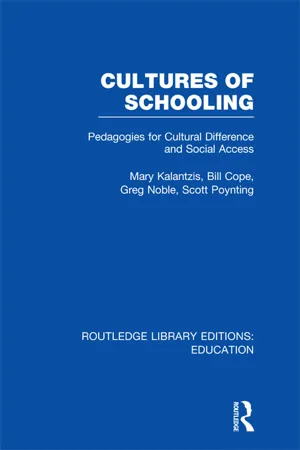
This volume examines the ways schools respond to cultural and linguistic diversity. A richness of accumulated experience is portrayed in this study of six Australian secondary schools; partial success, near success or instructive failure as the culture of the school itself was transformed in an attempt to meet the educational needs of its students. Set in the context of a general historical background to the development of multicultural education in Australia, a theoretical framework is developed with which to analyze the move from the traditional curriculum of cultural assimilation to the progressivist curriculum of cultural pluralism. The book analyzes the limitations of the progressivist model of multicultural education and suggests a new 'post-progressivist' model, in evidence already in an incipient and as yet tentative 'self-corrective' trend in the case-study schools.
eBook - ePub
Cultures of Schooling (RLE Edu L Sociology of Education)
Pedagogies for Cultural Difference and Social Access
- 4 pages
- English
- ePUB (mobile friendly)
- Available on iOS & Android
eBook - ePub
Cultures of Schooling (RLE Edu L Sociology of Education)
Pedagogies for Cultural Difference and Social Access
About this book
Information
Chapter 1
Introduction
Setting the Scene: Servicing Cultural and
Linguistic Diversity in Australia
Australia is the site of a quite remarkable social experiment. In just over four decades since the post-war immigration programme began, the Australian population has more than doubled, from 7.5 million in 1947 to 16 million by the mid-1980s. Without immigration, given the birth rates of the native born, the Australian population would now be only about 11 million. This in itself is not remarkable. Mass migration has been one of the most important historical features of the era of global industrialization, from the country to the city, the developing to the developed world, from points of crisis to points of quieter affluence. But, in a half century when global mobility has been greater than ever before, Australia's immigration programme has been greater than that of any first world country relative to the size of the existing population, bar the peculiar historical phenomenon of the establishment of the state of Israel in British Mandated Palestine.1
The diversity of Australia's post-war immigrant intake is also remarkable. Ostensibly, the first Minister for Immigration, Arthur Calwell, intended that mainly English-speaking immigrants come from the British Isles. This fitted with the official policy of assimilation, in which those people least likely to appear different in cultural and linguistic terms were to be encouraged as ideal immigrants and non-English speakers were to become ‘normal’, unaccented English-speaking Australians by the second generation. In fact, this prescription for cultural and linguistic homogeneity was immediately unworkable, even in the late 1940s, and the historical evidence shows that Calwell knew it despite much of the public rhetoric.2 As insufficient British immigrants could be recruited, a large emphasis was placed on recruiting refugees from Northern and Central Europe. During the 1950s and 1960s, recruitment was increasingly from Southern Europe — again, very much determined by the availability of suitable immigrants. During the 1970s, with the ‘economic miracle’ in Europe, the net had to be spread still further, to include Middle Eastern countries, particularly Turkey and Lebanon, then South and Central America. From the mid-1970s an increasing number of Indo-Chinese came to Australia, many as refugees. This was nominally the result of an international humanitarian obligation and a by-product of Australia's involvement in the Vietnam War. In reality, considerable diplomatic pressure was brought to bear upon Australia by front-line South East Asian countries with a serious refugee problem, and the Australian government perceived a need to avert the possibility of a large-scale arrival of ‘boat people’ on the shores of Northern Australia.3
Thus, although the original official intention of Australia's post-war immigration programme had been cultural and linguistic homogeneity, the end result has been extraordinary diversity. As well as about 150 extant Aboriginal languages, there are now over 100 immigrant ethnic groups, speaking about 80 different languages. Over 25 per cent of the population in 1988 was of non-English speaking background (NESB).4 Of the two million Australians who reported in the 1986 Census that they spoke a language other than English at home, 20.6 per cent spoke Italian, 13.6 Greek, 6.7 per cent a Chinese language, 5.6 per cent German and 5.4 per cent Arabic; Spanish, the various Yugoslav languages, Polish, Dutch, Vietnamese, Maltese, French, Macedonian, Aboriginal languages, Turkish, Hungarian and Russian each scored between 1 and 5 per cent; and a very large proportion of 14.4 per cent were ‘other’ languages, each with less than 1 per cent representation per language.5
Numbers and diversity alone, however, do not justify the claim that this continent is the site of a remarkable social experiment. Immigrants have officially been encouraged to come and become citizens, not guestworkers. Unlike other countries whose immigrant recruitment was largely for labour force reasons, Australia's immigration involved population building and thus permanent settlement. Later this reality came to be forced upon countries with temporary guestworker programmes, despite their intentions. A succession of sophisticated settlement policies were orchestrated by the Australian federal government for two purposes: to reduce the social cost of return migration and to ‘sell’ mass immigration to the existing population — a population which in 1947 was 90 per cent Australian born, almost exclusively Anglophone, and harbouring a vigorous history of racism.
The history of these policies — from the assimilation policy of the 1940s to the 1960s, then integration, and, most recently, multiculturalism since the late 70s — is complex, subtle, and of immense historical importance. If one overarching assessment of these programmes can be made, it is that, on their own terms, they have been extremely successful. For immigrants, there has been a degree of upward social mobility, perhaps not always commensurate with their aspirations but at least as significant as that found in any other country at a similar stage of economic development.6 In broader social terms, one of the world's most homogeneous societies, culturally insular and racist, has been peacefully transformed into one of the most diverse. The extraordinary sense of quiet on this continent belies an experience of world historical significance in the pace and extent of population change. The fact that change on this scale was effected in so few decades and the quiet maintained, history having been made almost behind the backs of its population, itself attests to the sophistication, creativity and adaptiveness of the succession of government policies dealing with cultural and linguistic diversity.7 Australia, in this respect, is an important place to look for lessons about social policy and practice relating to immigration and settlement.
This book documents this historical achievement on one social site only — schooling. Education, in fact, happens to be an extraordinarily significant site. It is compulsory. It is the place where the state, as nation builder and maker of national identity, can play its most deliberate, systematic and sustained socializing role. It is a place where the state can be creating the cultural conditions for peaceful social change rather than reactively patching up popular resistances to change. In fact, at each stage in the development of Australian policy, the state has always seen education this way: as one of the most important places where the real work of assimilation, or integration or multi-culturalism — whatever the policy at the time happened to be — took place.
Perhaps ironically, recently vocal opponents of multicultural education cite the social mobility of immigrants as a reason to scrap specialist programmes. Immigrants do not seem to need, so these opponents argue, the special treatment and additional government expense. Ethnic minorities have their own particular sense of commitment, closely bound into the migration process itself, manifest in the ‘ethnic success ethic’ or ‘ethnic work ethic’. It is argued that these factors, extraneous to institutionalized education, mean that specialist servicing such as multicultural education is unnecessary. These critics, in other words, advocate a laissez faire approach to the interaction of processes of immigration/settlement and education.8
Critical to the story of mobility, however, has been the success of education systems in meeting the special needs of immigrant students, in part through precisely those special programmes which the new critics of multicultural education seek to abandon. Rather ironically, it is precisely the interventionary role taken by Australian governments, not just in education but in all areas of social policy, that has made the social changes wrought upon Australian society by mass immigration so peaceful, despite the cultural proclivities of the native born population in 1947, despite the extent of the changes, and despite the inherent structural difficulties of incorporating labour migrants in such a way that they do not form a permanently ghettoized underclass. Whatever their weaknesses, federal government policies of assimilation, followed by policies of integration and then of multiculturalism, were extremely active and effective processes of state intervention, almost always ahead of public opinion in their historical vision, and taking an educative stance even in relation to ‘educated’, seemingly professional and ‘expert’ service providers, such as state education authorities and teachers. Most importantly, these policies have never been static. Assimilation, for example, was a necessary story to tell a population about to face mass labour immigration, but with a powerful, popular tradition of economically-based racism. But the architects of mass immigration knew right from the start that the immigration programme would inevitably bring with it cultural diversity which could not be erased by fiat of a policy of assimilation. Assimilation was therefore an extremely effective step in creating a culturally and linguistically diverse society, and its success was its own peaceful supersession by integration and multiculturalism.9 Similarly, today, multiculturalism is an unfinished historical process, visionary and historically active, yet ridden with limitations and inherent difficulties upon which its practitioners work creatively in their daily activity.
Despite the effective role of education, for example, in creating lasting social, cultural and linguistic change in Australia, there are still critical issues to be tackled. The positive social effects of education are distributed unevenly among ethnic groups. And even when educational attainments are statistically positive for any one ethnic group, generalization about the performance of students of particular ethnic groups ignores the fact that each group is itself deeply divided socioeconomically and by school performance. Even if one small stratum is making it through to higher education at a rate marginally more than average, the majority may still be having difficulties specific to their minority cultural and linguistic status in Australia in which their background plays a contributing part. Moreover, first generation immigrants enjoy substantially less social mobility through education than the second generation.10 And the cultural and linguistic content of curriculum is an issue that all Australian schools need to face all the time. These are just a few of the nagging questions that face those dealing with cultural and linguistic diversity in Australian education.
Thus this book is a critical documentation of an evolving social project. Australia might in some respects lead the world in the development of multicultural education policies and practices, yet this means more than ever that we must evaluate our ongoing failings, as lessons to be learnt before taking the next step. There are no lessons for direct export, which can be happily duplicated elsewhere. But there are experiences of partial success and a constructive approach to failure that might be very useful.
A Focus on Innovation
The research project ‘Education and Cultural and Linguistic Pluralism: Innovative Schools’ (ECALP), upon which this book is based, was devised by the Centre for Educational Research and Innovation (CERI) in the Organization for Economic Cooperation and Development (OECD). A number of OECD member countries is involved in a parallel programme of research, employing a common methodology centred around a case-study protocol. The Australian component of the project was initated and subsequently funded by the Australian Advisory Council on Languages and Multicultural Education (AACLAME) which operates under the National Policy on Languages. The Australian fieldwork and reporting has been undertaken by the Centre for Multicultural Studies at the University of Wollongong, New South Wales.
The objectives of the overall project were expressed by CERI/OECD as follows:
The purpose of this project is to study innovation strategies which have resulted in particularly successful forms of education for the children of immigrants or ethnic minority groups. Through case studies of innovations in OECD member countries, approaches proven to be successful in a variety of settings will be identified and the common conditions under which the approaches have succeeded will be described and analysed.
The detailed analysis of the innovations is likely to be of interest to all those who are involved in multicultural education. It will draw attention to some effective and exemplary practices and also identify useful criteria for the formulation of new policies in this area. In assembling case studies from a number of countries, the project seeks to go beyond the narrow circumstances reflected in a particular educational system or country setting. In this way, the conditions under which innovations succeed may be revealed more clearly, even amplified.
A case study approach is especially well suited to the goals of the project, since inclusion in the sample is dictated by the uniqueness or creativity of the approach rather than on the number of such cases. The multi-site case study strategy adopted for the project is unique in that, while the case studies are guided by the overall objectives of the CERI project, the design allows for case studies of quite different types of innovations. As a result, the individual case studies will have in common those aspects necessary to permit comparisons across cases,...
Table of contents
- Front cover
- Half Title
- Title Page
- Copyright
- Title Page
- Copyright
- Contents
- Acknowledgments
- Foreword
- Chapter 1 Introduction
- Chapter 2 A Systems Perspective
- Chapter 3 A Mission of ‘Empowerment’: The Community Liaison Program at MacKillop Girls’ High School
- Chapter 4 ‘Australian is a Wide Word’: The Bilingual ‘ESSPRO’ and Languages Other Than English Programs at Brunswick East High School
- Chapter 5 ‘Different Paths We’ll Tread’: The Translators’ and Interpreters’ Course at Burwood Girls’ High School
- Chapter 6 ‘Two Steps Forward, One Step Back’: The Bilingual and Languages Other Than English Programmes at Collingwood Education Centre
- Chapter 7 ‘A Place in the World’: The Language in Learning Program and the Intensive Language Unit at Cabramatta High School
- Chapter 8 ‘Culture Cocktail’: The English as a Second Language and Languages Other Than English Programmes at Footscray High School
- Chapter 9 Conclusions: Pedagogies for Cultural Difference and Social Access
- Bibliography
- Index
Trusted by 375,005 students
Access to over 1.5 million titles for a fair monthly price.
Study more efficiently using our study tools.
Frequently asked questions
Yes, you can cancel anytime from the Subscription tab in your account settings on the Perlego website. Your subscription will stay active until the end of your current billing period. Learn how to cancel your subscription
No, books cannot be downloaded as external files, such as PDFs, for use outside of Perlego. However, you can download books within the Perlego app for offline reading on mobile or tablet. Learn how to download books offline
Perlego offers two plans: Essential and Complete
- Essential is ideal for learners and professionals who enjoy exploring a wide range of subjects. Access the Essential Library with 800,000+ trusted titles and best-sellers across business, personal growth, and the humanities. Includes unlimited reading time and Standard Read Aloud voice.
- Complete: Perfect for advanced learners and researchers needing full, unrestricted access. Unlock 1.5M+ books across hundreds of subjects, including academic and specialized titles. The Complete Plan also includes advanced features like Premium Read Aloud and Research Assistant.
We are an online textbook subscription service, where you can get access to an entire online library for less than the price of a single book per month. With over 1.5 million books across 990+ topics, we’ve got you covered! Learn about our mission
Look out for the read-aloud symbol on your next book to see if you can listen to it. The read-aloud tool reads text aloud for you, highlighting the text as it is being read. You can pause it, speed it up and slow it down. Learn more about Read Aloud
Yes! You can use the Perlego app on both iOS and Android devices to read anytime, anywhere — even offline. Perfect for commutes or when you’re on the go.
Please note we cannot support devices running on iOS 13 and Android 7 or earlier. Learn more about using the app
Please note we cannot support devices running on iOS 13 and Android 7 or earlier. Learn more about using the app
Yes, you can access Cultures of Schooling (RLE Edu L Sociology of Education) by Mary Kalantzis,Bill Cope,Greg Noble,Scott Poynting in PDF and/or ePUB format, as well as other popular books in Pedagogía & Educación general. We have over 1.5 million books available in our catalogue for you to explore.