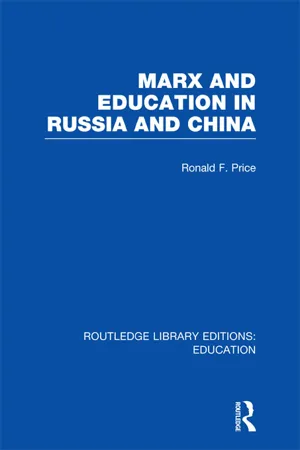
To many education students, Russian and/or Chinese education is at the same time their introduction to Marxism, and many students go no further. This book sets the record straight by giving a thorough introduction to the writings of Marx himself as they relate to education. It shows what Marxism implies for education, as aim, method and content. It then proceeds to compare educational developments in the former USSR and China in the light of this analysis, attempting to answer the question as to how Marxist this has been, in the schools and outside them.
- 4 pages
- English
- ePUB (mobile friendly)
- Available on iOS & Android
eBook - ePub
Marx and Education in Russia and China (RLE Edu L)
About this book
Information
1 MARX AND EDUCATION
Man, Alienation and the Vision of Communism
While marxism is not a humanism in the sense of assuming the theoretical priority of man over society, its raison d’etre is a concern with man's potential, both as individual and group. In that famous early statement, The German Ideology, where Marx and Engels clarified their views in a criticism of the Young Hegelians and contemporary Utopian socialists, they wrote:
The premises from which we begin are not arbitrary ones, not dogmas, but real premises from which abstraction can only be made in the imagination. They are the real individuals, their activity and the material conditions under which they live, both those which they find already existing and those produced by their activity. (GI, p. 31)
In everything Marx wrote, whether the early Economic and Philosophic Manuscripts of 1844 or the Capital (1867) of his maturity, there is protest against the present state of man and affirmation of belief in his future. The object of his prodigous labours was an attempt to understand the world in order to change it.
In a number of famous passages Marx compares man with other animals and brings out his peculiarly human characteristics. In the Feuerbach section of The German Ideology he and Engels wrote:
Men can be distinguished from animals by consciousness, by religion or anything else you like. They themselves begin to distinguish themselves from animals as soon as they begin to produce their means of subsistence, a step which is conditioned by their physical organization. By producing their means of subsistence men are indirectly producing their actual material life. (GI, p. 31)
In the Economic and Philosophic Manuscripts, where he used Feuerbach's concept of species being to refer to those qualities which were uniquely human (Oilman, p. 84) Marx developed the vision of man as having ‘free, conscious activity’ as his ‘species character’, a vision which is important for education. He wrote:
in the first place labour, life-activity, productive life itself, appears to man merely as a means of satisfying a need–the need to maintain the physical existence. Yet the productive life is the life of the species. It is life-engendering life. The whole character of a species–its species character–is contained in the character of its life-activity, and free, conscious activity is man's species character …
In creating an objective world by his practical activity, in working-up, inorganic nature, man proves himself a conscious species being, i.e., as a being that treats the species as its own essential being, or that treats itself as a species being. Admittedly animals also produce. They build themselves nests, dwellings, like the bees, beavers, ants, etc. But an animal only produces what it immediately needs for itself or its young. It produces one-sidedly, whilst man produces universally. It produces only under the dominion of immediate physical need, whilst man produces even when he is free from physical need and only truly produces in freedom therefrom. An animal produces only itself, whilst man reproduces the whole of nature. An animal's product belongs immediately to its physical body, whilst man freely confronts his product. An animal forms things in accordance with the standard and the need of the species to which it belongs, whilst man knows how to produce in accordance with the standard of every species, and knows how to apply every-where the inherent standard to the object. (EPM, pp. 75-6)
In creating an objective world by his practical activity, in working-up, inorganic nature, man proves himself a conscious species being, i.e., as a being that treats the species as its own essential being, or that treats itself as a species being. Admittedly animals also produce. They build themselves nests, dwellings, like the bees, beavers, ants, etc. But an animal only produces what it immediately needs for itself or its young. It produces one-sidedly, whilst man produces universally. It produces only under the dominion of immediate physical need, whilst man produces even when he is free from physical need and only truly produces in freedom therefrom. An animal produces only itself, whilst man reproduces the whole of nature. An animal's product belongs immediately to its physical body, whilst man freely confronts his product. An animal forms things in accordance with the standard and the need of the species to which it belongs, whilst man knows how to produce in accordance with the standard of every species, and knows how to apply every-where the inherent standard to the object. (EPM, pp. 75-6)
But labour is not only a process of creation, but of self-creation in which man is also his own educator.
Labour is, in the first place, a process in which both man and Nature participate, and in which man of his own accord starts, regulates, and controls the material re-actions between himself and Nature. He opposes himself to Nature as one of her own forces, setting in motion arms and legs, head and hands, the natural forces of his body, in order to appropriate Nature's productions in a form adapted to his own wants. By thus acting on the external world and changing it, he at the same time changes his own nature. He develops his slumbering powers and compels them to act in obedience to his sway. (Capital I, pp. 197-8, emphasis added)
In the Economic and Philosophic Manuscripts he gives Hegel the credit for this understanding:
Hegel conceives the self-creating of man as a process, … he thus grasps the essence of labour and comprehends objective man–true, because real man–as the outcome of man's own labour. (EPM, p. 177)
In 1845, in the third thesis on Feuerbach, Marx referred specifically to education. The materialism he criticises here is the French variety mentioned in The Holy Family (HF, pp. 175-6).
The materialist doctrine concerning the changing of circumstances and upbringing forgets that circumstances are changed by men and that it is essential to educate the educator himself. This doctrine must, therefore, divide society into two parts, one of which is superior to society.
The coincidence of the changing of circumstances and of human activity or self-changing can be conceived and rationally understood only as revolutionary practice. (GI, p. 660)
The same passage in Capital quoted above goes on to set man's peculiar creativity in the historical context of nineteenth-century capitalist society. Enjoyment, which as Timpanaro today stresses is ‘the basis of all scientific systems of ethics’ (Timpanaro, pp. 66, 108) is here posed as problematic.
An immeasurable interval of time separates the state of things in which a man brings his labour-power to market for sale as a commodity, from that state in which human labour was still in its first instinctive stage. We presuppose labour in a form that stamps it as exclusively human. A spider conducts operations that resemble those of a weaver, and a bee puts to shame many an architect in the construction of her cells. But what distinguishes the worst architect from the best of bees is this, that the architect raises his structure in imagination before he erects it in reality. At the end of every labour-process, we get a result that already existed in the imagination of the labourer at its commencement. He not only effects a change of form in the material on which he worked, but he also realises a purpose of his own that gives the law to his modus operandi, and to which he must subordinate his will. And this subordination is no mere momentary act. Besides the exertion of the bodily organs, the process demands that, during the whole operation, the workman's will be steadily consonance with his purpose. This means close attention. The less he is attracted by the nature of the work, and the mode in which it is carried on, and the less, therefore, he enjoys it as something which gives play to his bodily and mental powers, the more close his attention is forced to be. (Capital I, p. 198, emphasis added)
In the long chapter on ‘The division of labour and manufacture’ in Capital Marx develops his criticism of the crippling effects of the division of labour, quoting numerous previous writers. He contrasts the ‘intelligence in production’ which is developed in the invention of machines and the organisation of the manufacturing process with the mindless repetitive actions performed by the workers on the bench.
manufacture … converts the labourer into a crippled monstrosity, by forcing his detail dexterity at the expense of a world of productive capabilities and instincts … (Capital I, p. 396)
Machinery is put to a wrong use, with the object of transforming the workman, from his very childhood, into a part of a detail-machine. (Capital I, p. 461)
Writing in the Economic and Philosophic Manuscripts at a time when the official mores demanded saving and abstinence, Marx's discussion of needs applies even more in today's ‘consumer society’ with its compulsion to spend.
Under private property … the increase in the quantity of objects is accompanied by an extension of the realm of the alien powers to which man is subjected, and every new product represents a new potency of mutual swindling and mutual plundering. Man becomes ever poorer as a man. (EPM, p. 115)
Particularly significant is the following condemnation of possession:
Private property has made us so stupid and one-sided that an object is only ours when we have it-when it exists for us as capital, or when it is directly possessed, eaten, drunk, worn, inhabited, etc.,–in short when it is used by us. (EPM, p. 106)
Finally, in considering Marx's conception of man let us turn to some of the passages where he deals directly with the relation between the individual and society. These are of particular interest to us in the USSR and China. In the former ‘society’ has certainly been ‘re-established as an abstraction’, and at least from the thirties through to the late fifties youth were forced to participate in artificially collective activities. Activities by individuals or pairs were condemned as anti-social. In China the problem is more that of the persistence of traditional Confucian collectivities which stifle the individual. The first passage comes from the Introduction to the Critique of Political Economy (1857):
Man is in the most literal sense of the word a zoon politikon, not only a social animal, but an animal which can develop into an individual only in society. Production by isolated individuals outside of society … is as great an absurdity as the idea of the development of language without individuals living together and talking to one another. (CPE, p. 268)
The second comes from the Economic and Philosophic Manuscripts:
Social activity and social consumption exist by no means only in the form of some directly communal activity and directly communal consumption, although communal activity and communal consumption–i.e. activity and consumption which are manifested and directly confirmed in real association with other men–will occur whenever such a direct expression of sociality stems from the true character of the activity's content and is adequate to the nature of consumption.
But again when I am active scientifically, etc.,–when I am engaged in activity which I can seldom perform in direct community with others–then I am social, because I am active as a man. Not only is the material of my activity given to me as a social product (as is even the language in which the thinker is active): my own existence is social activity, and therefore that which I make of myself I make of myself for society and with the consciousness of myself as a social being.
My general consciousness is only the theoretical shape of that of which the living shape is the real community, the social fabric, although at the present day general consciousness is an abstraction from real life and as such antagonistically confronts it. Consequently, too, the activity of my general consciousness, as an activity, is my theoretical existence as a social being.
What is to be avoided above all is the re-establishing of ‘Society’ as an abstraction vis-à-vis the individual. The individual is the social being. His life, even if it may not appear in the direct form of a communal life carried out together with others–is therefore an expression and confirmation of social life. Man's individual life and species life are not different, however much–and this is inevitable– the mode of existence of the individual is a more particular, or more general mode of the life of the species, or the life of the species is a more particular or more general individual life.
Man, much as he may therefore be a particular individual (and it is precisely his particularity which makes him an individual, and a real individual social being), is just as much the totality–the ideal totality–the subjective existence of thought and experienced society present for itself; just as he exists also in the real world as the awareness and the real enjoyment of social existence, and as a totality of human life-activity. (EPM, pp. 104-5)
The link between Marx's view of man and his concept of communism is the controversial concept of alienation, one which perhaps more than any other divides marxists today. Those who have tried to divide Marx into a young humanist and a mature scientist on his use of this concept are clearly factually wrong (McLellan, Grundrisse, pp. 13-14; Mandel, 1971, pp. 163-77; Colletti, 1975 (b)). The terms alienation (Entausserung) or estrangement (Entfremdung) and the related terms, fetishism or reification (Versachlichung, Verdinglichung) occur repeatedly in works ranging from the Economic and Philosophic Manuscripts and The Grundrisse, both, it should be noted, notebooks not intended for publication in their present form, to Capital and Theories of Surplus Value. Serious argument can therefore only be about their meaning and significance.
In the Economic and Philosophic Manuscripts this ‘great synthesizing idea’, as Meszaros calls it (Meszaros, p. 16) occurs in a variety of forms. Man is separated from his work, from his products and from his fellow men. (Allman pp. 133-4; Walton and Gamble, pp. 14-5.) Meszaros adds alienation from nature. (Meszaros, p. 14; cf. Mandel, 1971, p. 165 and his references to A. Schmidt and Marx's concept of nature.) But the seminal idea of human activity becoming separated and appearing a...
Table of contents
- Front Cover
- Halftitle
- Title Page
- Copyright
- Title Page
- Copyright
- Dedication
- Contents
- Foreword
- 1. Marx and Education
- 2. The School System: Part One
- 3. The School System: Part Two
- 4. Education and the Economy
- 5. Labour and Education
- 6. Educating the New, Socialist Man
- 7. The Collective as Educator
- 8. Education and the Social-Political Reality
- Abbreviations
- Bibliography
- Index
Trusted by 375,005 students
Access to over 1.5 million titles for a fair monthly price.
Study more efficiently using our study tools.
Frequently asked questions
Yes, you can cancel anytime from the Subscription tab in your account settings on the Perlego website. Your subscription will stay active until the end of your current billing period. Learn how to cancel your subscription
No, books cannot be downloaded as external files, such as PDFs, for use outside of Perlego. However, you can download books within the Perlego app for offline reading on mobile or tablet. Learn how to download books offline
Perlego offers two plans: Essential and Complete
- Essential is ideal for learners and professionals who enjoy exploring a wide range of subjects. Access the Essential Library with 800,000+ trusted titles and best-sellers across business, personal growth, and the humanities. Includes unlimited reading time and Standard Read Aloud voice.
- Complete: Perfect for advanced learners and researchers needing full, unrestricted access. Unlock 1.5M+ books across hundreds of subjects, including academic and specialized titles. The Complete Plan also includes advanced features like Premium Read Aloud and Research Assistant.
We are an online textbook subscription service, where you can get access to an entire online library for less than the price of a single book per month. With over 1.5 million books across 990+ topics, we’ve got you covered! Learn about our mission
Look out for the read-aloud symbol on your next book to see if you can listen to it. The read-aloud tool reads text aloud for you, highlighting the text as it is being read. You can pause it, speed it up and slow it down. Learn more about Read Aloud
Yes! You can use the Perlego app on both iOS and Android devices to read anytime, anywhere — even offline. Perfect for commutes or when you’re on the go.
Please note we cannot support devices running on iOS 13 and Android 7 or earlier. Learn more about using the app
Please note we cannot support devices running on iOS 13 and Android 7 or earlier. Learn more about using the app
Yes, you can access Marx and Education in Russia and China (RLE Edu L) by R Price in PDF and/or ePUB format, as well as other popular books in Education & Education General. We have over 1.5 million books available in our catalogue for you to explore.