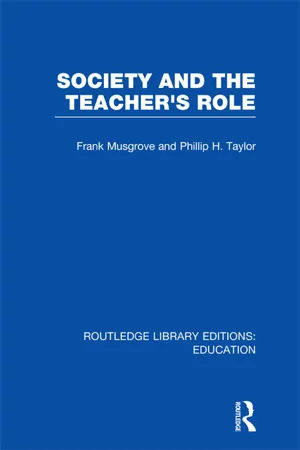
This study describes research into teachers' role conceptions and uncertainties in different types of school and neighbourhood. The authors examine in particular pupils' and parents' conceptions of the teacher's role, and the conflicts which teachers experience when they are exposed to different expectations and demands in a rapidly changing educational and social scene.
- 10 pages
- English
- ePUB (mobile friendly)
- Available on iOS & Android
eBook - ePub
Society and the Teacher's Role (RLE Edu N)
About this book
Information
Chapter One
THE TEACHER AND SOCIETY
THE RISE OF A NEW DESPOTISM
During the past hundred years there has grown up in our midst a new despotism: the rule of the teachers. Today they claim to decide what kind of people we shall be. This is not a joint and generally agreed decision even among the teachers themselves. One school has decided that Englishmen shall be decorous and self-restrained; another that they shall show greater spontaneity, even gaiety; a third that they shall be rooted in the ancient values of their locality; a fourth that they shall have broad horizons, that they shall be ‘universal men’. Curriculum, teaching methods and school organization are shaped to achieve these ends. In order that these, and a thousand others, shall be pursued with all the resources of pedagogic art, it is sufficient that the teachers have decided upon their course.
Even within a given school one teacher may be organizing his work and modifying his methods to produce Englishmen who approximate to the Pueblo Indians: encouraging co-operation and discouraging competition, using group methods, placing stress on creativity, he aims to produce human beings who place the common good above individual reputation. Next door his colleague aims to produce Englishmen who approximate to the Comanches: courageous, individualistic, enterprising, full of dash and initiative. For him mark lists and orders of merit are important instruments of policy; individual work is encouraged; punishment is inflicted to breed stoicism rather than to effect reformation. It is conceivable that the parents of these children want neither Pueblos or Comanches. This is an irrelevance. Only if the children are patently being trained to be neo-Nazis or polygynists would protest be likely or even seem in order.
A school will decide in a hundred ways what kind of human beings to produce: when it decides to run a Scout troop rather than a Combined Cadet Force; to stream or to de-stream; to teach Chinese and Persian or commercial French; to enforce or to abolish school uniform; to have prefects elected or nominated; to let boys sit with girls. These vital decisions – and a thousand others – will be made by the teachers themselves; they need the ratification of no higher authority; they are, in the strict sense, irresponsible. Only those parents who are rich enough to buy their children out of the maintained schools are able to decide, in some measure, what their children shall become.
The new despotism is a century old. It dates, at least in the grammar schools, from the eighteen-sixties. The groundwork for this licence was laid by the Taunton Commission. (In the elementary schools it was delayed by more than a quarter of a century by the Revised Elementary Code and the system of payment-by-results which effectively prescribed the teacher's role. Only the work of the National Union of Elementary Teachers secured for teachers at this level the licence enjoyed by schools at the secondary stage.)
Before the Report of the Schools Inquiry (Taunton) Commission in 1868 – and particularly before the Grammar Schools Act of 1840 – sovereignty in educational affairs resided neither with teachers nor parents, but with the law. The charter of the endowed schools was the legal instrument which defined the teacher's role. Sometimes it was possible to re-interpret the charter or to circumvent it. (The great Victorian headmasters like Arnold and Kennedy had the cunning and ruthlessness to evade their legal responsibilities, though they commonly spent a great deal of time and the wealth of the foundation in prolonged litigation.) In general the law remained inflexible, upheld to the letter by the courts as in the celebrated judgment of Lord Eldon in 1805 concerning the curriculum of Leeds Grammar School. The law could not easily be trifled with and neither parents nor teachers could flout the founder's intention of what should be taught and even how to teach it.
The obligations of schoolmasters both in their general behaviour and the practice of their art were commonly very closely defined. At Oundle ‘Neither the master nor the usher shall be common gamesters, haunters of taverns, neither to exceed in apparel nor any other ways to be an infamy to the school or give evil example to the scholars to whom in all points they ought to show themselves examples of honest, continent and godly behaviour’. At Chigwell Grammar School in Essex the second master must be ‘a man skilful in Greek and Latin tongues, a good poet, of sound religion, neither Papist nor Puritan, of a grave behaviour, of a sober and honest conversation, no tipler or haunter of alehouses, no puffer of tobacco . . .’ The curriculum was usually specified in the same detail as the schoolmaster's qualifications and deportment, even the books which the scholars were to use.
But there was a comparatively easy escape from the tyranny of the law: parents who were rich enough could establish or promote new foundations which conducted themselves and taught subjects as they decreed. The early and mid-nineteenth century was the heyday of the (middle-class) parent for whom a multitude of private and proprietary schools sprang into existence. Even the trustees of grammar schools, powerless to change the legal restrictions imposed by the foundation, opened rival (private) schools in the neighbourhood and guaranteed them a minimum number of pupils. In some cases they even persuaded the schoolmaster to leave the grammar school for the private establishment, exchanging the sovereignty of the law for the sovereignty of parents.1
In the eighteen-sixties there were some 37,000 boys in 542 ancient endowed grammar schools and 30 new endowed grammar schools; some 12,000 boys in 86 new proprietary schools, and probably at least another 40,000 in private schools – excluding the new preparatory schools, which probably contained 7,000 boys. The private schools offered the services which parents defined; the schoolmaster gave proper attention to his clients’ will. He could not flout it by referring to the legal requirements of a charter (though he learned to protect himself behind the regulations of the new public examinations like the Oxford and Cambridge ‘Locals’); he had not yet learned to claim a supreme authority qua teacher.
The new proprietary and private schools promised to inculcate the values and teach the skills and knowledge of which parents approved. Patents who were Roman Catholics, Anglicans, Quakers, Wesleyan Methodists, Primitive Methodists, or Congregationalists, supported new schools which would mould human beings to their specifications. They were not prepared to accept the specifications of any other authority. New private and proprietary schools which tried to dictate their own terms went out of business, as a report from Yorkshire made clear to the Taunton Commission: ‘All the schools which have been established by joint-stock companies, for the promotion of general education, have proved to be financial failures. The only proprietary schools which have succeeded are those founded by religious bodies for the education of their own children.’2 (For further details of the provision of private education in the nineteenth century, see Appendix.)
The Taunton Commission could see no virtue in schools which submitted to parental influence. The great expansion of Victorian private schools suffered from this defect: clients defined the services they required. Although the clients came predominantly from the professional and mercantile classes, their judgment in regard to the education of their own children was not to be trusted: they were so misguided as to want ‘modern’ subjects, even a vocational bias in the curriculum; they had no appreciation of the disciplined mind produced by the Classics:
Now it is quite certain, that it cannot be said, that the majority of parents of the middle classes are really good judges of education . . . of the best means of training the mind, and of strengthening the faculties, they are no judges at all.3
The Taunton Commission referred to middle-class parents with the same tremendous condescension that Mathew Arnold spoke during this period of the ‘Philistines’ in his Culture and Anarchy. They could not be trusted to place sufficient emphasis on ‘the cultivation of the understanding, on the refinement of the thoughts and manners, on what is solid and permanent, rather than on what is showy and transitory . . .’4 Vital decisions about their own children could be made only by the literati, the elect who had been vouchsafed sweetness and light.
It would be absurd to pretend that all, or even most, of the private schools which middle-class parents were supporting in the middle of the century were everything that could be desired. Many were ephemeral, inefficient, inadequately staffed.5 But many private schoolmasters were convinced from the start that the Commission did not approach them with an open mind. As Mr. Stanton reported from the South-West: ‘There was undoubtedly a general impression prevailing among the masters [in private schools] that the inquiry was hostile to their interests. The names of some of the Commissioners were quoted as taking a hostile view. . . .’6
The general verdict of the Taunton Commission in respect of private schools has been accepted at its face value for too long. In passing final judgment on all the evidence they had assembled, even the Commissioners were forced grudgingly to concede that many private schools were not simply good, but of outstanding quality: they specialized in individual tuition, they were flexible in their curricula and organization; they were pioneering advances in educational practices and techniques.7
But these schools were subject to the pressures of parents, and these pressures were invariably ‘in the direction of some special training for an occupation in after life’.8 The endowed schools were protected against their clients, and parents often preferred private schools because ‘they do not like the high and independent line which is taken by a fairly well endowed public school’.9 The Commission was outraged by the report of Mr. Fitch from Yorkshire that in some larger private schools, it seemed, ‘each parent had made a separate contract as to the amount of comfort and attention his child should receive’.10
Mr. Assistant Commissioner Stanton spoke with approval of the headmaster who ‘has no committee to consult for any change he may think requisite. He is a despot within his own limits. To an able man this is an advantage, and all our greatest schoolmasters have been those who have been least interfered with.’11
This was the ideal of the Taunton Commission: the maximum freedom for schoolmasters, the minimum for parents. The latter should have representation on the governing boards of grammar schools, but they should be counterbalanced by other governors ‘appointed on the grounds of their larger knowledge, and to represent education generally’.12 To the headmaster ‘should be assigned all the internal discipline, the choice of books and methods; the organization, and the appointment and dismissal of assistants’.13 And ‘In the internal management as a general rule the less the trustees interfere in the matter the better’.14
In the last two decades of the century Charlotte Mason attempted to rally parents against the new power of the schoolmaster. She rebuked (middle-class) parents for their ‘abdication’,15 and attempted to organize them for effective association in their children's education. The Parents’ National Educational Union (1887) and the ‘House of Education’ (1892) at Ambleside were a recognition of the dethronement of parents and an attempt to secure parental reinstatement.
During the last quarter of the nineteenth century there was one sphere of education (outside the independent schools) in which parents were extremely influential and secured an education for their children which accorded closely with their wishes – in the higher grade schools maintained under the Elementary Code by the larger urban school boards. The boards of the larger cities (established under the Education Act of 1870) were under strong pressure particularly from lower middle-class parents to establish schools with curricula relevant to an industrial and commercial nation.
In 1895 there were three higher grade schools in London and 60 elsewhere in England, mainly in the industrial North and Midlands.16 The demand in London came largely from people ‘with incomes from £150 to £200 a year’;17 in Leeds ‘persons of good social position, enjoying large incomes’, were sending their children to the higher grade school.18 At Sheffield, while the grammar school had 160 pupils, there were 1,000 in the higher grade school ‘who turn their superior knowledge to good practical account in the manufacturies. A very considerable proportion of the boys really go to useful careers in the large works.’19
The growth of such schools with a technical and commercial bias was the result of parental pressures. As the vice-chairman of the Birmingham School Board explained to the Bryce Commission :
The demand for these board secondary schools . . . has increased year by year in volume and intensity in the large urban centres of population; and the pressure to meet this demand has been so great upon the schools boards, and the reasonableness of the demand so obvious, that all the boards of the larger provincial towns – Liverpool, Manchester, Birmingham, Leeds, Sheffield, and others – have been forced into making efforts to supply the kind of school demanded.20
The famous Cockerton Judgment of 189921 was an affront to parents as much as a blow to the school boards which had responded so sensitively to their needs. The nineteenth century ended with the virtual exclusion of clients from any direct influence in publicly financed education. (The direct link – and power – which the payment of fees afforded finally disappeared after World War II.) The new and remoter local education authorities established under the Act of 1902 were a buffer rather than a link between school and client.22
This was felt to be the case particularly perhaps in rural areas. George Bourne has described the sense of exclusion of country people:
In the education of their children, for one thing, they [the people] have no voice at all. It is administered in a standardized form by a committee of middle-class people appointed in the neighbouring town, who carry out provisions which originate from unapproachable permanent officials in Whitehall. The County Council may modify the programme a little; His Majesty's Inspectors -strangers to the people, and ignorant of their needs – issue fiats in the form of advice to the school teachers; and meanwhile the parents of the children acquiesce, not always approving what is done, but accepting it as if it were a law of fate that all such things must be arranged over their heads by the classes who have book-learning.23
By the end of the nineteenth century teachers in maintained schools had escaped the constrictions of the law and the direct pressures of their clients. The new authorities which have since employed them have not sought to impose similar constraints. Teachers were set free. The Board of Education, the Ministry of Education, the local authorities, and the governing bodies of schools have been notable for their self-restraint.24 They have provided only the broad administrative framework within which the teacher does his job.
While Her Majesty's Inspectors have been reluctant to surrender their name, local authority inspectors have commonly been re-styled advisers. The President of the Board of Education had only rather ill-defined powers of ‘superintendence’; the Butler Act of 1944 gave the Minister the right to assume more positive functions.25 A more positive approach has been taken only with the greatest caution. The consequent freedom of teachers is the profession's glory; it is the people's shame.
The new Certificate of Secondary Education has gone to remarkable lengths to escape the charge of directing teachers what to teach and how to teach it. Examinations Bulletin No. 1 affirms that the content of syllabuses, the nature and the marking of examination papers, must be firmly in the teachers’ hands.26 Although the Bulletin points out that parents, commerce, industry, local authorities and other agencies have a contribution to make to discussions about curriculum, teaching methods and examinations, it accepts ‘the teachers’ final responsibility for curricular decisions’.27
SHAPING THE CONTEMPORARY TEACHER'S ROLE
The teacher's role in mid-twentieth-century England is determined by a variety of informal (and often conflicting) forces, pressures and expectations, often di...
Table of contents
- Front Cover
- Half Title
- Title Page
- Copyright
- Title Page
- Original Copyright
- Contents
- 1 The Teacher And Society
- 2 The Expectations Of Pupils
- 3 The Expectations Of Parents
- 4 Teachers' Role Conflicts
- 5 Parents Versus Teachers
- 6 Problems Of Status And Role
- 7 Teachers And Clients
- Appendix
- Notes
- Index
Trusted by 375,005 students
Access to over 1.5 million titles for a fair monthly price.
Study more efficiently using our study tools.
Frequently asked questions
Yes, you can cancel anytime from the Subscription tab in your account settings on the Perlego website. Your subscription will stay active until the end of your current billing period. Learn how to cancel your subscription
No, books cannot be downloaded as external files, such as PDFs, for use outside of Perlego. However, you can download books within the Perlego app for offline reading on mobile or tablet. Learn how to download books offline
Perlego offers two plans: Essential and Complete
- Essential is ideal for learners and professionals who enjoy exploring a wide range of subjects. Access the Essential Library with 800,000+ trusted titles and best-sellers across business, personal growth, and the humanities. Includes unlimited reading time and Standard Read Aloud voice.
- Complete: Perfect for advanced learners and researchers needing full, unrestricted access. Unlock 1.5M+ books across hundreds of subjects, including academic and specialized titles. The Complete Plan also includes advanced features like Premium Read Aloud and Research Assistant.
We are an online textbook subscription service, where you can get access to an entire online library for less than the price of a single book per month. With over 1.5 million books across 990+ topics, we’ve got you covered! Learn about our mission
Look out for the read-aloud symbol on your next book to see if you can listen to it. The read-aloud tool reads text aloud for you, highlighting the text as it is being read. You can pause it, speed it up and slow it down. Learn more about Read Aloud
Yes! You can use the Perlego app on both iOS and Android devices to read anytime, anywhere — even offline. Perfect for commutes or when you’re on the go.
Please note we cannot support devices running on iOS 13 and Android 7 or earlier. Learn more about using the app
Please note we cannot support devices running on iOS 13 and Android 7 or earlier. Learn more about using the app
Yes, you can access Society and the Teacher's Role (RLE Edu N) by Frank Musgrove,Philip Taylor in PDF and/or ePUB format, as well as other popular books in Education & Education General. We have over 1.5 million books available in our catalogue for you to explore.