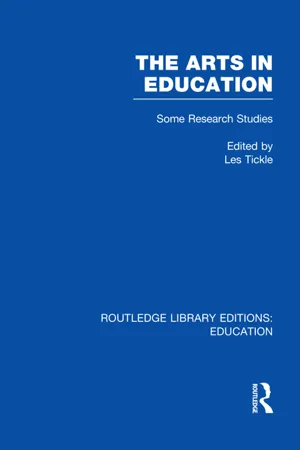
The arts in education are currently the subject of considerable controversy. Some people argue that fostering creativity in schools is important; that the arts can provide a substantial contribution to the development of the capacity for creative thought and action; and that therefore the arts should be well represented at all levels of the school curriculum. Some argue that the education system, in fact, leaves pupils incomplete, stultified and uncreative. Others argue that it is the processes of teaching and learning in the arts which are at fault because they are too passive. This book surveys the different sides of the debate and goes on to report on original research which examines just how the arts are taught in schools. It thereby makes a considerable contribution to the debate which has hitherto been incomplete due to a lack of evidence.
- 295 pages
- English
- ePUB (mobile friendly)
- Available on iOS & Android
eBook - ePub
About this book
Information
Chapter One
THE ARTS AND YOUNG CHILDREN
Heinrich Pestalozzi, Robert Owen and Friedrich Froebel accepted children of 3 to 6 years into their schools. Differing from their contemporaries, they believed that all children were educable and at an early age. Each had worked out a theory of child development, or rather socialisation and, particularly in Froebel’s case, a concomitant resource-based curriculum.
Although Froebel, in particular, exuded the cause of natural development in some of his writing, in practice neither his nor Pestalozzl’s or Owen’s schools based their pedagogy on notions of innocence and innateness. Even Amaud-Reid (1985) reiterates this popular misinterpretation in early childhood schooling:
But an older tradition, beneficial in its day, still lingers on, inherited from Rousseau, Froebel and others, that children grow up naturally like flowers, that they should not only be allowed to express themselves freely (which is quite right), but that parents and teachers should never intervene, or check, or even suggest. Apart from this (though related to it) there is still lingering the notion that what art is, is ‘self-expression’. I do not doubt that in some (and I am inclined to say much) art and art-making there is an element of self-expression, and of expression of other kinds. But I think that the emphasis on ‘self, and ‘expression of one’s personality’, rather than on the disoovery of meanings which are not oneself, is unhealthy and a bad influence.
The pedagogy of rote instruction was inappropriate to Pestalozzi’s and Froebel’s educational theories. Instead the teacher would ask the children questions about observable phenomena or about relationships between given items for the children to reason out. The questions were addressed to individuals but the group was encouraged to discuss their answers. Even young children were held to be capable of reflection on their own ideas and those of others. In the mid-18th to early 19th centuries, when these pioneers of early childhood education were active, knowledge was believed to form innately (cf. Plato) or be wholly acquired as inscription on a tabula rasa (cf. Locke). (1)
These pioneers of early childhood schooling opposed the doctrine of original sin with its antipathy to play and secular arts. For them children would, through a kind yet firm teacher who engaged their ‘interests’, become able to discern good from bad, right from wrong; would think for themselves. In Pestalozzi’s (1827) words:
Let the child not only be acted upon but let him be an agent in intellectual education … The child has a faculty of reflection independent of the thoughts of others. It is well done to make a child read, and write, and learn, and repeat, – but it is still better to make a child think.
In Froebel’s curriculum package of the Gifts and Occupations, the content and tasks upon which the children reflected ‘were largely prespecified. Although Froebel resisted writing instructional step-by-step texts for teachers, he had already prepared the way by his curriculum. Although he wanted the teachers to develop their pedagogy from the principles of this method, these principles were, he eventually acknowledged, poorly understood, forcing him to write his Pedagogics of the Kindergarten (1840, 1907). If we look at Froebel’s curriculum and pedagogic method we see a clearly sequenced set of tasks intended to progress the child intellectually, aesthetically and morally. An apposite question is, towards what? Froebel wished to engage what he saw as the child’s natural ‘interests’ (cf. Dewey, 1895, 1964) in a task-based quest for unity of the developing moral conscience with the pattern and beauty of the natural world. The deity was the source of this unity; this seamless web. The implication of this inextricable link between what Froebel called the ‘inner’ and the ‘outer’, is that children’s utterances, drawings, songs and plays have a visible and a metaphysical aspect. This is the ‘mystical’ aura of Froebel’s method of schooling, one upon which many educational writers have commented. Although Froebel included drawing, dance and music, and what we would call three dimensional design in his curriculum, the tasks were largely prespecified by the textbook and the teacher. Froebel’s method did not admit children’s spontaneous play. All activities were work (or the ‘plays of the kindergarten’ as Froebel described them), directed towards the progressive insight of unity of the ‘inner’ and the ‘outer’. (2) This limit on children’s interests and spontaneity meant that in schooling that followed the ‘letter’ (Bryan, 1890) of Froebel’s method, children would produce variations in required patterns rather than imaginative drawings, would sing songs and play ring games as specified by the curriculum and, in all, be under the close direction of the teacher. Now, although there were major changes in this regimen, particularly in the U.S.A., between about 1890 to 1910, Montessori’s method (1912) returns to sequenced progressive tasks without admittance of children’s play. She, like Froebel, believed that for proper moral and aesthetic development, children’s inherent goodness and discernment required releasing through particular stimulus objects. Montessori’s and Froebel’s epistemologies and theory of curriculum are similar, irrespective of the cultural sites of their formative work: with the impoverished children of Naples as compared to the children of the liberal intelligentsia and artisans in Keilhau, respectively.
Pestalozzi wanted to develop agency in his pupils. He believed that the young child could be educated to develop an inquiring approach to things and words. Pestalozzi argued against innate ideas and tabula rasa. Like his contemporary philosopher Kant (whom he read after meeting Fichte), Pestalozzi believed that all children were born with potential to discern good from bad and to make fundamental spatial distinctions. All other knowledge was learnt. However, Kant, unlike Pestalozzi, postulated a dualism between reasoning and aesthetic feeling with reasoning as superordinate (Kemal, 1976). According to Dewey (1934)
Schiller put forward the idea that play and art occupy an intermediate transitional place between the realms of necessary phenomena and transcendent freedom, educating man to recognition and to assumption of the responsibilities of the latter. His views represent a valiant attempt on the part of an artist to escape the rigid dualism of the Kantian philosophy, while remaining within its frame.
Pestalozzi’s great educational achievement was to create and apply a pedagogy which encouraged the development of the child’s agency, building on the child’s potential for moral and aesthetic discernment through reflection. The ‘products’ of a child’s reflective work were subject to criticism by peers and teachers. Pestalozzi went some way towards implementing and evaluating a non-dualistic pedagogy: one which matched Schiller’s ideals closely. Given the adherence of Froebel and Montessori to theories of release of innate faculties through prespecified external sensory stimuli, it follows that their methods neglect imaginative, creative play and work in the arts. Children learnt through work; the tasks being predefined by the curriculum and its materials. Although Montessori, unlike Froebel, was not an advocate of free will, they both treated the young child’s schooling as one provided by an adult disciplined environment for sensory and intellectual development.
Montessori, and in his later life Froebel, founded schools for the children of poverty; Pestalozzi, Owen and McMillan were not strangers to poverty but they did not equate an impoverished environment with an impoverished mind. Indeed, it was Pestalozzi, Owen and McMillan who believed that all children were capable of reflective action to become self-responsible agents. Their educational pedagogy and practice incorporate play (3) as a means towards development of the child’s aesthetic and intellectual powers. Yet Froebel wrote eulogies about children’s play based on his detailed observations of children:
Play is the purest, most spiritual activity in man at this stage, and at the same time, typical of human life as a whole – of the inner hidden natural life of man. Of all things he gives therefore joy, freedom, contentment, inner and outer rest and peace of the world … (Froebel, 1826).
I have outlined the educational philosophy and practice of the pioneers to make an important distinction between schooling that integrates play and that which excludes or even forbids it. When play is integral then children may try out their imaginative ideas of role, plastic art and music. But to provide only a ‘rich’ environment of materials is not enough for children ‘to learn through play’. Play, as Erickson (1972) observes, requires boundaries. The teacher has to be audience to the play, and ask questions to the children about what the relationships mean to them and from the perspectives of the adult world. In this way the children’s imaginative extensions of pivotal ideas and objects are appreciated for their integrity and the children are encouraged to make connections with the language of description and ideas used by adults. The latter neither overrides, supplants, denies nor becomes the main aim of the teacher’s engagement with the children’s play. The children’s realities are expressed in the creation of a played artifact, are placed in the context of what is actually possible in their and the teacher’s understanding. Play and its objects becomes the articulation point for such dialogue.
This argument is familiar to early childhood educators (Cazden (1972), N. Isaacs (1955), Vygotsky (1933), Wann et al. (1962)) but it conflicts with the philosophers of early childhood education who advocate all work or all play rather than an ‘interaction’ between work and play. The tensions that arise through an ‘interaction’ between play (imaginative constructions) and work (self-disciplined goal oriented task) are, however, in the felt experience of many teachers, but often denied. Furthermore, under a prespecified curriculum and teacher directed discipline, work sometimes becomes degraded to labour, the routine subservience to externally imposed tasks.
Dewey suggests that play and work are on a continuum. Play becomes transformed into work through the ordering of activity and materials towards an end – the child’s consciousness of the meaning of his ‘impulsions and acts’. The ‘selection and arrangement of arts’ is expressive of past experience. ‘However work becomes labour (4) or toil when the activities are onerous, undergone as mere means by which to secure a remit’ (Dewey, 193...
Table of contents
- Cover
- Halftitle
- Title
- Copyright
- Contents
- Contributors
- Introduction: The Arts in Education and Curriculum Research
- 1. The Arts and Young Children
- 2. The Oracle and the Muses: Aesthetic Activity in Six Schools
- 3. Black Spiders: Art Teaching in Primary and Middle Schools
- 4. MS Floral Mends her Ways: a Case Study of the Micro-Politics of Creative Drama
- 5. Diversions and Creations: Teaching Poetry and Drama in a Secondary School
- 6. A Kind of Oasis: Art Rooms and Art Teachers in Secondary Schools
- 7. Theatre, Memory and Learning: The Long-Term Impact of Theatre in Education
- 8. Picas and Points: Initial Encounters with Typography
- 9. Evaluation and the Arts - The Music Case
- 10. Art for Pupils’ Sake: Deprogramming Student Teachers
- 11. Mrs Kaye’s Drawing Class: Some Thoughts on Curriculum, Teaching and Learning as Theoretical Issues (1)
- Index
Trusted by 375,005 students
Access to over 1.5 million titles for a fair monthly price.
Study more efficiently using our study tools.
Frequently asked questions
Yes, you can cancel anytime from the Subscription tab in your account settings on the Perlego website. Your subscription will stay active until the end of your current billing period. Learn how to cancel your subscription
No, books cannot be downloaded as external files, such as PDFs, for use outside of Perlego. However, you can download books within the Perlego app for offline reading on mobile or tablet. Learn how to download books offline
We are an online textbook subscription service, where you can get access to an entire online library for less than the price of a single book per month. With over 1.5 million books across 990+ topics, we’ve got you covered! Learn about our mission
Look out for the read-aloud symbol on your next book to see if you can listen to it. The read-aloud tool reads text aloud for you, highlighting the text as it is being read. You can pause it, speed it up and slow it down. Learn more about Read Aloud
Yes! You can use the Perlego app on both iOS and Android devices to read anytime, anywhere — even offline. Perfect for commutes or when you’re on the go.
Please note we cannot support devices running on iOS 13 and Android 7 or earlier. Learn more about using the app
Please note we cannot support devices running on iOS 13 and Android 7 or earlier. Learn more about using the app
Yes, you can access The Arts in Education by Les Tickle in PDF and/or ePUB format, as well as other popular books in Education & Education General. We have over 1.5 million books available in our catalogue for you to explore.