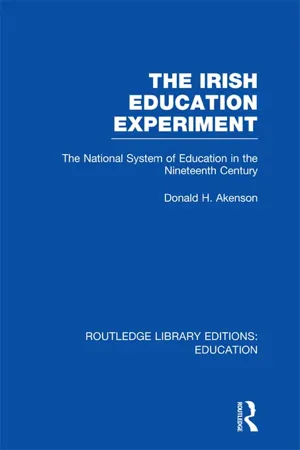
This volume focuses on the creation, structure and evolution of the Irish national system of education. It illustrates how the system was shaped by the religious, social and political realities of nineteenth century Ireland and discusses the effects that the system had upon the Irish nation: namely that it was the chief means by which the country was transformed from one in which illiteracy predominated to one in which most people, even the poorest, could read and write.
eBook - ePub
The Irish Education Experiment
The National System of Education in the Nineteenth Century
- 4 pages
- English
- ePUB (mobile friendly)
- Available on iOS & Android
eBook - ePub
The Irish Education Experiment
The National System of Education in the Nineteenth Century
About this book
Information
VIII
TWENTY HEARTS BEATING
AS NONE, 1871–1900

1
MUCH TO THE FRUSTRATION of those who favoured the immediate and wholesale adoption of the Powis commission's recommendations, the commission's proposals were implemented piecemeal and slowly. This was not the result of an attempt on the part of the commissioners of national education to hold the field against those wishing to restructure their system; rather, it was a result of the political situation in England. Gladstone intended to bring in legislation based upon the Powis report but found this to be impossible. England, in 1870, was experiencing a wave of anti-catholic feeling, an emotion associated with the disestablishment of the Anglican church in Ireland and with attempts in Westminster to repeal the ecclesiastical titles act. At such a time the implementation of the Powis recommendations could only appear as truckling to the wishes of the Roman Catholic hierarchy and hence was not politically feasible. The catholics remained active, bombarding parliament and select national leaders with petitions and letters urging the implementation of the Powis recommendations. Under this pressure Gladstone assured Cullen that the government did intend to act upon the suggestions, preferably after the passage in the 1872 session of the Scotch education act. Gladstone, however, left office in early 1874 having done little to modify the national system1
One important suggestion of the Powis commission was quicky acted upon and that was the recommendation that a portion of each teacher's salary should depend upon the marks the children under his charge received at regular examinations to be held under the charge of the inspectors. Payment by results had been introduced into England in 1862, and in 1866 the government had suggested to the commissioners of national education that the scheme be adopted in Ireland. At the request of the Powis commission, Patrick Keenan, then a chief of inspection, and later resident commissioner, drew up such a scheme for its consideration. On the basis of that scheme the commission recommended that all children in Irish national schools be examined annually by an inspector in reading, writing, and arithmetic, and that a fixed sum be paid for each child who passed in each subject, providing the child had made a given number of attendances during the year preceding the examination.2
The commissioners of national education seem to have swallowed this educational medicine without hesitation. There was no official debate among them on whether or not the policy should be introduced, but only a discussion as to what was the best means of effecting the policy. Two schemes for payment by results were submitted and, not surprisingly, Patrick Keenan's plan was the one selected. The commissioners, however, refused to condone a number of extra features with which Keenan studded his basic plan. With only one dissenting vote they passed a resolution that ‘Mr Keenan's plan be adopted so far as it makes the payment to the teacher beyond his fixed salary, to depend upon the amount of information acquired by his pupils, and the number who have acquired such information’, but they did not sanction his recommendation that the new system of payment be tied to local education rates, pensions for teachers, and changes in the regulations concerning local management.3 It should be noted that under the Irish plan, unlike its English prototype, the teacher was not dependent solely upon results of the fees for his income, for he was paid a basic salary irrespective of results. Thus, at least some of the insecurity surrounding the English school teacher was removed, while, hopefully, provision was made for incentives for increased educational production. The commissioners adopted Keenan's plan a fortnight after it was formally presented.4 When Alexander Macdonnell resigned in early 1872 as resident commissioner, Keenan was named to succeed him and thus had charge of bringing his own plan into action.5
One of the implications of the results-fees system was that the treasury would gain increasing control over Irish education, for each aspect of the grant arrangements had to receive treasury approval. Through 1874 the treasury allowed the entire amount of the results-fees earned by the teachers to be paid to the teachers irrespective of any question of local contribution.6 One of the treasury's complaints about the Irish national system, however, was that its cost fell almost entirely upon the central government. Payment by results appeared to their lordships to be an ideal opportunity to teach the Irish that education was a local responsibility. Hence, the National School Teachers (Ireland) Act, 1875 included a complicated mechanism for stimulating local contributions to the system of national education. Boards of guardians were given the choice of becoming either ‘contributory’ or ‘non-contributory’ unions. In the former unions, one third of the amount of results-fees earned by the teachers was to be raised by a rate to be struck by the guardians, the rest to be paid from the imperial exchequer. If the union refused to strike a rate, and thus was classified as non-contributory, one third of the amount of results-fees earned by the teacher was paid from imperial funds. In the treasury vocabulary, the result-fees above the guaranteed one-third were ‘contingent results fees’. The act was a dismal failure for, of the 163 poor law unions in Ireland, only seventy-three were ever at any time contributory. In 1897 there were only twenty-five contributory unions.7
The teachers, who under the act's rules lost most of the results-fees they had earned, objected strenuously. The treasury, realizing its mistake, pulled back a bit in 1876 and allowed one half of the contingent results-fees earned by the teacher to be paid by the central government, provided that at least three shillings and four pence per child per annum for the average annual number of children in attendance be raised.8 That is, they granted the same amount (two thirds of the total earned by the teacher) to non-contributory as well as to contributory unions. In 1880 the rule was further relaxed. Whereas it had previously been required that in non-contributory unions at least one half of the contingent results-fees had to be raised locally if imperial money was to be granted, from 1880 onwards the central government matched whatever amount local sources could raise in non-contributory unions, even if this fell below the level of fifty per cent of contingent results-fees.9 The government back-pedalled further in 1890 when the Local Taxation (Customs and Excise) Act was passed, under which £78,000 was paid annually to the commissioners of national education in Ireland. This money was distributed, proportionate to average attendance, to contributory unions in relief of local rates and in non-contributory unions as an addition to the local contributions to schools. This aid to local contributions was significant, for it meant that in 1890 only fourteen schools failed to receive the full amount of earned results-fees.10 In 1892, the requirement of local contributions was totally abolished,11 although contributory unions could continue to operate as educational rating authorities if they so desired.
The refusal of the majority of Irish communities to sanction local rates in aid of education is surprising, especially in view of the striking willingness to sacrifice for education which the Irish peasant showed in the eighteenth and early nineteenth century, and also in view of the enthusiasm with which the average Irishman sent his children to the national schools. In partial explanation, however, we must grant the Irishman his humanity, for one can hardly expect anyone to be pleased with the idea of paying local education rates when educational benefits have previously been paid by the central government. Since it was the teachers, not the parents of the school children who suffered when a local union chose not to be contributory, there was little incentive for parents to push for contributory status. Any desire local rate payers may have had to strike education rates was offset by the growing belief that Ireland was grievously overtaxed relative to its actual wealth. This popular belief was subsequently confirmed by the Childers’ report of 1896 on the financial relations between Great Britain and Ireland: the report revealed that Ireland was being taxed beyond her proportionate share by £2,750,000 a year.12
In partial explanation we should also note that the control of the national schools had never been a civic concern. On the local level the schools were almost completely under the control of ...
Table of contents
- Front Cover
- Half Title
- Title Page
- Copyright
- Title Page
- Original Copyright
- Dedication
- CONTENTS
- ABBREVIATIONS
- ACKNOWLEDGEMENTS
- I THE IRISH NATIONAL SYSTEM AS AN EDUCATIONAL SURPRISE
- II THE EIGHTEENTH-CENTURY BACKGROUND
- III AN ADMINISTRATIVE GENEALOGY
- IV SOME BUREAUCRATIC ARCHAEOLOGY, 1831–49
- V SPINNING THE EDUCATIONAL TOP, 1831–49
- VI THE POLITICS OF THE CURRICULUM, 1831–54
- VII OVER THE HILL AND INTO THE WOODS, 1850–70
- VIII TWENTY HEARTS BEATING AS NONE, 1871–1900
- IX CONCLUSION
- APPENDIX
- BIBLIOGRAPHY
- INDEX
Trusted by 375,005 students
Access to over 1.5 million titles for a fair monthly price.
Study more efficiently using our study tools.
Frequently asked questions
Yes, you can cancel anytime from the Subscription tab in your account settings on the Perlego website. Your subscription will stay active until the end of your current billing period. Learn how to cancel your subscription
No, books cannot be downloaded as external files, such as PDFs, for use outside of Perlego. However, you can download books within the Perlego app for offline reading on mobile or tablet. Learn how to download books offline
Perlego offers two plans: Essential and Complete
- Essential is ideal for learners and professionals who enjoy exploring a wide range of subjects. Access the Essential Library with 800,000+ trusted titles and best-sellers across business, personal growth, and the humanities. Includes unlimited reading time and Standard Read Aloud voice.
- Complete: Perfect for advanced learners and researchers needing full, unrestricted access. Unlock 1.5M+ books across hundreds of subjects, including academic and specialized titles. The Complete Plan also includes advanced features like Premium Read Aloud and Research Assistant.
We are an online textbook subscription service, where you can get access to an entire online library for less than the price of a single book per month. With over 1.5 million books across 990+ topics, we’ve got you covered! Learn about our mission
Look out for the read-aloud symbol on your next book to see if you can listen to it. The read-aloud tool reads text aloud for you, highlighting the text as it is being read. You can pause it, speed it up and slow it down. Learn more about Read Aloud
Yes! You can use the Perlego app on both iOS and Android devices to read anytime, anywhere — even offline. Perfect for commutes or when you’re on the go.
Please note we cannot support devices running on iOS 13 and Android 7 or earlier. Learn more about using the app
Please note we cannot support devices running on iOS 13 and Android 7 or earlier. Learn more about using the app
Yes, you can access The Irish Education Experiment by Donald Akenson in PDF and/or ePUB format, as well as other popular books in Education & Education General. We have over 1.5 million books available in our catalogue for you to explore.