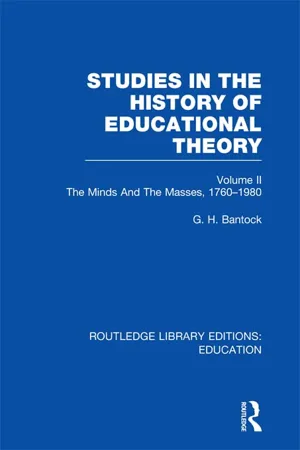
This volume completes G H Bantock's comprehensive study of educational thought, and its relationship to the broad development of European culture, from the time of the Renaissance to the present day. During the period under consideration, the new freedom from dogma and hierarchy allowed for the emergence of a large number of models of education intended to accommodate the autonomous personality and at the same time to meet the demand for educational expansion. The need to educate 'the masses' was increasingly recognized, and the dilemma posed by 'mass civilisation and minority culture' became acute as 'liberal' autonomy was increasingly threatened by new egalitarian and collectivist notions. The author considers the work of key theorists from the period, including such writers as Coleridge, Nietzsche and Tolstoy, all relatively neglected as educationists.
eBook - ePub
Studies in the History of Educational Theory Vol 2
The Minds and the Masses, 1760-1980
- 4 pages
- English
- ePUB (mobile friendly)
- Available on iOS & Android
eBook - ePub
About this book
Information
PART THREE
The Moderns: ‘Processes’
CHAPTER 1
‘A Hermit Who Mixes Little with Other
Men’: the Legacy of Rousseau
I
‘Reverse the usual practice and you will almost always do right’;1 this is Rousseau in his pose as outsider, hermit, overturning the normal conventions of society. His image of himself as a recluse reveals a romantic component in his make-up as an element of pose; but it also underlines his very real dissatisfaction with the society of his time and suggests a vantage-point from which he could view it and its ills. Like a number of his successors he constructs what he regards as a better social order in which a revised education is to play an important role – and his eremitic stance provides him dramatically with that isolation necessary as a preliminary to reconstruction. We have, indeed, reached a period when, as a result of a major intellectual effort to prise the human mind free from a variety of historical circumstances – both metaphysical-religious and social-institutional – the future destiny of mankind would be seen to be increasingly assigned to humanity itself and to the measures it took for its future progress. That progress, with its evaluative overtones, was conceivable constituted one of the fundamental assumptions of a growing optimism concerning human potential. That in contributing to this change for the better, education had a major part to play was an almost unquestioned article of faith: ‘Education, not God, is the source of grace’,2 an idea with its roots in the Renaissance but coming to fruition in the Enlightenment.
All the reformers shared a discontent with the ancient order of things3 though they varied in the degree of their reconstructive zeal. Nevertheless, as a whole, they contrasted markedly with humanist theorists. The earlier humanists at least, conscious of their developing association with the centres of power, concentrated on the minutiae of educational provision, satisfied in large measure with the dynamics of a society they helped to lead.4 Discontent with the traditional order, a permanent legacy of the Enlightenment, meant that theorists now saw their specifically educational recommendations as factors in a revised metaphysical-social fabric. Emancipation, however, often invited new types of restraint as essential stabilising factors. For a number of theorists, freedom, in fact, evoked at some stage – Necessity. For some, indeed, necessity was so ubiquitous that the problem was how to ensure morality in a non-moral, determined world.
Rousseau, traditionally regarded as the great liberator in education, admirably reveals some of these dilemmas. ‘Negative education’ – freedom from traditional educational restraints – is balanced by a recognised need still to encompass at least two categories of ‘order’ – that implicit in the psychological development of a child and that in the deployment of subject-matter. Both culminate in an ultimate commitment to the ‘general will’ of society. The first principle is evoked when Rousseau urges that ‘nature would have them children before they are men’,5 and sees Emile's progress in developmental stages; the second when he stipulates that material must be presented to Emile ‘in fitting order’.6 The tutor is only superficially a liberator; fundamentally he is the representative of certain categories of educational necessity. In outcome, this postulation of an ideal order of development culminates in the realisation of a supposedly ‘true’ self which avoids all the corruptions and artificialities of current society.
This ‘true’ self in fact is the prime ingredient of Rousseau's notion of the general will, expounded in the Social Contract, as the ultimate source of authority in the state. The general will is the manifestation of those who have shed their ephemeral desires and realised their ‘true’ needs and wishes in a way which Rousseau's educational prescriptions would encourage and foster. Emile ultimately evokes the social contract and the incipient tyranny it enables, as is made clear in the later pages of the book.7
Let us look more closely at some of these manifestations of ‘necessity’. There is the necessity implicit in the scientific laws of development it is the job of the teacher to observe – they must be children before they are men. But into the making of a man non-empirical elements enter, as the constant interventions of the tutor (evaluative as well as logical) make clear. Thus the ‘real’ self that emerges contains moral non-empirical elements as well as those which could be categorised as scientific.
The net effect of this is to tell us something very important and fundamental about the notion of ‘necessity’ as it is often employed during this period. ‘Necessity’ seems to imply some extra-human notion of ‘scientific’ law which must be observed and necessarily subserved by men. In fact it is very often a mixed concept implying an element of moral imperative as well as ‘necessary’ law. Like Rousseau himself, men often appeal to ‘necessity’ to justify on empirical grounds what they should seek to argue on moral ones. This is true in the frequent evocations of historical ‘law’ to support what are in effect human moral decisions – the notion of historicism. Historicism – which has been thoroughly deflated by Sir Karl Popper8 – implied the possibility of scientific prediction in social events as a result of the recognition of ‘laws’ of history analogous to the laws of physical behaviour postulated by Sir Isaac Newton and his followers. It could thus be used to justify social and political decisions on the grounds that they fulfil a predetermined destiny – they are in line with the imperatives of historical development. Inevitably, of course, they involve gross simplifications in the complex business of realising the future.
Any such confusions have their importance for educational theorising. As attention is increasingly focused on the scientific determinants of educational behaviour, the possibility of confusion between what is scientifically necessary and what is thought to be socially desirable exists. The confusion which is implicit in Rousseau's attempt to evolve a ‘true’ self out of a putatively scientifically observed and subserved order of development is merely an early example. When that ‘true’ self becomes the main source of authority in the state through his concept of the general will, the possibilities of manipulation or worse become increasingly dangerous. Whose general will is the general will and what happens to those who are perverse enough not to recognise where their ‘true’ interests lie? More generally, what happens to those who fail to recognise or go along with the dynamics of history? The importance of this muddled concept of ‘necessity’ can be recognised when it is realised that today about one-third of the population of the globe live under regimes which have considered themselves to be fulfilling the inexorable laws of history. What is involved is a secularised version of a former religious teleology. As God had directed, so the laws of nature were thought of as actually governing events, which events obeyed them. ‘Thus the regularity of nature was taken as representing the rules through which divine governance flowed.’9 Something of this notion of purposiveness in nature attached itself to the postulation of analogous historical imperatives, or ‘laws’ of human nature.
II
So important is the theme that it should perhaps be further exemplified in terms applicable to the more immediate post-Enlightenment period. ‘Freedom’ was achieved through the Enlightenment policy of disengagement from a variety of traditional restraints – metaphysical, religious, social and cultural – ‘freedom from’; the idea of ‘necessity’ in part arose out of the then need to find new structures, new regulations as boundaries to be observed – new regulative principles which might, for instance, appeal to the authority of putative scientific ‘law’ to legitimise intervention. This device can be especially remarked among what have come to be termed ‘progressive’ thinkers. Children, they argued, should be freed from all constraints; the teacher should become simply ‘passive and protective’ so that his charges could realise those laws of human development inherent in the human condition – in the same way as a seed realises its inner potentiality given maximum growing conditions. But then, as the analogy between child and plant breaks down – children demonstrating a power of self-activitation quite lacking in plants – it becomes necessary to assist ‘nature’ by postulating those quintessential human developmental attributes the theorist considers reveal ‘true’ humanity. Hence the appearance of aids to that end – the tutor's ‘fitting order’ in Emile, Froebel's ‘gifts and occupations’, Pestalozzi's ‘objects’, Montessori's apparatus. In each case there is an appeal to a form of ‘law’ as the legitimating factor: the aid assists the process of ‘natural growth’. I shall analyse this phenomenon more fully later;10 here it is simply important to note it as one evocation of necessity as an intended imperative.
The lifting of constraints on children evoked what has been termed ‘negative’ freedom – freedom from. The implication of the assisting aids evokes what is known as ‘positive’ freedom – freedom to, for example, to realise whatever is thought of as representing the ‘true’ self. (Professor Cranston has referred to it as ‘rational’ freedom.)11 Positive, ‘rational’, freedom often implies a form of evaluation12 and constitutes that sort of freedom which arises as a result of the acceptance of what is usually some form of moral choice. It is this positive freedom which is evoked by the acceptance of the ‘general will’ in Rousseau's terms, or the moral law – autonomy – in Kant's. In the latter case a transcendental, supra-empirical element is explicitly recognised – Kant's realm of the noumenal.
The problem of the constraints of scientific law – and Cassirer speaks of the ‘almost unlimited power which scientific knowledge gains over all the thought of the Enlightenment’13 – certainly raised this question of freedom in its positive sense. We have, in idea at least, freed man from the restraints of custom, habit, tradition, convention – all those bonds of the past which have hindered his realisation of himself. But now the terms in which that realisation is to take place come into question. One ‘necessity’, when applicable, could not, it was argued, be avoided – that of scientific law, to which man, in so far as he was part of nature, was as subject as the material particles which science had categorised into meaning...
Table of contents
- Front Cover
- Half Title
- Title Page
- Copyright
- Title Page
- Copyright
- Contents
- Acknowledgements
- Introduction
- PART THREE THE MODERNS: ‘PROCESSES’
- Conclusion
- Short Biographies of the Main Theorists
- Select Bibliography
- Index
Trusted by 375,005 students
Access to over 1.5 million titles for a fair monthly price.
Study more efficiently using our study tools.
Frequently asked questions
Yes, you can cancel anytime from the Subscription tab in your account settings on the Perlego website. Your subscription will stay active until the end of your current billing period. Learn how to cancel your subscription
No, books cannot be downloaded as external files, such as PDFs, for use outside of Perlego. However, you can download books within the Perlego app for offline reading on mobile or tablet. Learn how to download books offline
Perlego offers two plans: Essential and Complete
- Essential is ideal for learners and professionals who enjoy exploring a wide range of subjects. Access the Essential Library with 800,000+ trusted titles and best-sellers across business, personal growth, and the humanities. Includes unlimited reading time and Standard Read Aloud voice.
- Complete: Perfect for advanced learners and researchers needing full, unrestricted access. Unlock 1.5M+ books across hundreds of subjects, including academic and specialized titles. The Complete Plan also includes advanced features like Premium Read Aloud and Research Assistant.
We are an online textbook subscription service, where you can get access to an entire online library for less than the price of a single book per month. With over 1.5 million books across 990+ topics, we’ve got you covered! Learn about our mission
Look out for the read-aloud symbol on your next book to see if you can listen to it. The read-aloud tool reads text aloud for you, highlighting the text as it is being read. You can pause it, speed it up and slow it down. Learn more about Read Aloud
Yes! You can use the Perlego app on both iOS and Android devices to read anytime, anywhere — even offline. Perfect for commutes or when you’re on the go.
Please note we cannot support devices running on iOS 13 and Android 7 or earlier. Learn more about using the app
Please note we cannot support devices running on iOS 13 and Android 7 or earlier. Learn more about using the app
Yes, you can access Studies in the History of Educational Theory Vol 2 by G Bantock in PDF and/or ePUB format, as well as other popular books in Education & Education General. We have over 1.5 million books available in our catalogue for you to explore.