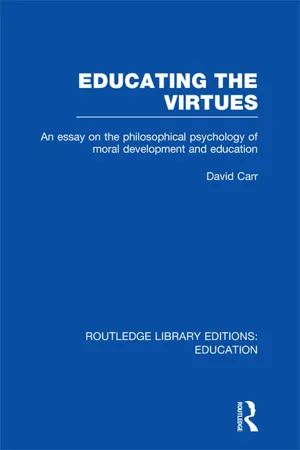
Tracing the views on moral life of such past philosophers as Plato, Aristotle and Kant, as well as of such theorists as Durkheim, Freud, Piaget and Kohlberg, the author sets forth a full discussion of the nature and educational implications of the idea of moral virtue.
eBook - ePub
Educating the Virtues (RLE Edu K)
An Essay on the Philosophical Psychology of Moral Development and Education
- 312 pages
- English
- ePUB (mobile friendly)
- Available on iOS & Android
eBook - ePub
Educating the Virtues (RLE Edu K)
An Essay on the Philosophical Psychology of Moral Development and Education
About this book
Information
Part I
IDEAS OF VIRTUE
IN
MORAL PHILOSOPHY
1
VIRTUE AS KNOWLEDGE:
SOCRATES AND PLATO
Since the main question to which the present work is addressed concerns the nature of moral virtue and how those qualities of human character we call virtues might be taught in the course of human education, there can be no more appropriate place to begin than with a consideration of the views of Socrates and Plato on this matter. In the first place, of course, these two great philosophers of classical antiquity are the main source of western philosophical thinking in general and of thought about moral life and conduct in particular; but in the second place it is precisely with the question of how virtue might be taught that one of Plato's better known dialogues – the Meno – begins, a question to which Socrates seeks an answer in the course of that dialogue.1
To be sure, the response which Socrates returns to that question in the Meno is a notoriously problematic one from the point of view of moral education, since the conclusion that the nature of moral virtue is a matter of opinion more than genuine knowledge can hardly place teaching about moral matters beyond the realm of genuine controversy. In the dialogue called Protagoras, however, which is usually collected together with the Meno, Socrates is represented as defending the view that virtue is knowledge and thus teachable and this would appear to have been the final view of both Socrates and Plato in so far as a final view is to be found expressed in Plato's dialogues.
Here, of course, I can provide no more than a partial and simplified account of the views on moral life and education of these two great ancient philosophers. Of necessity, my account of Socrates and Plato will be simple and unsophisticated since as a lay reader rather than a professional scholar of Plato my reading of his works is at best innocent and at worst ignorant of the many subtle disputes concerning their proper interpretation that have continued down the centuries to modern times. Although my account of Plato and Socrates will be relatively simple, however, I trust that it will not be too controversial since I shall try to concentrate only on identifying some general Platonic arguments and insights into the nature of moral life and education concerning which there is considerable agreement.
My account of the Socratic–Platonic moral philosophy, how-ever, will also be partial because besides avoiding unnecessary controversy, I also cannot enter here into the details, interesting as they are, of Plato's general social and educational philosophy. Unlike most educational philosophers before me, I shall show little apparent interest in Plato's programme of education for the philosopher-kings in the Republic, in his profound and insightful account of the nature of understanding in the Meno or in his observations on the nature of knowledge in the Theaetetos and other post-Republican dialogues. I shall concentrate mainly on Plato's moral psychology of virtue touching on as much of his general social, political and educational philosophy as it takes to understand his account of virtue. First, however, it is necessary to say something about Socrates.
What we know of Socrates as a historical figure from the dialogues of his greatest pupil Plato and from other sources2 is that he was the first great martyr to truth of western philosophical enquiry. Inspired by the Delphic oracle, so his own autobiographical account in Plato's Apology went, to embark upon a quest to find a mind endowed with greater wisdom than his own, Socrates spent his life in energetic pursuit of an understanding of the nature and meaning of truth, virtue, knowledge and justice in the course of which he laid the foundations of much subsequent epistemological and moral enquiry and also attracted the disapproval of the Athenian authorities as an impious and dangerous subversive so that he was condemned to death by his own hand at around the age of seventy.
It is, of course, a notoriously difficult (and ultimately rather pointless) task to determine where in Plato's dialogues, Socratic philosophy as such leaves off and Platonic philosophy begins,3 but it seems likely that well before Socrates ceases to appear as the central spokesman in the Platonic dialogues of the later period, Plato is using him as a dramatic character to explore and engage with epistemological and metaphysical questions that had been little more than hinted at by the actual historical Socrates. Having argued largely in the context of reflections upon social and political considerations that whatever is to be properly considered an expression of moral virtue must exhibit some kind of wisdom or knowledge, Socrates clearly stirred a hornet's nest of problems about the nature of knowledge, and that truth or reality which our knowledge is of, that were to continue to exercise the mature Plato of the Republic and beyond.
In the context of the present enquiry into the nature of moral virtue and education, however, clearly the right place to start is with the early Socratic dialogues in which it is likely that Plato is engaged in little more than a literary narrative or presentation of discussions about virtue and justice which were actually conducted by Socrates and attended by Plato. In these dialogues, we discover Socrates under the influence of his ‘daimon’ engaged in philosophical argument with various younger contemporaries or with some of the most renowned professors or teachers of his day – the sophists.
By and large, the sophists have received an extremely bad press from Plato's dialogues, not unlike that which the scribes and Pharisees received from the authors of the Gospels. Indeed, the Platonic picture of the sophists and the Gospel image of the Pharisees have much in common; a certain worldly cynicism, a generally expedient and opportunist attitude to questions of political and social policy, a sanctimonious and hypocritical posture regarding questions of virtue, moral principle and conduct and a definite penchant for rhetoric and verbal trickery. Of course, just as there are ‘good’ Pharisees such as Nicodemus in the Gospels, so the Platonic portrait of the sophists is not one of unrelieved hostility and resentment – the great admiration of both Socrates and Plato for the Eleatic philosophers Parmenides and Zeno is conspicuous and the portraits of both Protagoras and Gorgias are gentle and affectionate even when their teachings are harshly criticised; but in general sophistical attitudes and perspectives on human nature and society are the main targets of criticism in Plato's dialogues.
What, then, was the nature of the Socratic objection to the teachings of the ancient Greek sophists? In general it was towards a certain shallow and cynical scepticism with respect to the nature of our knowledge of experience and the status of conventional or traditionally based values and principles. Sophists like Protagoras taught that since all claims to knowledge are rooted in human experience, and experience is basically a function of individual perception, there must be an inherently subjective quality to any human claims to knowledge. Since individuals frequently disagree with respect to the deliverances of perception and as there is no court beyond human perception to which appeal for an objective decision in any circumstance of disagreement might be made, human understanding of reality as given in experience cannot break out of the circle of the individual's perceptually based ideas. In that case whatever an individual perceives must be true for him and whatever he values or desires must be right for him. Thus Protagoras observed that ‘man is the measure of all things’,4 by which he appears to have meant that there is nothing to the content of so-called knowledge over and above what may be construed in terms of human psychology or subjective experience.
These epistemological and metaphysical doubts about the nature of knowledge and what we can have knowledge of were translated at the level of moral, social and political life into a general scepticism about the status and validity of moral principles, social practices and political and religious institutions. Many sophists appear to have held that moral, social and political laws and principles are at best merely expressive of local customs and conventions and at worst rooted in tribal dogmas and superstitions with little or no rational basis; in short, they subscribed to beliefs which are also widely held in our own time and that is one reason why the arguments of Socrates and Plato against the sophistical view of these matters is of the highest relevance to contemporary discussions of these issues and should not be dismissed as of only historical interest.
How did the sophists propose that those who had grasped their doctrines (mainly the absolute truth that there is no absolute truth) should conduct their affairs in the light of them? In its most radical form the sophistical educational doctrine turns out to be remarkably like that taught some two thousand years later by the nineteenth-century German philosopher Friedrich Nietzsche. The beginning of wisdom in human affairs consists first and foremost in liberating oneself from the ties and constraints of conventional or traditional ideas and values in the interests of realising a transcendent set of goals and purposes in relation to which the generally accepted conventions are to be considered mere inhibitions or hindrances.5
In what, however, beyond conformity to accepted conventions can these goals and purposes consist? Essentially for the more radical sophists the answer to this question appears to have been construed in terms of the naked and unashamed pursuit of personal and political power. Traditional and conventional social and moral values were held to serve no genuine rational purpose beyond that of social control; they kept individuals in a state of slavish conformity and subservience to the interests of others and assisted the impediment of true individual self-fulfilment via the satisfaction of a person's deepest desires. Genuine self-realisation on the part of an individual, then, would be a matter of arranging circumstances to suit one's own advantage, largely through the manipulation of others, as much as possible. Power over the world and other people, should be the goal of the enlightened rational individual.
But how was this power to be exercised? The sophists were not at all the advocates of any kind of brutal or mindless control of others through physical coercion or violence for they knew of far better means of subtle persuasion which were more permanent and effective. This persuasive power was held by the sophists to reside mainly in the so-called art of rhetoric and it was the form of knowledge or skill of this name which the sophists professed to be able to teach others. In particular it was for instructing the sons of noble families in the art of rational persuasion that the sophists were mainly employed, for it was part of the general training of such young noblemen to learn how to exert influence over others by fair means or foul. In the primitive democracy of fourth-century Athens, power was to be won and wielded by means of flattering and seductive speeches in the assemblies through which the wills of others might be bent to the service of one's own. The ultimate aim was to secure for the individual all that he secretly desired in life in terms of personal honour, wealth and sensual pleasure; hence the rather curious mixture of Nietzscheanism and depravity that we often encounter in the Platonic dialogues among such young ‘supermen’ as Callicles and Thrasymachus who would have been graduates of this fashionable sophistical academy of self and power seeking.6
Socrates’ response to all of this as it is represented in the early to middle period dialogues of Plato – particularly in the Protagoras, Gorgias and Republic – is quite uncompromising. In reply to Gorgias’ claim that rhetoric is the art conducive to promoting the highest possible concerns of men, Socrates maintains that it is not any kind of art at all but merely a ‘knack’. Genuine arts such as legislation, gymnastics or medicine are directed towards the achievement of some actual human good such as physical health or justice. Knacks like cookery and cosmetics, on the other hand, aim for the most part not at the achievement of some genuine good but at the mere disguise of what is substandard, defective or unwholesome; just as cookery often serves to make spoiled or unnutritious food more appetising through the addition of rich spices and sauces so the art of the beautician may be used to conceal the symptoms of physical deterioration or disease. Like cookery and cosmetics and unlike medicine and gymnastics, then, rhetoric aims only at pleasing people by flattering them and it proceeds largely indifferent to the moral corruption of those it flatters since the sole aim of the employer of rhetoric is to gain power over others through the manipulation and exploitation of them.7
At this point, then, Socrates has seriously called into question the idea on which the power of rhetoric depends, that promising or giving people what they desire or what they think they want is to be considered an unqualified good. Far from being an unqualified good Socrates maintains, it depends crucially on what an individual or society wants whether it should be given them. Tested by the suggestion (expressed, for example, in the story of the magical ring of Gyges) that given the opportunity to do anything one liked without fear of retribution any man would seek the satisfaction of his basic desires (no matter what beastliness this involved) as a good worth pursuing, Socrates replies that it cannot be considered good even for a man to aspire to the satisfaction of all his desires. Socrates, then, draws a sharp distinction between what men happen as a matter of fact to want or desire, which tends to be dictated by their natural instincts, passions and appetites and what men should desire or what it is in their interests to want which can only be established through mature rational reflection on the nature of human good as such.
Certainly, Socrates argued, what lies in men's interests can be quite other than what they desire as expressed in terms of instincts and appetites. A man with a poisoned wound may well want to avoid the agonising pain that would result from the wound being cleaned and cauterised but it lies in the interests of his very survival that the surgeon should turn a deaf ear to his cries to be left alone. By analogy, Socrates argues at this point for what is treated by his interlocutors as the quite extraordinary view that far from it being a piece of good fortune for a notorious tyrant or criminal to get away with his crimes, it is rather to be considered a great misfortune for the miscreant in question; for if a man dies because he refuses the painful operation that would save his life, he only loses his life and suffers bodily disintegration, whereas to go unpunished for our misdeeds according to Socrates is to risk the even more serious corruption of that spiritual part of ourselves which is called the soul.
In Plato's Gorgias this doctrine is greeted with no greater sympathy than it would generally receive in most ordinary contexts of moral debate today. But even if one does not subscribe to Plato's belief in the immortality of the soul (and it is not easy to do so in the particularly implausible form in which Socrates is made to express it in the Phaedo and elsewhere) it is not hard to make reasonably good sense of the idea that getting away with murder is generally bad for the moral character; that the more others turn a blind eye or fail to hold us accountable or responsible for our thoughtless, hurtful and selfish actions, the more thoughtless, hurtful and selfish we may become and, of course, we can hardly maintain that these qualities are expressive of a good or healthy character.
What was particularly difficult for Socrates’ and Plato's con-temporaries to swallow, however, and what would also be hard to take for many people today, is the idea that getting away with murder is actually a bad thing for the agent in question in anything like as serious a sense as it is a bad thing for those on the receiving end of his injustice or misdeeds. In short, it is relatively easy to show why the rest of us have an interest in turning a bad character into a good one – it is a simple matter of getting rid of an infernal nuisance; but the paradoxicality of Socrates’ doctrine is contained in the idea that the way to spiritual or moral health and fulfilment lies not through getting everything that we want. It seems to be almost self-evident to many people that most of us live lives of decency, discipline and self-control only because we are poor and must work for a living or because if we get a little drunk then we land in gaol. But if suddenly we won the pools or if the police force was abolished then we could throw caution to the winds and realise true happiness in riotous and abandoned self-indulgence.
But as a matter of fact, the history of people who have been constrained by economic necessity to live lives of relative honesty and sobriety and who then suddenly win the pools goes some way towards supporting Plato's point. In those cases where honesty and sobriety have been viewed merely as shackles or constraints to be thrown off at the first opportunity the winners of big prizes have often gone on to wreck their lives in prodigal self-indulgence; the renunciation of moral virtue has ended not in true happiness but rather in very real tears. It is precisely the point of Socrates and Plato, then, that true human happiness, fulfilment and above all freedom is not to be had outside a moral context defined in terms of a life of self-control, sobriety and concern for others beside oneself – without precisely the virtues of wisdom, justice, temperance and courage.8 One important reason for this is that it is characteristic of human desires as expressive of instincts, passions and appetites to be actually insatiable. The sybarite's primary appetites for alcohol, drugs and sex and the fixations of the miser or megalomaniac on the secondary reinforcements of money and power know no bounds and it is these things, above all, which enslave men, rather than the discipline of the moral virtues.
In fact it is only through the moral virtues or by their help that a man may become truly free to assume something like genuine control of his own life. The man whose whole life is enmeshed in an endless attempt to gratify his appetites in a round of drunken binges or sexual encounters may be aptly compared to a leaky vessel which cannot stay filled and stands in constant need of topping-up. Thus the unjust tyrant or oppressor who has absolute power of life and death over his subjects and who can require of them anything that he wants, he who is for the most part envied by other men, is for Socrates and Plato a figure to be pitied or ridiculed if he is not at all the master of his own fate or destiny but a mere slave of his passions. Many centuries later, Rousseau was to observe that ‘those who regard themselves the masters of others are indeed greater slaves than they’ and in so doing he expressed rather concisely the Socratic– Platonic view.9
For Socrates and Plato, then, the proper route to human freedom and happiness lies not via the pursuit of political power for the unbridled or unlicensed gratification of individual or personal appetites, but through the reasonable self-control and discipline of the moral virtues in the light of some principled conception of how it is right and proper for an individual to live or of what lies in his true interests. What is right for or in the true interests of the individual, however, is not a matter that may be determined by reference to his subjective desires...
Table of contents
- Cover Page
- Half Title Page
- Title Page
- Copyright Page
- Original Title Page
- Original Copyright Page
- Dedication
- Table of Contents
- Preface
- Introduction
- Part I Ideas of Virtue in Moral Philosophy
- Part II Social Science and Moral Development
- Part III Virtue, Reason and Education
- Notes and References
- Bibliography
- Index
Trusted by 375,005 students
Access to over 1.5 million titles for a fair monthly price.
Study more efficiently using our study tools.
Frequently asked questions
Yes, you can cancel anytime from the Subscription tab in your account settings on the Perlego website. Your subscription will stay active until the end of your current billing period. Learn how to cancel your subscription
No, books cannot be downloaded as external files, such as PDFs, for use outside of Perlego. However, you can download books within the Perlego app for offline reading on mobile or tablet. Learn how to download books offline
Perlego offers two plans: Essential and Complete
- Essential is ideal for learners and professionals who enjoy exploring a wide range of subjects. Access the Essential Library with 800,000+ trusted titles and best-sellers across business, personal growth, and the humanities. Includes unlimited reading time and Standard Read Aloud voice.
- Complete: Perfect for advanced learners and researchers needing full, unrestricted access. Unlock 1.5M+ books across hundreds of subjects, including academic and specialized titles. The Complete Plan also includes advanced features like Premium Read Aloud and Research Assistant.
We are an online textbook subscription service, where you can get access to an entire online library for less than the price of a single book per month. With over 1.5 million books across 990+ topics, we’ve got you covered! Learn about our mission
Look out for the read-aloud symbol on your next book to see if you can listen to it. The read-aloud tool reads text aloud for you, highlighting the text as it is being read. You can pause it, speed it up and slow it down. Learn more about Read Aloud
Yes! You can use the Perlego app on both iOS and Android devices to read anytime, anywhere — even offline. Perfect for commutes or when you’re on the go.
Please note we cannot support devices running on iOS 13 and Android 7 or earlier. Learn more about using the app
Please note we cannot support devices running on iOS 13 and Android 7 or earlier. Learn more about using the app
Yes, you can access Educating the Virtues (RLE Edu K) by David Carr in PDF and/or ePUB format, as well as other popular books in Education & Education General. We have over 1.5 million books available in our catalogue for you to explore.