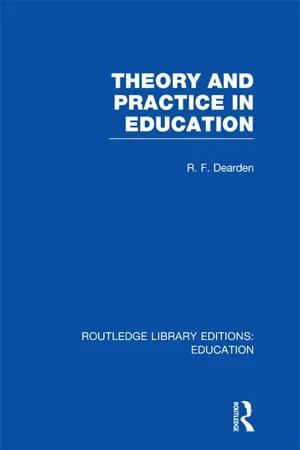
The main concern of the volume is the relation of theory to practice in education but the book also reviews the state of educational theory, and its relation to politics. Beginning with a group of papers on specific areas of the relation between theory and practice, the book goes on to discuss aspects of the curriculum, such as curricular principles in recent official reports, the newly emerging theme of general abilities, and controversial material in the curriculum. The theme of the third group of articles is personal autonomy, one of the very few generally supported educational aims of recent years, and a final group presents a retrospective view of the Plowden Report.
- 192 pages
- English
- ePUB (mobile friendly)
- Available on iOS & Android
eBook - ePub
Theory & Practice in Education (RLE Edu K)
About this book
Information
Part one
THEORY AND PRACTICE
1 THEORY AND PRACTICE IN
EDUCATION
I
The public reception given to a piece of educational research is commonly a function only partly of the research itself, or of its intrinsic interest. In part it will also be a function of the political climate surrounding its publication. Published at one time, and the research may attract little or no attention; published at another and its author is instantly elevated into being a ‘teleperson’ and ‘jet-setter’. Quite as curious is the rise and fall in popularity of the various general branches of educational study. Thus the traditionally well-entrenched educational studies of psychology and of history were for a time outshone, first by philosophy and then by sociology. These in turn were displaced from pre-eminence by curriculum studies, while the most recent candidate for the role of quasi-messianic leadership is the study of management. Each in turn waxes and then wanes, outshone by some newly rising star. I shall resist the temptation to speculate on the possible identity of the next new luminary.
Across these fluctuations, however, it is possible to discern a movement of longer span. I refer to the rise and fall in popularity of theoretical studies as a whole. These rose rapidly in esteem during the early 1960s, encouraged no doubt by the Robbins Report of 1963 with its suggestion that there should be a degree in educational studies, the BEd as it came to be called, and with its suggestion that the colleges were too narrowly conceived as places only of training. Also at this time some very influential articles were published on the nature of educational theory and its relations to practice. For example, Richard Peters persuasively argued for an ending to what he provocatively called ‘undifferentiated mush’, and for its replacement by studies firmly grounded in the separate theoretical disciplines, such as history, psychology, sociology and philosophy, to name the four that became canonical. (1) Major series of student texts were published under the eye of general editors whose appointments intentionally fell within these divisions. And, perhaps for the first time, a major government report on some aspect of education, the Plowden Report of 1967 on primary education, rested heavily on evidence and perspectives drawn from theory. In the second half of the 1960s, theory was riding high.
But with the 1970s has come something of a downswing, and not simply for reasons of cost-cutting or the demoralising closure of colleges. There have been grumbles that in the enthusiasm for theory too much attention has been distracted from practical preparation for the classroom. By 1972, the James Report was already demoting theory in its proposed second cycle of professional preparation. More recently, the schools have been criticised for being too readily wooed by ‘theorists’, who are apparently envisaged as a band of peripatetic half-wits, too fleet of foot ever actually to be seen. Some politicians, especially some noisy ones on the right, regularly promise to take a hatchet to theory if only we will place political power in their firmly practical hands.
Complaints of these kinds are not wholly new. No doubt they have their corrective place in the general scheme of things. But what is arguably new is a degree of disenchantment with theory amongst some theorists themselves. As early as 1957, Professor D.J. O'Connor had deprecatingly referred to the term ‘educational theory’ as being no more than a ‘courtesy title’, but this remark was swept aside in the general mood of rising optimism. (2) By 1975, however, John Wilson could write a whole book raising doubts both about the benefits of theory and, more radically, about whether educational theory actually existed at all in any reputable form. (3) In 1976, Hartnett and Naish, generously granted the space of two volumes by their publishers, remained at the close unconvinced of the relevance of theory. (4) Other theorists, perhaps thinking that professional suicide would be the only honourable course if these doubts were well founded, have turned to commonsense, not so much to exhibit some as to make of it a last remaining object of legitimate study, although no doubt in due course one to be made into something learned and obscure.
So what are we to think of theory? Was its general rise to prominence just a strange and temporary aberration for the sturdily pragmatic British? The teachers themselves commonly regard theory with a varying mixture of respect and suspicion: respect because it is thought of as difficult, and suspicion because its bearings are unclear on the detailed decision as to what to do next Monday morning. But is that suspicion grounded in the right expectations? Detailed practical assistance was never promised in the programmatic outlines of the 1960s. For Richard Peters, what philosophy was to offer was only a gradual change of perspective. (5) Brian Simon bluntly said that ‘no claim should be made that the study of history of education directly affects the practice of the teacher in the classroom’. (6) William Taylor added that ‘the justification for the inclusion of sociological studies in the course for intending teachers does not rest on any observable link between the pursuit of such studies and the improvement of classroom technique or practice’. (7)
One possible explanation of the disenchantment with theory is therefore that it has come to be regarded with inappropriate expectations. In consequence, it is judged to be failing where it could not succeed. Where initial training is concernned, the traditional disfavour of theory might, at least to some extent, be attributed to the natural impatience of beginners to be up and doing in the practical roles for which they have cast themselves. Apparently even doctors in training show some impatience with their early theoretical studies of anatomy, physiology and biochemistry. Indeed, the relation between theory and practice causes puzzlement across a very wide field. How is economics related to running a business, jurisprudence to being a lawyer, theology to faith, ethics to conduct, logic to reasoning, or, for that matter, sociology to being a police inspector? Different subject-matters will no doubt yield somewhat different answers, but not to the extent of precluding some striking parallels between them all.
To cut a long introduction short, it seems timely to look once again at the nature of educational theory and its relations to practice. The problems so raised are problems both for theory and for practice. They are problems for practice if we are trying to decide what sort of theory to teach, how much, in what way, to whom, where and when, or if we are preoccupied with the different sets of answers that might be appropriate in initial by contrast with in-service training. But they are problems for theory if we are concerned more abstractly to enquire into the nature of educational theory itself, or the sense in which it could be expected to be relevant to practice. It is primarily with these theoretical questions that I shall be concerned. Discussing them will involve some boundary-crossing references to many branches of educational studies, but the questions themselves fall largely within the philosophy of education, as being especially concerned with a scrutiny of the forms and interconnections of certain sorts of knowledge.
II
What meaning, then, can be attached to the term ‘theory’ in education? There is more than one answer available. Quite often what is meant is simply an idea that is impractical. Thus someone full of enthusiasm for de-schooling as an idea might suggest using the city as a school, with scant regard for the fact that the weather is quite often cold and wet. As James McClellan laconically remarks, one thing that we can say about school is that it beats standing out in the rain; or consider the student who plans a fine lesson on the onion (fine ‘in theory’ that is), only to find his classroom transformed into a gas chamber within minutes of the children's first inquisitive incisions. This first sense of ‘theory’ points to the many occasions when we wish to distinguish theoretical from practical possibility, a distinction to which I shall later return.
Again, sometimes what is meant by ‘theory’ is knowledge that may be admirable as far as it goes, such as propositional knowledge of valid general principles, but the possessor of which is as yet untried in practice. He knows, in a propositional way, such things as that one should start from the known, that one should build on existing interests, that one should avoid relying on extrinsic motivation, or that one should present material as the solution to some problem, but it is uncertain how far he will be capable of the detailed judgement, and the coping with the unpredictable, which the valid ‘application’ of these principles will bring. Plato's picture of the philosopher who has beheld the Sun, but who at first blunders about when he re-enters the cave of ordinary experience, provides a graphic image of the problems here. Doubtless every profession has in its folklore versions of the story of the teacher full of theoretical knowledge in this sense, and always a graduate, who is tripped by his first encounter with Joe Bloggs in 3C.
Less prejudicial and more fundamental is the distinction between theory and practice which contrasts questions as to what is the case with questions as to what should be done, or factual assertions about how things are with value-judgements bearing on how to act. Thus the theorist Lawrence Kohlberg may tell us how moral development proceeds through a certain invariable sequence, whereas what guides the moral agent is a particular code or set of principles. But should we concur here in the tacit assumption that evaluative or practical judgements are not also statements of what is the case, so perhaps granting at the very start a non-cognitivist theory of ethics? On the other hand, are all of the envisaged factual assertions really to be called ‘theoretical’? Is the assertion ‘this is a blackboard duster’ to be classed as theoretical, as it would have to be on the suggested ground of distinction?
What is already clear, I think, is that the distinction between theory and practice is not just one distinction but a shifting set of contrasts made to serve different, although possibly equally valid, purposes. Just as we use the term ‘belief sometimes to include and sometimes to exclude knowledge, so may theory sometimes cover everyday assertions of commonsense but at other times contrast with commonsense a more abstract and systematised understanding. Factual surveys and reports, such as the recent report of the inspectorate ‘Primary Education in England’, fall somewhat indeterminately in this shifting borderline area. For example, is the statement theoretical or practical that 17 per cent of the schools which could stream their 11-year-olds now actually do so?
A classic debate on this topic is that between D.J. O'Connor and Paul Hirst. (8) For O'Connor, science provided the paradigm of theory, which he defined as ‘a logically connected set of hypotheses whose main function is to explain their subject matter’. In tough positivist fashion he then saw psychology and sociology as offering the principal hope of some genuine educational theory. But even here he expected most of what is useful to be only commonsense, since we are not strangers to human nature and since teaching is no new endeavour. Even on this limited account, however, something more might be said in favour of theory. By its testing of truth it might transform a commonsense impression into reliaable hard fact; by its jargon it might effect a very useful economy of expression for a familiar enough idea, as with the concept of the ‘self-fulfilling prophecy’; and all this is quite apart from the fact that what ought to be commonsense is not always so common.
But these points of detail apart, Hirst's much more radical reply to O'Connor was that, in adopting a scientific paradigm, he completely misconceived the nature of educational theory. Better analogies, if justice is to be done, are to be found in such practical but theoretically informed pursuits as engineering, politics and medicine. That is to say, ‘theory’ must be seen as referring to general practical principles which are justified by reference to their backing in various disciplines. Elaborating on this a little, we may expect that the term ‘educational theory’ will sometimes refer to principles, sometimes to backing, and sometimes to both. Plato's educational theorising is a good example of the more comprehensive use of the term.
Hirst further adds that the transition from backing to practical principles is never a simple deductive step. No doubt he has in mind here some familiar although not uncontested points about the so-called ‘naturalistic fallacy’, such as that facts never speak for themselves, or that by themselves facts are without practical force or bearing. A ‘practical’ theory, as he would prefer to call educational and other such theories, must include values in order to give practical guidance or to have practical relevance.
O'Connor seems to accept the possibility of there being such a class of ‘practical theories’, but he rejects Hirst's evident assumption that educational theory will be monolithic. The incorporation of values brings with it, in his view, disagreements for which there is no shared or agreed decision-procedure. Thus some people will favour specialisation in the sixth form and others a more general education; some will favour competition and others intrinsic motivation; some will assess comprehensive education only by its examination results, while others will look for gains in social cohesion, equality of opportunity, or the acquisition of a common culture. Package deals, such as Plato's, Rousseau's or Dewey's educational theories, are therefore inherently controversial.
Accepting something from both O'Connor and Hirst in this debate, I would myself want to say that educational theory is the product of a particular endeavour, namely the endeavour to achieve an intellectually deepened understanding of educational practice in all its aspects: both curricular and institutional, and both empirical and evaluative. But to speak of a ‘deeper’ understanding is of course to rely on an unexplained metaphor, and moreover it is to suggest a line of division where none can in fact be drawn. Suppose a shrewd head-teacher, contemplating with dismay his falling roll, thinks this problem through to the point where he sees that he must make his school more attractive to the parents of a dwindling number of children. Has he then started to theorise? If not, then suppose him to go one step further and to see the likely consequences, especially if this trend is widely distributed, of a shift in the control of schools towards more parental influence. Surely by now he is theorising? Yet where was there a boundary to cross?
While it may be impossible to give clear necessary and sufficient conditions for theory, nevertheless typical illustrations can be given of the sort of thing that one has in mind. Theorising typically involves such activities as the careful testing of truth, either by critical argument or by empirical research. To assist in this, it typically makes careful distinctions, sets up hypotheses, teases out assumptions, assesses validity, reveals presuppositions, scrutinises justifications and explores alternative interpretations or frameworks. It searches for a basis in general principle and examines what lies behind such principles. Something remains in all this of the Greek origins of the term, for in theorising we seek as it were to gaze upon the reality behind the appearances, freed both from the particularity and from the importunity of practice. Whatever the origins of any branch of theory in practtice, its theorists soon become reluctant to be simple hand-maidens, in part because their theoretical activity comes to be governed by its own autonomous standards of excellence. Thus educational theorists are drawn from the question of what to do next Monday morning to more general inquiries into such questions as how exactly language is acquired, what conception of knowledge is presupposed by curriculum integration, how teacher labelling affects a child's self-concept, whether education redresses social inequality at all, why some children fail to learn certain things, and so on.
A chicken-and-egg problem lies in the direction in which I am gesturing here. If I begin by defining educational theory as the product of an endeavour to understand educational practice, does this whole approach not presuppose a satisfactory identification of educational practice in the first place? For such an identification of specifically educational practice can hardly be accomplished by so simple a device as pointing to what goes on in schools. Much that goes on in schools is not educational at all, while something of what goes on outside them is. Must we not therefore first have a theoretical concept of what may distinctively count as ‘educational’ before we can be in a position to identify the relevant practice, with the result that my account of theory is circular from the start? That is, educational theory would be the result of an endeavour to understand that practice which theory itself must first pick out as educational. Thus which comes first, chicken or egg?
Provided that we take this, not as a question about abstract logical relationships, but as a question about certain historically evolving activities, then I do not think that we have to choose. Neither theory nor practice will then have any general priority, but rather they will exist in mutually modificatory tension, as happens wherever an evolving human practice endeavours to understand itself. The nature of the rings around Saturn will not be altered simply by the attempt to understand them, but the nature of a school or university may well be altered in and by the attempt to understand it. Where we are both participants and observers, the attempt to understand both modifies, and is modified by, practice.
The broad characterisation of educational theory which I have suggested yields a distinction which usefully clarifies the possible relevance of theory to practice. I will mark this distinction as being between ‘thematic’ and ‘pragmatic’ relevance. By ‘thematic’ relevance I mean that theory should quite simply be about practice: somewhere or at some time. In this sense, it is a necessary truth that educational theory is relevant to educational practice, although this is not of course to provide a conceptual guarantee that anyone who occupies the role of educational theorist can safely be assumed to be at work on something relevant, any more than hav...
Table of contents
- Front Cover
- Half Title
- Title Page
- Copyright
- Title Page
- Original Copyright
- CONTENTS
- ACKNOWLEDGMENTS
- INTRODUCTION
- Part one THEORY AND PRACTICE
- Part two ASPECTS OF THE CURRICULUM
- Part three AUTONOMY AND LEARNING
- Part four PRIMARY EDUCATION – PLOWDEN AND AFTER
- INDEX
Trusted by 375,005 students
Access to over 1.5 million titles for a fair monthly price.
Study more efficiently using our study tools.
Frequently asked questions
Yes, you can cancel anytime from the Subscription tab in your account settings on the Perlego website. Your subscription will stay active until the end of your current billing period. Learn how to cancel your subscription
No, books cannot be downloaded as external files, such as PDFs, for use outside of Perlego. However, you can download books within the Perlego app for offline reading on mobile or tablet. Learn how to download books offline
Perlego offers two plans: Essential and Complete
- Essential is ideal for learners and professionals who enjoy exploring a wide range of subjects. Access the Essential Library with 800,000+ trusted titles and best-sellers across business, personal growth, and the humanities. Includes unlimited reading time and Standard Read Aloud voice.
- Complete: Perfect for advanced learners and researchers needing full, unrestricted access. Unlock 1.5M+ books across hundreds of subjects, including academic and specialized titles. The Complete Plan also includes advanced features like Premium Read Aloud and Research Assistant.
We are an online textbook subscription service, where you can get access to an entire online library for less than the price of a single book per month. With over 1.5 million books across 990+ topics, we’ve got you covered! Learn about our mission
Look out for the read-aloud symbol on your next book to see if you can listen to it. The read-aloud tool reads text aloud for you, highlighting the text as it is being read. You can pause it, speed it up and slow it down. Learn more about Read Aloud
Yes! You can use the Perlego app on both iOS and Android devices to read anytime, anywhere — even offline. Perfect for commutes or when you’re on the go.
Please note we cannot support devices running on iOS 13 and Android 7 or earlier. Learn more about using the app
Please note we cannot support devices running on iOS 13 and Android 7 or earlier. Learn more about using the app
Yes, you can access Theory & Practice in Education (RLE Edu K) by R F Dearden in PDF and/or ePUB format, as well as other popular books in Education & Education General. We have over 1.5 million books available in our catalogue for you to explore.