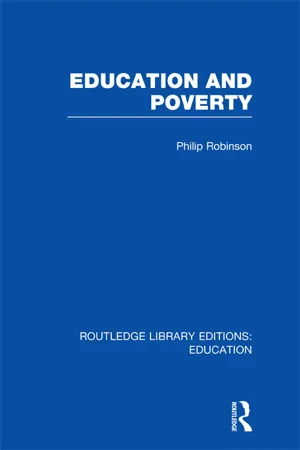
This book describes the attempts that have been made to achieve an educational policy relevant to those most disadvantaged in our society; examines the different ways in which sociologists have conceptualized the related problems; and evaluates the success of the policy. He suggests that we are in need both of a more realistically defined view of what schools can do and a concerted official approach to compensatory policy.
- 4 pages
- English
- ePUB (mobile friendly)
- Available on iOS & Android
eBook - ePub
Education and Poverty (RLE Edu L)
About this book
Information
1

Poverty:
private trouble
and social issue
Illth, an antonym to prosperity, is socially distributed; a minority of the population owns 95 per cent of the illth whilst the majority owns only 5 per cent. Some children are born into illth and no matter how they labour die with their capital stock undamaged. 111th has both social and private dimensions; the costs of bad housing, overcrowding, pollution, of strained social services are met by those who experience the most hurt, out of a private income which is usually below the national average wage. 111th is concentrated in what Rex (1968) has called a zone of transition, or those areas of the inner-city where houses are old; owned either by the council pending demolition or by absentee private landlords; and where the people are mainly the elderly or immigrants into the area. The former are a symbol of what the area was once like before the development of the land of the commuter whilst the latter fill the only accommodation available to those who have neither the resources to buy a house nor the residential qualifications to obtain a council tenancy.
This book is about the provision of education for the illthy, it is also about the provision of education within inner-city areas. The central problem which is addressed is the paradox that whilst there is a concentration of problems in the inner-city the majority of the illthy live outside. Thus a policy which concentrated on the zone of transition would only meet the needs of a minority whilst a policy which ignored the special needs of the inner areas could result in their increasing isolation and rapid deterioration of the social environment. I shall argue that reform within the education service will have little effect on improving the life chances available to the illthy as a group, though it can make an important contribution to the quality of life of the individual. Education has to operate at two distinct levels, the macro or the level of the group, and the micro or individual level. As a social service it must be adequate at both levels. At the level of the individual the tripartite system of grammar, technical and modern schools did have some success in that some individuals from the most disadvantaged homes achieved great academic distinction, yet at the level of the group this system failed to promote the interests of the disadvantaged as a group. An educational policy which resulted in equivalent outcomes for different social groups would be a failure at the individual level if a particular student was unable to develop his potential to the full. At the macro level education is inextricably linked to housing, employment, income and health; education will not improve the life chances of a group unless its policies are in harmony with those of other social policy departments. Much of the despair over the apparent failure of educational reform over the past ten years has been the result of confusing the macro and the micro levels. The challenge is with other government departments to develop a framework of a policy for the disadvantaged within which the individual child is able to maximize his own potential, whatever that may be.
The explanation of this dilemma will take us along many different paths. In this chapter the life-world of the illthy is discussed including attempts to assess the number of individuals who might be considered to be in poverty. The stress is not on the total population of the poor but on the number of children living in poverty with the intention of evaluating the magnitude of the task facing the education service. In Ch. 2 I take up the point that any solution to a problem is contingent on how the problem is defined. There are many ways of explaining poverty and it would be an interesting exercise within sociology to try and explain why certain explanations prevail at any particular historical period; my intention is to look at some of these explanations as vehicles for launching an educational policy for the illthy. In the third chapter current attempts at what is called ‘compensatory’ education are described and then, in Ch. 4, related to the wider issue of policies of positive discrimination, the strategy adopted by both Labour and Conservative governments in their approach to the problems of inner-city areas. Finally the paradox facing education is confronted: what sort of educational policy would meet the needs of those most disadvantaged in our society, bearing in mind the requirement of being adequate at both the micro and macro level?
The rediscovery of poverty
Friday, 9 October 1959 was a pleasant autumn day, warm with sunny intervals. It was also the day after the election when the Conservative Party was returned for the third successive time with an overall majority of a hundred. The election was symbolized by their poster, ‘You’re having it good. Have it better. Vote Conservative.’ The message was clear. In Manchester Harold Macmillan, the leader of the party, reported that nearly three million people could afford a holiday abroad and that nearly one family in three had got a motor car. In Birmingham he observed that there was no cleavage between the rich and the poor, all that had changed and a new world was approaching. This belief was echoed in a leader in The Times after the election: ‘A prosperous, mainly middle class Britain cannot be stampeded by the crude old cries of under-privilege.’ Abrams (1960) argued that the basic class position of the Labour Party was being eroded and a new middle class society was being born; if it was to succeed the Party would need to adapt, change its image, even become a socialist party before it was again returned to power. Poverty was not fashionable in 1959.
Five years earlier Townsend (1954) had begun to point out some of the assumptions upon which the belief of a narrowing gap between rich and poor was based. The definition of poverty accepted by the government not only assumed the poor, ‘to be skilled dieticians with marked tendencies towards puritanism’, but completely ignored those requirements necessary to allow the individual to act as a member of his own community, requirements like being able to offer a cup of tea, a cigarette or talk about a television programme. Townsend responded to the 1959 election with the warning that in a society seduced by its own affluence lay the danger that the sizeable minority who were poor would be neglected. The election campaign had not been informed of the extent of poverty.
The measurement of poverty
A classic study of the extent of poverty is that of Rowntree undertaken in York in 1899. He divided families living in poverty into two sections:
1. Families whose total earnings are insufficient to obtain the minimum necessaries for the maintenance of merely physical efficiency. Poverty falling under this head may be described as ‘primary’ poverty.
2. Families whose total earnings would be sufficient for the maintenance of merely physical efficiency were it not that some portion of it is absorbed by other expenditure, either useful or wasteful. Poverty falling under this head may be described as ‘secondary’ poverty.
Rowntree was convinced of the possibility of providing an absolute measure of poverty, an unequivocal line below which one was poor above which not poor. The task was made easier by developments in nutritional science which enabled the cost of providing food for the ‘maintenance of merely physical efficiency’ to be calculated. Such cost plus expenditure on rent and various sundries as clothing and fuel could be used as a basic measure of poverty. Rowntree was aware of some of the problems of the exercise and discussed the different food requirements needed to sustain men doing various jobs, but he was not aware of the different metabolic rate, that is the efficiency with which different people burn food. He was aware of the fact that ‘the poor buy their food in small quantities, and thus pay a higher price for it’ a problem which Piachaud (1974) discussed as being a persistent problem for the poor. The implication of these reservations is that the drawing of an ‘absolute’ poverty line is still a fairly arbitrary act in which judgement about life-style is endemic. Rowntree assumed a man would need a diet whose energy value was 3,500 calories obtained from a menu which was less generous than that which was currently offered in the workhouse. Meat was not allowed because of its cost, the major item was bread which it was assumed the poor would make for themselves. The allowed cost of food was 15p each week for adults and 11 1/2p for children. Having undertaken a similar exercise for fuel and clothing he concluded that in York in 1899 a family of four would require 94ip plus rent to meet minimum necessary expenditure. His survey revealed 7,230 people or 9.91 per cent of the population of York to be living at or below the level of primary poverty.
The criteria used were stringent. There was no allowance for a cup of tea, a pint of beer or even a ride on a bus or a train. Any expenditure on these items would have to be met by going without food. But a precedent had been set which was taken up by Beveridge in 1942 in his review of existing schemes of social insurance and his recommendations for the new Britain to emerge from the war. Though not a member of the committee chaired by Beveridge, Rowntree was a member of a sub-committee appointed to calculate a rate of benefit adequate for subsistence. The ‘basket of goods’ model was to prevail: ‘In considering the minimum income needed by persons of working age for subsistence during interruption of earnings, it is sufficient to take into account food, clothing, fuel, light and household sundries, and rent, though some margin must be allowed for inefficiency in spending.’ The calculations were based on 1938 figures to give an income requirement of £1.60 for a man and wife and an average of 35p for each child. In this way was born the official measure of poverty, the point at which National Assistance Benefits, since 1966 Supplementary Benefit, is to be paid.
The level of this official poverty fine is as arbitrary as that originally conceived by Rowntree. It is a committee number, the product of what is deemed necessary as a result of using a yardstick of the Rowntree type. What is not considered is the actual life-style of those on the lowest income; we have too little evidence on how those with the least resources actually manage, how they budget, what their priorities are, how they allocate expenditure. The present supplementary benefit rates are not generous, the ordinary weekly rate for husband and wife and two children of junior-school age would be £22.25 from 7 April 1975. Second, the rates have been remarkably consistent; Young (1975) shows that in 1948 ordinary supplementary benefit for a married couple was 29 per cent of average earnings and that in 1974 the figure was still 29 per cent. Field (1975) has given the warning that with inflation at its current rate the purchasing power of the poor is being eroded and even after the increases due in November 1975 ordinary benefit for a married couple will have fallen back to 26 per cent of average earnings. Finally, the rates have little relation to costs; the assumption made is that girls and boys cost the same, that a four-year-old costs about half to keep as a fourteen-year-old, that a seventeen-year-old is not an adult. What is not considered are the requirements necessary to enable the recipient to participate as a member of his local community.
The extent of poverty
The official definition of poverty is the level of resources at which one becomes entitled to supplementary benefit; £9-60 plus rent for a person living alone, £22«25 plus rent for a married couple with two junior-school children, as from 7 April 1975. The estimates of the percentage of the population living below the supplementary benefit level range from 3-2 per cent in 1972 to 3-8 per cent in 1960. The most important study undertaken into the extent is that of Able-Smith and Townsend (1965) using material gathered by the government for the 1960 Family Expenditure Survey. They showed that 14 per cent of the sample, an equivalent of seven and a half million people, were living at a level of income which was less than 40 per cent above the then national assistance rates. This cut-off point was chosen on the grounds that the actual rates under-represent the resources available to families on two counts; first discretionary payments may be made in addition to the basic scale for such items as extra heating, special diets and other exceptional needs, and second some income is not counted when entitlement to benefit is being assessed such as the first £2 of a disability pension, educational maintenance allowances and some savings. The 140 per cent line was taken as representing more closely the actual resources upon which the poor have to manage. The particularly disturbing finding was that 40 per cent of the sample, representing some three million people, were in households where the head was in full-time work; being paid poverty rates for his labour. The other categories identified were the old, two and a half million people; the sick and those in one-parent families, each representing three quarters of a million people; and the unemployed representing half a million people. Taking a lower limit of 120 per cent of supplementary benefit rates, the government estimated that 19 per cent of all families, about five million, were living in poverty in 1972.
The implicit definition of poverty used has been income poverty, but poverty is also lack of good schools, adequate homes, places to play, opportunity to choose. The attempts to measure the extent of poverty have taken a snapshot at a point in time disregarding those who live perilously close to the line. These are the people who are vulnerable to unemployment, to falling wages with increasing age, to pestilent inflation. If five million families are poor today far more carry the immediate cost of poverty and know poverty as a constant shadow in their lives.
What is poverty?
‘For you have the poor among you always’; is this quotation from St John’s Gospel an inevitable prediction? Rowntree tried to construct an absolute scale of poverty, a basic minimum which would allow the possibility for poverty to be eradicated. In fact in his third study of York published in 1951 Rowntree, in conjunction with Lavers, was able to show that primary poverty as he had defined it had been eliminated. There is now almost universal agreement that poverty is not an absolute but a relative concept. It could be argued that as government raised the poverty line to keep pace with increasing costs all that was happening was the perpetuation of the poverty sector, those who were poor being those who fell in the bottom 1, 5 or 10 per cent of the income distribution. As poverty is inevitable, by definition, then the task of government is limited to the alleviation of the more acute hardships experienced by the poor; poverty itself cannot be elminated. This is, however, to ignore the most important consequence of the shift from an absolute to a relative conception of poverty, the focus on the total distribution of resources within society. So long as an absolute concept is held, attention is on the appropriateness of the poverty line, argument centres on whether it is reasonable to expect the poor to live at the level the line dictates, concern is expressed about the need to ease the burden of poverty. Ignored is the principle that a theory of illth implies a theory of wealth, that poverty is part of the same pattern which produces opulence. The problem of poverty cannot be solved unless the problem of wealth is solved. The impotence of existing poverty policies is that they ignore the latter; without some redistribution of wealth poverty will endure.
There is an important distinction to be made between wealth and income; wealth refers to the stock of possessions owned by someone whilst income refers to the level of control one has over society’s scarce resources. Clearly one way of increasing income is to release some possessions though for most people their source of income is derived from selling the only possession which is readily available, their own labour. The poor are characterized by having little wealth and little income, the rich by ...
Table of contents
- Front Cover
- Half Title
- Title Page
- Copyright
- Dedication
- CONTENTS
- Editor’s introduction
- 1 Poverty: private trouble and social issue
- 2 What problem? What solution?
- 3 Strategies for compensation
- 4 The hope of positive discrimination
- 5 Education and social services
- 6 Conclusions
- References and name index
- Subject index
Trusted by 375,005 students
Access to over 1.5 million titles for a fair monthly price.
Study more efficiently using our study tools.
Frequently asked questions
Yes, you can cancel anytime from the Subscription tab in your account settings on the Perlego website. Your subscription will stay active until the end of your current billing period. Learn how to cancel your subscription
No, books cannot be downloaded as external files, such as PDFs, for use outside of Perlego. However, you can download books within the Perlego app for offline reading on mobile or tablet. Learn how to download books offline
Perlego offers two plans: Essential and Complete
- Essential is ideal for learners and professionals who enjoy exploring a wide range of subjects. Access the Essential Library with 800,000+ trusted titles and best-sellers across business, personal growth, and the humanities. Includes unlimited reading time and Standard Read Aloud voice.
- Complete: Perfect for advanced learners and researchers needing full, unrestricted access. Unlock 1.5M+ books across hundreds of subjects, including academic and specialized titles. The Complete Plan also includes advanced features like Premium Read Aloud and Research Assistant.
We are an online textbook subscription service, where you can get access to an entire online library for less than the price of a single book per month. With over 1.5 million books across 990+ topics, we’ve got you covered! Learn about our mission
Look out for the read-aloud symbol on your next book to see if you can listen to it. The read-aloud tool reads text aloud for you, highlighting the text as it is being read. You can pause it, speed it up and slow it down. Learn more about Read Aloud
Yes! You can use the Perlego app on both iOS and Android devices to read anytime, anywhere — even offline. Perfect for commutes or when you’re on the go.
Please note we cannot support devices running on iOS 13 and Android 7 or earlier. Learn more about using the app
Please note we cannot support devices running on iOS 13 and Android 7 or earlier. Learn more about using the app
Yes, you can access Education and Poverty (RLE Edu L) by Philip Robinson in PDF and/or ePUB format, as well as other popular books in Education & Education General. We have over 1.5 million books available in our catalogue for you to explore.