The Communication Yearbook annuals publish diverse, state-of-the-discipline literature reviews that advance knowledge and understanding of communication systems, processes, and impacts across the discipline. Sponsored by the International Communication Association , each volume provides a forum for the exchange of interdisciplinary and internationally diverse scholarship relating to communication in its many forms. This volume re-issues the yearbook from 1983.
IN his classic work on the “judicial mind,” Schubert (1965) found that ideologies and attitudes of justices of the Supreme Court of the United States accounted for a significant amount of their voting behavior. His sophisticated model of judicial behavior confirmed the a priori, albeit then inconoclastic, conclusion about the relationship between the Constitution and the Court held by Chief Justice Charles Evans Hughes: The Constitution, quite simply, is what judges say it is.
Schubert was not the first to predict decisions of the Supreme Court successfully, nor was he the last. Pritchett (1948), for example, used “bloc analysis” to reach essentially the same conclusions. Perhaps Pritchett stated the judicial behavioralistic premise most explicitly: “Private attitudes, in other words, become public policy.” The work of neither Pritchett nor Schubert would have surprised students of the school of legal realism who preceded the behavioralists. Hughes, Holmes (1897), Cardozo (1921), Frank (1930), and Llewelyn (1931), among others, had suggested for several decades that the human element existed in judicial decision making even though the notion of “mechanical jurisprudence” was, and continues to be, the guiding force in courts and law schools in the United States. Law is not something that is delivered by a stork; law is judicature, which is what judges, acting in a politically charged atmosphere, do (Sheldon, 1974).
Schubert’s progeny also number many, for example, Rohde and Spaeth (1976) have refined the predictive model; Berkson (1978) and Wasby (1970) have pursued impact models; Goldman and Jahnige (1976) have developed a systems model; Grossman (1968) has suggested a role model; Grunbaum (1969) offered a simulation model; and McLaughlin (1972) and Danelski (1961) have explored structural models.
Some subsequent applications of Schubert’s work have been in refining prediction in substantive areas of law; for example, Rohde and Spaeth (1976) have been highly successful in foreseeing the outcome of disputes at the Supreme Court by carefully depositing docketed cases into Guttman scales organized by familiar subjects and litigants (thus distinguishing Supreme Court attitudes toward subjects and Supreme Court attitudes toward objects; Spaeth & Parker, 1969).
Most research of Supreme Court attitudes toward the First Amendment, however, has largely ignored the helpful methodologies offered by the judicial behavioralists despite encouragement toward empiricism by some communication law scholars (Gillmor & Dennis, 1975, 1981; McGaffey, 1973). Some of this hesitation might stem from distrust of quantification that does not fit comfortably into the methodology of legal practice itself or into the tradition-laden system of jurisprudence. More hesitation might stem from sincere and as yet insufficiently explored doubt about the uniqueness of freedom of speech and press as an attitudinal referent and therefore as an appropriate substantive area of application for methodologies in the study of judicial behavior.
Some attempts to answer this question have been generally unsatisfactory because, among other reasons, case samples have been too broad or too narrow, operationalization of speech or press freedom has been lacking, or analyses have been too limited to take into consideration the multidimensional nature of the First Amendment.
In his study of the voting patterns of the Vinson and Warren Courts, Schubert (1965, 1974) developed two general scales: economic and civil liberties. He also developed several subscales, including one called “political freedom,” which was found to be a satisfactory attitudinal referent. Among the cases constituting the political freedom subscale were free expression cases, but so were voting rights and other cases that one could argue spoiled the unidimensionality of a hypothetical free speech and press scale. The same sort of problem existed in Rohde and Spaeth’s (1976) scales for the Burger Court, except that they may have narrowed the First Amendment scale too much because, for example, cases dealing with the fair trial-free press, privacy, and obscenity issues were placed in separate or other scales, not the First Amendment scale. Schwartz (1981) and Stempel (1982) both successfully scaled free press cases, concluding that at least the Burger Court has had a measurable, primarily negative, attitude toward freedom for the mass media. Arledge and Heck (1982), on the other hand, did not find the same thing when they scaled press freedom cases. They decided that the Burger Court has been in too much disarray to have had a unidimensional attitude toward press freedom.
All of the research in this area has used Guttman scalogram analysis (Guttman, 1944) as its primary method, with cases acting as questions-stimuli (referent) and votes as answers-responses (behavior). Guttman scaling assumes that if a set of reasonably related questions are asked of a legitimate sample of respondents and that if a coefficient of reproducibility and a measure of minimum marginal reproducibility reach a predetermined level of acceptability, then an attitude of the respondents toward the referent may be said to exist. Schwartz (1981) and Stempel (1982) thus found that the Supreme Court has had an attitude toward freedom of speech and press, but Arledge and Heck (1982) did not.
One possible explanation for this disparity could be in the respective case samples selected for study. Schwartz (1981) looked at 102 press cases that he operationally defined as cases appearing in designated volumes of United States Reports and United States Law Week under the index headings of “freedom of press,” “freedom of speech,” “freedom of expression,” “freedom of communication,” “freedom of speech and press,” and “obscenity.” In addition, Schwartz (1981, p. 14) required that the cases prompt either or both litigants or any or all justices to invoke the freedom of speech or press clause of the First Amendment as a major argument. A chosen case had to involve an attempted or successful interference with a “pure speech” communication with a mass audience.
Stempel (1982) examined 47 press cases that he did not operationally define. Arledge and Heck (1982, p. 2, fn. 3) studied 31 press cases that they operationally defined as any case in which the press or a journalist was a party and in which one or more justices took the position that the case involved a press freedom issue under the First Amendment. Arledge and Heck did not consider attitude toward subject as well as attitude toward object, even though Spaeth and Parker (1969) found that it was important to distinguish between the two attitudes. What Arledge and Heck may have found was that the Burger Court has not had a particular attitude toward the mass media as an institution, not that the Burger Court has not had an attitude toward freedom of speech and press. In addition, Arledge and Heck did not consider some cases that have had great significance for freedom of the press.1
Another reason for dissatisfaction with these studies might be in the lack of comparability of Supreme Court attitudes toward press freedom and toward other referents. Schubert (1965, 1974), while encouraging the development of behavioral study of other secondary and tertiary subscales, was unsatisfied by scaling alone to determine their unidimensionality. He compared the various primary (civil liberties and economic) and secondary (political freedom, fair procedure, right to privacy, prounion, antibusiness, federal fiscal claims) scales to ascertain whether they might in fact represent attitudes toward the same subjects.
Schubert attempted to make these comparisons by constructing matrices of rank-order correlation coefficients based on Guttman scale ranks of Vinson and Warren Court justices in each of the scales. He found scales correlated highly with some subscales; for example, fair procedure correlated with civil liberties at .970 and antibusiness correlated highly with economics at .998. Schubert also found it interesting when subscales were highly correlated with each other—for example, when political freedom correlated with fair procedure at .912. But he concluded that since the substantive subcategories of cases had satisfactorily scaled, they constituted unique referents. Other researchers have not compared press and speech freedom with other scales.
A third cause for dissatisfaction with and disagreement between the studies might be, as Nord (1977) put it, that a method such as Guttman scaling, which can measure only one dimension of freedom of speech and press, is inadequate when the multidimensional nature of the concept is obvious. Factor analysis, for example, might provide a better means by which to approach freedom of expression.
Given the findings of Schwartz and Stempel, it should be fair to say that speech and press freedom is a scalable attitudinal referent for the Supreme Court. This chapter attempts to explore how that scale compares to other of Schubert’s scales and subscales. In addition, this chapter will attempt to address yet another aspect of the problem by questioning the desire to attain only attitudinal unidimensionality and the selection of a methodology that can achieve only that purpose.
Method
The unit of analysis chosen was the Supreme Court case, which can be conceptualized as a dichotomous question with favorable or unfavorable answers. The Supreme Court decided 1747 nonunanimous economic and civil liberties (general) cases between 1946 and 1969, a period that spanned terms under the leadership of two chief justices, Frederick Vinson and Earl Warren, and eighteen other justices (Ryan & Tate, 1975, p. 80).
The period can best be examined if it is broken into four parts: the Vinson Court, which decided 451 cases between 1946 and 1953; the early Warren Court, which decided 329 cases between 1953 and 1958; the middle Warren Court, which decided 564 cases between 1958 and 1965; and the late Warren Court, which decided 413 cases between 1965 and 1969. The temporal divisions are necessary to avoid as much as possible the comparison of reaction by justices who did not serve together toward cases that were presented in varying contexts (Ryan & Tate, 1975, pp. 21–28).
Types of cases should also be analyzed separately. Three samples of cases will be analyzed: (1) all 1757 general cases, (2) 1002 civil liberties cases, and (3) 69 press and speech freedom cases. Schubert assembled the first two sets of cases and Schwartz’s (1981) criteria were used to assemble the third (see Appendix). Rank orders in each of the samples, based on degree of proportional liberalism in general and civil liberties cases and degree of proportional favorableness in press freedom cases, were constructed and compared with Spearman rho correlation coefficients in a matrix. A liberal or conservative vote was determined by Schubert; a press or speech favorable vote was determined by whether the litigant advancing a First Amendment claim was favored. Factor analysis, based on the degree of interagreement among justices, was performed to reach for additional dimensions of free expression ideology not provided by Guttman scaling.
Findings
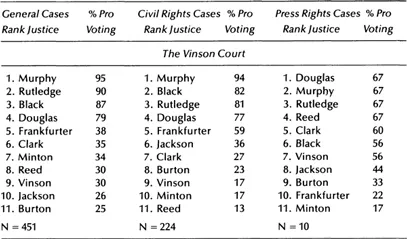
Each of the thirteen scale rankings was rather predictable for astute students of the Supreme Court. During the Vinson Court period, for example, Justices Frank Murphy, Wiley Rutledge, Hugo Black, and William Douglas generally voted more liberally than did Chief Justice Frederick Vinson and Justices Felix Frankfurter, Tom Clark, Sherman Minton, Stanley Reed, Robert Jackson, and Harold Burton (see Table 1.1). Frankfurter was more liberal in civil liberties cases than in economics cases. In the small sample of free expression cases, on the other hand, seven of the eleven justices voted favorably more often than they voted unfavorably. Reed, Clark, and Vinson were much more favorable in these cases than they were liberal in other kinds of cases. Frankfurter, in contrast, was less favorable in First Amendment cases than in other cases.
Table 1.1
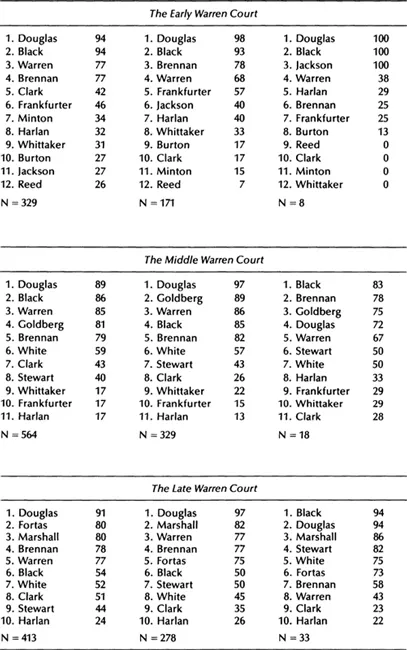
Rankings and Percentage of Liberalism in General and Civil Liberties Cases and Favorableness in Free Expression Cases
Note: To conserve space, ranks in whole numbers are assigned to justices who tied for a position. The correlation coefficients were calculated on the basis of tied (half) ranks.
During the early Warren Court period, Douglas, Black, Warren, and William Brennan were the most liberal justices. Frankfurter again showed he was more liberal in civil rights cases than in other cases, but not nearly as favorable toward the press and speech litigants. Black, Douglas, and Robert Jackson had perfect voting records in the small sample of First Amendment cases, while Warren and Brennan seemed much less favorable than they were in other cases. Apparently, for justices like Frankfurter, Jackson, Warren, and Brennan during these early periods, freedom of the press and speech did not present the same sort of ideological questions that other Supreme Court cases did, but this finding...
Table of contents
Cover
Half Title
Title Page
Copyright
Contents
Preface
Overview
Part I: Communication Reviews and Commentaries
Part II: Information Systems
Part III: Interpersonal Communication
Part IV: Mass Communication
Part V: Organizational Communication
Part VI: Intercultural and International Communication
Part VII: Political Communication
Part VIII: Instructional Communication
Part IX: Health Communication
Part X: Human Communication Technology
Part XI: Philosophy Of Communication
Author Index
Subject Index
About the Editor
About the Authors
Trusted by 375,005 students
Access to over 1.5 million titles for a fair monthly price.
Study more efficiently using our study tools.
Frequently asked questions
Yes, you can cancel anytime from the Subscription tab in your account settings on the Perlego website. Your subscription will stay active until the end of your current billing period. Learn how to cancel your subscription
No, books cannot be downloaded as external files, such as PDFs, for use outside of Perlego. However, you can download books within the Perlego app for offline reading on mobile or tablet. Learn how to download books offline
Perlego offers two plans: Essential and Complete
Essential is ideal for learners and professionals who enjoy exploring a wide range of subjects. Access the Essential Library with 800,000+ trusted titles and best-sellers across business, personal growth, and the humanities. Includes unlimited reading time and Standard Read Aloud voice.
Complete: Perfect for advanced learners and researchers needing full, unrestricted access. Unlock 1.5M+ books across hundreds of subjects, including academic and specialized titles. The Complete Plan also includes advanced features like Premium Read Aloud and Research Assistant.
Both plans are available with monthly, semester, or annual billing cycles.
We are an online textbook subscription service, where you can get access to an entire online library for less than the price of a single book per month. With over 1.5 million books across 990+ topics, we’ve got you covered! Learn about our mission
Look out for the read-aloud symbol on your next book to see if you can listen to it. The read-aloud tool reads text aloud for you, highlighting the text as it is being read. You can pause it, speed it up and slow it down. Learn more about Read Aloud
Yes! You can use the Perlego app on both iOS and Android devices to read anytime, anywhere — even offline. Perfect for commutes or when you’re on the go. Please note we cannot support devices running on iOS 13 and Android 7 or earlier. Learn more about using the app
Yes, you can access Communication Yearbook 7 by Robert Bostrom in PDF and/or ePUB format, as well as other popular books in Languages & Linguistics & Communication Studies. We have over 1.5 million books available in our catalogue for you to explore.