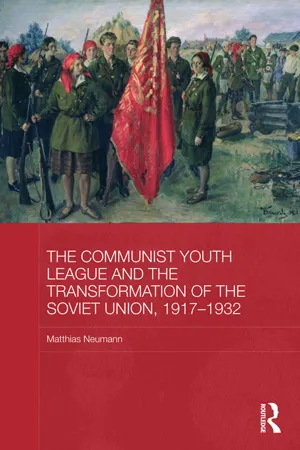
The study of Soviet youth has long lagged behind the comprehensive research conducted on Western European youth culture. In an era that saw the emergence of youth movements of all sorts across Europe, the Soviet Komsomol was the first state-sponsored youth organization, in the first communist country. Born out of an autonomous youth movement that emerged in 1917, the Komsomol eventually became the last link in a chain of Soviet socializing agencies which organized the young. Based on extensive archival research and building upon recent research on Soviet youth, this book broadens our understanding of the social and political dimension of Komsomol membership during the momentous period 1917–1932. It sheds light on the complicated interchange between ideology, policy and reality in the league's evolution, highlighting the important role ordinary members played. The transformation of the country shaped Komsomol members and their league's social identity, institutional structure and social psychology, and vice versa, the organization itself became a crucial force in the dramatic changes of that time. The book investigates the complex dialogue between the Communist Youth League and the regime, unravelling the intricate process that transformed the Komsomol into a mere institution for political socialization serving the regime's quest for social engineering and control.
eBook - ePub
The Communist Youth League and the Transformation of the Soviet Union, 1917-1932
- 288 pages
- English
- ePUB (mobile friendly)
- Available on iOS & Android
eBook - ePub
The Communist Youth League and the Transformation of the Soviet Union, 1917-1932
About this book
Information
Part I
Revolution and Civil War
1 The Birth of the Russian Youth Movement
Historical paradigms do not die easily. The image of an omnipresent and omnipotent autocratic regime which left no space for civic initiative and social engagement endured for a long time after it had been washed away by the February Revolution of 1917. Indeed, in popular history the paradigm remains prevalent. It is, however, far from the truth as numerous scholars have shown convincingly. Modernity arrived in Russia long before the watershed of 1917. Late imperial culture underwent a deep transformation which saw not only the emergence of a small but thriving civil and civic society, but also the beginning of mass and consumer culture. Numerous philanthropic, educational, cultural and recreational organizations mushroomed before and after the revolution of 1905, particularly in the growing urban centres. These penetrated not only the middle and upper classes but also the working class.1 The Great Reforms under Alexander II which accelerated urbanization and state-sponsored industrialization, as well as the increased interest in Russian national culture, facilitated this development.2 It was in the urban context that the term obshchestvennost’ came to refer to a ‘common identity to people of different estates and professions (and varying political views) who committed themselves to social duties’.3
Obshchestvennost’ is a term which is notoriously difficult to define. It carries with it connotation of public sphere, civil society, educated public, and social and political associational engagement.4 It is possible, albeit problematic, to locate the radical intelligentsia and even revolutionaries, with their visionary service to society, within obshchestvennost’, even though they often found themselves at odds with the liberal groups that worked within the existing political system and did not define themselves primarily in opposition to it. The professoriate, for instance, as Samuel Kassow has pointed out, regarded the student movement (studenchestvo) as a ‘major obstacle in the fight for academic freedom and university autonomy’;5 while the uncensored oppositional press would generally celebrate studenchestvo, portraying it as progressive and as part of a ‘public opinion’ in Russia.6
Obshchestvennost’, then, provided a conceptual framework, blurred and hybrid in character, that had enough diversity to embrace people with opposing ideological perspectives. Whereas some wanted to challenge and overthrow the existing order, others supported it and were prepared to work with it; others, in turn, oscillated between these two extreme poles. All members of obshchestvennost’, however, shared a commitment to social engagement which in itself posed a challenge to the authority of the central power and officialdom. Nevertheless, the relationship of the imperial Russian state to obshchestvennost’ can hardly be seen as a clear dichotomy. This observation applies even more so to the relationship of the Soviet state to obshchestvennost’.7 In the 1920s a huge bureaucratic machine emerged in Soviet Russia, a propaganda and agitation apparatus consisting of a vast number of agencies disseminating the Bolshevik cultural project and monitoring its implementation.8 This apparatus was, however, not the only agency concerned with the propagation of Bolshevik cultural visions. One of the crucial features of communist propaganda in the early Soviet period was that it included elements of civil society and thus offered opportunities for collectivist expressions. Seeking to create an egalitarian society in which the individualistic ‘I’ would be replaced by the collective ‘we’, the regime enunciated the formation of a Soviet obshchestvennost’ through various social and cultural organizations. These organizations were intended to act as transmission belts between the state and society. Sandra Dahlke argued in this context that the Soviet civic or public sphere has to be understood as a complex communication network which was created through negotiation between diverse interest groups as well as between society and political authority. The dialogue between these groups, organizations and political actors took place in the public sphere, making all participants part of it.9
The 1920s witnessed an impressive growth of a wide variety of social organizations, ranging from state-sponsored mass organizations such as the Komsomol or the civil defence league OSOAVIAKhIM, to small cultural-enlightenment societies and sport associations.10 The regime-sponsored ‘voluntary organizations’ (dobrovol’nye obshchestva) or ‘social organizations’ (obshchestvennye organizatsii) in particular became a focal point and agent in this process of constructing the ever-changing ideas of socialist culture. The new mass organizations served multiple functions in this context. In becoming pillars of the new Soviet obshchestvennost’, these organizations were supposed to help integrate a very fragmented population into a structured Soviet society; they were a means to represent, affirm and gain mass support for the Bolshevik transformation project, providing it with much needed legitimacy.11 Stalin later called them ‘the root of the socialist organisation of the public’.12 However, we should not forget that pre-revolutionary cultural clubs, theatre groups and private publishing houses also carried on operating.13
The continuing existence of these organizations and societies, and even more so the notable growth in social organizations, constitute a development that, as Irina Il’ina has argued, gives good reason to speak of a ‘golden age of Soviet obshchestvennost’ during the 1920s.14 This massive growth in civic activity did not emerge out of a vacuum. It can only be understood in the context of the emergence of a nascent civil society during the last decades of imperial Russia. Without the existence of the latter, it would be difficult to explain the extent to which political and social engagement erupted so abruptly after the collapse of autocracy. As the central power crumbled the people established new and autonomous centres of power almost overnight. These new organizations found many of their most active members among people who had been part of obshchestvennost’ before the Revolution. They should be borne in mind when studying the evolution and development of social organizations that emerged in context of the Revolution. The fact the Bolshevik regime would attempt to create a new obshchestvennost’ by creating new mass organizations should not prevent us from properly tracing the origins of these organizations. For many of them, their personal, institutional and cultural links lay in the pre-revolutionary period or in the turmoil of 1917 itself. The history of the Komsomol, established in October 1918, is no exception. Its origins go back to a number of grassroots organizations which emerged in and before 1917, and is particularly linked to the evolution of an autonomous youth movement in Petrograd. Better-educated people, i.e. young self-styled ‘conscious’ workers and students, played a crucial role in the formation of the youth movement which emerged as part of a wider working-class movement in 1917. In urban centres like Moscow and Petrograd youth circles had been established in people’s houses and factories in the final years of the tsarist empire. Evening courses brought together young people from all different districts and factories and generated new social networks. Reading and drama circles in particular proved to be popular among youth aged 15 to 20 years.15
Similarly, the student movement, albeit in crisis in 1914, had not disappeared. The disastrous performance of the regime in the war only encouraged the politicization of the students. When the February Revolution erupted, students formally declared their support for the workers’ movement and many took part in the street disorders in February.16 Of course, even before the war, there had been youth student circles and worker circles, and both kept their distinctive characters. However, it is important to note that even then the two clearly interacted.17 Young people who were involved in these circles before 1917 embodied a link to the existence and ideas of the old obshchestvennost’ and would do so for some time to come. Youth groups, as Diane Koenker has highlighted, were created in various ways in 1917. Some had clear links to existing circles, others would be formed by ‘energetic individuals, some representing party organistions and some only the idea of organisation’.18 The role of young people in this process is evidently clear.
In his study of Soviet youth, Ralph T. Fisher asserted that ‘the origins of Komsomol pattern must … be sought among Bolshevik ideas respecting the traits of any good Party member, among Bolshevik views on the relation of the Party to Russian youth in general, and in Bolshevik policies concerning the organizing of youth’.19 But this, clearly, can only be half of the answer. What is neglected in earlier works on the Komsomol, something that regrettably is also not sufficiently taken into account in Fisher’s otherwise superb study, is the agency of youth itself in the emergence and development of the Komsomol. Much of the earlier work largely ignores the immediate prehistory of the Komsomol or analysed it with the presumption that the organization was clearly incorporated into the new state from its start. Some studies describe the period between February 1917 and October 1918 simply in terms of a Bolshevik policy characterized by infiltration, penetration and capture of leadership, and largely ignore any developments from below that led to the formation of the Komsomol.20 Fisher too, spending only a few pages on the prehistory of the Komsomol, opens his chapter on the formation of the Komsomol with the bold assertion that ‘[t]he Communist Party established the Komsomol in 1918’21 – a plain oversimplification of the matter.22 Developments between the October Revolution and the establishment of the Komsomol in particular remained a blank spot in all these studies. Admittedly, the Petrograd youth movement almost completely disintegrated during that period. This, however, does not imply that the Komsomol was formed without links to 1917, a fact well-highlighted by Isabel Tirado’s study on Petrograd’s youth movement.23 She demonstrated that its transformation corresponded at all stages to the general development of the Revolution – in ‘its emergence, definition and realignment’.24 It was part of a larger workers’ movement, but also ‘the expression of autonomist, potentially “syndicalist” forces within the revolutionary process’.25
Child of Revolution
The political and social crisis in urban Russia, the war and finally the February Revolution of 1917 caused a general politicization of the population as well as an enormous increase in popular public activity across classes. This, in turn, stimulated the formation of numerous organizations and institutions, from soviets, trade unions and factory committees, to special interest groups of various kinds. ‘While some things got shattered, others were being organised. … Even the thieves started to organise themselves’,26 remembered Ekaterina Olitskaia. Many of the youth groups and circles that sprang up were the expression of a subgroup among the heterogeneous working class.27 It was no surprise that the revolutionary centres, the Moscow and Petrograd areas, became the centre of the movement, though youth groups and organizations mushroomed later in 1917 in other urban centres, such as Smolensk, Voronezh, Kazan, Odessa, Ekaterinburg, Viatka and Perm.28
The initial rise of the youth movement in February 1917 in Petrograd is clearly linked to the protests of women workers who brought their grievances onto the streets on 23 February, International Women’s Day. Young metalworkers in particular responded to the women’s call for joint demonstrations. Women and young workers comprised an important spontaneous force in the February Revolution. The young workers’ politicization was clearly linked to the dislocation of the economy during the war and the strong influx of adolescents into the labour force.29 Already before the war young urban-born workers, ‘hot-headed and impulsive’, were a driving force in the radicalization of the working class.30 This had not changed; if anything their militancy had increased as highlighted by their strong involvement in direct revolutionary actions such as freeing prisoners, capturing arms and sacking police stations.31 In many respects this development only echoed what was happening all over Europe. The radicalization of working-class youth during the war, leading to its backing of the most radical positions within the socialist movement, was a trans-European phenomenon.32
In Russia, most of the newly formed institutions, especially the soviets and factory committees, did not really represent the interests of young people, and thus fostered the urge among youth to build up their own organizations.33 Generational tensions were also an ingredient in this process. In a sense, the youth groups were both part of, and a response to, the growing factory committee movement. The strong link to the factory committee movement became even more obvious when the first citywide meeting of youth organizations formed an organizational bureau on 13 April 1917 to organize the expansion of the youth movement into further districts of the Petrograd area. Its main programmatic aim was to set up youth commissions in all factories to represent the interests of young workers.34 Although there was also a desire to secure representation in the soviets, the main focus was on the factory committees which constituted the most important organization in the microcosm of their workplace. Economic issues were, unsurprisingly, at the very core of the drive for organization, although there were also cultural and educational aspirations.35 Party politics were not at the forefront at this early stage of the movement.36
The citywide Petrograd conference in April 1917 was the first expression of tendencies towards centralization exerted from below. In direct analogy to the factory committees, the youth groups sought to increase the weight of their voice by coordinating between factories. It is remarkabl...
Table of contents
- Cover Page
- Half Title page
- Series page
- Title Page
- Copyright Page
- Dedication Page
- Contents
- Preface
- Abbreviation
- Note on Transliteration
- Introduction
- Revolution and Civil War
- The Birth of the Russian Youth Movement
- Revolution as Revelation The First Red Dawn
- Birth in the Civil War The Struggle for an Identity
- The New Economic Policy
- The Komsomol and the Policy of Class
- Revolutionizing Mind and Soul
- A Living Organization
- The socialist offensive
- The Komsomol as an Object of Class War
- The Komsomol as an Agent of Class War The Second Red Dawn
- Lost Identity A Static Organization Emerges
- Conclusion Between Rebellion and Revolution: Youth as a Force of Change
- Appendices
- Appendix 2 Dates of the Congresses of the Komsomol 1918–1940
- Appendix 3 Social Composition of the Komsomol 1922-1930
- Appendix 4 – Komsomol Leaders 1918–1938
- Bibliography
- Index
Trusted by 375,005 students
Access to over 1.5 million titles for a fair monthly price.
Study more efficiently using our study tools.
Frequently asked questions
Yes, you can cancel anytime from the Subscription tab in your account settings on the Perlego website. Your subscription will stay active until the end of your current billing period. Learn how to cancel your subscription
No, books cannot be downloaded as external files, such as PDFs, for use outside of Perlego. However, you can download books within the Perlego app for offline reading on mobile or tablet. Learn how to download books offline
Perlego offers two plans: Essential and Complete
- Essential is ideal for learners and professionals who enjoy exploring a wide range of subjects. Access the Essential Library with 800,000+ trusted titles and best-sellers across business, personal growth, and the humanities. Includes unlimited reading time and Standard Read Aloud voice.
- Complete: Perfect for advanced learners and researchers needing full, unrestricted access. Unlock 1.5M+ books across hundreds of subjects, including academic and specialized titles. The Complete Plan also includes advanced features like Premium Read Aloud and Research Assistant.
We are an online textbook subscription service, where you can get access to an entire online library for less than the price of a single book per month. With over 1.5 million books across 990+ topics, we’ve got you covered! Learn about our mission
Look out for the read-aloud symbol on your next book to see if you can listen to it. The read-aloud tool reads text aloud for you, highlighting the text as it is being read. You can pause it, speed it up and slow it down. Learn more about Read Aloud
Yes! You can use the Perlego app on both iOS and Android devices to read anytime, anywhere — even offline. Perfect for commutes or when you’re on the go.
Please note we cannot support devices running on iOS 13 and Android 7 or earlier. Learn more about using the app
Please note we cannot support devices running on iOS 13 and Android 7 or earlier. Learn more about using the app
Yes, you can access The Communist Youth League and the Transformation of the Soviet Union, 1917-1932 by Matthias Neumann in PDF and/or ePUB format, as well as other popular books in Politics & International Relations & Communism, Post-Communism & Socialism. We have over 1.5 million books available in our catalogue for you to explore.