International legal scholarship is concerned with the fragmentation of international law into specialised legal systems such as trade, environment and human rights. Fragmentation raises questions about the inter-systemic interaction between the various specialised systems of international law. This study conceptually focuses on the interaction between World Trade Organisation (WTO) law and external international law. It introduces a legal theory of WTO law, constrained openness, as a way to understand that interaction. The idea is that WTO law, from its own internal point of view, constructs its own law. The effect is that external international law is not incorporated into WTO law wholesale, but is (re)constructed as WTO law. It follows that legal systems do not directly communicate with each other. Therefore, to influence WTO law, an indirect strategic approach is required, which recognises the functional nature of the differentiated systems of the fragmented international legal system.
eBook - ePub
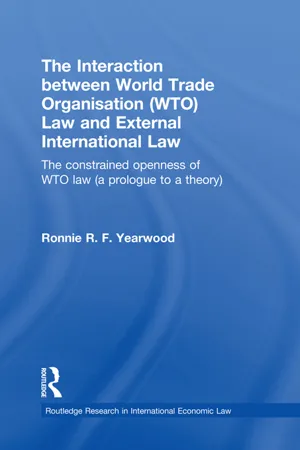
The Interaction between World Trade Organisation (WTO) Law and External International Law
The Constrained Openness of WTO Law (A Prologue to a Theory)
- 240 pages
- English
- ePUB (mobile friendly)
- Available on iOS & Android
eBook - ePub
The Interaction between World Trade Organisation (WTO) Law and External International Law
The Constrained Openness of WTO Law (A Prologue to a Theory)
1 Introduction
The Fragmented Nature of International Law
1.0 Introduction
The purpose of this chapter is to provide a background on the fragmentation of international law. It is also to discuss some ideas underpinning fragmentation and how we perceive them affecting the interaction between WTO and external international law. In light of this, I importantly advance a method by which to define WTO law. After all, the argument could run counter, that we all know what WTO law is: the covered agreements and possibly some secondary law making within the WTO, from for example, WTO Committees. However, the fact is that if we all agreed on what WTO law was, then much if not all the discussion to follow on the disagreements that exists among commentators on what WTO law is and on what basis external international law may or not become part of WTO law, would be non-sequitur. By virtue of these debates, at least one thing is clear, we all do not agree on what is WTO law. Discussion on the nature of the law does not assume we all know or share a common understanding as to what the law is and its purpose. Consider this simple analogy: if we all identify and define something as a table, then the argument could possibly follow that by common understanding we all know what a table is. How could there be disagreement as to what is a table, this most basic everyday staple in human life? But then what kind of table? Is it round, square, how many legs, is it made of wood, metal, stone or plastic, do you write on it, eat on it, sleep on it, stand on it? What is the purpose of the table? We can all agree to have a general understanding of something but then can correctly and logically disagree about the specifics of what that something looks like, how it is constituted and what purpose(s) it serves. What does WTO law look like, what purpose(s) does it serve, how are we able to know something is WTO law and something else is not WTO law. Essentially this chapter is an exercise in defining what WTO law is, within the context of a fragmented international legal system.1 Hart in writing on the use of definitions states that,
Sometimes . . . a definition of word can supply . . . a map: at one and the same time it may make explicit the latent principle which guides our use of the word, and may exhibit relationships between the type of phenomena to which we apply the word and other phenomena. It is sometimes said that definition is ‘merely verbal’ or ‘just about words’; but this may be most misleading where the expression defined is one in current use.2
The purpose to defining WTO law is not purely about being more linguistically specific.3 In fact the concern is more to do with attempting to understand what can count as WTO law and in that way we are able to arrive at an understanding of what does not count as WTO law. The definitional exercise therefore serves two purposes. Firstly, in defining WTO law we can also know what does not constitute WTO law, for as we know and discussed in the Prologue, every definition carries its exclusion. Secondly, providing a definition of WTO law lays the basis for advancing a legal theory of WTO law, which we can use to help us understand how it interacts with external international law. In the Prologue, we argued that in order to discuss the interaction between WTO and external international law, that we must define what WTO law is, making our claims about it open to critique. Further, we emphasised that there is no objective Archimedean point from which to engage with reality. We determine what the thing is and then apply ways to understand it, always doing so from some position as to another. The role of the author is to work out as best as possible what that position is without engaging in guises of pure objective thinking where facts can speak for themselves as if magically discovered.4
There are several reasons for my approach of setting out a method to determine what WTO law is. Firstly, by openly defining what counts as the law I am able to decide the data that forms a basis of intelligibility for what to observe as the law. Consequently, in defining what counts as law, I am proposing that the framework for assessing that law will be more open to critique. This as will be explored, in chapter 4, is dissimilar to the dominant models on WTO law, which in their pattern of argument, counter-argument potentially shut out external critique and creates a superficial commensurable middle ground. Secondly, by defining what I see or count as the law will enable consistent analysis. There can be no unconstrained choices as to what is WTO law. Otherwise the result of the permissive empirical Jacksonian tradition of WTO law (see Prologue) may imply an ever-widening sphere of what is WTO law. Without a clear and open method, it would mean that whatever I wanted as the law could be the law, for political expediency. In laying out a method, apart from showing when our ideas can make sense of reality, we can critically show when they do not capture or make sense of all the data before them. This provides an opportunity for the improvement of those ideas through internal and external critique. Thirdly, determining what WTO law is supports the premise as introduced in the Prologue and further explored in this chapter that law has no natural existence. Law exists because we believe it to exist. This means that law is not a brute fact. It is a thought object and only gains currency because we create and embody it as the law. As a consequence, there can be no investigation of and conclusions about the law until we determine what the law is.
Section 1.1 provides a definitional sketch of fragmentation to frame the context in which the interaction between WTO and external international law occurs. Section 1.2 then sets out rational reconstruction as the means by which I can posit an organising norm – Hart’s the rule of recognition – as a method to select the data to observe as WTO law, within the context of a fragmented international legal system. Sections 1.3–1.3.3 describe and assess the merits of Hart’s rule of recognition as a method for defining WTO law. The purpose of this chapter is not to comprehensively assess Hart’s The Concept of Law5 in which he proposed and discussed the rule of recognition. I do not offer a de novo interpretation of Hart’s broader legal project. The purpose of this chapter is somewhat more restrained and precise. It necessary here to discuss and emphasise the elements of Hart’s work, his legal method, which are relevant to defining WTO law. The task is therefore to isolate Hart’s municipal rule of recognition in order to apply it to WTO law. In section 1.4, I apply Hart’s rule of recognition to WTO law. This involves separating the rule of recognition as Hart’s conceptual commitment to law as fact from Hart’s method of the rule of recognition as the practice of the judiciary. This makes the rule of recognition counter-factual and supports the conclusion that the rule of recognition is not transposable wholesale to the discourse of WTO law, as was attempted by international trade law theorist David Palmeter.6 Moreover, it supports the approach considered in the Prologue and taken here in this chapter that WTO law must initially be defined before it is investigated because law is a thought-object. In section 1.5, I conclude that having applied the rule of recognition to WTO law to define what counts as WTO law, it does not provide a way to describe what we have defined. In chapter 3, I consider the second part of the theory of WTO law, which is to add conceptually flesh to what we have identified as WTO law in this chapter.
1.1 Definitional Sketch of Fragmentation
The International Law Commission (ILC) as part of its ‘long-term’ work programme conducted a study entitled ‘Fragmentation of International Law: Difficulties arising from the Diversification and Expansion of International Law’.7 This is an indication that contemporary international legal scholarship is concerned about the fragmentation of international law into specialised rationalities such as trade, environment and human rights.8 ‘Without attempting to add yet another sociology of globalisation, it may be accepted that political communities have become more heterogeneous, their boundaries much more porous, than assumed by the received images of sovereignty and the international order.’9 Alongside differentiation based on the territoriality of the nation state is the emergence of a social differentiation of rationalities, which are non-territorially functional.10 These differentiated rationalities of international law are functional detailed specialised systems of international law. Each fragmented system regulates a specific set of ideas, values and corresponding institutional practice of professional experts knowledgeable in the language and vocabulary of the specialisation. This makes them appear autonomous from the system of general international law and, importantly for the study, each other. There is a concern that irresolvable systemic conflicts may arise if the broader and general international leg...
Table of contents
- Cover
- Half Title
- Title Page
- Copyright
- Dedication
- Contents
- Table of cases
- Preface
- Acknowledgements
- Abbreviations
- Prologue
- 1. Introduction: The Fragmented Nature of International Law
- 2. The Inadequacy of the Professional Tool Box of Treaty Interpretation as an Account of Fragmentation
- 3. The Constrained Openness of WTO Law
- 4. The Debate on the Interaction Between WTO Law and External International Law
- 5. The Precautionary Principle and the WTO Agreement on Sanitary and Phytosanitary Measures
- 6. Examples of Interaction Between WTO Law and External International Law
- 7. Conclusion
- Selected Bibliography
- Index
Trusted by 375,005 students
Access to over 1.5 million titles for a fair monthly price.
Study more efficiently using our study tools.
Frequently asked questions
Yes, you can cancel anytime from the Subscription tab in your account settings on the Perlego website. Your subscription will stay active until the end of your current billing period. Learn how to cancel your subscription
No, books cannot be downloaded as external files, such as PDFs, for use outside of Perlego. However, you can download books within the Perlego app for offline reading on mobile or tablet. Learn how to download books offline
Perlego offers two plans: Essential and Complete
- Essential is ideal for learners and professionals who enjoy exploring a wide range of subjects. Access the Essential Library with 800,000+ trusted titles and best-sellers across business, personal growth, and the humanities. Includes unlimited reading time and Standard Read Aloud voice.
- Complete: Perfect for advanced learners and researchers needing full, unrestricted access. Unlock 1.5M+ books across hundreds of subjects, including academic and specialized titles. The Complete Plan also includes advanced features like Premium Read Aloud and Research Assistant.
We are an online textbook subscription service, where you can get access to an entire online library for less than the price of a single book per month. With over 1.5 million books across 990+ topics, we’ve got you covered! Learn about our mission
Look out for the read-aloud symbol on your next book to see if you can listen to it. The read-aloud tool reads text aloud for you, highlighting the text as it is being read. You can pause it, speed it up and slow it down. Learn more about Read Aloud
Yes! You can use the Perlego app on both iOS and Android devices to read anytime, anywhere — even offline. Perfect for commutes or when you’re on the go.
Please note we cannot support devices running on iOS 13 and Android 7 or earlier. Learn more about using the app
Please note we cannot support devices running on iOS 13 and Android 7 or earlier. Learn more about using the app
Yes, you can access The Interaction between World Trade Organisation (WTO) Law and External International Law by Ronnie R.F. Yearwood in PDF and/or ePUB format, as well as other popular books in Business & International Business. We have over 1.5 million books available in our catalogue for you to explore.