![]()
1 Prospects of a Progressive Mental Health System in South Africa Before Apartheid
Tara Hospital and Psychobiology, c1939–1948
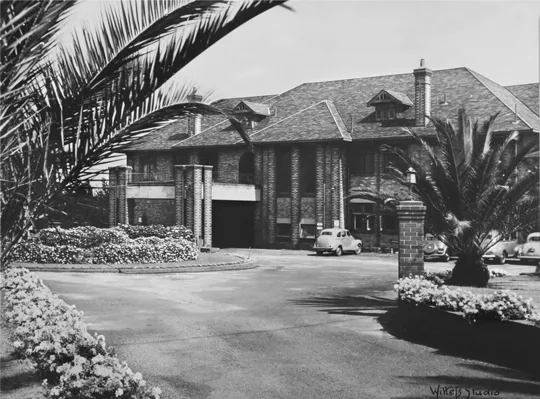
In 1946, a modern, innovative neuropsychiatric hospital opened on the outskirts of Johannesburg. Tara Hospital, renamed Tara, the H. Moross Centre in 1969, was the first of its kind in South Africa. It was an open, therapeutic hospital that combined new notions of psychoanalytical, behaviorist, hereditarianist, and somatic approaches in the treatment of its patients. For the first time, a mental hospital in South Africa claimed to offer promises of cures for previously neglected mental patients within a relatively hospitable environment.
Figure 1.1 Main building of Tara Hospital, c1960s. Photo © Adler Museum of Medicine, Faculty of Health Sciences, University of Witwatersrand, Johannesburg.
Tara was the embodiment of innovative international approaches towards mental health care that challenged a previous custodial system. Before the First World War, like in most of the rest of the world, South African psychiatric practitioners had simply detained mental patients. Yet by the 1940s, new ideas about the treatment of mental patients that were emerging in Europe and North America were changing the way South African practitioners approached mental health care. Psychiatrists began to suggest that patients could actually be cured. This revolution in approach towards mental health care in South Africa was precipitated by new views of psychiatry and the First and Second World Wars, which produced large amounts of soldiers said to be affected by psychoneurosis. International ideas on psychoanalysis and behaviorism, coupled with existing hereditarianist ideas and new radical therapies, for the first time offered hope of restoration to patients and their families.
Conceptualizations of progress are relative, however, and although practitioners in the early twentieth century believed that South African psychiatry was progressing into a therapeutic field where they could actually treat patients, how one measures such progress is subjective. In the eighteenth century, psychiatry emerged as a separate field within the medical sciences, but few viewed it as equal to biological medicine. Even when numbers of patients increased throughout the nineteenth and early twentieth centuries, and more institutions opened, the government rarely saw psychiatrists and psychologists in the same light as their medical counterparts. With the onset of the First and Second World Wars, and the emergence of new ideas about treatment of patients, psychiatric practitioners felt the need to advance their own status within the medical field. Their goal seemed in line with South African government officials, who wanted to regulate the behavior of the public and maintain a semblance of social control. What becomes apparent through an analysis of this period, however, is that psychiatrists neither were simple lackeys of the state nor were they a homogeneous group. South African psychiatrists held disparate views about the cause and treatment of mental disorder. Not all of these views supported those of the state. Indeed, in the 1930s and 1940s genuine attempts at reform originated from within the mental health profession, even if these endeavors mainly targeted white patients. Although their efforts for change often resulted in unanticipated consequences and psychiatric practice in the 1940s ended up perpetuating racial and gender inequality in South Africa, we also need to acknowledge that most state-sanctioned psychiatrists genuinely wanted to reform a previous dismal mental health system.
Because many of the practices set up during and immediately after the First and Second World Wars formed the foundation for future mental health policies, understanding practitioners’ perceptions of treatment of mental illness during this period is important. New views towards patients informed later practices. Although apartheid, implemented in 1948, changed mental health services somewhat, the foundation had been laid for future inequities. The opening of Tara Hospital reflected the complexity of these new psychiatric views. It promoted an emerging therapeutic psychobiological ideal among practitioners, but also reflected the very gendered and racialized structure of South African society and psychiatry in general.
The Treatment of Madness Before The First World War
To fully comprehend the complex role of the South African psychiatric profession and their actions after the First World War, we need to understand the state of mental health services in the years leading up to the twentieth century. Tracing the origins of apartheid South Africa’s mental health policy is somewhat problematic because of the diverse and ambiguous nature of mental science both as a profession and as a medical specialty. The inception of the actual discipline in South Africa is difficult to determine.1 Most historians begin their history of South African psychiatry with the establishment of the Cape of Good Hope settlement in 1652.2 They usually discuss the movement from makeshift beds for lunatics during early colonialism to the establishment of permanent institutions for the mentally disordered in the late nineteenth century. However, the question of the origins of psychiatry is intrinsically connected to the question of what exactly psychiatry is. If one defines psychiatry as a scientific discipline, then one traces psychiatry’s origins to the beginnings of medical science, and in South Africa’s case, the beginning of colonial occupation.3 On the other hand, if one were to extend the definition of psychiatry to include unconventional ideas of mental and spiritual health, as some scholars recently have begun to do, the definition and origin of psychiatry becomes more complex.4
Conceptualisations of mental health and mental disorders may have existed in South Africa before the advent of colonialism. The lack of pre-colonial written sources renders this history mostly inaccessible. Some scholars have suggested looking at African views of mentality during colonialism as indicative of pre-colonial views. Indigenous healers’ understanding and treatment of mental disorders certainly have their roots in pre-colonial times. Anthropologists have suggested that Africans had terms to describe and distinguish between mental complaints.5 However, one must recognise that notions of mentality among African groups are not universal, static and separate from that of the body.
Whether madness is a universal phenomenon irrespective of culture remains under debate.6 Understandings of deviancy and madness should however be seen in relation to their socio-political context. In the early years of Dutch and British rule in South Africa, institutions for the mad were non-existent and they were left to the devices of their families or arbitrarily placed in wings of hospitals, prisons or on the convict station of Robben Island.7 The first institution solely designated for the detention of the mad opened in Grahamstown in the Eastern Cape in 1876. Later known as Fort England Hospital, Grahamstown Lunatic Asylum materialized out of the abandoned structures of a British military post. Four years later, Town Hill Mental Hospital in Natal, then known as Pietermaritzburg Lunatic Asylum, was built. A few years after, Bloemfontein or Oranje Hospital in the Orange Free State and Valkenberg in the Cape opened its doors. The first institution to open in the Transvaal was Pretoria Asylum (now known as Weskoppies), which in 1892 was specifically built for the purpose of housing mental patients.
Much debate exists about why institutions and psychiatrists became the means to care for the insane at this particular juncture in history. South Africa was highly influenced by trends in the western world. The nineteenth century in Europe and in the United States, as Andrew Scull points out, was a period of dramatic change. Perceptions of the mad transformed from the idea that they were simply part of the larger group of social miscreants, towards a more defined view in which they were seen to have a specific condition that could only be determined by experts. It was a period in which larger amounts of individuals were restrained within isolated institutions and where the psychiatric profession arose as the legitimate and legal manager of the insane. Force, abuse, and suffering were commonplace within the institutions and explicitly accepted.8
There are many reasons for this increased institutionalization. Scull argues that exiling the mad to institutions in western countries was connected to the rise of the industrial economy.9 Indeed, the nineteenth century was a period when increased industrialisation was causing a breakdown between rural and urban areas and previous practices of dealing with the insane were no longer viable. At the same time, there was also an increased concern with humanism that was propounded by a desire for modernity and scientific rationalism. Within this institutional structure, however, contradictions existed between the ideas of humanism and authoritarianism.10 Institutions were therefore in paradoxical positions—on the one hand signifying the increased concern with protecting and treating the insane, while on the other regulating and disciplining patients.
Johann Louw and Sally Swartz have demonstrated how trends within Europe influenced South African perceptions of the insane. They show how there was a strong desire to replicate British institutions. The rise of humanism in Britain certainly played a part in the colonial office’s decision to build Valkenberg Mental Hospital in the late nineteenth century. They point to how staff within the institutions were placed in a contradictory position, wherein they had to “tread a fine line between freedom and confinement, domesticity and institutionalism, recreation and labor, and treatment and simple incarceration.”11 British influence inevitably penetrated the practices of practitioners, as most of those working within the institutions were either British or trained in England. Before 1922, South Africa did not have its own medical or psychiatric training programme, and many of those practitioners interested in medicine and psychiatry took courses, albeit rudimentary courses, on psychoses in Europe. Up until 1932, mental nurses also had to take the Royal Medico-Psychological Association of Great Britain and Ireland test, which was administered in South Africa and graded in Great Britain.12
In South Africa, however, the choice to open mental institutions at this particular juncture can not only be ascribed to international trends in humanism. South Africa was experiencing its own era of industrialisation. At the end of the nineteenth century, when gold and diamonds were discovered in the interior and South Africa experienced rapid industrialization and urbanization, family relationships changed. It became increasingly difficult and more of a nuisance to take care of a deviant family member. The previously “eccentric” aunt or the “wandering” sibling became more noticeable and inconvenient.13 In the growing urban areas, the control over and the safety of such individuals was also less assured. Moreover, the large exodus of single black men to work on the gold mines and the lack of family members to care for them in the vicinity meant that more beds, even if just used temporarily before repatriation, were needed to control those exhibiting abnormal behavior.
In 1910, South Africa unionized. The various republics and colonies came under the unitary rule of an Afrikaans and English-speaking coalition government that continued to enforce segregationist practices against Africans. Whereas racial exclusion of black Africans from the vote was not initially legislated, the socio-economic restrictions meant that the majority of the black population had no franchise. The Union government established a Ministry of Native Affairs and passed a series of legislative acts that enshrined segregationist practices.14 Mental institutions were microcosms of the state reflecting its desire to enforce a universal social norm, while simultaneously promoting exclusion and differentiation, particularly along the lines of race and gender. In the late nineteenth and early twentieth century, psychiatry reinforced segregationist structures by perpetuating its racist and gendered rhetoric. Practitioners depicted Africans as more childish and less susceptible to treatment than Europeans. They also classified individuals and used differential diagnoses to maintain and rationalize the inequalities of the facilities.15 Indeed, white men obtained significantly superior accommodation than black men and women, although treatment for all patients was limited.
In 1910, South Africa had eight mental institutions roughly fashioned along their European counterparts that accommodated approximately 1,692 European and 1,932 non-European patients.16 Pre-union legislation regarding the insane differed provincially, with each province or colony having its own, albeit similar, Act governing mental services.17 In 1914, the Union government passed the Lunacy and Leprosy Laws Amendment Act to ensure that certifications of mental patients were recognized crossprovincially. Shortly thereafter, it implemented the Mental Disorders Act of 1916 to further unify mental health services of the country.18 Under the 1916 Act, the administration of psychiatric patients, practitioners, and mental hospitals now fell under the jurisdiction of the Commissioner for Mental Hygiene in the Department of the Interior (DI), a department also responsible for overseeing prisons in the country. After 1919, the DI also accommodated the Department of Public Health, which was in charge of a few public hospitals that mainly handled infectious diseases.
The connection between prisons, infectious disease, and mental institutions had always been close. Jail cells had always housed those deemed mad. Even when permanent mental institutions had been erected, they were quickly filled, and prisons continued to serve as temporary holding areas for the mentally disordered. The DI also housed tuberculosis (TB) and leprosy patients in wings in mental hospitals, or sanatoriums next door. Moreover, mental hospitals and TB sanatoria were very like prisons. They were closed detention centers that mostly housed the underprivileged, disorderly, and miscreant.19
Poor treatment within the institutions was exacerbated by the lack of available nursing staff. Mental nursing was extremely demanding and there was always a high staff turnover rate. For most of the early years of the asylums, white English-speaking male nurses, many of whom were discharged soldiers, were the main custodians of patients. Institutional work involved physical constraint and was generally considered unsuitable for women, yet some widows served as supervisors of a few coloured female attendants, and black male attendants were later hired to attend to the few institutionalized black female patients.20 With the onset of the World Wars, the shortage of practitioners and nurses would become more critical as white men were called to partake in the war and the numbers of traumatized patients increased.
M. Minde, a psychiatrist interested in the history of psychiatry in South Africa, fittingly calls the period from the nineteenth century up to the 1930s as the “custodial period,” when practitioners simply housed patients in institutions and had few alternatives for the treatment of their patients.21 Indeed, few therapeutic options were available to practitioners who acted mainly as wardens, and patients were left to spend the rest of their days within the bleak walls of the institutions. South Africa had insufficient trained psychiatrists. Medical practitioners with an interest in mental disorders mainly oversaw the care of the mentally insane. In 1922, physician superintendents at Valkenberg Mental Hospital began train...