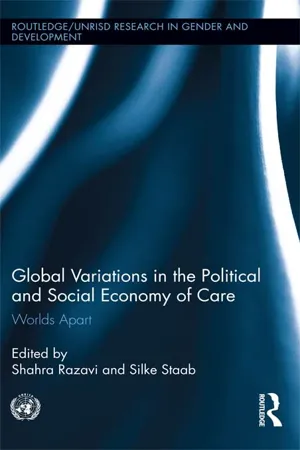
Care work, both paid and unpaid, contributes to well-being, social development and economic growth. But the costs of providing care are unequally borne across gender and social class. Feminist scholarship on the gendered construction of welfare provisioning and welfare regimes has produced a conceptually strong and empirically grounded analysis of care, reinforcing the necessity of rethinking the distinctions between "the public" and "the private" as well as the links between them. Yet this analysis, premised on post-industrial contexts, does not travel easily to other parts of the world. Many of its core assumptions – about family structures, labor markets, state capacities, and public social provisioning – do not hold for a wider range of countries. Drawing on original research on the care economy in three developing regions (Africa, Asia, Latin America), this volume addresses a major empirical lacuna while facilitating a conversation across the North-South divide.
eBook - ePub
Global Variations in the Political and Social Economy of Care
Worlds Apart
- 16 pages
- English
- ePUB (mobile friendly)
- Available on iOS & Android
eBook - ePub
About this book
Information
1 Introduction
Global Variations in the Political and Social Economy of Care—Worlds Apart?
INTRODUCTION
The dividing line between “the North” and “the South”, or the “developing” and the “developed” world, has become somewhat blurred in recent decades. Financial liberalization, regressive tax reforms and labour market policies aimed at making labour more “flexible” have generated a number of common global trends such as the increasing prevalence of informal or non-standard forms of work, recurrent economic and financial crises (since 2008, also part of the landscape in the developed world), and increasing levels of income inequality in the majority of countries (Milanovic 2008; UNRISD 2010a; Saith 2011). Whereas there are notable differences in the specific templates followed by states in adapting to these changing circumstances, and even though the social outcomes generated by different “varieties” of market-led development are far from homogeneous, there has been a common trend towards the strengthening of markets in the allocation and distribution of resources over the past decades. At the same time the increasing flows of information, ideas and people across national borders give the impression of an ever-more integrated world. Access to and provision of care, this volume argues, are intrinsically connected to these broader processes of change in national and global political economies.
Globally, inequalities in income and power between nations have been one impetus for the movement of people across national borders. International migration also shapes care arrangements (Hochschild 2000; Parrenas 2005; Yeates 2004). Among the stratified migrant streams are many women (and some men) who migrate from poorer countries to more affluent ones, both within regions and from South to North, to be employed as care workers in private homes and public institutions. Whereas the burgeoning literature on this topic usefully exposes the unequalizing tendencies of policies and processes associated with globalization, and theorises the links between the South and the North, its empirical focus has been largely on care arrangements and institutions in the migrant-receiving countries of the North. Care arrangements within developing countries have not received the same level of scrutiny—a lacuna that the present collection of papers seeks to address.
Most of the contributions in this volume therefore provide a country-based analysis of the institutional dynamics of care provision, its gendered/class/racial character, its intersection with policy processes, and its interactions with broader trends of social differentiation and polarization. By bringing together contributions from contexts that are “worlds apart”—developing countries (of sub-Saharan Africa, South Asia, Latin America), as well as those from advanced industrialized countries (of Europe, Northeast Asia)—this book seeks to explore commonalities and differences in care arrangements and in policy tendencies across regional and developmental divides. In addition to the unequal distribution of care resources globally, many of the country studies show that care arrangements vary widely across income groups and household types within one and the same country, even city, and that care itself can become one of the drivers of growing inequality. To put it bluntly: whereas elites can satisfy their care needs by hiring others (domestic workers, nannies, carers, therapists and so on), lower-income households have to rely on under-funded public services and over-stretched kinship and family networks. With care arrangements that are “worlds apart”, opportunities for human development are thus as unequally distributed as income.
The focus on national-level processes is not to suggest that global forces are unimportant. Indeed, global themes surface in several contributions to this volume, be it the global migration of nursing personnel (Nicola Yeates), the (often ambivalent) role of international organizations in putting care needs and policy blueprints onto the agenda (Kate Bedford), or the far less subtle imposition of policy conditionalities in lending and development aid practices through which donors and international financial institutions exercise influence on the design and funding of social programmes, as the chapters on Nicaragua (Juliana Martinez-Franzoni and KoenVoorend) and Tanzania (Debbie Budlender and Ruth Meena) illustrate.
Global structures and processes arguably shape discourses and policy spaces at the national level, but they do not determine them. Rather, they work in conjunction with context-specific characteristics—demographic, epidemiological and labour market trends, institutional legacies, social norms, constitutional structures or party politics—in producing specific care needs, in shaping interpretations of these needs, and in bringing about contending policy solutions as well as the collective actors and reform-oriented coalitions that support them. Furthermore, as Peter Houtzager (2004) argues, the “territorially defined nation-state today remains the only actor able to extract the vast resources from society that make possible significant distributive and redistributive policies and the only actor capable of providing public goods on a significant scale (p. 4)”. If care has important features of a public good whose benefits to society and the economy extend well beyond the individual care recipient, as Nancy Folbre (1994) has argued, then it is unlikely to be provided in sufficient quantity and quality without distributive and redistributive interventions that socialize its costs.
The remaining part of this introduction is structured as follows. The next section provides a brief analysis of the main currents of conceptual and empirical work on care, followed by a clarification of the terminology used by the chapters in this volume, as well as a brief explanation of the rationale that guided the selection of country cases that form the core of the book. The following two sections focus on care institutions and care politics, respectively. The former (on institutions) analyses variations in the roles played by families, markets, not-for-profit sectors and states in the provisioning of care needs and the reproduction—but also occasionally, disruption—of inequalities of gender, class and race/ethnicity. What this section also underlines is the strategic role of the state in shaping the care mix or care diamond and its social outcomes, whether through inaction or through active policy-making. The latter section (on politics) then raises questions about the politics of care, examining how and by whom care “needs” and responses to them are articulated and made a policy imperative often within national and sometimes regional contexts, and what role, if any, global processes and actors have played in this regard. We close with final reflections on the main themes and insights that emerge from the volume.
CONCEPTUAL ISSUES AND DISCIPLINARY CURRENTS
The time and effort that people put into taking care of one another—whether mediated through kinship and family ties, neighbourly relations and friendship, or through paid forms of care—constitute a key input into the well-being not only of children and frail elderly persons, but also “able-bodied” adults (UNRISD 2010b). From a political economy perspective, through investment in human capabilities (which includes what is traditionally known as “human capital”) caring (re)produces a labour force that is fit, productive and capable of learning and creativity.
Yet the costs of providing care are unequally borne by women who perform the bulk of such work across all economies and cultures, whether it is done on an unpaid basis (Budlender 2010), or as a component of paid work (England et al. 2002; ILR 2010). It is no surprise then that the analysis of care has been most developed in feminist work. Recent years have seen a growing literature from diverse disciplinary perspectives and underpinned by distinct conceptual and theoretical foundations converging around the issue of care. These intellectual currents include efforts within feminist economics, work within social policy research, as well as more philosophical writings on ethics and morality.
The sub-discipline that is now referred to as feminist economics grew in response to the restricted view of “the economy” offered by mainstream economic thinking. The dissatisfaction stemmed from two key elements. One was the fact that mainstream economics privileged the monetized aspects of the economy, while ignoring the sphere of social reproduction, which included both subsistence production and unpaid care. The second element of dissatisfaction—shared by other heterodox economists—concerned the validity and usefulness, for rich countries as well as poor ones, of the neoclassical assumption of rational choice as a model of individual behaviour and of the broader economy and society (Ferber and Nelson 1993).
Making visible what is often hidden and taken-for-granted, and providing a representation of the economy as “if women counted”1 (Waring 1988), has been the driving force behind a good part of feminist scholarship on care and related statistical work through time-use surveys, the imputation of monetary value to time spent on unpaid work, and the creation of so-called “satellite accounts” to show the full national account. One aim has been to ensure that the work traditionally done by women is “counted in” and hence rendered visible to those who devise policies—to show that it has value and is not an unlimited and cost-free resource. Undertaking valuation is not intended to imply that this work should necessarily be paid; instead the aim is “to provide support for arguments that those who do this work are entitled to a fair share of, and control over, the income generated by the paid work done by members of their family or household” (Budlender 2010: 35).
There is some dissonance, however, between those who highlight and seek to make visible the unpaid “productive” work of women and men, and those who emphasize the unpaid care aspects of social reproduction. The former has a long-standing history within the debates on gender and development. By stressing women’s unpaid participation in production, researchers provided a timely challenge both to the definition of work and to the methods of data collection used for generating official statistics. An important component of this endeavour was the attempt to deal with the much-debated category of generally unpaid “family labour” (on smallholder farms and family businesses), as well as unpaid provisioning of water and fuel for household consumption.2 The analysis of the interpersonal, face-to-face care of persons, on the other hand, emerged from feminist work on advanced industrialized countries, and is a relatively more recent concern in the gender and development field.
Apart from the statistical work, feminist economics has also sought to conceptualize the connections between the sphere of market-based capital accumulation, on the one hand, and that of non-market-based social reproduction, on the other.
Two sets of debates in particular have helped crystallize the connections between these two realms. The first has come from work on how the unpaid economy acts as a “shock absorber” in periods of crisis (associated with structural adjustment policies in the South, or neoliberal restructuring more broadly), as well as episodes of rapid accumulation and growth. Whereas the tensions between the commodity economy and the unpaid economy become particularly stark during periods of economic crisis, the process of capital accumulation, even in “successful” development episodes such as in East Asia in the 1960s and 1970s, or in China and India more recently, engenders a potential trade-off with levels of non-marketed output, including unpaid care (Elson 2005).
A second area of work has focused on the tension between providing good quality care, on the one hand, and the pressures for cost-containment on the other. Good quality care, whether paid or unpaid, is very labour intensive, and therefore said to be afflicted with a “cost disease” (Donath 2000, drawing on William Baumol’s analysis of the service sector more generally). The attempt to raise the productivity of care work by increasing the numbers of people cared for at any one time quickly runs into the risk of reducing the quality of the output (care). In other words, there is a definite limit to the number of infants and small children or frail elderly and handicapped adults that one person can care for. “Going beyond this limit results in neglected children, not productivity improvements” (Donath 2000: 118). How the problem of high labour content and relatively constant productivity in care services is dealt with varies depending on where care takes place.
Care-providers operating within markets frequently attempt to keep wages down (or to increase the hours of work for the same wage) by using “docile” labour provided by socially marginalized social groups. In the public care sector the problem of low productivity and the related cost increases are often interpreted as signs of inefficiency, “rather than as the consequences of an inherent characteristic of care” (Himmelweit 2005: 7). This contributes to political pressures for the commercialization and privatisation of public services, and efforts to make the public sector behave more like profit-making entities, by raising user charges and/or “rationalizing” staff time, sometimes with perverse outcomes for the quality of care.
These are also issues that are analysed by feminists working on social policy and welfare regimes who developed the concept as an important dimension of welfare provision and of welfare state variation (Lewis 1992; Sainsbury 1999). One of the strengths of this literature has been its cross-national comparative dimension. The other has been its strong policy focus, using comparative analysis to reflect upon the strengths and weaknesses of different policy instruments (services, cash, time) in terms of a number of criteria and objectives, including gender equality and women’s choices (Daly 2001). The focus on welfare or care regimes has also underlined the fact that the relative weight of different societal institutions (states, markets, households and communities) has profound implications for vertical and horizontal inequalities. The more redistributive and rights-based approach of social-democratic welfare states illustrates that strong state provision can mitigate class inequalities and improve women’s economic independence through generous transfer systems and widely available public care services. In liberal welfare regimes, by contrast, where market mechanisms dominate, the costs of care are most “privatized”, and the state assumes only a residual role in social provision; here class inequalities loom large. This, in turn, leads to important differences among women from different social and racial backgrounds in terms of the opportunities and constraints for re-negotiating the gender division of labour and enhancing their economic independence.3
Yet welfare regime analyses have also been criticised for their methodological nationalism, i.e., for ignoring the role of global forces in shaping within-country power dynamics and welfare settlements. One manifestation of globalism that has received attention within feminist analyses of care in recent years, alluded to earlier, has been the dynamics and impacts of cross-border migration of female labour for the purposes of providing social and health care services, within people’s homes and public institutions. Hence, it as been argued, migration regimes increasingly shape the development of the national care sector (see also Williams and Gavanas 2008). For southern European countries, for example, Bettio, Simonazzi and Villa (2006) suggest that migrant workers are making up for the structural deficiencies of public elderly care provision by caring for the increasing numbers of elderly people in private households. Whereas this “transition from a ‘family’ to a ‘migrant in the family’ model of care” (272) may seem like an attractive solution for states that are drawn between the need to address growing care demands and the imperative of controlling public expenditure, it raises serious questions of long-term viability and equity.
These two broad strands of thinking—feminist economics and feminist social policy—converge at many different points—both conceptual and policy. One is their critique of the undervaluation of care (both paid and unpaid), the other is their scepticism toward markets (both in terms of providing good quality care to recipients and decent work to care-providers), and a third is the emphasis on the need for voice of those providing care, on a paid or unpaid basis, if they are to access social rights and enhance their economic security. Dovetailing, and enriching, these conceptual and empirical engagements has been a philosophical conversation about the “ethic of care” among feminists of diverse persuasions and disciplines, contesting the narrowness of an ethic of paid work and an ethic of justice (Gilligan 1982; Tronto 1993; Williams 2001).4
In her contribution to this volume Joan Tronto underlines the limitations of thinking about care in terms of current emphases of the “political economy of work producing unlimited wealth” because within such a framework care will always finish last, being seen as an “expensive or dilemma-inducing prerequisite to economic activity”. One of the most problematic outcomes of the present arrangement is the vicious circle of inequality that is intensifying and globalizing wherein “economic inequalities leak over into care inequalities” and the t...
Table of contents
- Cover
- Halftitle
- Title
- Copyright
- Contents
- List of Figures and Tables
- List of Acronyms and Abbreviations
- Preface and Acknowledgments
- 1 Introduction: Global Variations in the Political and Social Economy of Care—Worlds Apart?
- Part I: Care’s Place Re-Imagined
- Part II: Shaping the Policy Agenda: Care in Advanced Industrialized Economies
- Part III: Different Worlds? The Challenge of Care in a Development Context
- Part IV: The Politics of Care “Going Public“: Actors and Institutions
- Part V: Global Care Chains: The Transnational Aspects of Care
- Contributors
- Index
Trusted by 375,005 students
Access to over 1.5 million titles for a fair monthly price.
Study more efficiently using our study tools.
Frequently asked questions
Yes, you can cancel anytime from the Subscription tab in your account settings on the Perlego website. Your subscription will stay active until the end of your current billing period. Learn how to cancel your subscription
No, books cannot be downloaded as external files, such as PDFs, for use outside of Perlego. However, you can download books within the Perlego app for offline reading on mobile or tablet. Learn how to download books offline
Perlego offers two plans: Essential and Complete
- Essential is ideal for learners and professionals who enjoy exploring a wide range of subjects. Access the Essential Library with 800,000+ trusted titles and best-sellers across business, personal growth, and the humanities. Includes unlimited reading time and Standard Read Aloud voice.
- Complete: Perfect for advanced learners and researchers needing full, unrestricted access. Unlock 1.5M+ books across hundreds of subjects, including academic and specialized titles. The Complete Plan also includes advanced features like Premium Read Aloud and Research Assistant.
We are an online textbook subscription service, where you can get access to an entire online library for less than the price of a single book per month. With over 1.5 million books across 990+ topics, we’ve got you covered! Learn about our mission
Look out for the read-aloud symbol on your next book to see if you can listen to it. The read-aloud tool reads text aloud for you, highlighting the text as it is being read. You can pause it, speed it up and slow it down. Learn more about Read Aloud
Yes! You can use the Perlego app on both iOS and Android devices to read anytime, anywhere — even offline. Perfect for commutes or when you’re on the go.
Please note we cannot support devices running on iOS 13 and Android 7 or earlier. Learn more about using the app
Please note we cannot support devices running on iOS 13 and Android 7 or earlier. Learn more about using the app
Yes, you can access Global Variations in the Political and Social Economy of Care by Shahra Razavi,Silke Staab in PDF and/or ePUB format, as well as other popular books in Social Sciences & Gender Studies. We have over 1.5 million books available in our catalogue for you to explore.