The connection between environment and health has been well studied and documented, particularly by the World Health Organization. It is now being included in some legal instruments, although for the most part caselaw does not explicitly make that connection. Neither the right to life nor the rights to health or to normal development are actually cited in the resolution of cases and in judges' decisions.
This volume makes the connection explicit in a broad review of human rights and legal issues associated with public health and the environment. It will be particularly useful as many legal instruments emphasize the right to 'development' without fully discussing the necessary safety and public health aspects, and the respect for the ecology of any area where such 'development' (often unwanted by local or indigenous communities) is to be located. Climate change is another pressing variable that is considered, and several chapters address the interface between human health and ecological conditions. Overall the book integrates perspectives from a wide range of disciplines, including ethics, ecology, public health and epidemiology, and human rights and law.
eBook - ePub
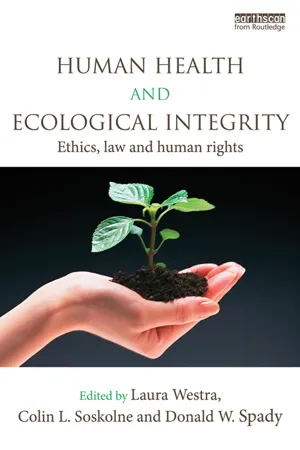
Human Health and Ecological Integrity
Ethics, Law and Human Rights
- 364 pages
- English
- ePUB (mobile friendly)
- Available on iOS & Android
eBook - ePub
Human Health and Ecological Integrity
Ethics, Law and Human Rights
About this book
Part I
Health and the Environment
Introduction
Laura Westra and Colin L. Soskolne
Foundational to the 2011 meeting of the Global Ecological Integrity Group (GEIG) in Prague – with its focus on public health – the first part of this book contains five chapters. Each chapter addresses the key elements that connect life, health and the environment. The right to health as embodied in supranational conventions and law is addressed throughout. The main focus is on the legal aspects of the interface between environment and health. The final chapter appeals to Aldo Leopold to remind the reader of the pivotal importance of ecological integrity, not only to the GEIG, but to anyone considering health and the environment, as Leopold himself did.
In Chapter 1, Westra discusses the flaws in present international legal regimes, and the denied connection between environment and the human right to health. These flaws emerge clearly in the paucity of jurisprudence dealing explicitly with that link, even when environmental causes and the resulting illnesses are the reason why a case is brought to the courts. Despite the presence of explicit appeals to the right to health and to a ‘healthy environment’ existing in various instruments, the link between that right and the environment is denied by omission in all case law.
In Chapter 2, Kintzele discusses the presence of environmental and public health clauses in numerous constitutions, in the states on all continents. She notes that biodiversity conservation is explicitly named in Article 38 of the Statute of the International Court of Justice. Thus, it is entirely appropriate for state statutes to adopt not only that principle, but also to support explicitly the connection between it and public health. This interconnection is clearly present in the constitutions of states from South Africa to Bahrain, from Somalia to Kenya, and from Bolivia and Ecuador to Sweden and France. Kintzele notes especially the importance of safety in food, brought to the attention of the world community in Europe with their resistance to genetically modified organisms (GMOs), and – even more recently – in Japan, as the impact of radiation on food was noted after the Fukushima disaster.
In Chapter 3, Mitchell attempts to trace an ‘ecological interpretation of international law’. Her starting point is the necessity for change, a change that acknowledges ecological integrity as the basis of all possible instruments that attempt to connect public health and environment, and the right to life. What she proposes is an ‘ecologically literate interpretation of the law’, but she also hopes for more explicit declarations to emerge from the work of the UN Human Rights Committee.
Taylor turns to international law in Chapter 4, where she carefully examines the possibilities inherent in the principle of the Common Heritage of Mankind (CH), a well-respected principle of international law since its emergence in 1960. Taylor views that principle as a possible antidote to the ongoing ‘final enclosure of the commons’ (Westra), as she considers whether the CH could be used to ‘overcome some of the traditional democratic deficit of international law’, as she traces its history and present and earlier usage. Particularly important is the question she raises as to whether ‘humanity’ can now be considered a subject of international law, given the unique language of the CH.
Finally, in Chapter 5, Carrick examines the GEIG’s starting point, in some sense; that is, the work of Aldo Leopold. Leopold had explicitly connected health and the environment, clarifying how the ‘community health perspective’, ‘the holistic health perspective’ and the ‘perspective of legal moralism’ combine to support and reinforce the emphasis on ecological and biological integrity. The latter have been the main platform of our group, and of this book.
The importance of including principles relating to human rights in soft-and hard-law instruments is revealed to be essential for protecting human health and, indeed, all life on Earth. Without these foundational governance instruments, the weight of argument for protecting the right to health will be less compelling and persuasive.
1 Life, Health and the Environment
The Denied Connection
Laura Westra
Introduction
This chapter is intended to explore the interface between human rights violations of human health and legal regimes intended for environmental protection. The time seems appropriate to explore this topic, on which a number of initiatives have converged over the last decade, and particularly over the last year. Examples include:
• the United Nations General Assembly (UNGA) Human Rights Council Resolution (16th Session) of 12 April 2011 on ‘Human rights and the environment’;
• preparatory meetings under way for the Rio+20 United Nations Conference on Sustainable Development in June 2012;
• the World Health Organization (WHO) work on the social determinants of health in 2008; and
• the United Nations Commission on Human Rights (UNCHR) Resolution 2002/31 (22 April 2002), addressing ‘The right of everyone to the enjoyment of the highest attainable standard of physical and mental health’.
My concern is that, for the most part, the interface between human rights and environmental hazards is not well represented in legal regimes; in fact, most often the interface is deliberately misunderstood, with a view to protecting commercial interests and maintaining the status quo (Mattei and Nader 2009). In order to present a concise but inclusive summary of some of the problems we face in this regard, I briefly discuss the issue under the following four separate (but interconnected) topic areas:
• explicit denial of the interface in jurisprudence, from United States cases under the Alien Torts Claims Act (ATCA), to the European Court of Human Rights and the International Court of Justice;
• lack of explicit prohibitions on the part of the WHO regarding industrial chemical and agricultural processes, despite the abundant evidence
• amassed by that UN body and available in medical journals regarding the human health consequences of those industrial activities, which today can be compared with the evidence gathered by the WHO before drafting their Framework Convention on Tobacco Control (WHO, 2003);
• ongoing denial of the egregious human rights violations that follow upon climate change, including glacial melts in the Arctic through drought and famine in sub-Saharan Africa, while the same Western practices continue to contribute to global warming, including the overuse of water and grains in industrial meat production with its resulting methane releases;
• insistence on the ‘right’ to ‘sustainable development’, without the right of Indigenous and other land-based communities to say ‘no’ when the development in question is unwanted, as it continues to impact gravely these peoples’ very subsistence, as well as their health and survival, both as individuals and as peoples.
Hence, I begin with a summary survey of some of the existing material for the protection of health and the environment (without, however, disclosing any specific binding document defining the interface between the two). I then consider other issues mentioned in the list above, before finally arguing for the urgent need for reforms to the candidate most likely to propose enforceable legal instruments, without risking the ‘veto’ that often accompanies other attempts to propose resolutions in defence of human rights on the part of UN organs (Westra, 2012). As well, the WHO is particularly well positioned to offer guidelines and courses of action that are seen as being beyond dispute.
Health and the Environment: the Missing Linkages
In confronting the insalubrious ramifications of globalization, human rights scholars and activists have argued for greater national and international responsibility pursuant to the human right to health … However, in pressing for the highest attainable standard for each individual, the right to health has been ineffective to address burgeoning inequalities in underlying determinants of health focusing on individual medical treatments at the expense of public health. (Meier, 2006, pp711–712)
The problem is not a lack of instruments, declarations and resolutions that extol the value of health, and even the universal right to it; rather, it is that such a right is universally non-enforceable and that the instruments that prescribe it are non-binding. The main problem is that the abundant scientific information available to connect health and environment is not, in practice, considered. In addition, public health refers to collective (universal) rights, or at least to community rights, while for medicine it is individual rights that are central, and most significant.
On the one hand, there are declarations and even instruments that enshrine the right to health (if not the right to life); on the other hand, there is the research undertaken by the WHO and by scores of independent scholars, whose findings link health, inescapably, to environmental conditions. Nor are there only human rights in many documents clearly intended for the protection of health (e.g. UN, 2000; WHO, 2008), but both UN documents and recent scholarly work point clearly to the interface between environment and health as they advocate for the right to both.
Nevertheless, neither regulatory regimes nor judgements when cases come to court reflect that interface. One reason may be that neither lawmakers nor judges are trained to understand that connection and make it explicit. The other is the pervasive influence of economic interests and of the institutions that support them. Particularly significant is the recent UNGA document entitled ‘Harmony with nature’ (UNGA, 2010). In 2009, resolution 64/196 (UNGA, 2009) was intended to promote life in harmony with nature; but the later document adds also the dubious notion of ‘sustainable development’ that is oriented to trade and economics instead.
Annex B of this document addresses various worldwide efforts towards ‘sustainable development’, intended to ‘strengthen stewardship of the global commons’ (UNGA, 2010, para. 67): they include new constitutional provisions in several countries in South America, including Argentina (forest preservation), Bolivia (Indigenous Peoples’ vision/new constitution); Cuba (environmental protection law, 1 July 1997), Chile (‘socioeconomic factors that promote a healthy life‘), and several others. Other countries’ reported efforts bypass entirely the human–nature connection, as they refer to ‘the right to have the environment protected, while promoting justifiable economic and social development’ (South Africa Constitution), or even the Marrakesh Task Force on Education for Sustainable Consumption (UNEP, 2010).
The United States’ Executive Order 13514, requires ‘federal agencies to improve energy efficiency … mitigation of greenhouse gas emissions … and recycling’ (White House, 2009, para. 85); and the European Union is somewhat less inconclusive, as it explicitly recognizes that the natural resource base for human life and development is in great danger and that fundamental changes in the way societies produce and consume are vital for achieving sustainable development.
Yet even this ignores the necessity for degrowth (contraction and convergence), and the fact that, according to ecological footprint analysis (Rees, 2006, pp143–158), the present rates of consumption and economic ‘development’ are completely unsustainable, as they already exceed the capacity of the Earth to sustain present human populations. Hence, the only possible ‘development’ may be spiritual, intellectual or moral, as every other form of material development is already unsustainable.
It is understandable that ‘Harmony with nature’ (UNGA, 2010) would take such a position; a position of covert (if not explicit) support for globalized economics, given that it is based on the work of neoclassical economists (Stiglitz et al., 2009). Essentially, all that the UNGA document proposes, despite its promising title, is a list of empty justifications and band-aid solutions that will – at best – slightly modify the status quo, without any recognition of the gravity of the ongoing human rights violations that globalization supports and defends (Mattei and Nader, 2009; Westra, 2011). Even the wonderful new constitutions of many South American countries (Ecuador, Colombia, Bolivia), with their spirited defence of nature (Pachamama), and of Indigenous Peoples and their traditional ways, remain no better than paper tigers; once individuals or communities harmed by ‘development’ and globalized trade regimes attempt to use them in their defence, they carry no weight. I will return to this subject later in this chapter).
Nonetheless, the ‘Conclusion and recommendations’ end on a more realistic note:
Nature has been treated as a commodity that exists largely for the benefit of people, and all environmental problems as solvable with a technological fix. Loss of biodiversity, desertification, climate change and the disruption of a number of natural cycles are among the costs of our disregard for nature and the integrity of its ecosystems and life-supporting processes. (UNGA, 2010, para. 101)
In its support of this conclusion, the document cites a three-page article in Nature (Rockström et al., 2009), ignoring the ample literature that exists on the necessity for ecological integrity and its relatio...
Table of contents
- Cover Page
- Half Title page
- Title Page
- Copyright Page
- Dedication
- Contents
- List of Contributors
- List of Abbreviations
- Foreword
- Prologue
- Introduction
- Part I Health and the Environment
- Part II Ecosystem Services and State Responsibility for Public Health Introduction
- Part III Public Health Issues Introduction
- Part IV Climate Change, Water and Public Health Introduction
- Part V New Approaches Introduction
- Part VI Environmental Laws and Human Health Introduction
- Index
Trusted by 375,005 students
Access to over 1.5 million titles for a fair monthly price.
Study more efficiently using our study tools.
Frequently asked questions
Yes, you can cancel anytime from the Subscription tab in your account settings on the Perlego website. Your subscription will stay active until the end of your current billing period. Learn how to cancel your subscription
No, books cannot be downloaded as external files, such as PDFs, for use outside of Perlego. However, you can download books within the Perlego app for offline reading on mobile or tablet. Learn how to download books offline
Perlego offers two plans: Essential and Complete
- Essential is ideal for learners and professionals who enjoy exploring a wide range of subjects. Access the Essential Library with 800,000+ trusted titles and best-sellers across business, personal growth, and the humanities. Includes unlimited reading time and Standard Read Aloud voice.
- Complete: Perfect for advanced learners and researchers needing full, unrestricted access. Unlock 1.5M+ books across hundreds of subjects, including academic and specialized titles. The Complete Plan also includes advanced features like Premium Read Aloud and Research Assistant.
We are an online textbook subscription service, where you can get access to an entire online library for less than the price of a single book per month. With over 1.5 million books across 990+ topics, we’ve got you covered! Learn about our mission
Look out for the read-aloud symbol on your next book to see if you can listen to it. The read-aloud tool reads text aloud for you, highlighting the text as it is being read. You can pause it, speed it up and slow it down. Learn more about Read Aloud
Yes! You can use the Perlego app on both iOS and Android devices to read anytime, anywhere — even offline. Perfect for commutes or when you’re on the go.
Please note we cannot support devices running on iOS 13 and Android 7 or earlier. Learn more about using the app
Please note we cannot support devices running on iOS 13 and Android 7 or earlier. Learn more about using the app
Yes, you can access Human Health and Ecological Integrity by Laura Westra, Colin L. Soskolne, Donald W. Spady, Laura Westra,Colin L. Soskolne,Donald W. Spady in PDF and/or ePUB format, as well as other popular books in Law & International Law. We have over 1.5 million books available in our catalogue for you to explore.