The Jewish community in Rome is the oldest in Europe, the only one to have existed continuously for over 2,000 years. This detailed study of the Jewish banking community in Italy is therefore of special value and interest. Poliakov's classic account of the rise and fall of the Jewish bankers is at the same time the story of medieval finance in general, its decline, and the birth of 'modern' finance. The author traces the economic and theological implication of each stage in the ambiguous relationship that developed between the Jewish money trade and the Holy See. He shows that the protection enjoyed by the Jews from the Holy See had not only theological, but also economic roots. The study ends with an account of the introduction of modern, 'capitalist' techniques and of the consequent inevitable decline of the Jewish money trade.
eBook - ePub
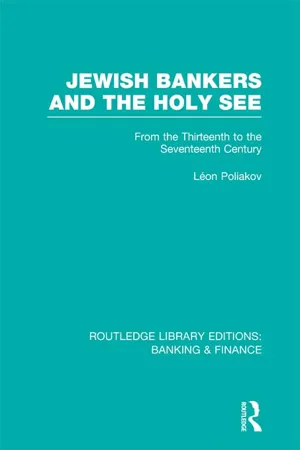
Jewish Bankers and the Holy See (RLE: Banking & Finance)
From the Thirteenth to the Seventeenth Century
- 276 pages
- English
- ePUB (mobile friendly)
- Available on iOS & Android
eBook - ePub
Jewish Bankers and the Holy See (RLE: Banking & Finance)
From the Thirteenth to the Seventeenth Century
PART ONE
The Rise of the Jewish Money Trade
CHAPTER I
The Significance and Basis of the Protection Granted to the Jews by the Holy See
Generally in those days, the world over, the Jews were taken and burned, and their possessions were confiscated by the lords on whose land they were living, except at Avignon and in Church lands under the wing of the pope, as the Church did not think it necessary that they should be put to death since they would be saved if they would return to our faith—Jean Froissart, Chroniques, ed. Luce, Paris, 1873, vol. 4, pp. 101, 332
Nothing can give a better idea of the closeness and complexity, even the ambivalence, of the secular links between the Jews and the Holy See than the cycle of legends (Judeo-Italian and Judeo-German) about a ‘Jewish pope’ which was woven from the early middle ages on.1 According to the oldest version (fifth century), the first pope, Simon Kefa or Simon Caiaphas, was fundamentally a loyal Jew. Disturbed by the rapid progress of Christianity and afraid that this heresy might seduce the Chosen People (or again in another version: because the Christians were threatening to massacre the Jews if they did not rally to their ranks), he pretended to be a Christian. His purpose was to make his way into the bosom of the rival sect and divert the dangers that threatened. He was also concerned to reserve the blessings of the Hereafter solely for the Jews, and to that end to widen the gulf between the two religions. Consequently, so it was said, Simon diverted Christianity on to paths which made it unacceptable to Jews. On the other hand, he forbade Christians to convert Jews by violence. He may have adopted the name of Petrus, but this was because he had exempted or ‘absolved’ (Pator in Hebrew) the Christians from their loyalty to Mosaic practices. Once his task was completed, he is said to have retired to a tower where he lived as a hermit and composed the Nishmat prayer which forms part of the Sabbath liturgy.
He is an astonishingly composite personality, this ‘Simon Caiaphas’: he is assigned the historic role of the apostle Paul, while he also bears the surname of the high priest said to have committed Jesus for trial!
According to a later version (twelfth to thirteenth centuries), it was the father of the ‘Jewish pope’ who was called Simon. Under this name he is identified with a historic character, the liturgical poet Simon the Great, who lived at Mainz round about the year 1000. His son Elchanan, who had been stolen by a Christian servant and baptised, made a brilliant career for himself as a theologian, and was raised to the throne of St Peter. In order to see his father again (in one version, he remembered him; in another, he was suspicious and forced his servants to reveal the truth to him), he decreed that the Jews of Mainz be persecuted. They sent a deputation led by Simon the Great to Rome and immediately got in touch with the Jews there who expressed great surprise, because the pope was known to be friendly towards the Jews. In fact, the pope received the delegates kindly and embarked on a theological discussion with Simon, astonishing the Jews by the depth of his rabbinic knowledge. A game of chess ensued in which the son beat his father, using a manoeuvre which the father thought was known to him alone. The son then revealed his identity, nullified the decree of persecution, and after publicly announcing that he was a Jew, killed himself (according to one version) or (according to another) fled to Mainz.
These legends and their multiple variants reflect not only the diverse aspects of the relations between the Jews and the Holy See, and, of prime importance, the outstanding significance of papal protection in theory, but also the special role that pertained in these circumstances to the Jewish community of Rome.
To begin with papal protection: Catholic historians, like Jewish authors, have not failed to emphasise the importance of this protection for the very survival of Judaism. In the seventeenth century, a period of decadence and of persecution of the Jews in Italy, the Venetian rabbi Simone Luzzatto gave the following evidence on the subject:2
The Zealots state that to tolerate those who do not follow the commonly approved religion is a sign of contempt for that religion; the simple answer to them is that they should moderate their pious zeal and note that the supreme head of the Christian religion tolerates Jews in the city where he himself resides: they have been settled there for over eight hundred years, have a stable domicile there and are governed there with justice and charity; so that no one should claim to know more about religious matters than he.
I will do my utmost throughout this book to study at their varied levels alternately the bases and methods of this protection. From the point of view of traditional attitudes, it is interesting to note the specific Hebrew term of uncertain etymology which designated and still designates the pope: Afifior, avi or abi pior, most probably a corruption of Father Peter or Abbot Peter.
It is well known that the protection of the Jews by the Holy See was justified by the theological idea, going back to the Fathers of the Church, of the necessity or utility of preserving the ‘witness people’. It was this motive, as well as Christian charity, that the sovereign pontiffs invoked when they intervened with Christian princes on the Jews’ behalf. It goes without saying that this argument only meant anything insofar as the popes them-selves set an actual example of this preservation by granting the Children of Israel the absolute freedom of the city of Rome. At most periods, this freedom imposed quite substantial reciprocities on the Jews; in particular, it will be seen how, under the Renaissance popes, the Holy See drew not inconsiderable sums from the guild of Jewish moneylenders, by means of appropriate pressure. It would be rash to claim that protection rested on this alone. However, the specific training of the economic historian makes him approach the practical bearing of the theologians’ concepts with caution. He will therefore tend to look for another interpretation of the exceptional fact of the peaceful continuance of a Jewry in a town which happened to be the capital of Christianity. The exceptional situation itself contributes to obscuring the terms of the problem thus posed. If it is not easy to identify, even when documents are plentiful, the sorts of reasons (religious hatred? economic competition? demographic increase?) why Jews were, as a general rule, expelled, it seems even more difficult to say why, when the sources are necessarily silent, they were not. The scanty references available exist only for a late period, namely the great pontificate of the Counter-Reformation under which expulsion was decreed. At that time, Pius V is seen stating almost in one breath that if he is sparing the Jews at Rome and Ancona while expelling them from other towns of the States, it is because certain members of the former communities are useful to trade, and that a limited number of the Children of Israel seem to him sufficient to bear witness (the utility of which he does not deny) in favour of Christianity. We are therefore hardly any further forward, except to note that the conjunction of patristic tradition and the financial interests of the Holy See were perhaps necessary to save the Roman Jews from the fate of their co-religionists in the great Catholic states (a fate the pope did not fail to mention). What can, on the contrary, be suggested with a degree of certainty is that the liquidation of the Rome ghetto would, in the short or long run, have sealed the fate of the other ghettos which still existed in Italy and throughout the German Empire. It can there-fore be maintained that in 1569 the future of western Judaism was balanced between Pius V and the Jewish businessmen of Ancona and Rome.
This brings us back to the ambiguity of the relationship between the Jews and the Holy See. The collective unconscious of the ghetto in its own way spun a myth around the fragile margin of security left it by papal toleration-protection in the form of belief in a secret ally, the ‘Jewish pope’. But such a dream of power, with its precise details, is legitimately open to additional interpretations. It will be noticed, inter alia, that the Jew Simon is a secret Jew in the first version of the legend and becomes a declared Jew, father of the Christians’ pope Elchanan (which means ‘favoured by God’), in the second. Perhaps we may be allowed to discern here both an allusion to the dialectic relationship between the mother and the daughter religion and a gleam of secret pride in the temporal success of the Jewish child who becomes the sovereign pontiff of the Christians. In any case, the theological contest between father and son, Jew and pope, reflects a concrete and living form of this relationship. It evokes the favour which so many scholars, particularly so many Jewish medical men, enjoyed at the papal court, to the great benefit of the Children of Israel as a whole. The fact that a number of medieval popes, in defiance of warnings, entrusted the health of their bodies to Jews perhaps contains a message of its own that we will on no account attempt to decipher. It was mainly a question of affinities between men whose education, reading, intellectual level and even certain preoccupations were not so different, thus facilitating a dialogue of which many examples will be quoted later. In short, the impression emerges that it was this sort of cultural affinity, rather than a point of doctrine, which was the determining factor in the protection granted to the Jews. In trying to fathom the secret of their continued existence at Rome, it must also be remembered that in the capital of the Church, it is the clergy who set the tone.
The abduction of the Jewish child by a Christian servant is a strange story which recurs throughout history. It is a permanent nightmare of Judaism and a symbol of those forced conversions which decimated the populous Jewries or, in certain regions, even put an end to their existence.
As for the Jewish delegation which hastened from Germany to Rome to report a decree of oppression, this detail also corresponds to a constant practice. Jewish chronicles abound in mentions of such missions coming to solicit favours and bearing presents, some of which are crowned with success, some fruitless. But another incident testifies even more eloquently to the prestige and renown of the papacy throughout the four corners of the Diaspora. From the distant island of Negropont (Euboea), a Venetian possession at that time, a Jew victimised by a co-religionist came to Rome in about 1400 to ask the pope for justice. The letter of recommendation he bore (which is our source of information on this episode) asked the leaders of the Jewish community in Rome to intercede with the Curia on his behalf.3 We can thus see that this community enjoyed particular importance as a natural intermediary between the papacy and the Diaspora in Christian lands. The Jews of Rome probably obtained various advantages from these comings and goings and might even have been able to cash in on the support they granted the supplicants.
A good time to begin our study of them is the second half of the twelfth century, a period when moneylending became wide-spread throughout Europe and of major concern to the Holy See. There was then a community of about a thousand souls, whose situation, on the evidence of Benjamin of Tudela (c. 1165) left nothing to be desired. If, as this traveller says, the Jew Yehiel, grandson of a famous rabbi, was entrusted with the administration of papal finances at this period, the majority of Jews pursued crafts—just as they did further south in the kingdom of the Two Sicilies, which at that time sheltered several thousand Jews at least; while in northern Italy, in the territories of the nascent communes, the Jewish population was very scattered or still non-existent.
This was still true in the following century. While Sienese and Florentine merchants who swarmed throughout Christendom were becoming the financial agents of the Curia and developing techniques for transferring funds, there is only a single known case of a diploma issued to Jewish merchants—this was by Alexander IV. ‘Curiam nostrae sequentes’, says the text, and not ‘mercatores camere’ as for the official Christian bankers—Yves Renouard has shown the importance of this subtlety.4 Further search, in the chronological registers of Pressutti, reveals a Jewish banker in Rome connected with a Florentine consortium; but he was a converted Jew.5 It is Renouard again who seems to provide the key to this relative omission of early Jewish finance to take advantage of the situation. On the subject of the Venetian or Genoese traders, he notes that their organisation was not the same as the Tuscans’ and that they lacked ‘both capital and stability in their affairs’. It is only in the Tuscan companies’, he continues, ‘that [the popes] found stable, powerful, universal bodies… with which regular collaboration was possible and could even be accompanied by foresight.’6 From the point of view of the frequency of unforeseeable risks, the Jews were probably in the same boat as the Venetians or Genoese.
Even if there are no documents actually to prove it before 1360, it is very probable that some Jews, better off than the rest, were carrying out loan transactions at Rome to pilgrims and prelates, or to citizens. They would thus have laid the foundations of a Jewish bank which began to expand beyond the Eternal City at the end of the thirteenth century, as will be shown later. But the greatest number remained tied to crafts and would remain so in the following centuries, just as in southern Italy.
In short, as early as the thirteenth century, the Jewish community of Rome demonstrated the same socio-economic features that were to characterise it in later days. It was headed by an aristocracy of lenders at interest, whose existence is vouched for both by the Roman origin of men who went and settled in the provinces from the end of the thirteenth century and by a statute of 1360 which regulated the practice of the profession. Then came the merchants, particularly pedlars of cloth, trading in silk and other goods. Finally there were the masses, pursuing every sort of craft. Observers were struck by the fact that the majority of them worked with their hands. A memorandum which a Bavarian Dominican friar attached to the court of Nicholas V sent to his duke on the subject of Jewish ‘usury’ concluded: ‘that they live amongst the Christians as they do in Rome, where they wear the rouelle [the circular badge], buying and selling, and working with their hands’.7
The predominance of craftsmanship was even more pronounced among the Jews in the kingdom of the Two Sicilies. Thomas Aquinas was certainly thinking of the latter when he held up the Italian Jews as an example to the duchess of Brabant: ‘It is preferable that the Jews be forced to work with their own hands to earn their living, as they do in the Italian countries’. But such professions and means of existence do not always seem to have been propitious to the preservation of Judaism in Christian lands.
There is no lack of interest in the problem thus stated, especially as it seems as if every type of attitude has contributed to preventing it from being stated in these precise terms. That is why we are going to take a brief look at the Jews in the south of the peninsula.
According to a paraphrase attributed to Rabbenu Tarn, a twelfth-century French Talmudist, ‘the Law will go out from Bari, and the word of the Lord from Otranto’ (a paraphrase of the lines from Isaiah 2:3: ‘Out of Zion shall go forth the law, and the word of the Lord from Jerusalem’). He was referring to the brilliance and prestige of the Jews of southern Italy under the Normans and the Hohenstaufen. Their number is said to have risen to 3 per cent of the population (according to Raphael Straus), or to at least 30,000 souls (Milano's figure).8 From the socio-economic point of view, the structure of this Jewish community, particularly in Sicily, continued on the eastern pattern of a ‘Vertical nation’, within which several peoples coexisted and a variety of activities was carried on. Crafts predominated and trade played a relatively secondary role, with the Jews specialising particularly, as in the East, in cloth-dyeing and silk manufacture. Under Frederick II (1194–1250) these two occupations became a monopoly w...
Table of contents
- Front Cover
- Half Title
- Title Page
- Copyright
- Title Page
- Original Copyright
- Contents
- Dedication
- Preface and Acknowledgments
- Part One The Rise of the Jewish Money Trade
- Part Two The Techniques of the Jewish Money Trade
- Part Three The Decline of the Jewish Money Trade
- Conclusion
- Appendix: The Epistle ofJacob ben Elijah
- Notes
- Index
Trusted by 375,005 students
Access to over 1.5 million titles for a fair monthly price.
Study more efficiently using our study tools.
Frequently asked questions
Yes, you can cancel anytime from the Subscription tab in your account settings on the Perlego website. Your subscription will stay active until the end of your current billing period. Learn how to cancel your subscription
No, books cannot be downloaded as external files, such as PDFs, for use outside of Perlego. However, you can download books within the Perlego app for offline reading on mobile or tablet. Learn how to download books offline
Perlego offers two plans: Essential and Complete
- Essential is ideal for learners and professionals who enjoy exploring a wide range of subjects. Access the Essential Library with 800,000+ trusted titles and best-sellers across business, personal growth, and the humanities. Includes unlimited reading time and Standard Read Aloud voice.
- Complete: Perfect for advanced learners and researchers needing full, unrestricted access. Unlock 1.5M+ books across hundreds of subjects, including academic and specialized titles. The Complete Plan also includes advanced features like Premium Read Aloud and Research Assistant.
We are an online textbook subscription service, where you can get access to an entire online library for less than the price of a single book per month. With over 1.5 million books across 990+ topics, we’ve got you covered! Learn about our mission
Look out for the read-aloud symbol on your next book to see if you can listen to it. The read-aloud tool reads text aloud for you, highlighting the text as it is being read. You can pause it, speed it up and slow it down. Learn more about Read Aloud
Yes! You can use the Perlego app on both iOS and Android devices to read anytime, anywhere — even offline. Perfect for commutes or when you’re on the go.
Please note we cannot support devices running on iOS 13 and Android 7 or earlier. Learn more about using the app
Please note we cannot support devices running on iOS 13 and Android 7 or earlier. Learn more about using the app
Yes, you can access Jewish Bankers and the Holy See (RLE: Banking & Finance) by Leon Poliakov, Miriam Kochan in PDF and/or ePUB format, as well as other popular books in Economics & Business General. We have over 1.5 million books available in our catalogue for you to explore.