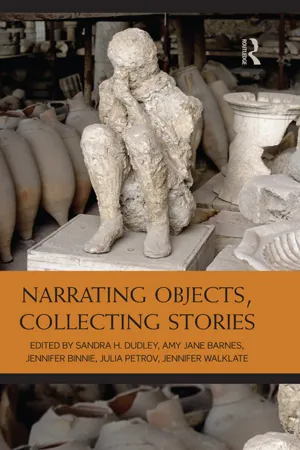
Narrating Objects, Collecting Stories is a wide-ranging collection of essays exploring the stories that can be told about objects and those who choose to collect them. Examining objects and collecting in different historical, social and institutional contexts, an international, interdisciplinary group of authors consider the meanings and values with which objects are imputed and the processes and implications of collecting. This includes considering the entanglement of objects and collectors alike in webs of social relations, the creation of value and social change; object biographies and the stories – often conflicting – that objects come to represent; and the strategies used to reconstruct and retell the narratives of objects. The book includes considerations of individual objects and groups of objects, such as domestic interiors, Chinese Buddhist artefacts, novelty tea-pots, Scottish stone monuments, African ironworking, a postcolonial painting and memorials to those killed on the roads in Australia. It also contains chapters dealing with particular collectors – including Charles Bell and Beatrix Potter – and representational techniques.
eBook - ePub
Narrating Objects, Collecting Stories
- 288 pages
- English
- ePUB (mobile friendly)
- Available on iOS & Android
eBook - ePub
About this book
Trusted by 375,005 students
Access to over 1.5 million titles for a fair monthly price.
Study more efficiently using our study tools.
Information
1
Introduction
Objects, collectors and representations
The wide-ranging essays in this collection set out to explore the stories that can be told about objects and those who choose to collect them, and how objects and collectors themselves narrate and indeed create lives and meanings as they move through time and space. The authors in this book examine objects and collecting in different historical, social and institutional contexts, between them reflecting upon a wide diversity of issues. They variously consider both the meanings and values with which objects come to be imbued, and the processes and implications of collecting. There are investigations of the entanglement of objects and collectors alike within social relations, of the creation of value and social change, of object biographies and the stories – often conflicting – that objects come to represent, and of the strategies used to reconstruct, retell and represent the narratives of objects and the persons with whom they are or once were associated. The book includes studies of individual objects and groups of objects (such as domestic interiors, novelty teapots, Scottish stone monuments, African ironworking, a postcolonial painting, memorials to those killed on the roads in Australia and Australian Aboriginal art). It also contains chapters dealing with particular collectors – including Charles Bell and Beatrix Potter – and representational strategies, and an epilogue that explores the historical traces of relationships between individual and institutional collecting on the one hand, and the place of indigenous art with the canon of art history on the other. Indeed, it is in the very combination of chapters reflecting on such topics as the boundaries between objects and persons and the effects of shifting context, together with focal studies of particular collectors and object types, and the addition of explorations of different approaches to telling stories and representation, that this volume’s character and intellectual trajectory lie.
The connections between persons and things
The first part of the book explores the relationships between, and mutual constitutiveness of, objects and people, and the relevance of this interconnectedness to the stories objects can be used to tell. In a sense, of course, the whole book addresses these core issues, for the entire volume is concerned with examining the ways in which both persons and things, through their shared embeddedness in social relations, act to make each other what they are, in a dynamic, continual relationship. The first three chapters, however, set up what is to follow by focusing particularly on mutuality, exploring the processual nature of the organic connections between people and things, the shared history of certain people and certain objects and the ways in which particular artefacts can become imbued with specific meanings and associations for individuals. Through three very different case studies, these chapters encourage us to reflect on the very physical connections between human bodies and in-process objects, the personal connotations and cultural values that are both created and represented within the historical linkages between people and things and the multi-layered meanings people give to certain artefacts depending upon their context. Specifically, they address the performative making of string figures, the personal narration of objects on display in the Museum of Free Derry and the acquisition of souvenirs by Portuguese migrants in Australia on their trips back home.
Dinah Eastop’s opening chapter on string-figure making, in particular, takes us right to the heart of a fundamental question concerning the relationship between person and thing: where does one end and the other begin? Eastop draws on Dant’s conception of agency as the object/person in totality (Dant 1999), and demonstrates how the string-figure maker objectifies parts of his or her own body parts in various positions, so as to create various representations as part of a social performance. Although the performative objective of string-figure making is rather different from that of an everyday utilitarian process such as digging, cooking or walking, there is nonetheless an interesting parallel between Eastop’s analysis and discussions of the Blind Man’s Stick (BMS) hypothesis (Bateson 1973; Merleau-Ponty 1962; Polanyi 1966). The latter reflect upon where the visually impaired individual’s self ends and the world beyond commences, and explore the hypothesis that the stick – the object – in some sense becomes part of the person. Malafouris has interestingly extended this hypothesis broadly to explore relationships between the human mind and objects, and the impact of objects – specifically, tools – on cognition in early, prehistoric, human development (Malafouris 2008). Of course, on one level Eastop’s example is a reversal of the Blind Man’s Stick: in her study, parts of the person could be said to become part of the object, rather than the object becoming part of the person. I would suggest, however, that this is merely a question of emphasis; in both cases what matters is the drawing of our attention to the blurred boundary between person and thing, to their mutuality and lack of distinction.
The chapters by Elizabeth Crooke and Andrea Witcomb address the boundary between person and object less explicitly, but nonetheless their points of focus each allow us to reflect on the dynamic and mutual constitutiveness of people and things and its underpinning of the stories to be told. Both concentrate on the processual and intricate nature of the relationships between persons and objects, each exploring a case study of especial poignancy and complexity, and particularly revealing of the shared history of certain people and objects. Crooke’s chapter, based on an interview with John Kelly, a visitor facilitator at the Museum of Free Derry whose brother was killed in the 1972 Bloody Sunday shootings in Northern Ireland, explores the temporally shifting, private and public significances of personal objects associated with those who died on Bloody Sunday. Through Kelly’s narrative and her analysis of it, Crooke demonstrates not only the biographical significance of mundane objects – including a half-eaten chocolate bar – that become associated with loss, trauma and both personal and communal tragedy, but also the extent of the artefacts’ intimate connection, and ultimately mutuality, with the deceased and those who mourn them. The chapter shows us that even in the public setting of museum display and interpretation, this deeply personal, material connection comes across in very potent ways – indeed, it is the basis upon which the museum’s most powerful stories can be told. This role of objects in both museum and personal narrative-making is picked up by Witcomb’s chapter. She also discusses the significance of artefacts as representations of a longed-for past time, prior to a moment of rupture – only in this case study, that of Portuguese migrants in Australia, the rupture was migration rather than the violent death of a loved one; furthermore, the objects concerned are not ‘authentic’ items from the pre-migration past, but souvenirs bought by Portuguese Australians on more recent visits to their ancestral homeland. Witcomb examines interesting questions pertaining to nostalgia and longing, and the differences between souvenirs and heirlooms; she also highlights potential implications for museum display and possible directions for future research in this area.
Meanings and contexts
Following on neatly from Witcomb’s focus on the movement of people and artefacts, the second part of the book highlights the impacts of different and shifting contexts on the meanings attributed to objects. It includes examinations of different historical, political and domestic settings, as well as reflection on the cultural-biographical approach to objects and their meanings. These are themes that have of course featured particularly prominently in the resurgent interest in material culture studies and theory that has increasingly strengthened in various academic disciplines, since its rebirth in the 1970s and 1980s in the work of Ian Hodder, Daniel Miller, Howard Morphy, Nancy Munn, Susan Pearce and others (e.g. Hodder 1987; Miller 1985; Morphy 1980, 1989; Munn 1973; Pearce 1989).1 Much of the work done in the past two to three decades has focused on the socio-historical trajectories of objects, on how things construct, acquire and change meanings and values, and on the extent to which material culture is embedded in social relationships (e.g. Appadurai 1986; Hoskins 1998; Kopytoff 1986; Pearce 1995; Thomas 1991, 1994). The consumption of objects has been an important area of interest here (e.g. Miller 1987), and to a far lesser extent research has also been done on contexts of production, particularly in relation to art (e.g. various in Coote and Shelton 1992; Morphy 1991) and textiles (e.g. Ahmed 2002; Barnes 1989; various in Weiner and Schneider 1989).
This part of the book begins with a chapter that focuses on one particular artefact in one specific historico-political context, and the meanings it can be said to represent. In Margaret Lindauer’s discussion of Frida Kahlo’s painting, What the Water Has Given Me, the artwork is considered as a postcolonial map of Mexico, and effectively a text representing power balances, social relations and cultural praxis. Lindauer’s analysis involves three key concepts from postcolonial theory – abrogation, filiation/affiliation and rhizomic relations of power – and requires her to identify in the artefact the representation of subtly shifting temporal-spatial histories and politics. Ultimately, she concludes that while the traces of the past in the painting are clear, they are also fundamentally fluid in their relationships to each other in any particular moment.
Latin America remains the geographical context for the next chapter, though now we move into a consideration not of one specific object but of a type of material setting: domestic interiors in nineteenth- to early twentieth-century São Paulo as that city undergoes considerable social change. The growth of conspicuous, individual consumption of imported goods was accompanied by, for those fortunate enough to own their own homes, increasing focus upon ownership of certain objects and, especially, upon the concept of hygiene as a marker of social distinction and modernity. Vânia Carneiro de Carvalho’s careful analysis of the shifting material and spatial distinctions, and indeed differences of embodied knowledge, that accompanied, represented and contributed to social change in the domestic sphere gives us considerable insight into the different perspectives on the material realm depending upon one’s place in the social world.
A strongly cultural-biographical approach is taken in Mark Hall’s chapter, which deals with the lives of some pieces of early medieval Pictish sculpture. Hall not only actively pursues the earlier biography of these objects, but also argues strongly that their lives do not cease when they become museum pieces. Indeed, he argues that mid-twentieth-century graffiti present on one of the stones are as much a part of the artefact’s acquired associations and characteristics as it has moved through time, as are far earlier elements of the objects and their story. Biographical approaches also feature in Deirdre O’Sullivan’s chapter on monastic ruins; however – and fittingly for the last chapter in this part of the book – O’Sullivan problematizes this method. She provokes us into engaging with the material remains of the sixteenth-century English Dissolution of the monasteries not as often beautiful and romantic features of the landscape, nor as pieces of heritage, but, through an imaginative, indeed empathic engagement with the time and process of ruination itself, as ugly, physical reminders of what the state can do when its power is too great and insufficiently challenged.
Collectors and collecting
The influence of biographical approaches can unsurprisingly be traced too in the third part of the book, in which a range of case studies of individual collectors elucidates how objects and collectors alike are embedded in social relations. Chapters look at collecting patterns, the ways in which people and their behaviour are embedded within wider practices, moments and contexts, and the ways in which collecting contributes to the attribution of values and meanings to objects. They contribute to the existing literature on the complex relationships between people and objects, and often institutions too, that are involved in collecting processes (e.g. Belk 1995; Martin 1999; Pearce 1998). The biographical and social life methodologies found in wider material culture studies can be seen to have some direct or indirect influence here, as they do in the wider literature on collectors and collection and institutional histories (e.g. Gosden and Knowles 2001; Larson 2009; Tythacott 2011).
Actor-network theory too can be an important influence on approaches to studying collectors and collecting trajectories, as Fiona Cheetham shows in this volume and as can be seen elsewhere (e.g. Gosden, Larson and Petch 2007). Here, in her analysis of teapot collecting, Cheetham builds on actor-network theory as particularly exemplified by Callon (1986), and seeks to nuance its understanding of the creation of actor-networks with a careful exploration of the work of some of those (less visible) actors in the network other than the network builder (Star 1991). She argues that an actor-network approach to collecting both allows the foregrounding of the productive aspects of collecting, in contrast to the more common conceptualization of it as primarily or solely consumption, and indeed ultimately offers an opportunity to overcome the unhelpful division between production and consumption (cf. Miller 1987).
A somewhat different approach to that of actor-network theory is taken by Jane Hattrick in the next chapter, which examines the collecting practices of the royal couturier Norman Hartnell. Hattrick’s analysis focuses first on Hartnell’s collecting and display in relation to his own identity-making processes – with particular reference to his public persona and to his sexuality – and second on the same objects after they were inherited, on Hartnell’s death, by his close associate, George Mitchison. Hattrick’s investigation of descriptions and photographs of Hartnell’s homes has enabled her to compare how Hartnell’s objects are displayed in Mitchison’s home with how they were utilized over seventy years earlier, and raises issues of embodiment, selfhood, taste and identity politics.
Domestic interiors and objects therein, and their significance and utility in identity making, also form the theme of Claire Leighton’s chapter on Strawberry Hill. Styled by the mid-nineteenth-century political hostess Frances, Lady Waldegrave, Strawberry Hill exemplifies both the use of a house and its interiors to construct and secure social and political status, and the nature of gender and class relations at the time. Importantly, the identity being fashioned through the creation of Strawberry Hill was very much a public persona: as was appropriate in this historical period, Lady Waldegrave was seeking not to display her individuality but to secure her position, in a culture and time where appearance mattered greatly and was even linked to integrity and character. Furthermore, because Lady Waldegrave’s taste was learned by careful observation of others’, examining Strawberry Hill also, Leighton argues, reveals much that is of more general value in understanding mid-Victorian upper-class tastes in collecting and domestic display.
Observation and the building of expertise of a different kind, is explored in Emma Martin’s examination of the Tibetologist Sir Charles Bell. She demonstrates how his knowledge of Tibet, and his collecting, depended on not only his own direct acquisition of information, but also the building and use of an active network of key Tibetan and Sikkimese individuals, whose influence on his work and collection is clear. Such tracing of the complicated histories embodied in a collection enables both the revealing of the multiple relationships that the collecting process involves and, as Martin indicates, the welcoming nuancing of museum collections gathered in colonial contexts. The last...
Table of contents
- Cover Page
- Half Title page
- Title Page
- Copyright Page
- Dedication
- Contents
- List of illustrations
- List of Contributors
- Preface
- 1 Introduction Objects, collectors and representations
- Part I The mutuality between objects and persons
- Part II Object meanings in context
- Part III Collectors and collecting in focus
- Part IV Representational and narrative strategies
- Epilogue The recognition of Aboriginal art and the building of collections
- Index
Frequently asked questions
Yes, you can cancel anytime from the Subscription tab in your account settings on the Perlego website. Your subscription will stay active until the end of your current billing period. Learn how to cancel your subscription
No, books cannot be downloaded as external files, such as PDFs, for use outside of Perlego. However, you can download books within the Perlego app for offline reading on mobile or tablet. Learn how to download books offline
Perlego offers two plans: Essential and Complete
- Essential is ideal for learners and professionals who enjoy exploring a wide range of subjects. Access the Essential Library with 800,000+ trusted titles and best-sellers across business, personal growth, and the humanities. Includes unlimited reading time and Standard Read Aloud voice.
- Complete: Perfect for advanced learners and researchers needing full, unrestricted access. Unlock 1.5M+ books across hundreds of subjects, including academic and specialized titles. The Complete Plan also includes advanced features like Premium Read Aloud and Research Assistant.
We are an online textbook subscription service, where you can get access to an entire online library for less than the price of a single book per month. With over 1.5 million books across 990+ topics, we’ve got you covered! Learn about our mission
Look out for the read-aloud symbol on your next book to see if you can listen to it. The read-aloud tool reads text aloud for you, highlighting the text as it is being read. You can pause it, speed it up and slow it down. Learn more about Read Aloud
Yes! You can use the Perlego app on both iOS and Android devices to read anytime, anywhere — even offline. Perfect for commutes or when you’re on the go.
Please note we cannot support devices running on iOS 13 and Android 7 or earlier. Learn more about using the app
Please note we cannot support devices running on iOS 13 and Android 7 or earlier. Learn more about using the app
Yes, you can access Narrating Objects, Collecting Stories by Sandra H. Dudley, Amy Jane Barnes, Jennifer Binnie, Julia Petrov, Jennifer Walklate, Sandra H. Dudley,Amy Jane Barnes,Jennifer Binnie,Julia Petrov,Jennifer Walklate,Sandra Dudley, Sandra Dudley, Amy Jane Barnes, Jennifer Binnie, Julia Petrov, Jennifer Walklate in PDF and/or ePUB format, as well as other popular books in Social Sciences & Archaeology. We have over 1.5 million books available in our catalogue for you to explore.