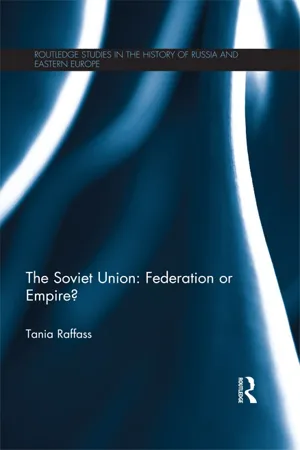
The Soviet Union is often characterised as nominally a federation, but really an empire, liable to break up when individual federal units, which were allegedly really subordinate colonial units, sought independence. This book questions this interpretation, revisiting the theory of federation, and discussing actual examples of federations such as the United States, arguing that many federal unions, including the United States, are really centralised polities. It also discusses the nature of empires, nations and how they relate to nation states and empires, and the right of secession, highlighting the importance of the fact that this was written in to the Soviet constitution. It examines the attitude of successive Soviet leaders towards nationalities, and the changing attitudes of nationalists towards the Soviet Union. Overall, it demonstrates that the Soviet attitude to nationalities and federal units was complicated, wrestling, in a similar way to many other states, with difficult questions of how ethno-cultural justice can best be delivered in a political unit which is bigger than the national state.
- 400 pages
- English
- ePUB (mobile friendly)
- Available on iOS & Android
eBook - ePub
The Soviet Union - Federation or Empire?
About this book
Trusted by 375,005 students
Access to over 1.5 million titles for a fair monthly price.
Study more efficiently using our study tools.
Information
1
The original federation
The present and next chapters scrutinise the orthodox assertions that federal conditions enhance personal and corporate liberty. To this end, they closely examine American federalism. The paradigmatic character of the American Union is the reason for looking in some detail at its history. Subsequent federation builders looked up to the USA as a model to imitate,1 and constitutionalists of the late nineteenth century onwards have portrayed the US government as the embodiment of the federal principle.2 As such, the American federation has been, explicitly or implicitly, the benchmark against which most outside observers would find the federation designed by the Bolsheviks wanting. Hence, it is expected here that the process of examining American federalism will help elucidate the reasons for such non-recognition of the USSR’s federality.
‘Federalism’ is frequently used to refer to the American political history and governing institutions or even the entire identity of the United States.3 On a more narrow reading, it refers to the areal division of jurisdiction between two tiers of government, also known as ‘territorial democracy’, which is one component in the set of ‘checks and balances’ that define the American regime. Although dual federalism is usually presumed to be integral to that regime, an examination of the establishment and development of the American Constitution suggests that it is not. In this and the next chapter, I intend to show that it was a nonessential component at founding, and that the subsequent history has confirmed the prognostications of the antifederalists at the time about its transience in the process of the maturation of the system towards complete unification. Elazar’s claim that ‘the American founders recognised that simple republicanism was not enough, that was required was a compound republic, what we today call a federal system’4 is hardly accurate. Neither party at the convention desired the compound republic, and the admixture of the federal features to the national constitution, not really desirable in the eyes of Publius, was what just happened to be achievable under the given split of opinions at the convention. This improvised solution, perceived with disappointment initially, was only gradually accepted as a potentially durable formula that eventually congealed into a new orthodoxy.
Simultaneously, this is a critique of the prescriptive theory of federalism. Federal arrangements have been championed on the grounds that they empower the people as individuals and as members of territorially based communities. As we shall see, however, the specific interests and intentions of the original federation builders did not match the current ideals of federalism in either respect. On the one hand, the federal Constitution did not aim at all at increasing the ability of ordinary people to influence government. On the other hand, far from creating protections for subnational units, the Framers strove to overcome the prerogatives of the states, which they regarded as a nuisance. States’ rights and intimate government were the platform of the defeated side in the constitutional confrontation, twice defeated – the second time on the battlefield in the mid-nineteenth century. The latter aspect is pursued separately in Chapter 4. In this chapter, I am taking issue with the view as presented in the quotation below.
The constituent units of the federation are not mere local authorities subordinate to a dominant, overarching central power as we would expect to find in a unitary state … On the contrary, they themselves are states with state rights.5
This belief originates in the federalist advocacies of the Constitution, and it appears to underpin the constructions of the USSR as an empire. The Soviet republics on such constructions were sovereign only on paper, and that is not how a ‘real’ federation should have been. Here is a typical summation of Soviet federalism running along these lines:
Lenin’s federal formula, which thereafter became known as the Leninist nationality policy, was a brilliant move at the time. It disarmed national tensions, offered a seemingly valid justification for the rejection of separatism and created the image of a voluntary federation. But in fact it was neither voluntary nor a federation. Instead, it instituted a centralised unitary state that carried the seeds of its own destruction because it gave the component nations and nationalities the forms, but not the substance, of national existence and political power.6
Nationality policy was something entirely peculiar to Soviet federalism and absent from the American prototype, a theme attended to in other chapters. Here it will be argued that the rights of the subfederal units in the archetypal federation do not represent a foil to those in the Soviet Union. Moreover, the charge that the federal constitution leaves ‘the form but not the substance’ of independence to the states was originally levelled at the American federation itself.7
In what follows, I shall consider what inspired the foundation of the North American Union and what characterised its subsequent permutation. On the basis of the historical survey and the structural analysis of the national–state relations in the US, I shall then endeavour to challenge the normative interpretation of federation as a distinct form of territorial-political organisation that unlike its unitary or imperial forms does not involve hierarchy. The normative theory can account neither for the founding of the first federation, nor for its operation. In that sense, the interpretation offered here upholds Preston T. King’s claim that ‘the doctrine of federalism conflicts with the fact of federation’.8
The foundational controversy around the form of the Union
At the time of the Philadelphia Convention in 1787–8, the words ‘federation’ and ‘confederation’ were synonyms, and long after the event, throughout the eighteenth and nineteenth centuries, they continued to be interchanged in the Anglo-American and French usage.9 The US founders viewed the end product of the convention as a middle ground between two principles – federal and national – and emphasised that there was no name for it, but with time it has ceased to be thought of as a composite and acquired the status of a separate basic state-building form, alternative to the nation-state. This eventually led to the differentiation between the two terms and to the entrenchment in the literature by the late nineteenth century of the tripartite continuum of political integration: ‘unitary-federal-confederal’.10 Effectively, what happened in American history was that the federal idea was brought from the area of international relations over to the area of state organisation; in other words, the internal federalism of a territorial state emerged, while confederation remained a category of international relations.11
The Articles of Confederation had been in operation on a provisional basis since their adoption in 1777, and legally in force upon the completion of the dragged-out ratification process in 1781. This nearly a decade of experience sufficed to cause a sentiment of dissatisfaction that was strong enough to occasion a constitutional revision.12 The drafters at Philadelphia were divided in their understanding of how far-reaching the constitutional alterations should be. Liberal nationalists (the Federalist party) pushed for consolidation. The adherents of ‘American Whiggism’ (the Antifederalist party) defended the existing arrangements as optimal to liberty. They were alarmed by the shift in priorities from the preoccupation with liberty as the end of government during the war for independence to the preoccupation with the international grandeur of America, manifest in the thinking of The Federalist.13 They questioned the federalists’ commitment to republicanism, and feared that their aspirations for national glory would bring back the yoke of centralised aristocratic authority that had been overthrown in the Revolution.
Antifederalists believed that the survival of freedom in America depended on the survival of the smaller sovereign communities. They reasoned that in such polities, citizens abide by the laws voluntarily, because they create them for themselves, thus making force in the organisation and maintenance of order redundant. As their officials are selected from among themselves and for short terms, they cannot develop interests separate from those of the community.14 The delegation of governmental responsibilities away from the locality and from the persons of the citizens, even if the distant government might deliver services more efficiently, antifederalists argued, would lead to the relaxation of civic vigilance and eventually the atrophy of the capacity for self-rule. Hence, participation was crucial regardless of the instrumental quality of the outcomes, and the professionalisation of the political and military metiers was to be resisted. Although appreciative of private enterprise, antifederalists were apprehensive of large-scale commercialism that would lead to gross inequality, elevating few above many, and stimulating lust for luxury, power, and self-aggrandisement – vices corrosive of the civic health. Some of them also believed that not only social, but also cultural homogeneity was prerequisite for civic accord, and therefore objected to the naturalisation of foreigners. Finally, more writers among antifederalists accorded value to Protestantism as a cohesive force in a republic as opposed to federalists, who were indifferent to the public function of religion.
Federalists, on the contrary, valued efficiency over participation, saw small communities as oppressive of minorities, and dismissed at best as utopian the desires of their opponents to preserve pastoral simplicity, social homogeneity and participatory government or at worst their ‘zeal for the right of the people’ as masking ‘the obvious interest of a certain class of men in every State to resist all changes which may hazard a diminution of the power, emolument, and consequence of the offices they hold under the State establishments’.15 They were anxious to put the United States on the map of world politics as a match to the great commercial nations of Europe, not a contemptible collection of petty, feuding, and backwardly agrarian commonwealths. In the eyes of the antifederalists, the survival of liberty depended on the survival of the states. Contrariwise, the federalists maintained that national integration would help preserve liberty. Thus, the pivotal issue in the wrangling at the convention and later in wider society was whether the Union ought to remain one between states-as-communities or to be transformed into a union between individuals.16
As a basic step towards understanding the debate, I shall need to elucidate the designation of ‘federal system’ or ‘confederacy’ at the time of founding. It was typically known to have three features: the confederal centre was not an organ of government in the sense that it could not apply coercion either to member-states, or their individual citizens; the functions of the confederation were narrowly limited to serving mutual interests of its members with respect of outside security threats, and did not extend to the management of internal affairs of the members, which remained the exclusive purview of the latter; because it was not a governing body, decisions became binding on the sovereign members only through their consent and, as a corollary, collective decision-making needed to be unanimous.17 Let us now examine why the federalists rejected the Articles.
Under the Articles, Publius18 argued, the lack of a political centre with mechanisms to enforce its decisions made the American union fragile internally, as there was no means to restrain infighting between the states.19 The obligation of good faith that binds confederates will not stand to test, given the flawed human nature, Publius reasoned, and it is to be expected that federal pledges will be reneged under the spurs of self-seeking temptations.20 Anticipating the contemporary institutional analysis of federal structures as creating incentives and facilitating secessionism, Publius wrote that state leaders were natural enemies of the united authority. The republican character of the states did not change that, and in contravention of the democratic peace thesis, Hamilton denied that commercial republics were less aggressive than aristocratic monarchies. He warned that economic rivalry, disagreements over the distribution of the federal debt and competing claims to Western territories were bound to lead to wars between the states.21
As there was no firmly united front of diplomacy and no single foreign policy, states were ever tempted to collude separately with foreign powers against other members of the Confederation. It was easy for foreign potentates, always eager to exploit inter-state rivalries to their advantage, to meddle in the relations between the confederates, further fuelling the internal discord by intrigues in the hope of moving in to deprive the Americans of sovereignty.22 Given this permanent internal turbulence and resultant weakness, the threat of foreign attack was high, but the defensive capacity of the Confederation was low, because it had no supreme central military command to organise a swift and co-ordinated rebuff to an incursion. Furthermore, the lack of central economic authority disallowed the organisation of an effective protection of the domestic market from outside competition, the removal of barriers to and the promotion of internal commerce.23
The Federalist dedicated several essays to projecting ancient and medieval feudatory empires and corporatist confederacies as seedbeds of anarchy, antithetical to what they had in mind.24 The idea that was pressed most forcefully throughout the papers was that the root cause of the failure of the Articles, as of every other known confederation, was the structural flaw of an imperium in imperio. The multiplicity of sovereignties made confederation ‘a system so radically vicious and unsound, as to admit not of amendment but by an entire change in its leading features and characters’.25 The remedy suggested was ‘consolidation’, the replacement of the ‘league’ constitution with a ‘national constitution’, or simply ‘government’, legislating directly for individuals. I shall be bringing out the adverse implications of this for the normative theory below when analysing Elazar’s interpretation of American federalism, but right now some space will be given to the case of the ‘other Founders’.
A great variety of objections was mounted against the federalist Constitution in the wider public debate surrounding its ratification. Some of them were of a liberal character, raising alarm over the non-inclusion of the Bill of Rights in the new Constitution. Others expressed fears, in the leftist vein, that the wealthy were contriving to impose aristocratic rule and desired a stronger government to enable them to keep the common people in check, despoil small farmers though heavier taxes, etc.26...
Table of contents
- Cover
- Title
- Copyright
- Contents
- Introduction
- PART 1
- PART 2
- PART 3
- PART 4
- Concluding discussion
- Notes
- Bibliography
- Index
Frequently asked questions
Yes, you can cancel anytime from the Subscription tab in your account settings on the Perlego website. Your subscription will stay active until the end of your current billing period. Learn how to cancel your subscription
No, books cannot be downloaded as external files, such as PDFs, for use outside of Perlego. However, you can download books within the Perlego app for offline reading on mobile or tablet. Learn how to download books offline
Perlego offers two plans: Essential and Complete
- Essential is ideal for learners and professionals who enjoy exploring a wide range of subjects. Access the Essential Library with 800,000+ trusted titles and best-sellers across business, personal growth, and the humanities. Includes unlimited reading time and Standard Read Aloud voice.
- Complete: Perfect for advanced learners and researchers needing full, unrestricted access. Unlock 1.5M+ books across hundreds of subjects, including academic and specialized titles. The Complete Plan also includes advanced features like Premium Read Aloud and Research Assistant.
We are an online textbook subscription service, where you can get access to an entire online library for less than the price of a single book per month. With over 1.5 million books across 990+ topics, we’ve got you covered! Learn about our mission
Look out for the read-aloud symbol on your next book to see if you can listen to it. The read-aloud tool reads text aloud for you, highlighting the text as it is being read. You can pause it, speed it up and slow it down. Learn more about Read Aloud
Yes! You can use the Perlego app on both iOS and Android devices to read anytime, anywhere — even offline. Perfect for commutes or when you’re on the go.
Please note we cannot support devices running on iOS 13 and Android 7 or earlier. Learn more about using the app
Please note we cannot support devices running on iOS 13 and Android 7 or earlier. Learn more about using the app
Yes, you can access The Soviet Union - Federation or Empire? by Tania Raffass in PDF and/or ePUB format, as well as other popular books in Social Sciences & Regional Studies. We have over 1.5 million books available in our catalogue for you to explore.