eBook - ePub
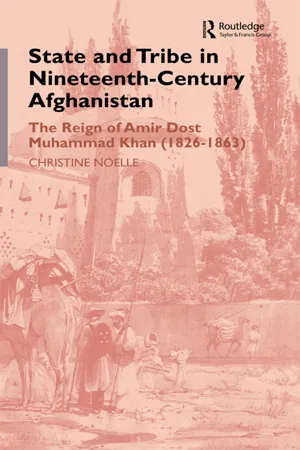
State and Tribe in Nineteenth-Century Afghanistan
The Reign of Amir Dost Muhammad Khan (1826-1863)
- 464 pages
- English
- ePUB (mobile friendly)
- Available on iOS & Android
eBook - ePub
State and Tribe in Nineteenth-Century Afghanistan
The Reign of Amir Dost Muhammad Khan (1826-1863)
About this book
With the exception of two short periods of direct British intervention during the Anglo-Afghan Wars of 1839-42 and 1878-80, the history of nineteenth-century Afghanistan has received little attention from western scholars. This study seeks to shift the focus of debate from the geostrategic concern with Afghanistan as the bone of contention between imperial Russian and British interests to a thorough investigation of the sociopolitical circumstances prevailing within the country. On the basis of unpublished British documents and works by Afghan historians, it lays the groundwork for a better understanding of the political mechanisms at work during the early Muhammadzai era by analysing them both from the viewpoint of the center and the pierphery.
Trusted by 375,005 students
Access to over 1.5 million titles for a fair monthly price.
Study more efficiently using our study tools.
Information
Chapter 1
DOST MUHAMMAD KHAN’S FIRST REIGN AND THE FIRST ANGLO-AFGHAN WAR
THE POLITICAL SETTING IN THE EARLY NINETEENTH CENTURY
Dost Muhammad Khan was formally proclaimed ruler of Kabul in 1834–5. But his reign unofficially began in 1826, when he was able to gain control of this city after a prolonged civil war. The first part of this chapter is concerned with the circumstances accompanying his rise to power, which marked the end of Sadozai supremacy and the beginning of the Muhammadzai era. In the second part, I will discuss the unsuccessful attempt of the British to reestablish the Sadozai ruler Shah Shuja‘ in the course of the First Anglo-Afghan War. The legitimacy of Dost Muhammad Khan’s claims to kingship was not only challenged by his half brothers but was also called into question by the remaining Durrani elite, which had entertained close links with the Sadozai dynasty. This is not to say that Dost Muhammad Khan and his relatives were newcomers to the political arena in Afghanistan. As will be seen from my introductory discussion concerning the prominent subdivisions of the Durrani confederacy, the claims of the Muhammadzai Barakzais to leadership among the Durranis were as old as those of the Sadozais.
Shah Mahmud, the last sovereign Sadozai ruler of Kabul, was deposed in 1818, but the crumbling of Sadozai power had already begun in the final decade of the eighteenth century at a time when the Sadozai empire was barely fifty years old. Its founder, Ahmad Shah Sadozai had gainded ascendancy in Afghanistan in 1747, at a period when the equilibrium of power which had previously existed between the Safawids of Iran, the Mughals of India and the Uzbek khanate of Transoxania had dissolved. In the political vacuum resulting from the demise of the Safawid dynasty and the abrupt end of Nadir Shah’s efforts at empire building, Ahmad Shah assumed leadership over the Pashtun contingents which had formerly served in the Nadirid army and made them privileged partners of his expansionist policies. While deriving a great part of his strength from his close linkage with the chiefs of the Durrani and Ghilzai confederacies, Ahmad Shah sought to balance their influence by forming a personal bodyguard of tribal outsiders, the Qizilbash of Iran. His son Timur Shah (1772–1793) continued this policy, extending the Qizilbash force in his service and primarily relying on this group in administrative matters.
In 1762, at the height of Ahmad Shah’s power, the Afghan empire included Kashmir, Punjab, Sind, Baluchistan, and part of Khurasan. Controlling the trade routes linking Iran, Central Asia and Eastern Turkistan with India, it was, next to the Ottoman empire, the largest state in the Middle East. Yet by the 1820s the core regions of the Sadozai empire had broken up into several independent principalities. While Kabul and Qandahar were held by two competing sets of Muhammadzai brothers, Herat had become the last bastion of Sadozai authority. North of the Hindu Kush, a number of Uzbek khanates had reasserted their independence. In the west, parts of Khurasan had fallen to the Qajar dynasty of Iran.1 East of the Khyber Pass, the Sikh ruler Ranjit Singh (r. 1801–1839) had gained control of the revenue-rich Indian provinces.2 What were the causes of this dramatic disintegration? To begin with, the Sadozai empire had been built on Ahmad Shah’s ability to garner tribal support by offering the prospect of profitable military campaigns to India. Securing these conquests was a more difficult matter, and the allegiance of the provincial governors tended to waver with each indication of weakness at the center. Thus the maintenance of this sphere of influence required constant efforts. Already in 1767 the Sikhs were able to wrest Lahore from Afghan control.3 Ahmad Shah’s successor Timur had to contend with resistance in Khurasan, Turkistan, Kashmir, Baluchistan, and Sind throughout his reign. This situation was exacerbated with the power struggles breaking out after Timur Shah’s death. While his successor Shah Zaman was able to establish his claims to kingship over the opposition of his elder half brother Humayun, he continued to face the rivalry of another influential set of half brothers, Shah Mahmud and Haji Feroz al-Din. In the course of the ensuing conflicts, Shah Zaman relied on the assistance of Dost Muhammad Khan’s father, Payinda Khan Muhammadzai. Ironically, his reign came to an end in 1799 when, fearing the immense influence of Payinda Khan, he executed the man who had protected his claims to kingship in the first place. This process was to repeat itself under Shah Zaman’s successor Shah Mahmud, who gained royal authority twice with the support of Payinda Khan Muhammadzai’s eldest son Fatih Khan. His reign, and Sadozai supremacy over Afghanistan, dissolved after he ordered Fatih Khan to be blinded and killed in 1818.
Between 1800 and 1818, Afghanistan was the scene of the rivalry between Shah Zaman’s full brother Shah Shuja‘ on the one hand and Shah Mahmud and his son Kamran on the other. Another contender for power was Shah Zaman’s eldest son Qaisar Mirza. In the unfolding game of constantly shifting coalitions, Fatih Khan Muhammadzai assumed a central position. Fatih Khan’s growing political influence was in turn resented by certain powerful Durrani and Ghilzai leaders, who, fearing the loss of their traditional privileges, espoused the cause of Shah Shuja‘. In revenge for the death of his father at the hands of Shah Zaman, Fatih Khan brought Shah Mahmud to power for the first time in 1800. Shah Mahmud’s first reign lasted only until June 1803, when a Sunni-Shi‘a riot encouraged by members of the Durrani leadership allowed Shah Shuja‘ to gain control of the capital. In 1809 Kabul passed to Shah Mahmud’s possession again, who strongly relied on the political acumen of his wazir Fatih Khan for the administration of his realm. Throughout these events, Shah Mahmud’s full brother Haji Feroz al-Din had been able to hold on to the government of Herat, maintaining a precarious independence between the interests of the rulers of Kabul and Teheran. But in 1817 Haji Feroz al-Din, seeking to develop a counterpoise to the increasing pressure exerted on his dominion by the Qajar ruler Fath ‘Ali Shah, turned to Shah Mahmud for assistance. This gave Fatih Khan Muhammadzai and his youngest brother Dost Muhammad Khan the opportunity to gain control of Herat and to engage in a battle with the Iranian army under the Qajar governor of Mashhad, Hasan ‘Ali Mirza Shuja‘ al-Saltana.4 Fatih Khan’s political and military success notwithstanding, Shah Mahmud gave in to the resentment harbored by his son Kamran and other members of the Durrani elite and ordered Kamran to remove Fatih Khan from power. Fatih Khan’s blinding and execution in 1818 triggered a rebellion by the remaining Muhammadzai brothers, which eventually led to Dost Muhammad Khan’s proclamation as Amir.
In the following, I will take a more detailed look at the events summarized above, shifting the focus of my discussion from the ruling Sadozai family to the most prominent sections of the state-supporting elite. Among the Abdalis/Durranis, the Alikozai, Popalzai and Barakzai subdivisions were most closely associated with Nadir Shah Afshar and the early Sadozai kings and were able to gain privileges disproportionate to their numerical strength. I will outline the careers of some of the most prominent members of these subdivisions in order to introduce the reader to some of the influential contemporaries and rivals of the Muhammadzai family. As will be seen below, the Alikozais were to retain an influential position in Herat, acting as ministers and eventually seizing the authority there for themselves. In Kabul, the interests of the Bamizai Popalzais were pitted against those of Fatih Khan’s family. The historical narrative touched upon in the sections concerning the Alikozais and Popalzais will be expanded upon in the description of the Muhammadzai rise to power. In order to provide a frame of reference for the events to be discussed below, I would like to begin by recapitulating the milestones of Afghan history in the eighteenth and early nineteenth centuries:
| 1708/9 | Qandahar breaks away from Safawid rule |
| 1716/17 | Herat asserts its independence from the Safawids5 |
| 1722–1729 | Hotak rule at Isfahan |
| February 1732 | Nadir Shah Afshar occupies Herat |
| March 1738 | Nadir Shah Afshar conquers Qandahar |
| 1747–1772 | Ahmad Shah Sadozai |
| 1772–1793 | Timur Shah Sadozai |
| 1793–1800 | Shah Zaman Sadozai |
| 1800–1803 | Shah Mahmud Sadozai |
| 1803–1809 | Shah Shuja‘ Sadozai |
| 1809–1818 | Shah Mahmud Sadozai’s second reign |
The Alikozais
In the early nineteenth century, the Alikozais were estimtated at 10,000 families.6 The most prominent families among them played an important role in Durrani politics even before Nadir Shah’s assumption of power. In the early 1720s, ‘Abd al-Ghani Khan Alikozai (the maternal uncle of Ahmad Shah) was instrumental in promoting Zulfaqar Khan (Ahmad Shah’s elder brother) to a leading position among the Abdalis. During Nadir Shah’s reign ‘Abd al-Ghani Khan became the governor of Qandahar province. At the beginning of the Sadozai era he refused to relinquish control of the city of Qandahar to the newly proclaimed king, Ahmad Shah, and was killed. When Ahmad Shah set out to erect a new capital in the vicinity of Qandahar in the early 1760s, ‘Abd al-Ghani’s descendants forced him to postpone his plans by refusing to let him build on their land.7 In 1799 two Alikozai leaders were part of an unsuccessful plot hedged in Qandahar by Payinda Khan Muhammadzai and a number of Durrani and Qizilbash nobles, which aimed at deposing Shah Zaman and killing his minister Wafadar Khan but resulted in the execution of the noblemen involved instead.8
In the 1820s the Alikozais moved to center stage in the politics of Herat. ‘Ata Muhammad Khan, a member of the Naso section of the Alikozais and descendant of Sardar ‘Abd al-Ghani Khan, had been influential during Shah Mahmud’s second reign in Kabul.9 In late 1818 Shah Mahmud lost control of Kabul and Qandahar and was forced to settle in Herat, ‘Ata Muhammad Khan served him as minister until his death in 1828/9.10 ‘Ata Muhammad Khan was succeeded by his nephew Yar Muhammad Khan (d. 1851) whose father ‘Abdullah Khan had been governor of Kashmir at the time of Shah Zaman and during Shah Mahmud’s last reign. Yar Muhammad Khan, who was to become known as an able and ruthless administrator, assisted Shah Mahmud’s son Kamran in removing his father from power. Once Kamran was installed as ruler of Herat, Yar Muhammad virtually controlled all sectors of the government. In early 1842 he had Kamran killed and assumed full authority. The ministership of ‘Ata Muhammad Khan and Yar Muhammad Khan not only furthered the interests of those linked immediately to their family interests but also brought many members of the greater group of Alikozais to Herat.11
The Popalzais
In the early nineteenth century, the Popalzais were thought to number 12,000 families. Among them the Sadozai and Bamizai subdivisions, being closely related to Ahmad Shah by genealogical links, occupied a prominent position at the Sadozai court.12 Officially known as ‘Khan-i Khanan’, Jahan Khan Popalzai acted as Ahmad Shah’s war minister and commander in chief of the army. Fatihullah Khan Kamrari Khel Sadozai held the title ‘Wafadar Khan’ and was highly influential at the courts of Ahmad Shah and Timur Shah. His son Rahmatullah Khan was closely connected with Shah Zaman and, depriving Payinda Khan Muhammadzai of his ministership in 1799, prepared the ground for his rebellion and subsequent execution. Rahmatullah Khan was executed in 1801 at the beginning of Shah Mahmud’s first reign. His son Nawwab Muhammad ‘Usman was influential during Shah Shuja‘’s first reign from 1803 to 1809 and was awarded the title ‘Nizam al-Daula’. During the First Anglo-Afghan War, his ill-fated policies as Shah Shuja‘’s minister were to trigger the great uprising which put an end to the British presence in Afghanistan.13 Among the Bamizais, the person of ‘Abdullah Khan Ayubzai Bamizai needs to be mentioned. During Ahmad Shah’s and Timur Shah’s time he held a number of positions, among them those of ishik aqasi (chief master of ceremonies) and diwanbegi (highest civil magistrate). In 1785 ‘Abdullah Khan was succeeded by his son ‘Alam Khan, who was active in the politics of the Sadozai empire until the early part of Shah Mahmud’s second reign.14
The most influential and, in many ways, controversial figure in the politics of early nineteenth-century Afghanistan was Sher Muhammad Khan, the third son of Bagi Khan Salihzai Bamizai. Between 1738 and 1747 Bagi Khan acted as a military commander in Nadir Shah’s army. At the time of Ahmad Shah’s rise to power Bagi Khan was the first Durrani noble to pledge allegiance and was appointed as prime minister with the title ‘Ashraf al-Wuzara’. Henceforth known as Shah Wali Khan, Bagi Khan was instrumental in establishing Ahmad Shah’s authority in Afghan Turkistan and Bamiyan in 1751. In return, he received rich tracts of land in Gulbahar. At the beginning of Timur Shah’s reign, Shah Wali Khan was executed because he had supported Sulaiman Mirza, his son-in-law and Timur’s elder brother, as rival contender for the throne.15
After Shah Wali Khan’s death, Sher Muhammad resided in Baluchistan. In 1773 he interfered in favor of Timur Shah during a rebellion by Sardar ‘Abd al-Khaliq Khan Sadozai and his brother at Qandahar and was restored to his father’s possessions. Even so, he received no office or title from Timur Shah and played no political role. Sher Muhammad Khan’s situation improved significantly when Shah Zaman came to power in 1793. From this point on he was allowed to assume the title of his father, Ashraf al-Wuzara, and acted as commander-in-chief of the army. Furthermore, Shah Zaman gave him the title Mukhtar al-Daula and recognized him as leader of the Bamizais.16
During Shah Mahmud’s first reign, Sher Muhammad Khan retained his titles, position, and salary. Although he played a great role in subduing the Ghilzai rebellion in 1801, he found his position at court increasingly eclipsed by Fatih Khan Muhammadzai, who usurped his title as Shah Mahmud’s minister. Closely...
Table of contents
- Cover
- Halftitle
- Title
- Copyright
- CONTENTS
- ACKNOWLEDGEMENTS
- PREFACE
- ABBREVIATIONS
- INTRODUCTION
- 1 DOST MUHAMMAD KHAN’S FIRST REIGN AND THE FIRST ANGLO-AFGHAN WAR
- 2 AMIR DOST MUHAMMAD KHAN’S POLICIES IN TURKISTAN
- 3 THE POSITION OF THE PASHTUN TRIBES IN THE MUHAMMADZAI STATE
- 4 DOST MUHAMMAD KHAN’S OCCUPATION OF QANDAHAR AND HIS ADMINISTRATION
- 5 CONCLUSION
- NOTES
- GLOSSARY
- Appendix A: MAPS
- Appendix B: GENEALOGICAL TABLES
- Appendix C: CURRENCIES AT THE TIME OF DOST MUHAMMAD KHAN
- Appendix D: THE SERVICE GRANTS MADE BY AHMAD SHAH IN THE QANDAHAR REGION
- Appendix E: THE POPULATIONIN THE TOWNS OF AFGHAN TURKISTAN AND BADAKHSHAN AS REFLECTED BY REPORTS OF THE NINETEENTH AND EARLY TWENTIETH CENTURY
- BIBLIOGRAPHY
- INDEX
Frequently asked questions
Yes, you can cancel anytime from the Subscription tab in your account settings on the Perlego website. Your subscription will stay active until the end of your current billing period. Learn how to cancel your subscription
No, books cannot be downloaded as external files, such as PDFs, for use outside of Perlego. However, you can download books within the Perlego app for offline reading on mobile or tablet. Learn how to download books offline
Perlego offers two plans: Essential and Complete
- Essential is ideal for learners and professionals who enjoy exploring a wide range of subjects. Access the Essential Library with 800,000+ trusted titles and best-sellers across business, personal growth, and the humanities. Includes unlimited reading time and Standard Read Aloud voice.
- Complete: Perfect for advanced learners and researchers needing full, unrestricted access. Unlock 1.5M+ books across hundreds of subjects, including academic and specialized titles. The Complete Plan also includes advanced features like Premium Read Aloud and Research Assistant.
We are an online textbook subscription service, where you can get access to an entire online library for less than the price of a single book per month. With over 1.5 million books across 990+ topics, we’ve got you covered! Learn about our mission
Look out for the read-aloud symbol on your next book to see if you can listen to it. The read-aloud tool reads text aloud for you, highlighting the text as it is being read. You can pause it, speed it up and slow it down. Learn more about Read Aloud
Yes! You can use the Perlego app on both iOS and Android devices to read anytime, anywhere — even offline. Perfect for commutes or when you’re on the go.
Please note we cannot support devices running on iOS 13 and Android 7 or earlier. Learn more about using the app
Please note we cannot support devices running on iOS 13 and Android 7 or earlier. Learn more about using the app
Yes, you can access State and Tribe in Nineteenth-Century Afghanistan by Christine Noelle in PDF and/or ePUB format, as well as other popular books in Social Sciences & Ethnic Studies. We have over 1.5 million books available in our catalogue for you to explore.