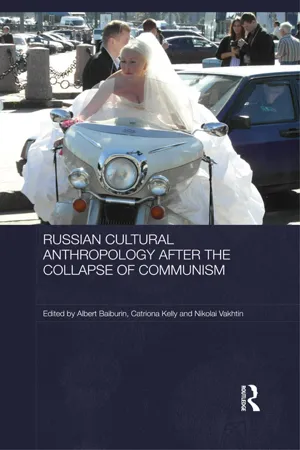
In Soviet times, anthropologists in the Soviet Union were closely involved in the state's work of nation building. They helped define official nationalities, and gathered material about traditional customs and suitably heroic folklore, whilst at the same time refraining from work on the reality of contemporary Soviet life. Since the end of the Soviet Union anthropology in Russia has been transformed. International research standards have been adopted, and the focus of research has shifted to include urban culture and difficult subjects, such as xenophobia. However, this transformation has been, and continues to be, controversial, with, for example, strongly contested debates about the relevance of Western anthropology and cultural theory to post-Soviet reality. This book presents an overview of how anthropology in Russia has changed since Soviet times, and showcases examples of important Russian anthropological work. As such, the book will be of great interest not just to Russian specialists, but also to anthropologists more widely, and to all those interested in the way academic study is related to prevailing political and social conditions.
eBook - ePub
Russian Cultural Anthropology after the Collapse of Communism
- 288 pages
- English
- ePUB (mobile friendly)
- Available on iOS & Android
eBook - ePub
Russian Cultural Anthropology after the Collapse of Communism
About this book
Trusted by 375,005 students
Access to over 1.5 million titles for a fair monthly price.
Study more efficiently using our study tools.
Information
1
Writing the history of Russian anthropology1
The status of any area of research is directly linked on the one hand to its recognition as an independent discipline within the system of transferring knowledge as it exists in higher education, and on the other, to the acknowledgement and recognition of such an area of research as an independent domain of knowledge production within modern academia’s overall division of labour. The metaphor of the division of labour, borrowed by science studies from economics, is based on several premises, among which are ideas about the cumulative nature of knowledge, about the fundamental unity of reality and about the uniqueness of the remit and methods of a particular area of research laying claim to relative autonomy and independence that is shaped by these underlying principles.
As a rule, modern problem-oriented knowledge fits poorly into the strict institutional and disciplinary matrix, something which is reflected in the growing level of inter-disciplinarity of many current academic projects. In addition, the aforementioned matrix – the institutionalised and legitimised division of labour in academia – also suggests a corresponding specialisation of administration and financial support for research. In other words, the system of disciplines that has been formed, which is based on their classification, formalised by legislation, and corresponds to the management of academic research and funding, contradicts the variable and changeable configurations of knowledge in specific academic areas. In the best case scenario this gives rise to hybrid disciplines, and in the worst it essentially puts a halt to the development of research into ‘border’ (that is, inter- or transdisciplinary) issues.
The boundaries of anthropology as a discipline have always been problematic and relative, but in the last quarter of a century they have proved to be considerably more so than is the case for the boundaries of the other social sciences, humanities, and disciplines such as history, sociology, psychology and philosophy. The fragmentation of its topics of study, and numerous alliances and mésalliances with neighbouring academic disciplines, have facilitated the spread of a feeling of crisis not only in Russian, but also in American anthropology, which is today the largest anthropological community in the world.
A quarter of a century ago, in 1983, the American Anthropological Association (AAA) underwent a fundamental reorganisation. The aim of the reorganisation was to reflect changes in the configuration of research fields, which had led to the formation of a multitude of specialised ‘anthropologies’. The reorganisation also led to the doubling of the number of ‘societies’ included within the association. Institutionalised in this way, the system of specialisation can only metaphorically be termed a ‘system’, since its constituent parts – the numerous ‘societies’, ‘associations’, ‘councils’ and ‘groups’ – rarely possess the whole range of identifiers which are ideally typical of a discipline: a subject with defined boundaries, special methodologies and techniques for research, an idiosyncratic system of concepts and so forth. However, virtually all of the member organisations of the AAA as a rule have their own journal and often a corresponding faculty or special courses in universities, their own array of interdisciplinary partnerships, and of course networks of researchers linked by collaboration and communication. In other words, there has been a profound institutionalisation of the academic division of labour that reflects the specialisation of research interests; I emphasise once again that it is a matter of specific interests, not unique methods or an original conceptualisation.
I will name just a selection of these organisations here. Examples of broad, general organisations are the American Ethnological Society, the National Association for the Practice of Anthropology, the Society for Cultural Anthropology, the Society for Humanistic Anthropology, and the General Anthropology Division, which is quite specialised despite its name. Alongside these are the remnants of the Boasian ‘four research areas’ – the Archaeology Division, the Biological Anthropology Section and the Society for Linguistic Anthropology.
Given such diversity, and the extreme fragmentation of research fields, as expressed even in the naming of associations, groups and divisions of the AAA – and even more so in publications in the main relevant journals – one can assert that American anthropology as a whole is oriented towards searching for solutions to the burning social issues of the day, as arising in all kinds of social sub-systems – from the spheres of education to ecology, medicine and social work.
In Russia, on the other hand, social motivation is often replaced by political incentives. Research into the ruling elite’s own problems (conflicts between different interest groups, issues of effective ‘spin’, political ratings and so on) are willingly financed, whereas those which are encountered by ordinary people (poverty, the collapse of the free education and public health systems, the decreasing standard of living) are funded only meagrely. As a result, in a country where more than half of the population are living below the poverty line, economists prefer to invent indicators and measuring systems that mask the social chasm between the rich and the poor (for example, calculations relating to the cost of a basket of goods or to relative wage levels are regularly ‘massaged’). Where they research the social divide at all, researchers concentrate on peripheral problems, making no attempt to analyse the underlying reasons for the social crisis. Even the emergence of extremist movements is often explained by psychological and ideological ‘deviations’ among individual people, rather than by the growing level of deprivation in the population of whole regions of the country. It is only in highly specialised literature that we find a comparison of current life expectancy and life expectancy in the 1980s, or birth and mortality rates over the same period, so badly do the statistics reflect on today.2
This is an extremely disturbing trend that bears witness to the fact that the social sciences in Russia, having barely succeeded in acquiring the opportunity of carrying out objective and unbiased analysis, are doing their best to squander this opportunity, under pressure from the authorities, who are more interested in their own positive image than in accurate reporting of social problems.
The difference between the political and social demands is so subtle that many administrators regularly ‘confuse’ them, all the more so because this strategy guarantees generous financial support. The institutionalisation of new directions of research chronically lags behind the demands of knowledge. Academic administrators are, as a rule, less aware of these demands than researchers themselves, and because of this they are not well disposed to thorough and systematic reform of academic institutions, or to the organisation of new faculties, research groups and departments, or to the adequate financing of new interdisciplinary projects. On the other hand, applied research that promises a rapid increase in political capital fares much better.
But let us return to the disciplinary nature of knowledge, and the metaphor of the disciplinary division of labour as it impacts on anthropology. This metaphor assumes that work on the creation of a truthful picture of reality and the accumulation of knowledge is realised in all academic disciplines systematically and regularly, which in turn depends on interdisciplinary coordination, and the existence of common criteria for the formulation of research aims and tasks and of shared standards for evaluating results. In addition, it is expected that the results obtained by researchers in different disciplines will somehow mutually correspond and supplement one another in producing a general picture of reality. This kind of mutual dependence cannot fail to give cause for concern about the standards of the production of knowledge in neighbouring disciplines and mutual demands on the quality of research. Does this metaphor, which arose in the age of the Enlightenment, reflect today’s research practices? Is disciplinary knowledge really cumulative and can it be in harmony with and supplemented by knowledge from other disciplines in an interdisciplinary synthesis without conflict? Do all scientific disciplines really need common standards or, for example, are those for the humanities and social sciences different from those for the so-called ‘exact sciences’? Should we coordinate our efforts with those in neighbouring academic professions, whether these are close to our own or distant from it? In different periods in the history of Russian anthropology, its representatives have answered these questions differently.
The history of the national tradition of anthropological research is as long and complex as the history of other European (British, Dutch, German and French) and American traditions, although it is significantly less well known, if one compares these national traditions at the level of the number of translations of work into another language, or their overall readership. Russian-language historiography is an extremely rich genre, but one that is virtually unknown beyond the audience that is able to read it in Russian.3 One can take the viewpoint that it is the language barrier that has hindered the integration of Russian anthropology into the history of world anthropological thought. But while this might in itself seem to explain the under-representation of the Russian contribution to the history of anthropology in university textbooks and general histories outside Russia, such an interpretation is contradicted by the international prominence of the works of Russian linguists, cultural critics and folklorists (in this context, Roman Jakobson, Mikhail Bakhtin and Vladimir Propp come immediately to mind), and by their significant impact on the development of scholarship in their own fields and outside these across many countries in Europe and both of the Americas.
The absence of separate chapters on the history of Russian anthropology in English-, French- or German-language general studies of the field,4 as against the presence of chapters on the history of British, French, American, and (sometimes) German, traditions, compels us to reflect on the contribution of Russian anthropology to the global bank of theoretical thought. Evidently the contribution is not that great, since it can be disregarded when describing the development of anthropological knowledge in the world. At this level, Russian tradition stands comparison with the Brazilian, Chinese, Japanese, and even (to some extent) Indian traditions of anthropological research, which have had equally little impact, although the impulse to develop post-colonial research – a highly influential area of modern social criticism – has come specifically from India.
The dominance of American anthropology is usually explained simply as a sociological fact – a huge numerical superiority, virtually tenfold, over any other large national anthropological community. However, the quantitative ratios, albeit essential, only reflect the public success of a discipline, doing little to explain the reasons behind it. The lack of a direct causal link between the membership of a professional community and its influence in the world is indicated by, for example, the fact that British and Brazilian anthropologists are on approximately equal footing when it comes to numbers, although the British tradition, even setting aside its history and taking into account only the current generation, is significantly better-known and more influential. The long-term success of a discipline is facilitated less by growth in the numbers of those practising it (this is more likely to be a consequence of its success), and more by conscientious effort by those who practise it to form an attractive image and engineer public recognition, which in turn facilitates the creation of new academic posts. Also important is the drive to steer the discipline towards fulfilling social services that elevate its socia...
Table of contents
- Cover
- Title
- Copyright
- Contents
- List of illustrations
- List of contributors
- Acknowledgements
- Conventions
- Introduction: Soviet and post-Soviet anthropology
- 1 Writing the history of Russian anthropology
- 2 Female taboos and concepts of the unclean among the Nenets
- 3 ‘The wrong nationality’: ascribed identity in the 1930s Soviet Union
- 4 The queue as narrative: a Soviet case study
- 5 ‘I didn’t understand, but it was funny’: late Soviet festivals and their impact on children
- 6 The practices of ‘privacy’ in a South Russian village (a case study of Stepnoe, Krasnodar Region)
- 7 Believers’ letters as advertising: St Xenia of Petersburg’s ‘National Reception Centre’
- 8 ‘The yellow peril’ as seen in contemporary church culture
- 9 ‘Don’t look at them, they’re nasty’: photographs of funerals in Russian culture
- 10 Historical Zaryadye as remembered by locals: cultural meanings of city spaces
- 11 Yerevan: memory and forgetting in the organisation of post-Soviet urban space
- Name index
- Subject index
Frequently asked questions
Yes, you can cancel anytime from the Subscription tab in your account settings on the Perlego website. Your subscription will stay active until the end of your current billing period. Learn how to cancel your subscription
No, books cannot be downloaded as external files, such as PDFs, for use outside of Perlego. However, you can download books within the Perlego app for offline reading on mobile or tablet. Learn how to download books offline
Perlego offers two plans: Essential and Complete
- Essential is ideal for learners and professionals who enjoy exploring a wide range of subjects. Access the Essential Library with 800,000+ trusted titles and best-sellers across business, personal growth, and the humanities. Includes unlimited reading time and Standard Read Aloud voice.
- Complete: Perfect for advanced learners and researchers needing full, unrestricted access. Unlock 1.5M+ books across hundreds of subjects, including academic and specialized titles. The Complete Plan also includes advanced features like Premium Read Aloud and Research Assistant.
We are an online textbook subscription service, where you can get access to an entire online library for less than the price of a single book per month. With over 1.5 million books across 990+ topics, we’ve got you covered! Learn about our mission
Look out for the read-aloud symbol on your next book to see if you can listen to it. The read-aloud tool reads text aloud for you, highlighting the text as it is being read. You can pause it, speed it up and slow it down. Learn more about Read Aloud
Yes! You can use the Perlego app on both iOS and Android devices to read anytime, anywhere — even offline. Perfect for commutes or when you’re on the go.
Please note we cannot support devices running on iOS 13 and Android 7 or earlier. Learn more about using the app
Please note we cannot support devices running on iOS 13 and Android 7 or earlier. Learn more about using the app
Yes, you can access Russian Cultural Anthropology after the Collapse of Communism by Albert Baiburin,Catriona Kelly,Nikolai Vakhtin in PDF and/or ePUB format, as well as other popular books in Social Sciences & Ethnic Studies. We have over 1.5 million books available in our catalogue for you to explore.