- 292 pages
- English
- ePUB (mobile friendly)
- Available on iOS & Android
eBook - ePub
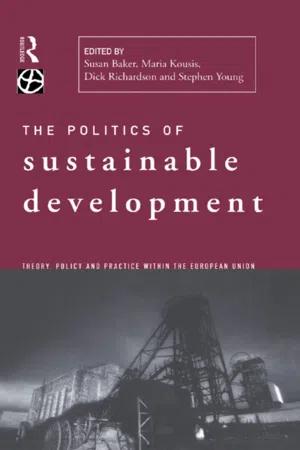
Politics of Sustainable Development
About this book
The concept of sustainable development was popularised by the 1987 Brundtland Report and became a central theme in the EU's Fifth Environmental Action Programme. It dominated the Rio Earth Summit and its promotion has been much in evidence in the subseque
Trusted by 375,005 students
Access to over 1.5 million titles for a fair monthly price.
Study more efficiently using our study tools.
Information
Part I
The concept of sustainable development
1
The politics of sustainable development
Dick Richardson
Sustainable development is a political fudge: a convenient form of words, promoted, though not invented, by the Brundtland Commission, which is sufficiently vague to allow conflicting parties, factions and interests to adhere to it without losing credibility. It is an expression of political correctness which seeks to bridge the unbridgeable divide between the anthropocentric and biocentric approaches to politics.
Beneath the rhetoric of the political platform, the reality is that the concept of sustainable development as presently used is inherently contradictory and begs a number of important questions. There are two basic approaches: the anthropocentric, sometimes referred to as the environmental, and the biocentric, sometimes referred to as the ecological or Gaian. The former approach, adopted by the traditional political parties, by business and trade union interests, and by governments and bureaucracies generally—the European Union among them—presupposes no great changes in the political and economic process or the relationship between humankind and nature. In contrast, the biocentric approach, adopted by ecological interest groups and the majority of Green parties, is predicated upon a fundamental change in the relationship between humankind and nature, with consequential social, political and economic implications.
This Chapter will address the political implications of the differing approaches to sustainable development. It will consider the challenges faced by governments at all levels—international, national and local— within a planetary system of finite resources. It will argue that for the concept to have any real meaning, other than as a consensual phrase of political agreement, it needs to be radically redefined along purely ecological lines. If that is not possible it should be totally abandoned.
ANTHROPOCENTRICITY, BIOCENTRICITY AND SUSTAINABLE DEVELOPMENT
The rise of industrial society in the late eighteenth and nineteenth centuries stimulated the emergence of anthropocentric rather than biocentric ways of thinking (Richardson 1994:4). By the mid-twentieth century the industrial worldview, based on the conquest of nature, materialism and consumption, had achieved almost universal acceptance. In the industrialized world, consumers and politicians look to ever-increasing material standards of living; in the less-developed countries (LDCs) politicians seek to emulate the achievements of the established industrialized states. The achievement of economic growth, measured quantitatively through gross national product (GNP) or through GNP per capita, has become the touchstone of success.
The essence of the anthropocentric approach to the natural world is that humankind is above nature and has the right—divine or otherwise—to subjugate it. Often called domination theory (Richardson 1994: 4), this approach has two main aspects—religious and secular. Of the major religious traditions, the Christian is by far the most anthropocentric (White 1967:1205), calling on humankind to impose its will on the natural world, to subdue it (Genesis: 26, 28). This tradition, through industrialism, has become allied and entwined with the secular: the scientific-rationalist concept, grounded in the ideas of Bacon, Newton and Descartes, that planet Earth exists for the benefit of, and exploitation by, the human race. Humankind is seen as something separate from the rest of life on earth— and superior to it.
It was not until the 1960s that the industrial worldview was seriously challenged, by newly emergent biocentric thinkers and practitioners in what has been termed ‘The Green Challenge’ (Richardson 1994:4–11).1 Central to the biocentric analysis is that humankind is part of nature, not above it; that all life forms, of which humankind is only one, are interconnected in a self-sustaining biosphere (planet Earth). It follows that the part (humankind) cannot dominate the whole (the natural world). Thus, by seeking to subjugate the planet, by imposing human domination, humankind is threatening its own existence. This selfdestruction, it is suggested, can be seen in the language of terrorism, genocide, breakdown, pollution and exhaustion (Schumacher 1974:10–11, 246–247).
In practical day-to-day terms, the anthropocentric approach to the human condition within the natural world is based on materialism and the pursuit of wealth, expressed primarily through industrial expansion and economic growth. Following the teachings of Bacon, Newton and Descartes, explanations of life are reduced to the material. Anything that cannot be proved scientifically is deemed not to exist; anything that cannot be measured does not matter. It is this impersonal, rationalizing outlook, with its emphasis on purely economic and scientific values in measuring human progress, which is integral to the concepts of capitalism, communism, liberalism, socialism and conservatism—and to the political parties which stem from them. The pursuit of wealth and exploitation of the planet may take place on an individualist basis (conservatism), on a collectivist basis (socialism and communism) or on a mixed basis (liberalism and social democracy); but in practice the only differences between the anthropocentric political parties are their methods of organizing the pursuit of wealth and material expansion, dependent as they are on the exploitation of the Earth’s resources.
The biocentric approach to the human condition is radically different. It is anti-materialist in that it eschews the pursuit of wealth as a goal in itself and seeks to enhance the non-material (some would say spiritual) dimension of the human experience. There is emphasis on the quality of life as distinct from the quantity of material possessions, on feelings and values, on the inner rather than the outer self. Partly this is a question of recognizing the wholeness of the self (material and non-material) as well as the wholeness of the planet. But more fundamentally, from the point of view of the present Chapter, it is a question of recognizing that the pursuit of wealth through industrial expansion and economic growth is ultimately incompatible with the Earth’s finite resource base. Central to this approach is the view that the Earth’s resources should be used as capital rather than as income, otherwise humankind is merely consuming what rightly belongs to future generations (Schumacher 1974:12–14, 16). The concept is that of Right Livelihood. Consumption should be based on human need rather than human greed.
The late 1960s and early 1970s saw the climax of what came to be known as the Great Doom debate, between the anthropocentric establishment and its emergent biocentric critics. Major attacks on the industrial worldview came from E.J.Mishan with The Costs of Economic Growth (1967), the Club of Rome’s The Limits to Growth (Meadows et al. 1972), the Ecologist’s Blueprint for Survival (1972) and E.F.Schumacher’s Small is Beautiful (1974). The first national Green party in Europe, with a specifically biocentric basis, was founded in 1973—the UK Green Party— then known simply as ‘People’. By the early 1980s Green parties had been established in most western European states, and in West Germany Die Grünen entered the Bundestag in March 1983. In subsequent years, Greens have entered national and local assemblies throughout Europe and pose not only an intellectual threat to the prevailing anthropocentrism of the traditional political parties, but a political threat as well.2
Anthropocentrism in its various guises remains the dominant force within national and international society. But in recent years, with the development of the ecological critique of the industrial worldview and the appearance of Green parties in national assemblies, there has been an attempt on the part of anthropocentric thinkers and practitioners to dilute the impact of their biocentric critics. For example, a watered-down version of domination theory has gained currency. As regards the religious aspect, this has found expression in the concept of stewardship, whereby the human race is extolled to ‘take all possible action to ensure man’s responsible stewardship over nature’ (Echlin 1988:5). This is seen by some as a middle way between the environmental destruction associated with the industrial worldview, and ecological determinism (O’Riordan 1976:204), but in reality the concept of stewardship is as human-centred as the cruder forms of anthropocentric theory. Humankind is still in charge of the natural world. Similarly, as regards the scientific-rationalist aspect of domination theory, watered-down anthropocentrism can be seen in the concept of sustainable development, which in practical terms has come to mean that a modicum of attention is paid to environmental—as distinct from ecological—concerns, within the overall context of the continued plundering of the Earth’s resources (Orton 1994:13).
The term ‘sustainable development’ is hardly a new one. The Canadian government began to use the term, intermittently and anthropocentrically, in the early 1980s. However, it was the publication of the Brundtland Report, Our Common Future, in 1987 which popularized and politicized the term. The report itself, the product of three years’ work by the United Nations’ World Commission on Environment and Development, was a series of compromises between the opposing views of twenty-three commissioners from twenty-one different states from around the globe. Typical of the compromises was that on the definition of sustainable development: ‘development that meets the needs of the present without compromising the ability of future generations to meet their own needs’ (WCED 1987:8). It was a ‘catch-all’ definition which left all the commissioners happy: a good political fudge—and an excellent political slogan—but on deeper analysis a vague, contradictory, even meaningless concept.
The key to understanding the Brundtland approach to the natural world is that it frames anthropocentric programmes and the industrial worldview in the language of biocentricity. At the level of rhetoric, Brundtland unites the supporters of treadmill production such as Simon and Kahn (1984) with those who would mitigate its effects on the environment, through either a market-reliant environmental policy (Pearce et al. 1989) or an environmentally regulated market (Jacobs 1991). Similarly, in terms of a Ladder of Sustainable Development (see the Introduction) the Brundtland phraseology unites the advocates of exponential growth with the exponents of ‘weak sustainable development’ and ‘strong sustainable development’. In essence, the supporters of Brundtland do not seek to question the concept of quantitative growth measured in traditional terms, although adherents of strong sustainable development may wish to see it redirected in part along qualitative lines. In contrast, the advocates of a biocentric approach question the very concept of quantitative growth.
Given their inherent anthropocentricity and support of the industrial worldview, it is hardly surprising that the Brundtland principles have been endorsed, indeed welcomed, by governments at all levels. They are the basis of the European Union’s Fifth Environmental Action Programme. They are written into the Maastricht Treaty, which aspires to ‘sustainable and non-inflationary growth respecting the environment’. They are reflected in the agreements reached at the Earth Summit in Rio in June 1992: the Rio Declaration; the Convention on Biodiversity; the Statement of Forest Principles; the Framework Convention on Climate Change; and Agenda 21. Principle 12 of the Rio Declaration, for example, lays down that ‘States should co-operate to promote a supportive and open international system that would lead to economic growth and sustainable development in all countries’. This approach is further reflected in the United Nations Commission on Sustainable Development, established after Rio as a promotional vehicle to offset the threat of the political ecology movement to national governments and global multinational business (Orton 1994: 14). The UK Government’s report to the UN Commission on Local Agenda 21 stated specifically that ‘Sustainable development is not incompatible with economic growth’ (UKLGMB 1993:2).
The problem with the Brundtland Commission was that it tried to unite the ununitable—the anthropocentric and biocentric approaches to the natural world—by means of an agreed form of words. It was an act of political consensus which sought to bring together not only governments (both Left and Right), but the business community, the scientific establishment, non-governmental organizations (NGOs) and even environmentalists. In this it has achieved considerable success. It is almost universally subscribed to. It gives hope to developed states, in particular their scientific and business communities, that economic expansion can be achieved without adversely affecting the environment. It gives hope to LDCs and underdeveloped regions that their development needs will be met. It has given environmentalists credibility. In reality, however, by the very fact that it based its findings on the need for political consensus, the Brundtland Commission begged the very questions that it was established to analyse. What, in fact, constitutes development? What is the relationship, if any, between development and growth? How can needs be identified? How should future needs be compared with present needs? What are needs as distinct from desires? Which future generations should be taken into account in formulating policy? The next generation? The next but one? Or, given the problem of nuclear waste, the next but twenty-one?
THE TERMINOLOGICAL IMPLICATIONS OF POLITICS
For the concept of sustainable development to have any utility—except as a political slogan—it needs to be radically redefined. Given its inherent contradictions, there is a good case for abandoning it altogether. However, its assimilation into the political vocabulary as an icon of political correctness makes redefinition, at this stage, a justifiable and potentially productive exercise. Essentially, this means coming to terms with three main issues: development, needs and sustainability
The anthropocentric view of development is that it is synonymous with growth, growth which follows the Western development paradigm based on international free trade, the maximization of output and the expansion of individual economies, local and national, measured in terms of GNP. In practice, it is this development paradigm which has been adopted by ruling elites on a worldwide basis. Terminologically, it has much to be said for it. Indeed, it is backed by the Shorter Oxford English Dictionary. Development, according to dictionary definition, has four main meanings: a gradual unfolding, in the sense of a fuller working out of details; evolution, in the sense of the production of a new form or matter; growth of what is in the germ; and growth from within. In other words, all four definitions entail some kind of expansion or growth, and in the first three definitions this is primarily physical. Only the fourth definition— inner growth—allows for purely non-physical growth.
The biocentric approach to development is opposed to the anthropocentric in that it concentrates on the fourth definition of growth —inner growth—measuring well-being in terms other than that of annual consumption. The biocentric premise is that since consumption is merely a means to human well-being, whether individual or collective, the aim should be to obtain the maximum of well-being with the minimum of consumption (Schumacher 1974:47–48). This, of course, poses the question of what should be indicators of human well-being. The problem here is that it is difficult to formulate indicators which relate to feelings and values and the non-material world. Birth and death rates, adult literacy levels and life expectation have all been put forward, but they are deficient in that objective factors cannot adequately measure subjective values.
What, then, constitutes development? In theory, there is no one answer, or the answer is ambiguous. But in practice, in the parlance and actions of the political world, the answer is that development is equated with growth, in its material sense. Indeed, the interconnection between development and growth has been enshrined in documentary form, as for example in the Maastricht Treaty and Rio Declaration. Further, it has taken root in the acceptance of the growth-oriented Western development paradigm across the globe. Nevertheless, in the final analysis the equation of growth with development is unrealistic, since exponential economic growth is a physical impossibility given the finite limits of the planet. The consequence, therefore, is that those who wish to define development in terms of non-material, non-physical growth, or in terms of social and cultural growth as well as economic and technological growth, are left with a conundrum. Should they continue to use a term— development—which has effectively been hijacked by the anthropocentric proponents of the industrial worldview, or should they seek a new or refined term which encapsulates their own ideas and feelings?
The question of needs is in many ways similar to that of development, given that there is a material and a non-material element to both. The anthropocentric approach is concerned solely with the material side. Needs are identified and quantified in economic terms, on the grounds that the accretion of wealth, assessed through GNP or GNP per capita, makes it possible to meet the material needs of all. This is the basis of the ‘Brundtland consensus’, which identifies the problem as ‘meeting the basic needs of all and extending to all the opportunity for a better life’ (WCED 1987:44). Yet there is no distinction between the perceived needs of people in the industrialized North, with their often extremely high standards of living, and those of the industrializing South, where standards of living are in most cases extremely low.
It is a basis of the Western development paradigm that needs are unmet and unfulfilled, as this gives rise to aspirations for greater material growth. Unhappiness and discontentment are deliberately fostered, in the sense of people and governments wanting more than is obtainable at any one moment (Sadie 1960:302). At the individual level, the ‘have-nots’ of the industrialized world aspire to the standards of living and material possessions of those that ‘have’. Similarly, at governmental level the ‘have-not’ states of the industrializing world aspire to the standards of living and material possessions of the ‘have’ states. The suffering and dislocation that may be caused to the ecosystem or its human subsystems in the process of attempting to meet these aspirations may be objectionable, but is the price to be paid for economic ‘progress’.
Thus the problem with the anthropocentric approach to needs, enshrined as it is in the Brundtland consensus, is not only that it fails to give due weight to non-material needs, but also that it fails to distingui...
Table of contents
- Cover Page
- Title Page
- Copyright Page
- List of illustrations
- Notes on contributors
- Preface
- Introduction
- Part I: The concept of sustainable development
- Part II: The practice of sustainable development
Frequently asked questions
Yes, you can cancel anytime from the Subscription tab in your account settings on the Perlego website. Your subscription will stay active until the end of your current billing period. Learn how to cancel your subscription
No, books cannot be downloaded as external files, such as PDFs, for use outside of Perlego. However, you can download books within the Perlego app for offline reading on mobile or tablet. Learn how to download books offline
Perlego offers two plans: Essential and Complete
- Essential is ideal for learners and professionals who enjoy exploring a wide range of subjects. Access the Essential Library with 800,000+ trusted titles and best-sellers across business, personal growth, and the humanities. Includes unlimited reading time and Standard Read Aloud voice.
- Complete: Perfect for advanced learners and researchers needing full, unrestricted access. Unlock 1.5M+ books across hundreds of subjects, including academic and specialized titles. The Complete Plan also includes advanced features like Premium Read Aloud and Research Assistant.
We are an online textbook subscription service, where you can get access to an entire online library for less than the price of a single book per month. With over 1.5 million books across 990+ topics, we’ve got you covered! Learn about our mission
Look out for the read-aloud symbol on your next book to see if you can listen to it. The read-aloud tool reads text aloud for you, highlighting the text as it is being read. You can pause it, speed it up and slow it down. Learn more about Read Aloud
Yes! You can use the Perlego app on both iOS and Android devices to read anytime, anywhere — even offline. Perfect for commutes or when you’re on the go.
Please note we cannot support devices running on iOS 13 and Android 7 or earlier. Learn more about using the app
Please note we cannot support devices running on iOS 13 and Android 7 or earlier. Learn more about using the app
Yes, you can access Politics of Sustainable Development by Susan Baker in PDF and/or ePUB format, as well as other popular books in Politics & International Relations & Politics. We have over 1.5 million books available in our catalogue for you to explore.