First published in 2011. Johannes Brahms: A Research and Information Guide is an annotated bibliography concerning both the nature of primary sources related to the composer and the scope and significance of the secondary sources which deal with him, his compositions, and his influence as a composer and performer. The second edition will include research published since the publication of the first edition and provide electronic resources.
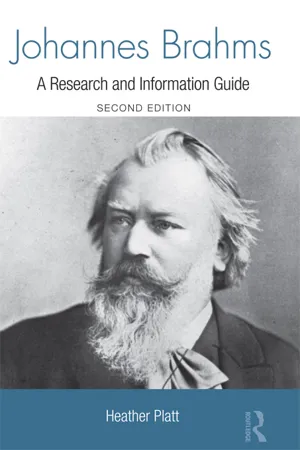
- 552 pages
- English
- ePUB (mobile friendly)
- Available on iOS & Android
eBook - ePub
Johannes Brahms
About this book
Trusted by 375,005 students
Access to over 1.5 million titles for a fair monthly price.
Study more efficiently using our study tools.
Information
Subtopic
Music1
Basic Resources
MANUSCRIPTS
Collections and Catalogs of Manuscripts and Correspondence
1. Albrecht, Otto Edwin. A Census of Autograph Music Manuscripts of European Composers in American Libraries. Philadelphia: University of Pennsylvania Press, 1953. xvii, 331 pages. ML 135.A2A4.
Now partially out of date, this catalog includes eighty-eight entries for Brahms (pp. 49–67). Each entry provides the name of the work, the size of the manuscript, its location, and the date of the work's publication. The Library of Congress owns these manuscripts, though private owners are also identified.
2. Badura-Skoda, Paul. “Eine Brahms-Kadenz zu Mozarts d-Moll Konzert KV 466 und andere unbekannte Musikerhandschriften aus der Leipziger Universitätsbibliothek.” Das Orchester (Mainz) 28/11 (November 1980):887–90. A slightly different version appeared as “Eine ungedruckte Brahms-Kadenz zu Mozarts d-Moll-Konzert KV 466.” Österreichische Musikzeitschrift 35/3 (March 1980): 153–6.
The discovery and physical characteristics of this formerly unpublished cadenza to Mozart's K. 466, which was thought to be by Brahms, are described. Some of the other materials housed at that time in the same collection in Leipzig, including an autograph of Brahms's SATB Quartet op. 92, no. 1, are also briefly mentioned. The article in Das Orchester includes a facsimile of an excerpt of the cadenza.
The cadenza to K. 466 is now thought to be spurious. See George S. Bozarth, “Brahms's Posthumous Compositions and Arrangements: Editorial Problems and Questions of Authenticity.” In Brahms 2: Biographical, Documentary and Analytical Studies, ed. Michael Musgrave, pp. 59–94. Cambridge: Cambridge University Press, 1987. See no. 40.
3. Bozarth, George S. “The First Generation of Brahms Manuscript Collections.” Notes 40/2 (December 1983): 239–262. Corrections to this article are given in Notes 40/4 (June 1984): 769.
Many of Brahms's autographs were dispersed during his life; they were given to friends and publishers, or were destroyed by the composer. The fate of some of the most important collections of these manuscripts, including those owned by Clara Schumann, Levi, Joachim, Ottilie Ebner, Julius Otto Grimm, and Celestine Truxa, are described. An appendix (pp. 251–262) provides a comprehensive list of the autographs, with the names of their original and present owners.
4. Bozarth, George S., with the assistance of Elizabeth H. Auman and William C. Parsons. The Musical Manuscripts and Letters of Johannes Brahms (1833–1897) in the Collections of the Music Division, Library of Congress. Washington, DC: The Library, 1983. 22 pages. ML 134.B8L5 1983.
The Library of Congress has been collecting Brahms material since 1913 and now holds a number of important items, including the autograph of Symphony no. 3. This catalog is a simple list of the Brahms autographs that the library owns.
5. Elvers, Rudolf. “Die Brahms-Autographen in der Musikabteilung der Staatsbibliothek Preußischer Kulturbesitz, Berlin.” Brahms-Studien 2 (1977): 79–83.
This is a list of the autographs (including music and correspondence) held in the Staatsbibliothek.
* Fellinger, Imogen. “Die Brahms-Gesellschaft in Wien (1904–1938).” In Musikkulturgeschichte: Festschrift für Constantin Floros zum 60. Geburtstag, ed. Peter Petersen, pp. 573–586. Wiesbaden: Breitkopf & Härtel, 1990. See no. 1398.
* Kross, Siegfried. “Brahmsiana: Der Nachlass der Schwestern Völckers.” Musikforschung 17/2 (April-June 1964): 110–151. See no. 350.
6. Leibnitz, Thomas, and Agnes Ziffer, eds. Katalog der Sammlung Anton Dermota: Musikhandschriften und Musikerbriefe. Tutzing: Schneider, 1988. ix, 190 pages. (Publikationen des Instituts für Österreichische Musikdokumentation, 12.) ISBN 3-7952-0534-4. ML 138.D47 1988.
Dermota, a twentieth-century singer, owned several Brahms autographs that, along with the rest of his collection, are on loan to the Music Collection of the Österreichische Nationalbibliothek. The autographs are for the lieder opp. 19, nos. 2 and 3; 32, no. 6; and for the canon op. 113, no. 12. There are also five very short items of correspondence and a photograph of the composer. The catalog (pp. 15–21) briefly describes each item and provides a short history of each work, drawn mainly from Kalbeck and the McCorkle catalog. There is a small facsimile of op. 113, no. 12, and another of a card Brahms sent to Hanslick.
7. Maier, Elisabeth. “Die Brahms-Autographen der Österreichischen Nationalbibliothek.” Brahms-Studien 3 (1979): 7–34.
The music collection of the Österreichische Nationalbibliothek houses numerous autographs of Brahms's compositions and letters, including correspondence with Emil Streicher. There are autograph materials for opp. 1, 25, 26, 50, the second quartet of 51, 55, 56a, 67, 77, 80, 81, and 83. Each source is described and the letters are transcribed.
8. McCorkle, Margit L. “Die erhaltenen Quellen der Werke von Johannes Brahms: Autographe, Abschriften, Korrekturabzüge.” In Musik, Edition, Interpretation: Gedenkschrift Günter Henle, ed. Martin Bente, pp. 338–54. München: Henle, 1980. ISBN 3-87328-032-9. ML 55.H44 1980.
This article anticipates the publication of the McCorkle catalog of Brahms's compositions. A fourteen-page table notes the type and location of the surviving autograph material for each of Brahms's works.
9. Neubacher, Jürgen. “Das Brahms-Archiv der Staats-und Universitäts-bibliothek Hamburg: Ein Überblick über dessen Geschichte und Bestände.” In Johannes Brahms: Quellen—Text—Rezeption—Interpretation: Internationaler Brahms-Kongreβ, Hamburg 1997, ed. Friedhelm Krummacher and Michael Struck, with Constantin Floros and Peter Petersen, pp. 279–88. München: Henle, 1999. See no. 103.
A brief history of the Brahms-Archiv is followed by a list of its important holdings, which include autographs and copies (with corrections) of Brahms's pieces, as well as letters. The Archiv owns material from the estates of Kalbeck, Joachim, and Fritz Schnack.
* Prillinger, Elfriede. “Johannes Brahms und Gmunden (Die Sammlung Miller-Aichholz im Gmundner Kammerhofmuseum).” Part I: Brahms-Studien 5 (1983): 181–204. Part II: Brahms-Studien 6 (1985): 75–87. See no. 77.
Collections and Institutions Dedicated to Brahms
10. Brahms-Institut an der Musikhochschule Lübeck. www.brahms-institut.de/
The Brahms-Institut in Lübeck, which began with the collection of Renate and Kurt Hofmann, owns manuscripts (autographs and copies), early printed sources, letters, and photos relating to the composer. It has begun to digitize many of these sources and to make them available via its web page. This page already includes a digitized version of the first Brahms collected edition. The institute hosts concerts and a variety of exhibits. It also publishes books and catalogs related to the exhibits and to its most significant holdings. (See nos. 11–8, 70, 105, and 676.) Wolfgang Sandberger provides an overview of the institute and its current location in: “‘Neue Bahnen’: Das Brahms-Institut an der Musikhochschule Lübeck,” Der Wagen (Lübecker Beiträge zur Kultur und Gesellschaft) (2004): 156–70.
In addition to the items listed below, publications relating to the holdings of the Lübeck institute can be accessed through this bibliography's index listing for Brahms Societies & Institutes/ Brahms-Institut an der Musikhochschule Lübeck.
11. Auckenthaler, Jörg, et al. 32 Stichvorlagen von Werken Johannes Brahms’. Berlin: KulturStiftung der Länder, 1995. 63 pages (KulturStiftung der Länder—PATRIMONIA, 107.) ML 136.L9B73 1995.
The Brahms-Institut in Lübeck now owns the Stichvorlagen that were part of the estate of Simrock, one of Brahms's publishers. This catalogue provides a detailed description of each source, including information concerning any emendations Brahms made to the music. Renate Hofmann prepared this catalog. In addition, there is a brief introduction by Jörg Auckenthaler and two short essays by Kurt Hofmann. The first essay concerns the relationship between Brahms and Fritz Simrock (pp. 7–15), and the second, the significance of Stichvorlagen and manuscript copies of Brahms's works (pp. 17–21). There are eight clear photographs of some of the cataloged sources, and some of these show Brahms's own notes or corrections. Aside from Brahms's music, a small number of letters and compositions by Franz Wüllner are also described. The musical sources include materials for opp. 16, 18, 19 (no. 5), 36, 46 (nos. 1 and 3), 47 (nos. 2, 3, and 5), 48 (nos. 1, 5, and 6), 51, 54, 55, 61, 68, 69, 70, 71, 72, 74, 75, 89, 91, 92, 93b, and 121.
12. Fischer, Joachim, et al., eds. Brahms-Institut an der Musikhochschule Lübeck: Musikhandschriften und Briefe aus dem Familienarchiv Avé-Lallemant. Lübeck and Berlin: Kulturstiftung der Länder in Verbindung mit dem Brahms-Institut an der Musikhochschule Lübeck, 2001.78 pages (KulturStiftung der Länder—PATRIMONIA, 197.)
Theodor Avé-Lallemant met Brahms in 1850, and he was in contact with many of the composer's closest friends, including the Schumanns and Joachim. He had a significant music library, and part of his estate is now at the Brahms-Institut. This volume includes an essay about Avé-Lallemant by Kurt Hofmann (pp. 8–12) and essays about the manuscripts of Brahms and Clara and Robert Schumann that Avé-Lallemant owned. The two essays on Brahms's autographs are: Wolfgang Sandberger, “Johannes Brahms: Motette Es ist das Heil uns kommen her, op. 29, Nr. 1, Autograph” (pp. 14–23); and Stefan Weymar, “Johannes Brahms: Töne, lindernder Klang, Kanon für vier Stimmen, WoO 28, Autograph (Erstfassung)” (pp. 44–51). Both essays place these works in the context of Brahms's life and describe the respective manuscripts. They also include facsimiles of excerpts from some of the manuscripts. Renate Hofmann describes the letters that belonged to the estates of Theodor and Johannes Avé-Lallemant (pp. 53–72), five of which were written by Brahms.
* Hofmann, Kurt. Brahms-Institut an der Musikhochschule Lübeck: Johannes Brahms Klavierquartett Nr. 2 A-Dur op. 26 Autograph, ed. Ute Metscher. Kiel and Berlin: Kulturstiftung der Länder in Verbindung mit der Ministerin für Bildung, Wissenschaft, Kultur und Sport des Landes Schleswig-Holstein, 1993. 27 pages. (KulturStiftung der Länder—PATRIMONIA, 53.) See no. 676.
* Hofmann, Kurt. “Johannes Brahms’ letzte Lebenszeit: Unveröffentlichte Dokumente im Brahms-Institut Lübeck.” In Internationaler Brahms-Kongress Gmunden 1997: Kongreβbericht, ed. Ingrid Fuchs, pp. 531–51. Tutzing: Schneider, 2001. See no. 123.
13. Metscher, Ute, and Annegret Stein-Karnbach, eds. Johannes Brahms, “Ein deutsches Requiem”: Stichvorlage des Klavierauszuges. Berlin: Kulturstiftung der Länder, 1994, 36 pages. (KulturStiftung der Länder— PATRIMONIA, 80.) ML 410.B8S8 1994.
The Brahms-Institut in Lübeck acquired materials formerly owned by Friedrich Georg Zeileis (see no. 19), and three essays describe these sources: Michael Struck, “Ein deutsches Requiem—handlich gemacht: Der Klavierauszug und seine Stichvorlage” (no. 924); Renate Hofmann, “Vier Briefe des Verlages J. Rieter-Biedermann an Johannes Brahms” (no. 176); and ‘“Brahms am Klavier’: Zeichnung von Willy von Beckerath” (no. 70).
14. Nogalski, Gabriele, ed. Brahmsiana aus dem Nachlaβ Oswald Jonas. Kiel und Berlin: Kulturstiftung der Länder in Verbindung mit dem Ministerium für Bildung, Wissenschaft, Forschung und Kultur des Landes Schleswig-Holstein, 1999. 68 pages. (KulturStiftung der Länder—PATRIMONIA, 162.)
Kurt and Renate Hofmann describe the Brahms sources that were formerly part of the estate of Jonas, but since 1998 are at the Brahms-Institut in Lübeck. For each collection of pieces Kurt Hofmann provides a brief historical sketch, and then his wife describes the physical characteristics of the sources. She provides information on each piece and notes the markings that Brahms himself made, and the different colored inks that were used. The sources are: the Stichvorlagen for opp. 52a, 65, 120 (version for violin and piano), and WoO 33, Heft. 1–7; the engraver's proofs for WoO 33, Heft. 1–6; Kalbeck's score of op. 120 (the version for violin and piano); and three brief letters from Brahms to Theodor Engelmann, Friedrich Gernsheim, and Richard Fellinger. The texts of these notes are transcribed and explained. A small number of facsimiles of the sources are included. Irene Schreier Scott provides a biography of Oswald Jonas.
15. Sandberger, Wolfgang, ed. “Ich schwelge in Mozart… ”: Mozart im Spiegel von Brahms. Eine Ausstellung im Brahms-Institut an der Musikhochschule Lübeck (in Verbindung mit dem Archiv der Gesellschaft der Musikfreunde in Wien, 28. April-31. Juli 2006). Lübeck: Brahms-Institut an der Musikhochschule Lübeck, 2006. 95 pages. ISBN 3-00-018531-3.
Pages 6–22 include essays by Wolfgang Sanberger, Jürgen Köchel, and Otto Biba that outline Brahms's knowledge of Mozart's life and works. Brahms played and conducted a variety of Mozart's compositions and heard many others (including operas). He studied scores, knew of Köchel's work on the Mozart catalog, and edited Mozart's Requiem for the complete edition. The remainder of this glossy catalog comprises annotated color illustrations of scores, books, and photographs of people who were in some way connected with Brahms's study of Mozart.
16. Sandberger, Wolfgang, and Stefan Weymar. Johannes Brahms: Zeichen, Bilder, Phantasien. Lübeck: Brahms-Institut an der Musikhochschule Lübeck, 2004. 107 pages. ML 410.B8S118 2004.
This catalog offers a sampling of the items related to Brahms that the Institut owns. Aside from one-page facsimiles of the autographs of “Es ist das Heil und kommen her” and “Liebesglut” (opp. 29, no. 1 and 47, no. 2), there are also photographs of scores and books Brahms owned, facsimiles of some of Max Klinger's art (which was inspired by Brahms's compositions), and photographs of the composer's friends. Each illustration is annotated.
17. Stein-Karnbach, Annegret, ed. Brahms-Institut an der Musikhochschule Lübeck: Die Sammlung Hofmann. Berlin: Kulturstiftung der Länder, 1992. 28 pages. (KulturStiftung der Länder—PATRIMONIA, 18.)
Carmen Debryn, in ‘“… und plötzlich hatte mich das Sammelfieber gepackt…’: Der Sammler Kurt Hofmann und die Entstehung der ‘Sammlung Hofmann’” (pp. 4–11), sketches the history of the Hofmann collection. Michael Struck, in “Struktur, Inhalte und Bedeutung der ‘Sammlung Hofmann’” (pp. 13–20), gives an overview of the collection, which is now housed at the Brahms-Institut in Lübeck. This material includes sources for Brahms and his circle, such as manuscripts, first and early editions, programs, and correspondence. A catalog of some of these items is included (pp. 21–5), as are a small number of facsimiles. Since the time of this publication, however, the collection has been enriched by further important manuscript materials.
18. Wiesenfeldt, Christiane (comp.), and Wolfgang Sandberger, eds. Julius Spengel: Ein Brahms-Freund zwischen Identifikation und Emanzipation. Lübeck: Brahms-Institut an der Musikhochschule Lübeck, 2005. 103 pages.
Spengel promoted Brahms's compositions through his position as the conductor of a choral society in Hamburg. Wiesenfeldt published an essay based on this catalog: “Julius Spengel (1853–1936): Ein Brahms-Freund zwischen Identifikation...
Table of contents
- Front Cover
- Half Title
- Music/Reference
- Title Page
- Copyright
- Dedication
- Contents
- Preface
- Acknowledgments
- 1 Basic Resources
- 2 Letters and Recollections
- 3 Life and Works
- 4 Orchestral and Chamber Works
- 5 Keyboard Music
- 6 Vocal Music
- 7 Analysis and Interpretation
- 8 Brahms and Other Composers' Music
- 9 Performance Issues
- 10 Critical Reception of Brahms's Compositions
- Name and Subject Index
- Index of Brahms's Compositions
Frequently asked questions
Yes, you can cancel anytime from the Subscription tab in your account settings on the Perlego website. Your subscription will stay active until the end of your current billing period. Learn how to cancel your subscription
No, books cannot be downloaded as external files, such as PDFs, for use outside of Perlego. However, you can download books within the Perlego app for offline reading on mobile or tablet. Learn how to download books offline
Perlego offers two plans: Essential and Complete
- Essential is ideal for learners and professionals who enjoy exploring a wide range of subjects. Access the Essential Library with 800,000+ trusted titles and best-sellers across business, personal growth, and the humanities. Includes unlimited reading time and Standard Read Aloud voice.
- Complete: Perfect for advanced learners and researchers needing full, unrestricted access. Unlock 1.5M+ books across hundreds of subjects, including academic and specialized titles. The Complete Plan also includes advanced features like Premium Read Aloud and Research Assistant.
We are an online textbook subscription service, where you can get access to an entire online library for less than the price of a single book per month. With over 1.5 million books across 990+ topics, we’ve got you covered! Learn about our mission
Look out for the read-aloud symbol on your next book to see if you can listen to it. The read-aloud tool reads text aloud for you, highlighting the text as it is being read. You can pause it, speed it up and slow it down. Learn more about Read Aloud
Yes! You can use the Perlego app on both iOS and Android devices to read anytime, anywhere — even offline. Perfect for commutes or when you’re on the go.
Please note we cannot support devices running on iOS 13 and Android 7 or earlier. Learn more about using the app
Please note we cannot support devices running on iOS 13 and Android 7 or earlier. Learn more about using the app
Yes, you can access Johannes Brahms by Heather Platt in PDF and/or ePUB format, as well as other popular books in Media & Performing Arts & Music. We have over 1.5 million books available in our catalogue for you to explore.