![]()
Section 1
Knowledge for teaching and learning
Introduction
Hugh Lauder
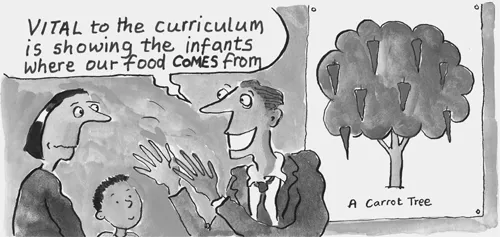
(Cartoon by Ros Asquith)
This section examines one of the fundamental puzzles in education. In terms of knowledge there is a robust view which sees knowledge as being what our best theories tell us about the world (Haig, 1987). These theories are often embedded in socially and historically constructed disciplines, such as chemistry, mathematics or sociology, although increasingly they cross disciplinary boundaries. In contrast, the best theories of learning currently available suggest that learners, in some sense, construct knowledge. As Palincsar and Scott in Chapter 1.3 put it, ‘we create our understanding through our experiences and that the character of our experiences is influenced profoundly by the lenses we bring to those experiences’.
The puzzle is this: on the one hand we have theories that have logical structures and ways of gathering and interpreting evidence that are objective, and arguably students need to comprehend if they are to develop a deeper understanding of the natural and social worlds we inhabit; and on the other a view of learning which involves students’ construction of knowledge. How then can these two positions be reconciled?
We need to start with the idea that (i) there are forms of knowledge as expressed through theories and related disciplines which are objective in the sense that they are independent of any individual and open to inspection and discussion through language and other symbolic systems, for example maths; and, (ii) that these forms of knowledge should be taught in schools and universities. The chapters by Michael Young and Roy Nash approach these questions from different perspectives but come to remarkably similar conclusions. Both acknowledge that there are social foundations to knowledge, that is to say that there are no certain foundations to knowledge or techniques which enable us to be certain about our knowledge claims. However, it can be argued that we can make judgements about which is the best theory at any given moment in history, and it is on this basis that knowledge advances and gives us the power to comprehend the world.
Michael Young begins by asking the fundamental question and one that is often taken for granted, ‘what are schools for?’. Schools are often seen as the solution to all society’s ills, from teaching about finance, to sex education and environmental sustainability. But Young argues that their primary purpose is to impart the kind of formal knowledge represented by academic disciplines and theories. This claim immediately raises a series of policy and pedagogical questions. ‘Knowledge’ as he uses the word has, he notes, been absent from much educational policy discourse because the focus has been on developing student competencies and qualifications. He acknowledges that the kind of knowledge he is advocating may be problematic in a pedagogical sense for working-class students to acquire because it goes beyond any common-sense understanding of their world and may in the sciences be counter to common sense. In this respect, such knowledge has often been identified as that of the professional middle class. But Young draws a distinction between ‘knowledge of the powerful’ and ‘powerful knowledge’. While formal knowledge has often been associated with the culture and norms of the powerful he sees it as also being necessary for working-class and other dominated groups because it provides ways of systematic thinking and tools for practice that enable them to be active in the construction of their destinies. For example, it could be argued that some understanding of statistics is necessary for reasons of personal health, to understand the problems of environmental sustainability and social deprivation.
Nash’s chapter tackles the issue of knowledge of the powerful and powerful knowledge head-on. He discusses the theories of one of the leading sociologists in the past century, Pierre Bourdieu, who sought to explain the significant advantage that professional middle-class children have in education. Part of his explanation lies in observing that the culture of middle-class homes and that of schools is similar: both have an emphasis on literacy and the importance of books and appeal to the merits of high culture. Bourdieu views this culture and the knowledge that it embodies as a form of symbolic violence against working-class students. He is able to make this claim, in at least one version of his theory, because he sees knowledge as culturally arbitrary and tied to class interests. However, Nash argues that some forms of knowledge should be taught as necessary, not arbitrary, if we are to flourish as human beings, because it is ‘a gateway to an autonomous form of life’.
The chapters by Young and Nash raise fundamental problems of pedagogy and learning since abstract symbol systems such as those found in science, maths or literature are more consistent with life in professional middle-class families. But this practical problem also meets the theoretical problem of how children learn head-on. One of the dominant approaches to how children learn is that of constructivism: that is, children construct their own knowledge. Commenting on a constructivist position developed by Rudolph (2000), Nash argues that:
students often possess naive realist perceptions of the nature of science and privilege demonstration and experimentation over other forms of reasoning, and if this is so then far from being ‘a bad thing’ it might provide a sound basis for a scientific education. Is it self-evident that the sort of idealism students might pick up from some constructivist teaching, which is unlikely to be a highly sophisticated understanding, is superior to ‘naive realism’? The realism considered so naive may more likely be grounded in a robust materialism, which is a philosophy with a long history in working-class radicalism.
This view is contrary to that taken by Annemarie Sullivan Palincsar and Sarah Scott, who are committed to a particular version of what is the broad church of constructivism. They take constructivism to be first and foremost a theory of knowledge (an epistemology) which has implications for pedagogy and learning. However, their chapter is largely taken up with a discussion of theories of learning and in particular the way children construct their learning. Such an approach sees the child as active, rather than passive as some previous theories of learning have assumed. Moreover, it is clear from their chapter that they do not see children’s learning as a kind of ‘free-for-all’ in which it is possible for every child to have different views of the world. For example, in enlisting Vygotsky’s theory in the constructionists’ cause they note that teachers are seeking particular forms of competence from children, which suggests a pre-existing social set of standards or competences that teachers are aiming for. Equally, in discussing reasoning in science they refer to forms of evidence which are different from those used in history.
Mariane Hedegaard’s chapter addresses one of the key issues arising out of the work of Young, Nash and Palincsar and Scott in that she is seeking to help students make the transition from everyday categories of thought to the more abstract and theoretical. Her approach is in the tradition of learning theories developed by Vygotsky. Her proposal for a ‘double move in teaching’ exemplifies the application of Vygotsky’s and his co-workers’ understandings about the nature of theoretical knowledge and its relation to common-sense knowledge in learning. Her concern is that too much of the activity that is organised in schools is oriented only to empirical knowledge and that it fails to connect with the systematicity of abstract knowledge. Her recent extension of this ‘within-school’ analysis has been to focus also on the relation between the knowledge traditions in the local community and general theoretical knowledge of social matters. In this way the ‘double move’ seeks to engage local and personal experience with the broader tools for thinking and their basis in historical development that we use when we embark on any act of learning.
References
Haig, B. (1987) ‘Scientific problems and the conduct of research’, Educational Philosophy and Theory, 19(2), pp. 22–32.
Rudolph, J.L. (2000) ‘Reconsidering the “nature of science” as a curriculum component’, Journal of Curriculum Studies, 32(3), pp. 402–19.
![]()
1.1 What are schools for?
Michael Young
Introduction
Every parent and teacher needs to ask the question ‘what are schools for?’ They are not, of course, the only institutions with purposes that we should question, but they are a special case. Like families they have a unique role in reproducing human societies and in providing the conditions which enable them to innovate and change. Without schools each generation would have to begin from scratch or – like societies which existed before there were schools – remain largely unchanged for centuries. There are, however, more specific reasons why it is important to ask the question ‘what are schools for?’ today. Since the 1970s, radical educators and many critical sociologists have questioned the role of schools and have seen them in largely negative terms. I shall argue that despite having an element of truth which we should do well not to forget, these critiques are fundamentally misconceived. More recently, John White, the philosopher of education, has offered a critical but explicitly positive answer to the question (White, 2007). However, like the negative critiques, by failing to specify what is distinctive about the role of schools, he does not take us very far. I begin this chapter therefore by reviewing these two kinds of answer. I then go on to explore the implications of an alternative approach that locates schools as institutions with the very specific purpose of promoting the acquisition of knowledge.
For rather different reasons, the question of knowledge and the role of schools in its acquisition has been neglected by both policy makers and by educational researchers, especially sociologists of education. For the former, a focus on the acquisition of knowledge is at odds with the more instrumental purposes that are increasingly supported by governments. For many educational researchers a focus on knowledge masks the extent to which those with power define what counts as knowledge. However, there is no contradiction, I shall argue, between ideas of democracy and social justice and the idea that schools should promote the acquisition of knowledge.
The 1970s and 1980s critics of schools
In the 1970s negative views of schooling came largely from the left and were given considerable support by researchers in my own field – the sociology of education. The idea that the primary role of schools in capitalist societies was to teach the working class their place was widely accepted within the sociology of education (Althusser, 1971; Bowles and Gintis, 1976; and Willis, 1977). The few working-class students that did progress to university were seen as legitimating the fundamental inequalities of the education system as a whole. In the 1980s and 1990s this analysis was extended to refer to the subordination of women and ethnic and other minorities. However, these analyses rarely went beyond critiques and presented little idea of what schools might be like in socialist, non-patriarchal, non-racist societies. Radical critics such as such as Ivan Illich (1971) went even further and claimed that real learning would only be possible if schools were abolished altogether.
The post-structuralist turn in the social sciences
In the late 1980s and the 1990s, under the influence of post-modernist and post-structuralist ideas and the collapse of the communist system in Eastern Europe, Marxism and other grand narratives foretelling the end of capitalism (and even of schooling) lost their credibility. As a consequence, the critiques of schooling changed, but more in style than substance. They drew much on the work of the French philosopher Michel Foucault, who grouped schools with hospitals, prisons and asylums as institutions of surveillance and control; they disciplined pupils and normalised knowledge as subjects. The difference between thinkers such as Foucault and the left-wing ideas of earlier decades was that the ‘post-Marxist’ theorists dispensed with the idea of progress and any idea of a specific agency of change such as the working class. For Foucault there was no alternative to schooling as surveillance – all social scientists and educational researchers could do was to offer critiques. He expressed this point in the following terms:
I absolutely will not play the part of one who prescribes solutions. I hold that the role of the intellectual today … is not to prophesy or propose solutions since by doing so one can only contribute to the determinate situation of power that must be critiqued.
(Foucault, 1991, quoted in Muller, 2000)
It is not surprising, therefore, that these critiques were not listened to by policy makers – they really had little to say about schools, except to other social scientists.
Governments’ responses
At the same time as the emergence of post-structuralist ideas, another set of ideas – neoliberalism – came to dominate economics and government and, indirectly, education. Neoliberals argued that the economy should be left to the market and governments should give up trying to have economic or industrial policies. The logic of this position was followed through with enthusiasm by governments of both main parties in the UK, with profound implications for schools. While ceding to the free market any role in the economy (with the exception of the control of interest rates), governments devoted their efforts to reforming the school system or improving ‘human capital’. New Labour went even further than the Tories; they argued that the market offered the best solution for improving the public as well as the private sector – and education in particular. This had two consequences that are relevant to the question ‘what are schools for?’ One has been the attempt to gear the outcomes of schools to what are seen to be the ‘needs of the economy’ – a kind of mass vocationalism. The control of much post-compulsory education and even some schools and local education authorities has been put in the hands of sometimes will...