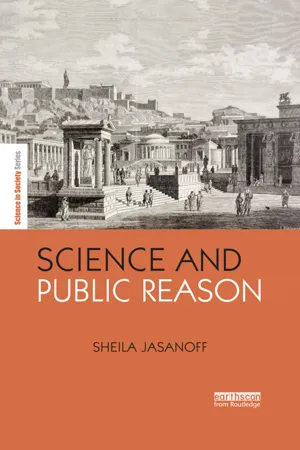
This collection of essays by Sheila Jasanoff explores how democratic governments construct public reason, that is, the forms of evidence and argument used in making state decisions accountable to citizens. The term public reason as used here is not simply a matter of deploying principled arguments that respect the norms of democratic deliberation. Jasanoff investigates what states do in practice when they claim to be reasoning in the public interest. Reason, from this perspective, comprises the institutional practices, discourses, techniques and instruments through which governments claim legitimacy in an era of potentially unbounded risks—physical, political, and moral. Those legitimating efforts, in turn, depend on citizens' acceptance of the forms of reasoning that governments offer. Included here therefore is an inquiry into the conditions that lead citizens of democratic societies to accept policy justification as being reasonable. These modes of public knowing, or "civic epistemologies," are integral to the constitution of contemporary political cultures.
Methodologically, the book is grounded in the field of Science and Technology Studies (STS). It uses in-depth qualitative studies of legal and political practices to shed light on divergent cross-cultural constructions of public reason and the reasoning political subject. The collection as a whole contributes to democratic theory, legal studies, comparative politics, geography, and ethnographies of modernity, as well as STS.
- 290 pages
- English
- ePUB (mobile friendly)
- Available on iOS & Android
eBook - ePub
Science and Public Reason
About this book
1
Reason in practice
For the world’s most privileged citizens, life in the early twenty-first century offers abundant ease and enjoyment, together with unprecedented opportunities for personal growth and fulfillment. Yet in countries around the globe, even in the most mature democracies, politics today is marked by pent-up anger, cynicism, fear, and violence. From the United States, an unexpected cauldron of populist discontent, to Europe, the Arab world, and beyond, there is widespread loss of faith in good government and even in the idea of progress. It is as if societies have lost the knack, and the taste, for reasoning together to plan futures which all can see as serving their needs and interests. Crisis, however, brings opportunity, in scholarship no less than in politics. This troubled historical moment offers an unexpected vantage point from which to rethink our ideas of democracy and good government, and to do so with closer attention to two institutions that have transformed the modern world: science and technology. This is a moment which, through its very contradictions, invites us to be attentive to democracy’s failures. It forces us to ask whether, prompted by the ascendancy of science and technology, issues that matter to publics have been prematurely taken out of politics— and, if so, how democratic nations might reinvent their practices of governance in the interests of building more just, inclusive and promissory futures. This collection of essays contributes to that project of reimagination.
The politics of demonstration
Little more than a century ago, Western intellectuals and social reformers saw the world as nicely progressing from superstition and ignorance to knowledge and reason. Science led the way, revealing indisputable facts about the natural world and ourselves in it. Those truths, self-evident to the founding thinkers of the Enlightenment, laid the basis for actions whose rightness could be taken for granted because they were consistent with the observable realities of nature. The idea of natural law was not strange to human minds: premodern societies depended on shamans and seers, priests, and prophets to ratify correspondences between nature’s dictates and human institutions. Kings ruled by divine right; people went to temples to pray for children or for rain. Science, however, overturned habits of blind deference, offering a less fallible, more democratic means of creating harmony between nature and human aspirations. Here, finally, was a way of getting at nature’s truths unmediated by power and influence. The experimental method, in particular, seemed to put scientists in direct conversation with the world as it is. Truth claims could be checked experimentally against phenomena that could in principle be observed by all (Dear 2006; Shapin and Schaffer 1985). The potential for public witnessing bypassed the risks of distortion by well-placed actors falsely claiming superior knowledge. Enlightened societies from the late eighteenth century onward became those in which science spoke truth to power— and power listened of necessity, to defend and demonstrate its own right to rule (Price 1965; Picon 2002).
Scientific ways of knowing gave rise to a politics of demonstration that modern nation states found supremely useful. Advances in science and technology— technoscience for short—made lives easier, healthier, more productive. In the hundred years after the industrial revolution, diseases yielded, distances were crossed, the air was cleaned, and the sheer slog of countless workaday lives gave way to rhythms that were far more comfortable, if also more humdrum. Armed with scientific knowledge and enabling technologies, human societies seemed poised to challenge the ancient ills of old age and sickness, penury, and hunger. Nirvana could be reached here on Earth; research and development, not prayer and meditation, held the answers. A sense of control over nature was born, especially in rich nations with the resources to exploit technoscientific advances. To the delight of enlightened rulers, technological power seemed easy at first to reconcile with democratic values (Ezrahi 1990). As long as state-supported scientific and technological developments delivered tangible public goods, accountability was served and the threat of despotism receded.
That optimistic alliance between science, technology and democracy proved short-lived. A hundred years of shocks and surprises rudely disrupted the original compact: two World Wars with millions dead; repeated genocidal conflicts; entrenched poverty and hunger; environmental pollution; epidemic diseases; states ruling by terror, prepared to turn guns on their own people rather than cede control; and from 1945 onward the fear of ultimate war, bringing nuclear annihilation. President John F. Kennedy’s inaugural address of 1961 captured in its well-remembered cadences the contradictions of the unfolding technological future: “For man holds in his mortal hands the power to abolish all forms of human poverty and all forms of human life.” The utopian promises of the Enlightenment retained their appeal. Yet offsetting them by mid-century were grimmer prospects, even the extinction of the species that had aspired to godlike knowledge and power. More science could no longer be counted on to deliver better lives when the same knowledge could be turned to good and evil uses—to manufacture pharmaceuticals or deadly toxins, generate nuclear power or make nuclear bombs, diagnose threats or impose dictatorial discipline. How to direct science and technology toward beneficial ends became an increasing preoccupation of postwar societies and governments. New social movements of the mid-twentieth century made it clear that state expectations from science and technology no longer mapped neatly and inevitably onto visions that citizens held for themselves.
The wheel of enlightenment took another implacable turn before the end of the millennium, introducing new disconnects between science and democracy. Knowledge in a sense became its own undoing, as a vast penumbra of what we do not know and cannot presume to control grew along science’s moving frontiers (Beck 1992). Scientific research could no longer be counted on to provide an expanding array of reliable, documented, policy-relevant facts. Indeed, facts in the sense of uncontested claims turned out to be in surprisingly short supply as governments undertook more ambitious projects of national defense, public health, economic growth, agricultural production and global environmental sustainability. Nor could technology be relied on to validate political action through successful demonstrations in real time. Technology in operation proved far more unruly (Wynne 1988), more error prone, less predictable, and less easily transferable across geopolitical boundaries than optimists had proclaimed. Increasingly, technological systems seemed to develop lives of their own, overflowing the pilots, models and field tests that had once justified them (Callon et al. 2009).
Things went wrong, sometimes on catastrophic scales, from computer system crashes to global financial meltdowns to industrial disasters and climate change. The jolting nuclear accident at Japan’s Fukushima Daiichi power plant in March 2011 carried all the trademarks of human overreaching: in a nation schooled to accept the state’s expert assurances, an earthquake of unexpected severity set loose a tsunami of epic proportions, overwhelming an aging and ill-maintained plant’s inadequate failsafe mechanisms. Political questions quickly surfaced in all such cases: who was at fault; who should have known; who should be compensated; and who held responsible?
One common response was denial. Accidents and disasters were often written off in official accounts as unintended consequences of well-intentioned choices. No one, this story went, could reasonably have foretold that rising fossil fuel use would lead to climate change, high dams would destroy riverine ecosystems, disease-preventing chemicals would give rise to insect and viral resistance, hormone replacement therapy in postmenopausal women would raise their risk of breast cancer, explosives would be commandeered by terrorists converting bodies into living bombs, or electronic social networks would create preconditions for both anti-despotic revolutions and crimes of violence. Defining such failures as “unintended” tacitly absolved technology and its human progenitors of responsibility and blame. No actors, after all, could be held to account for the unknowable. Without knowledge there can be no basis for logic or causal argument; to act against the unknown is to be like mad Hamlet discoursing with the “incorporeal air.” Paradoxically, the theme of unintended consequences reaffirmed the naturalistic narrative of progress from which policymakers continued to draw their legitimacy (Wynne et al. 2007). The benefits of technology could be seen and known; these were real, reliable, calculable. Harms, by contrast, were deemed exceptional, systemic, recognizable only after the fact, and therefore relegated to the category of the unpredictable.
A second response, loved by bureaucrats and their expert advisers, was to seek refuge in rational calculation. Futures perhaps could not be completely known, but they could be assessed and managed under the increasingly important rubrics of risk assessment, cost-benefit analysis (Kysar 2010), and evidence-based policy. These too were exonerating discourses. They neatly divided the tasks of governing the future into a scientistic and supposedly apolitical realm of assessment and prediction, and a concededly political, but entirely separate, realm of political response and management (NRC 1983). Products, projects and scenarios could be modeled well enough according to this conceptual paradigm by experts with the knowledge and training to evaluate their strengths and vulnerabilities. Political managers could come in when calculation was complete, to demand safeguards whose costs would not be out of proportion to the benefits conferred by taking useful risks. Who bears the risks and who gains the benefits was not always on the discussion table.
To many observers this retreat to technical expertise only reinforced technological society’s “organized irresponsibility” (Beck 1988); it implied levels of control that seemed demonstrably overblown. The near meltdown at the Three Mile Island nuclear plant in 1979 eliminated U.S. public trust in the safe operation of nuclear power and ended the nation’s supremacy in nuclear engineering. The calamity at Fukushima opened the way to doubts and questions whose full implications for the nuclear industry would not be known for years. More fundamentally, from the standpoint of ruling institutions, the discovery that every seeming certainty carries at its margins a weight of unresolvable uncertainty challenged the foundational presumptions of enlightened governance. If a government’s first duty is to find solutions to social problems, consistent with public interest and public demand, then a technoscientific enterprise that inexorably links knowledge to non-knowledge fails to deliver the legitimacy that it once so confidently promised.
Demonstration, under these challenging conditions, slipped out of the grasp of governments and became at once more democratic and more oppositional (Barry 1999; Callon et al. 2009). When governments unveiled new technoscientific programs, from the construction of railroads, runways or high dams to support for new and emerging technologies, people demonstrated their contrary views through active resistance. In the United States, politicians gained mileage from alliances with the religious right, which denied scientific doctrines from evolution to anthropogenic climate change. Elsewhere, genetically modified plants were uprooted from research plots, animal testing labs and nanotechnology centers were bombed, and people staged mass marches, sit-ins or blockades to prevent new construction projects. Seen as Luddite excess by political authorities, but as “uninvited participation” by more detached analysts (Doubleday and Wynne 2011), direct action by citizens signaled at the very least a breakdown in orthodox political communication and a demonstrable need for new forms of public accountability.
A new age of reason
Caught between the hammer of uncertainty and the anvil of unintended consequences, how can governments renegotiate the double contract of modern democracies—first, with the citizens who elect them and, second, with the science and technology that enable states to promise growth and employment? How can governments persuade skeptical and skittish citizens that theirs is not a world of magical realism in which massive technological intrusions into the material world can be authorized with no one to take responsibility for evil consequences? Citizens of advanced technological societies demand a modicum of certainty that the benefits of science and technology, especially when conducted with taxpayer support, will arrive as promised, and not bring danger or ruin (or, as in the case of the life sciences, moral breakdown) in their wake. Even when innovation is left largely to the private sector, as it mostly is in liberal democracies, governments must try to ensure that corporate profit motives will not expose publics to harms that are unlimited and uncompensated. How under these trying circumstances can states seek to retain public trust?
These dozen essays, culled from some twenty-five years of research and writing, cast the spotlight on one answer to the problem of trust in an age of uncertainty: public reason. The term public reason as I use it in this volume is not a matter of constructing principled arguments that obey universal rules of democratic deliberation (Rawls 1971). Instead, my objective, grounded in the field of science and technology studies (STS), is to ask what ruling institutions do in practice when they claim to be reasoning in the public interest. Public reason, for me, is not simply the result of meeting exogenously defined criteria of logic or argument, though such rules matter: rather, it is what emerges when states act so as to appear reasonable. Reasoning comprises the institutional practices, discourses, techniques and instruments through which modern governments claim legitimacy in an era of limitless risks—physical, political and moral. Included here as well is an inquiry into the background conditions that lead citizens of democratic states to accept policy justification as being reasonable. What kinds of reasons sit best with which sorts of publics, and how does public reasoning relate to political culture and the authorization of expertise? More particularly, how does the fact that we live in information-soaked environments, constantly depending on others’ expertise, affect the democratic ambitions of public reason? The attempt to answer these sorts of questions positions my work in conversation with related explorations in democratic theory, legal studies, and ethnographies of modernity.
A complete political theory of late modern democracy must include, in my view, alongside classical reflections on representation, participation, and voice, an explicit and sufficient account of the reasoning of state institutions. Sufficiency, for these purposes, means that we have to account for reason not only theoretically, at the level of claims made on its behalf, but also empirically, as a political practice that connects the communicating state to its attentive citizens. In acting for or on behalf of citizens, governments operate with tacit understandings of what people are like, especially in their capacity to interpret facts and develop arguments (Jasanoff 2004a). By uncovering those presumptions, these essays speak to the construction of the political subject as a reasoning agent, not through the sciences of mind, brain and behavior, but through legal and institutional arrangements that presuppose certain ideals of human agency and autonomy. This volume therefore extends work in the history and sociology of the human sciences by exploring, through studies of public decision making, contemporary presumptions about the nature of rationality, both as an attribute of human minds and as a normative goal for social and political collectives.
Scattered in time and across disciplinary literatures, the essays collected here articulate a set of theoretical preoccupations that may not be immediately apparent to readers who have come upon these works singly or in isolation. Those unused to my methods of extracting broad theoretical ideas from the empirical details of everyday talk and practice may miss the forest for the trees, seeing topical case studies instead of an integrated exploration of abiding questions in democratic theory. Yet recurrent questions and gradually coalescing answers run through all of my work on science, technology, law and policy, whether the examples pertain to environmental risk, technological disasters, novel biological organisms, global environmentalism, the nature of evidence, or the legitimacy of administrative rulemaking.
Three organizing themes have guided my choice of research topics and analytic methods: first, a commitment to comparison, especially across national political cultures, as a means of elucidating entrenched but unacknowledged habits of reasoning in the public square; second, a focus on the practices of separating expert from commonplace modes of reasoning, especially in the production of what I call “regulatory science” (Jasanoff 1990); and third, a deep concern with the law as both site and instrument of shaping democratic accountability and forms of reasoning. The articles that follow are grouped for convenience under one or another of these three headings, but it is their interwoven character that I want to emphasize. The centrality of the law in particular—not as written text, but as a set of practices, a source of norms, a continuous historical narrative of what societies are about, and an instrument for stabilizing or destabilizing authority—is visible throughout these pieces. The essays also illustrate my attempts to bridge divides that have proved perennially troublesome for social analysis—between macro and micro, structure and agency, theory and practice, descriptive accuracy and normative theory. Necessarily, too, the works illustrate changes in my own thinking, notably from the structural modes of analysis that I followed in the 1980s to the need I see now to acknowledge the fluidity and performativity of reasoning while still remaining attentive to cultural stability and continuity.
Reason by comparison
Reason is a great naturalizer, and public reason naturalizes much that seems arbitrary in politics. Once we are persuaded of the reasonableness of an argument or action, it becomes the most natural thing in the world to accept it: of course, this is how things are; of course, this is how things should be. To make the contingency of reason visible, then, we must look as if through the eyes of visitors from other worlds, much like pre-colonial ethnographers who decoded the locally contingent and culturally specific assumptions that held together the complete, self-reinforcing logics of alien belief systems (Douglas 1986; Sahlins 1996). Even today, the ant...
Table of contents
- Cover
- Title
- Copyright
- Contents
- Preface
- Acknowledgements
- Credits
- 1 Reason in practice
- 2 Product, process, or programme: three cultures and the regulation of biotechnology
- 3 In the democracies of DNA: ontological uncertainty and political order in three states
- 4 Restoring reason: causal narratives and political culture
- 5 Image and imagination: the formation of global environmental consciousness
- 6 Contested boundaries in policy-relevant science
- 7 The songlines of risk
- 8 Judgment under siege: the three-body problem of expert legitimacy
- 9 Technologies of humility: citizen participation in governing science
- 10 What judges should know about the sociology of science
- 11 Expert games in silicone gel breast implant litigation
- 12 The eye of everyman: witnessing DNA in the Simpson trial
- 13 In a constitutional moment: science and social order at the millennium
- 14 Afterword
- Index
Trusted by 375,005 students
Access to over 1.5 million titles for a fair monthly price.
Study more efficiently using our study tools.
Frequently asked questions
Yes, you can cancel anytime from the Subscription tab in your account settings on the Perlego website. Your subscription will stay active until the end of your current billing period. Learn how to cancel your subscription
No, books cannot be downloaded as external files, such as PDFs, for use outside of Perlego. However, you can download books within the Perlego app for offline reading on mobile or tablet. Learn how to download books offline
Perlego offers two plans: Essential and Complete
- Essential is ideal for learners and professionals who enjoy exploring a wide range of subjects. Access the Essential Library with 800,000+ trusted titles and best-sellers across business, personal growth, and the humanities. Includes unlimited reading time and Standard Read Aloud voice.
- Complete: Perfect for advanced learners and researchers needing full, unrestricted access. Unlock 1.5M+ books across hundreds of subjects, including academic and specialized titles. The Complete Plan also includes advanced features like Premium Read Aloud and Research Assistant.
We are an online textbook subscription service, where you can get access to an entire online library for less than the price of a single book per month. With over 1.5 million books across 990+ topics, we’ve got you covered! Learn about our mission
Look out for the read-aloud symbol on your next book to see if you can listen to it. The read-aloud tool reads text aloud for you, highlighting the text as it is being read. You can pause it, speed it up and slow it down. Learn more about Read Aloud
Yes! You can use the Perlego app on both iOS and Android devices to read anytime, anywhere — even offline. Perfect for commutes or when you’re on the go.
Please note we cannot support devices running on iOS 13 and Android 7 or earlier. Learn more about using the app
Please note we cannot support devices running on iOS 13 and Android 7 or earlier. Learn more about using the app
Yes, you can access Science and Public Reason by Sheila Jasanoff in PDF and/or ePUB format, as well as other popular books in Economics & Development Economics. We have over 1.5 million books available in our catalogue for you to explore.