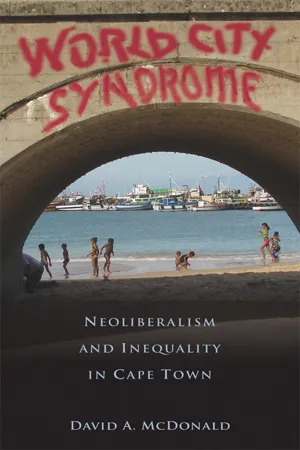
The literature on 'world cities' has had an enormous influence on urban theory and planning alike. From Manila to London, academics and policy makers have attempted to understand, and to some extent strive for, world city status. This book is a study of Cape Town's standing in this network of urban centres, and an investigation of the conceptual appropriateness of this world city hypothesis. Drawing on more than a dozen years of fieldwork in Cape Town, McDonald provides an historical overview of institutional and structural reforms, examining fiscal imbalances, political marginalization, (de)racialization, privatization and other neoliberal changes. By examining and analyzes these reforms and changes, McDonald contributes the first radical critique of the world city literature from a developing country perspective.
- 384 pages
- English
- ePUB (mobile friendly)
- Available on iOS & Android
eBook - ePub
1 Cape Town as World City
The term “world city” is widely and increasingly used in popular and academic writing, making it one of the most familiar and influential ways of describing and understanding large cities in a globalized world. Countless books, articles, conferences and policy papers use the phrase to describe the links between globalization, cities and the growth of the service economy.
This chapter provides an overview of the world city hypothesis and tests it against the city of Cape Town. I begin with an assessment of the primary tenets of the world city hypothesis. The purpose of this review is to clarify my own interpretation of the conceptual and methodological characteristics of the literature, while at the same time ensuring that readers are familiar with the basic theory. There is no single interpretation of what constitutes a world city, though it is possible to identify central lines of analyses.
In doing so, I hope to demonstrate the complexity and sophistication of the world city hypothesis. Despite my criticisms of the concept in later chapters, the world city hypothesis is an enormously useful descriptive and analytical tool, offering important insights into urbanization in a global economy.
I start with a discussion of the different terminology employed in the world city literature, followed by an overview of the core concepts. I conclude by asking whether Cape Town fits the analytical bill, arguing that it is in fact a paradigmatic example of the world city hypothesis.
DEFINING THE TERMS
Originally attributed to Goethe, the term “world city” (Weltstad) found its way into contemporary academic literature through the work of Peter Hall (1966) (who, in turn, drew inspiration from Patrick Geddes’ work on proposals to establish a “world league of cities” in the 1920s (Taylor 2004, 21)). Hall’s book did not, however, draw systematic links between individual cities. Couched as it was in the ‘national urban systems’ thinking of the day, and the Fordist world economy of the time, the book presented world cities as relative islands of cultural, political, economic and technological development.
It was not until the 1980s—most notably with the reworking of the term by Friedman (1982, 1986)—that the concept of a world city came to be associated with a broader “world economy”. This reconceptualization made the links between cities as important to their study as their individual, internal dynamics. World city research as we know it today began “when the economic restructuring of the world-economy made the idea of a mosaic of separate urban systems appear anachronistic and irrelevant…. New thinking about cities was required and a world cities literature emerged in the 1980s and flowered in the 1990s as a central theme of globalization” (Taylor 2004, 21).
This is not to say that contemporary cities are the only urban conglomerations that could be considered ‘worldly’. Hall’s cities of the mid-twentieth century and many cities of medieval Europe and precolonial Asia and Africa were also world cities in their own right, trading and engaging in international ways (Braudel 1984, Abu-Lughod 1989, King 1990). It is the post-Keynesian, post-Fordist capitalism of the last three decades, and the massive geographical expansion of production via new forms of technology and telecommunication, that sets contemporary world cities apart from these formerly global urban centres. Today’s world cities are quantitatively and qualitatively different from their predecessors and require a different set of analytical tools.
Given this larger historical perspective it could be said that Cape Town has always been a world city, having played a significant political and economic role in the European colonial system since its founding as a Dutch supply station in the seventeenth century. But it is Cape Town’s role and place in the contemporary global network of cities that we are interested in here and it is in this more limited, temporal sense that the term “world city” will be used in this book.
World city is not the only term used in the literature, however. Saskia Sassen (1991), in her seminal work on the subject, consciously chose to use the phrase “global city”. In the Preface to the second edition to the book, Sassen (2001, xix) argues that she chose not to use the phrase ‘world city’ exactly because of its historical significance, because it “referred to a type of city which we have seen over the centuries, and most probably in much earlier periods in Asia than in the West”. But as we shall see in our analysis of her global city model below there is no fundamental difference between what she calls a global city and what other analysts call a world city, and the terms are used interchangeably in the larger literature on the subject. My own terminological preference is world city, though I will use global city at times to minimize repetition of one phrase and when quoting other authors.
One other small terminological point of note is the use of the phrase ‘world-class city’. Although not an integral feature of the academic literature on world cities the phrase has come to be something of a proxy for world cityness in popular writing and in government publications. So pervasive has the expression become in South Africa that it is now used to describe virtually anything a major city has to offer. As such, Table Mountain becomes a ‘world-class urban park’, Cape Town’s new conference centre becomes a ‘world-class’ conference centre, and Cape Town itself a ‘world-class’ tourist destination. The term has also come to represent a strong ideological commitment to ‘going global’ and is an important discursive example of the normative desire of policymakers in Cape Town to see it become a ‘world city’ in the more academic sense of the term.
DEFINING A WORLD CITY
The following overview of the world city hypothesis is by no means a comprehensive review of what is a very large and sometimes divergent literature on the subject (readers are referred to the growing number of texts that have been compiled for just that purpose: King 1990, Kawano 1992, Knox and Taylor 1995, Marcuse and van Kempen 2000, Clark 2003, Amen, Archer and Bosman 2006b, Brenner and Kiel 2006, to name but a few). My objective here is simply to outline the central conceptual and empirical arguments of the writings.
In doing so I have adopted what Taylor (2004, 21–22), in his own summary of the literature, calls the “nugget approach”: an attempt to identify the most important “signposts” of the genre. But unlike Taylor, who reviews three of the “seminal contributions” to the writing (Friedman 1986, Sassen 1991, and Castells 1996), I will focus primarily on Sassen’s work, and in particular her 1991 contribution, The Global City (though I will largely cite the second edition of the book published in 2001 because of its updated empirical data, its partially revised conceptualization, and its useful Preface and Epilogue).
I use Sassen’s work for several reasons. First, and most importantly, I consider it to be the single most representative and comprehensive body of work in the genre. Although she does not deal with every facet of the world city debate in detail—or in sufficient detail—her writing nonetheless encompasses the central facets of the writing. Sassen is also one of the most prolific authors in the field. Some of her writing is only indirectly related to world cities but all of it helps to fill out the gaps in her Global City contribution (Sassen 1988, 1991, 1994, 1995, 1996, 1998, 1999, 2000, 2003). She has also edited and contributed to a collection of essays that look specifically at world cities in the South, helping to fill another important gap in the world city literature (Sassen 2002a, 2004, 2006).
Sassen’s writing is also the most influential, and certainly the most widely cited, work in the field. Friedman’s (1995, 29) reference to Sassen’s 1991 book as a “masterful summation” of the world city hypothesis is one indication of this acclaim, as are Castells’ (1996, 378) adoption of her thesis, the use of her work in various ‘readers’ on cities (LeGates and Stout 1996, Brenner and Kiel 2006), and the use of her work by influential organizations such as the UN-Habitat (2001, chapter five).
I frame my summary of the literature around Sassen’s “seven global city hypotheses”, in the order that she presents them. I have rephrased some of the language (for stylistic consistency), and have inserted some references to other scholarship to fill out her ideas, but the conceptual framework remains hers.
Globalization Creates the Need for Spatial Concentration
The first, and perhaps most critical, world city hypothesis is that the global spread of manufacturing since the 1970s has necessitated the centralization of corporate control functions. With operations in many countries multinational firms need to centralize their command and control structures in order to coordinate their activities. Not all functions are done at head office, but there are important centralized activities such as corporate planning that require a corporate headquarters. This geographic dispersal of corporate production—what Sassen refers to as “economic globalization”—is facilitated by advances in telecommunications and transportation, effectively compressing the space-time limitations of earlier forms of international trade and production.
There is, then, a spatial irony to this new “organizational architecture”: it contains “not only the capabilities for enormous geographic dispersal and mobility but also pronounced territorial concentrations of resources necessary for the management and servicing of that dispersal and mobility” (Sassen 2002b, 2). In other words, the globalization of economic activity has made place both less and more important. In this regard, the predicted death of the city in the mid-twentieth century, with some analysts assuming that advances in transportation and telecommunication would create ever-spreading suburbanization and de-urbanization as people did not need to be in cities, was fundamentally wrong (Williamson 1990).
There has been some deconcentration of urban corporate headquarter activities due to these technological developments, and not all corporate headquarters need to be in major urban centres, but the increasing dispersal of corporate activities has necessitated a spatial concentration of core activities, not their diffusion. This need for command and control centres is true of all sectors, from manufacturing and services to nongovernmental organizations.
The Rise of a Producer Service Economy
The second hypothesis is that centralized command and control corporate functions have become so complex that they have been increasingly out-sourced. This outsourcing has, in turn, created a secondary site of control functions outside of the producing firm, leading to the rapid and massive expansion of a ‘producer services’ sector—i.e. firms that service the centralization requirements of globalized manufacturing companies.
Most notable amongst these producer service firms are accounting, law, advertising, corporate travel, security, public relations, management consulting, information technology, real estate, storage, data processing and insurance companies. Although not entirely separate in corporate ownership terms from ‘consumer services’ (i.e. services intended for consumption by individuals, such as leisure travel or home insurance) producer services overwhelm even the large and growing consumer services sector.
Driven initially by the manufacturing sector, the producer services sector has now taken on a life of its own. As specialized service companies have grown and internationalized so too have their own requirements for specialized outsourcing of the same command and control functions as their manufacturing counterparts. A multinational advertising firm, for example, may require the services of a legal firm, a financial services company, IT specialists, and so on. In what has become a self-perpetuating cycle of producer services growth and service company expansion we have witnessed a fundamental transformation of the global economy from manufacturing at its centre to one with producer services at the core.
Producer services now dominate international trade, foreign direct investments, and job creation, with the fastest growth in producer service employment being in cities. This is especially true in the North as urban manufacturing jobs continue to move offshore, but it is generally true in the South as well where growth in urban manufacturing jobs has been slight (Sassen 2002a, Gugler 2004).
Of special significance is the immense growth in financial services, which has grown faster than all other producer services and now dominates the producer services sector. This growth is primarily the result of deregulation, starting in the US and spreading rapidly in the 1990s to virtually every country in the world. Securities markets have seen the most dramatic change and growth but similar expansion has occurred in international financial flows, currency markets and so on.
The complex requirements of the finance sector have also meant the development of sophisticated and wide-ranging service support inputs (e.g. changing legislative environments, new international regulatory mechanisms) while the potential for super-profits has proven highly attractive to service support firms. Moreover, this potential for massive profits—and the (perceived) potential for job growth—has led to the relative devalorization of the manufacturing sector in terms of support from the state.
This de(re)valorization dynamic has also heightened the influence of service sector firms in public policymaking. Witness, for example, the increasing influence of financial firms in city budgeting processes and real estate developers in urban planning. Even if the services sector “accounts for only a fraction of the economy of a city, it imposes itself on that larger economy” through policymaking pressure, creating a “new valorization dynamic … [that] has had devastating effects on large sectors of the urban economy” (Sassen 2002b, 16–17).
This is not to say that manufacturing is irrelevant to service-dominated cities. Even in New York, London and Tokyo, three of the most service-intensive urban economies in the world, approximately 10% of formal employment is still in the manufacturing sector (Sassen 2001, 208, 213, 221). Moreover, jobs that were once in the manufacturing sector (e.g. assembly) have, with the introduction of new technologies, been moved from the shop floor to the office floor (e.g. data entry). The increasingly intensive automation of production—much of which is now outsourced to the producer services sector—has created a whole new assembly line workforce. This may not be the manufacturing sector of old, but “modern technology has not ended nineteenth-century forms of work”, it has simply shifted them around (Sassen 2001, 10).
Agglomeration Economies
The third hypothesis is that the outsourcing of centralized control functions by multinational firms in the manufacturing sector has meant that the head offices of these firms are relatively free to locate where they want. This is demonstrated empirically by the exodus of the headquarters of manufacturing multinationals from cities like London and New York over the past two decades to sma...
Table of contents
- Cover Page
- Half Title page
- Series page
- Title Page
- Copyright Page
- Dedication
- Contents
- Tables
- Figures
- Acronyms
- Preface and Acknowledgments
- Maps of Cape Town and its Regional Setting
- Introduction: World City Syndrome
- Part I
- Part II
- Part III
- Notes
- References
- Index
Trusted by 375,005 students
Access to over 1.5 million titles for a fair monthly price.
Study more efficiently using our study tools.
Frequently asked questions
Yes, you can cancel anytime from the Subscription tab in your account settings on the Perlego website. Your subscription will stay active until the end of your current billing period. Learn how to cancel your subscription
No, books cannot be downloaded as external files, such as PDFs, for use outside of Perlego. However, you can download books within the Perlego app for offline reading on mobile or tablet. Learn how to download books offline
Perlego offers two plans: Essential and Complete
- Essential is ideal for learners and professionals who enjoy exploring a wide range of subjects. Access the Essential Library with 800,000+ trusted titles and best-sellers across business, personal growth, and the humanities. Includes unlimited reading time and Standard Read Aloud voice.
- Complete: Perfect for advanced learners and researchers needing full, unrestricted access. Unlock 1.5M+ books across hundreds of subjects, including academic and specialized titles. The Complete Plan also includes advanced features like Premium Read Aloud and Research Assistant.
We are an online textbook subscription service, where you can get access to an entire online library for less than the price of a single book per month. With over 1.5 million books across 990+ topics, we’ve got you covered! Learn about our mission
Look out for the read-aloud symbol on your next book to see if you can listen to it. The read-aloud tool reads text aloud for you, highlighting the text as it is being read. You can pause it, speed it up and slow it down. Learn more about Read Aloud
Yes! You can use the Perlego app on both iOS and Android devices to read anytime, anywhere — even offline. Perfect for commutes or when you’re on the go.
Please note we cannot support devices running on iOS 13 and Android 7 or earlier. Learn more about using the app
Please note we cannot support devices running on iOS 13 and Android 7 or earlier. Learn more about using the app
Yes, you can access World City Syndrome by David A. McDonald in PDF and/or ePUB format, as well as other popular books in Economics & Economic Conditions. We have over 1.5 million books available in our catalogue for you to explore.