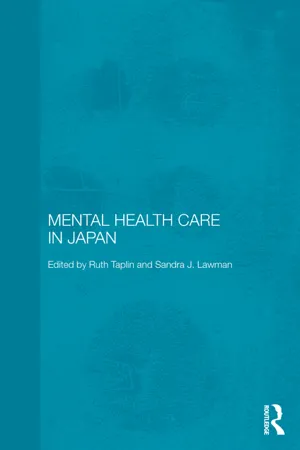
Mental health, including widespread depression, a high suicide rate and institutionalisation, is a major problem in Japan. At the same time, the mental health care system in Japan has historically been more restrictive than elsewhere in the world. This book looks at the challenges of mental health care in Japan, including problems such as the institutionalisation of long-term patients in mental hospitals. The book discusses the latest legislation to deal with mental health care, and explores the various ideas and practices concerning rehabilitation into the workforce, the community and service user groups that empower the mentally ill. It goes on to look at the social stigma attached to the mentally ill in Japan and Britain, which touches upon the issue of counselling those with post traumatic stress after the recent earthquake.
- 148 pages
- English
- ePUB (mobile friendly)
- Available on iOS & Android
eBook - ePub
Mental Health Care in Japan
About this book
Trusted by 375,005 students
Access to over 1.5 million titles for a fair monthly price.
Study more efficiently using our study tools.
Information
1 Mental Health Care in Japan
An Introduction
Introduction and Overview
Mental health care in Japan has been much misunderstood with little attention given to the role of service providers and the fact that Japan still has the highest number of suicides of any country in the world underplayed. In this book the contributors, who are both psychiatric professionals of the highest calibre and practitioners and service users, add their perspectives to the current state of mental health care in Japan. A great deal of this material has not been available before in the English language.
To do this, a number of key areas of enquiry are explored and analysed: the role of culture such as tatemae and honne; the role of the family in causing mental illness; whether the best care is in the community or still in hospitalisation; the need for the mentally ill to be integrated into mainstream work; social stigma; and the development of the service users group as an essential part of mental health care in Japan.
It has only been recently in Japan that mental illness has become an issue of concern and action. This has been seen in the reforms to a number of statutory acts passing into law concerning the mentally ill and disabled. A White Paper, which will be reviewed further, has given the issue more prominence. Towards the end of December 2011 Dr Hiroto Ito, one of the expert contributors to the book, was appointed by the Japanese government as one of the members to make preparations to include mental illness as one of the five major diseases in Japan in addition to acute myocardial infarction, cancer, diabetes and stroke. He is also starting a nationwide collaborative project on screening and treatment of co-morbidities of persons with mental disorders and physical illness. This is a major step forward for placing issues of mental health care in Japan in the mainstream, which has been much needed.
Depression and suicide in Japan has been a much hidden problem and it was only in September 2010 (based on 2009 figures) that the Japanese government released figures noting the financial cost, to say nothing of the social and emotional costs. Such problems cost the Japanese economy nearly 2.7 trillion yen including among other factors, medical costs, loss of income and spending on social security.
The Japan Times1 reported the suicide rates for 2009, which were announced at a meeting concerning resolving issues of suicide and depression by Health Minister Akira Nagatsuma. More than 32,000 took their lives with the majority of individuals between 15 and 69 years of age. Hiroto Ito notes in Chapter 2 that the suicide rate in Japan rose from 18.8 suicides per 100,000 population in 1997 to 24.9 per 100,000 in 2010.2 He argues that the prolonged recession seems to affect this trend and that the National Police Agency suggested common reasons including health concerns, unemployment and financial difficulties. As suicide has been now acknowledged as a major issue in Japan, the Basic Act on Suicide Prevention was enacted in 2006. Multidimensional countermeasures are being implemented through both the high-risk group approach and population approach, but unfortunately the suicide rate does not appear to be declining as expected. So if the suicide rate is not declining despite much effort being put into its reduction, there must be other factors that will be explored in this book and below in relation to the Japanese family and other variables of causation.
The cost to the Japanese economy of depression and mental illness is great with an estimated 45.6 billion yen being lost on worker compensation benefits for those who had to take time off work because of depression. Former Prime Minister Naoto Kan connected the high numbers of suicide and depression with both economic and emotional downturn and launched a video campaign to try and combat the problem.3
Tatemae and Honne
Tatemae and honne are concepts essential to understanding the Japanese psyche as the former refers to how things should be and the latter refers to the reality and how things are in actuality. In all cultures there is a tension between such states of mind. In Japan, the very attempt to separate the two states of mind so they do not come into conflict can cause other tensions, especially within the context of the family where it is more difficult to hide true feelings. Within Japanese society, strict rituals, which are exercised day in and day out, serve to keep the two separate at work, in business communication and in institutions. However, within the family where one lives emotionally and closely with kin, the two concepts often come into conflict causing mental distress from lack of communication. The family is the one place in which individuals have the chance to air their genuine feelings. When individualism is stifled and all relations become one of society through ritual, human safety nets for expression can turn inward with anger becoming internalised and depression ensuing. There are some safety mechanisms for genuine emotions in Japanese society such as karaoke evenings when all become drunk, rank is supposedly forgotten and workers are allowed to become open with their bosses with the content of drunken outbursts forgotten the next day. This does work in some contexts but for the family and in society as a whole such tensions can become unbearable. Often children must adhere to ritualised lives set out for them by their families and if they do not fulfil their duties are treated very harshly emotionally and mentally. This is why many psychiatric social workers find communication within the family the first port of call when trying to deal with those who suffer from mental illness. Yayoi Imamura, a psychiatrist who contributes a chapter to this book (Chapter 4), notes that for centuries in Japan it was the family that had to hide away mental illness with private isolation rooms permitted, as the behaviour of the mentally ill had to be hidden and any aberrant behaviour could not be tolerated. Below examples are given of how mental health care is changing for the better at the level of the family, local authorities and the wider communities, with service user groups an important part of this process.
The Family, Communication and Mental Illness
Shouzou Imai,4 a psychiatric social worker, has so far been involved in supporting sufferers and families who suffer from various illnesses and are facing a range of issues, such as issues associated with the period of adolescence, personality disorders, addiction and growth disorder as well as mental disorders, a main cause of such problems. He found himself seeing ‘something’ that exists as a common issue between ‘a sufferer and family’ as well as between ‘families’, although the symptoms, issues, treatments and measures they have been seeing are different.
Recently, he started paying more attention to the ‘something’. Putting aside illness, issues associated with people’s state of mind and other issues, he felt strongly that re-establishment and facilitation of communication was a far more important issue as a first step to resolve and reduce the issues. Although Imai understands that it can be said that in hindsight, communications have failed to be delivered smoothly as a result of challenges and pain, caused by illness and problems, he felt from his experience that verbal communications were delivered unilaterally or there were many families who communicated less in quantity or poorly in quality, issues that were at the root of the problem. To analyse further how the family and communication are linked to mental illness Imai began to define what is meant by communication.
What is Communication?
Communication: Human beings deliver their will, emotion and thoughts to each other and it is delivered through means such as language, letters, gestures, expression and voice which appeal to both a visual and acoustic sense.5
Communication is to be carried out by utilising various means and methods not only verbally. Silence/timing, gesture, the way of speaking and looks are used.
Meaning and Purpose of Communication
Human beings have different personalities and senses of values even though they may be connected as parent and child, husband and wife and siblings. Even though we say that we ‘are fellow human beings who share the food out of the same pan’ or ‘a family shares the same destiny’, it does not necessarily mean that our views and interests are exactly the same. Therefore, it is absolutely imperative that we establish meaningful communication, either in quality or quantity, to establish and maintain a harmonious relationship.
In the event that important issues need to be solved or improved urgently, much closer communication will be required. In having a meaningful communication, people can have a feeling of togetherness and deal with the common issues they face.
Understanding the ‘Definition of Communication’ More Widely and Deeply
When we talk about communication, we tend to regard it as ‘a relationship through conversation’ in most cases. In other words, the definition of communication is interpreted very narrowly. Although greetings such as ‘Good Morning’ are an important element for establishing a relationship, it is not sufficient to establish communication.
Other elements, such as correspondence for something, exchange of information and chatting are a necessary and a refreshing element in our daily lives and are naturally considered as part of communication. However, communication can have much wider meaning, such as delivering deepest thoughts, from one person to another, views and opinions and, in some cases, delivering thoughts to each other sufficiently, even if such thoughts concern very serious issues.
Additionally, forming a relationship and working to bring certain issues that remain vague in people’s minds to their attention through dialogue also forms an important part of communication.
Preconditions Required to Establish Communication
Communication takes place through human relationships. Establishing and maintaining human relationships backed by affection is the basis for achieving smooth communication.
It is natural that people have different tastes, interests, sense of values and lifestyles. However, people are required to have an attitude to show understanding towards such differences in order to establish communication between each other.
While people may grow to like someone, they may also grow to hate someone. It is natural that a couple may eventually not wish to see one another. However, in case of having a child, it may be difficult for his/her parents to behave according to their feelings or emotions, as the child lives in the environment that has been created by his/her parents. In this case, parents have to maintain their relationship by controlling their emotions but they may be put in very difficult circumstances sooner or later. However, a child has nothing to do with it and parents are required to separate their own issues from issues associated with childcare and to form a system of cooperation only for childcare.
Communication Methods
A verbal method is commonly used for communication. We deliver our thought to others by means of words.
Non-verbal methods can also be used, which include body movements, fa...
Table of contents
- Cover
- Half Title
- Title Page
- Copyright
- Contents
- List of illustrations
- Notes on contributors
- Foreword
- Acknowledgements
- List of abbreviations
- 1. Mental health care in Japan: an introduction
- 2. Mental health policy and services: where we stand
- 3. Reintegrating the mentally ill into society and work
- 4. How mental hospitals treat their patients, and programmes for rehabilitation into the community
- 5. National Federation of Families for the Mentally Ill in Japan: historical and future perspectives
- 6. An overview of the user movement in Britain and Japan
- 7. Attitudes to mental illness in Japan and Britain
- Postscript: a personal perspective
- Index
Frequently asked questions
Yes, you can cancel anytime from the Subscription tab in your account settings on the Perlego website. Your subscription will stay active until the end of your current billing period. Learn how to cancel your subscription
No, books cannot be downloaded as external files, such as PDFs, for use outside of Perlego. However, you can download books within the Perlego app for offline reading on mobile or tablet. Learn how to download books offline
Perlego offers two plans: Essential and Complete
- Essential is ideal for learners and professionals who enjoy exploring a wide range of subjects. Access the Essential Library with 800,000+ trusted titles and best-sellers across business, personal growth, and the humanities. Includes unlimited reading time and Standard Read Aloud voice.
- Complete: Perfect for advanced learners and researchers needing full, unrestricted access. Unlock 1.5M+ books across hundreds of subjects, including academic and specialized titles. The Complete Plan also includes advanced features like Premium Read Aloud and Research Assistant.
We are an online textbook subscription service, where you can get access to an entire online library for less than the price of a single book per month. With over 1.5 million books across 990+ topics, we’ve got you covered! Learn about our mission
Look out for the read-aloud symbol on your next book to see if you can listen to it. The read-aloud tool reads text aloud for you, highlighting the text as it is being read. You can pause it, speed it up and slow it down. Learn more about Read Aloud
Yes! You can use the Perlego app on both iOS and Android devices to read anytime, anywhere — even offline. Perfect for commutes or when you’re on the go.
Please note we cannot support devices running on iOS 13 and Android 7 or earlier. Learn more about using the app
Please note we cannot support devices running on iOS 13 and Android 7 or earlier. Learn more about using the app
Yes, you can access Mental Health Care in Japan by Ruth Taplin, Sandra J. Lawman, Ruth Taplin,Sandra J. Lawman in PDF and/or ePUB format, as well as other popular books in Social Sciences & Ethnic Studies. We have over 1.5 million books available in our catalogue for you to explore.