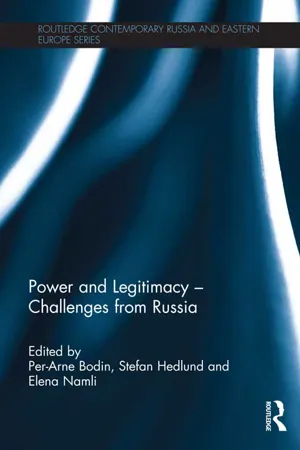
This book sheds new light on the continuing debate within political thought as to what constitutes power, and what distinguishes legitimate from illegitimate power. It does so by considering the experience of Russia, a polity where experiences of the legitimacy of power and the collapse of power offer a contrast to Western experiences on which most political theory, formulated in the West, is based. The book considers power in a range of contexts – philosophy and discourse; the rule of law and its importance for economic development; the use of culture and religion as means to legitimate power; and liberalism and the reasons for its weakness in Russia. The book concludes by arguing that the Russian experience provides a useful lens through which ideas of power and legitimacy can be re-evaluated and re-interpreted, and through which the idea of "the West" as the ideal model can be questioned.
eBook - ePub
Power and Legitimacy - Challenges from Russia
- 246 pages
- English
- ePUB (mobile friendly)
- Available on iOS & Android
eBook - ePub
Power and Legitimacy - Challenges from Russia
About this book
Trusted by 375,005 students
Access to over 1.5 million titles for a fair monthly price.
Study more efficiently using our study tools.
Information
Subtopic
Ethnic StudiesIndex
Social Sciences1 Dimensions of Russia
Developments after the USSR
In the wake of the collapse of the USSR, Russia embarked on a project of institutional transformation that was widely viewed at the time as a laboratory of sorts for social science experimentation. The importance of recalling these early stages of post-Soviet development lies in emphasizing that the standard tools of social science may not have been up to the task of conceptualizing the nature and complexity of the problems that faced the early reformers.
In this chapter, we shall look at seven specific dimensions of institutional transformation, where Russian developments after the collapse of the USSR have been at variance with initial expectations, and where such variance calls for careful consideration of what driving factors might have been at play. We shall begin, however, with a brief look at prior perceptions of the nature and durability of the Soviet order, and at attempts made to predict and later to explain its eventual demise. To the extent that scholarship failed to properly understand where Russia was coming from, it might not have been well positioned to recommend what should be done, or indeed to point at who was to blame for what happened.
Conceptualizing the Soviet order
Following the death of Joseph Stalin, the Soviet Union moved from totalitarian to authoritarian rule. Yet, despite the celebrated ‘thaw’ that was allowed under Khrushchev it failed to democratize. Sustained by the ‘vertical of power’ that was embodied in the Communist Party, the system as such remained stable until late into the Brezhnev era. It was, however, beginning to suffer the consequences of immobility. With the ageing of the senior members of the Soviet elite, stability turned into stagnation and a crisis of legitimacy was brewing.
Having long been prone to denounce the alleged ‘socialdemocratization’ of other socialist countries, especially Hungary and Poland, in the end the Soviets would prove to be themselves ‘socialdemocratized’. In sharp contrast to what the Chinese leadership would do in June 1989, on Tiananmen Square in Beijing, they would consequently fail to react with force against new social movements.1 The liberalization that was implemented under Gorbachev was impressive as such, but sometimes already excessive; too much glasnost’ tended to kill an orderly perestroika.
After the disintegration of the Soviet Union, two important questions came to the fore in Russian discourse. Originally formulated as famous book titles, both had played major roles in Russian intellectual history, and were immediately familiar to all cultivated Russians. One was Alexander Herzen’s classic Kto vinovat?, ‘Who is to be blamed?’, published in 1845, and the other Nikolai Chernyshevsky’s equally classic Chto delat? ‘What is to be done?’, published in 1863. Both were of immediate relevance to reforms that were implemented by Gorbachev, and to the dissolution of the USSR.
For all the tremendous prestige that Gorbachev would enjoy in Western Europe, at home he was held broadly responsible for the end of the Soviet order. In a more precise and less emotive setting, he could be blamed for not having even attempted to implement important structural reforms that might have saved the system. We can list three separate areas where this was arguably the case.
The first and most challenging was the option of abandoning the one-party system and admitting new political forces to compete in open elections. Gorbachev was under enormous pressure from all sides. While democrats in the ‘Democratic Russia’ movement were pushing for rapid democratization, Communist Party conservatives were holding back. That Gorbachev’s speeches at party meetings were only partly welcomed was clearly reflected in the protocol, which would mark burnye aplodismenty (‘stormy applause’) only when the General Secretary ended a reformist idea with a quotation from Lenin. Perestroika would in this area stop at introducing halfway house measures such as the Congress of People’s Deputies, which served to increase the ambitions of the democrats without providing any real satisfaction.
A second area where bold measures might have saved the day was in reforming the federal structure of the state. Such a reform might have prevented the mounting tension between the Russian leader Boris Yeltsin and the Soviet leader Mikhail Gorbachev from escalating into a confrontation that provoked a Russian declaration of sovereignty and in the end the collapse of the Soviet Union. Barring discussion of what could have been achieved, we may note that actual reform stopped far short of addressing the core of the problem, seeking to achieve little more than the promotion of popular ethnic dance groups.
And, of course, there was the problem of economic reform, phrased here as the gradual acceptance of market society. By refusing to consider seriously a formal introduction of the basic building blocks of the market economy, such as market-based pricing, capital markets and private property rights, Gorbachev instead had to tacitly approve of spontaneous forces that achieved the same in a peripheral and partly clandestine way, paving the way for the type of ‘robber capitalism’ that was to follow.
Looking back at how the Soviet order as such was perceived, we may note that both Russian and Western scholars were prone to believe in the stability of the system. They would in consequence rarely predict its possible dissolution. While there were a few who did forecast the collapse of the Soviet Union, their predictions were based on the wrong premises. One was Andrei Amalrik, whose famous book 1984, published in 1970, almost correctly predicted the beginning of the end in the Soviet Union.2 Yet, he gave the wrong reason, namely, military conflict between China and the Soviet Union. Another was Hélène Carrère d’Encausse, whose L’empire éclaté, published in 1978, even got it wrong in the subtitle: ‘The revolt of nations in the USSR’.3 The nationalities did regard the disintegration of the system as an opportunity to gain independence, but with the possible exception of the Baltic states they did not cause the collapse with their own actions.
During the early Soviet era, Western scholars were frequently ready to believe in the dictum of the Austrian economist Ludwig von Mises that communism will succeed only for as long as the majority of the people accept it, and that it will normally not be a promising workable economic system.4 Although considerable economic growth was in consequence held to be impossible, it did happen after World War II. Scholars such as the Czech exponent of the Dubcek reforms in Czechoslovakia, Zdenek Mlynarz, predicted that there would be growing crises because innovations failed and economic growth withered away.5 But he only anticipated less aggressive Soviet foreign policy, not the collapse of the system.
After the disintegration of the Soviet Union, ‘retrospective prophecy’ has flourished among Western scholars. Many analyses of the reasons for the collapse have been summed up in one major factor, such as the role of corruption in the work of Leslie Holmes.6 Corruption certainly contributed to the decline, mainly in the sense that it delegitimized the Soviet elites, but it was not a sufficient cause for explaining collapse. Most authoritarian systems are corrupt and nevertheless survive for a long time – especially in Latin America. In the Soviet period, it used to be said that ‘America has a military–industrial complex – the Soviet Union as a whole is a military–industrial complex’. This bon mot was to be adopted for post-communist Russia in a slightly modified form: ‘America has a mafia – Russia is a mafia system’.
Proceeding now to look at how Russia would develop in the wake of the collapse of the Soviet order, we shall examine seven specific dimensions that may help us towards a better understanding of the post-Soviet order. These seven dimensions are: a) the role of political culture, b) Russian perceptions of democracy and the law-based state, c) the design of political institutions, d) the need to deal with the nomenklatura elites, e) problems of Russian federalism, f) transforming the party system, and g) controlling the media.
Let us begin with the role of political culture, an area where differences between Russia and the West are held to be the most intuitively obvious.
The role of political culture
Given how important the notion of ‘political culture’ has become to Western scholarship, it is of some interest to note that it was only recognized very late by Soviet scholars. The first conference on this topic to be held in the communist bloc took place in Cracow in the 1970s.7 The official Soviet attitude was to vehemently criticize this ‘bourgeois concept’, preferring instead to develop the substitute of a socialist obraz zhizni, a ‘way of life’, entailing investigations about what the citizens were really thinking, beyond the façade of propaganda.8 The absence of common grounds for analysis would not be helpful in achieving common understanding.
As many scholars who have frequently visited the country will testify, differences in political culture between Russia and the West are important as such, and may at times also have important consequences. As suggested by Margaret Mommsen, perhaps the most important challenge to visitors has been emotional, rooted in a contrast between eulogies advanced in toasts at evening dinners, with glasses of vodka raised high, and disappointing toughness that follows in negotiations during the following day.9 Behind the emotional façade, however, we may find important problems of identity that are deeply rooted and that keep playing important roles.
In the wake of the collapse of the USSR, Russia tried to stabilize a new idea of her identity by introducing new mandatory subjects for students in all faculties, namely, that of kul’turologia (see Jutta Scherer’s contribution to this volume). Rooted in late nineteenth- and early twentieth-century Russia, when it was associated with some of the most prominent intellectuals, during the Stalinist era kul’turologia was superseded by the social focus of Marxism-Leninism. Although the corresponding English notion ‘culturology’ may sound clumsy, it was the American anthropologist Leslie White who seems to have used it first.10 The German language in contrast has no difficulties with the term Kulturologie.
In post-Soviet Russia, the old economic-centrism of Marxism-Leninism has again been replaced by the culture-centrism of kul’turologia. Importantly, however, both ideologies share a kind of ‘wholism’ or ‘totalism’ in outlook. This offers one of several reasons why the latter has been vulgarized and used in an exaggerated way. In its modern form, kul’turologia was developed into a kind of citizen training. Even Putin made use of these new possibilities to strengthen Russian feelings of identity. Analysts, such as Jutta Scherrer, have also found it astonishing that the Eurasian way of thinking was hardly built into the new ideology.11
An important challenge to our understanding of Russia, which may be found in this new way of Russian thought, rests on the fact that it tends to think in binary oppositions, such as ‘popular culture’ in Russia vs. Western mass culture. It thus remains within the long tradition of feelings of superiority that has marked Slavophile and Neo-Slavophile movements in Russia. By way of illustration, we may note that Germany has had a unique experience with the associated differences in mentality.
Beginning in 2003, an annual ‘Petersburg dialogue’ has been arranged between political and economic leaders and experts from Russia and Germany. Frequently focused on promoting the grazhdanskoe obshchestvo, or civil society, this experiment has been highly elitist. Given that the two teams never meet at the same intellectual and emotional level, one observer has even dubbed it a mesalliance par excellence.12 Another Russia expert compared the ‘dialogue’ to an old married couple going about their daily routine without espousing any new ideas.13 Some critics have demanded the Europeanization of the institution – others have remained sceptical because the agenda might develop in an even more chaotic way.
Returning to the problem of contrasts in political culture, what has been evidenced by the process as a whole is that while Russians negotiate in a strategic rationalistic way, being always on the lookout for possible advantage, Germans – contrary to what people abroad normally think of Germany – tend to start from a highly idealistic impetus to promote civil society, a task which Russian negotiators mostly pay no more than lip-service to.
The importance of differences in cultural traditions is sometimes played down via encouraging quotations from the Russian poet Tiutchev, stating that one cannot understand Russia but one can only believe in it. For a less poetic approach, we may turn to the philosopher Ivan Ilyin – a favourite ideologue for Putin – who has criticized the naivety of the idea that Russia could be governed as democratically as Switzerland.14 Several further illustrations along similar lines may be advanced.
A case in point is the new national anthem that was introduced under Putin. While symbolically retaining the familiar tune ...
Table of contents
- Cover
- Title
- Copyright
- Contents
- List of contributors
- Introduction
- 1. Dimensions of Russia: developments after the USSR
- 2. Never show weakness: how faking autocracy legitimates Putin’s hold on power
- 3. Legitimizing the Russian executive: identity, technocracy, and performance
- 4. Legitimacy of power and security of property
- 5. Capitalism and Russian democracy
- 6. Democracy in Russia: problems of legitimacy
- 7. Power and society in Russia: a value approach to legitimacy
- 8. Powerful rationality or rationality of power?: reflections on Russian scepticism towards human rights
- 9. The ‘cultural/civilizational turn’ in post-Soviet identity building
- 10. Conservative political romanticism in post-Soviet Russia
- 11. ‘Bez stali i leni’: Aesopian language and legitimacy
- 12. Medvedev’s new media gambit: the language of power in 140 characters or less
- 13. Legitimacy and symphony: on the relationship between state and Church in post-Soviet Russia
- Concluding remarks
- Index
Frequently asked questions
Yes, you can cancel anytime from the Subscription tab in your account settings on the Perlego website. Your subscription will stay active until the end of your current billing period. Learn how to cancel your subscription
No, books cannot be downloaded as external files, such as PDFs, for use outside of Perlego. However, you can download books within the Perlego app for offline reading on mobile or tablet. Learn how to download books offline
Perlego offers two plans: Essential and Complete
- Essential is ideal for learners and professionals who enjoy exploring a wide range of subjects. Access the Essential Library with 800,000+ trusted titles and best-sellers across business, personal growth, and the humanities. Includes unlimited reading time and Standard Read Aloud voice.
- Complete: Perfect for advanced learners and researchers needing full, unrestricted access. Unlock 1.5M+ books across hundreds of subjects, including academic and specialized titles. The Complete Plan also includes advanced features like Premium Read Aloud and Research Assistant.
We are an online textbook subscription service, where you can get access to an entire online library for less than the price of a single book per month. With over 1.5 million books across 990+ topics, we’ve got you covered! Learn about our mission
Look out for the read-aloud symbol on your next book to see if you can listen to it. The read-aloud tool reads text aloud for you, highlighting the text as it is being read. You can pause it, speed it up and slow it down. Learn more about Read Aloud
Yes! You can use the Perlego app on both iOS and Android devices to read anytime, anywhere — even offline. Perfect for commutes or when you’re on the go.
Please note we cannot support devices running on iOS 13 and Android 7 or earlier. Learn more about using the app
Please note we cannot support devices running on iOS 13 and Android 7 or earlier. Learn more about using the app
Yes, you can access Power and Legitimacy - Challenges from Russia by Per-Arne Bodin, Stefan Hedlund, Elena Namli, Per-Arne Bodin,Stefan Hedlund,Elena Namli in PDF and/or ePUB format, as well as other popular books in Social Sciences & Ethnic Studies. We have over 1.5 million books available in our catalogue for you to explore.