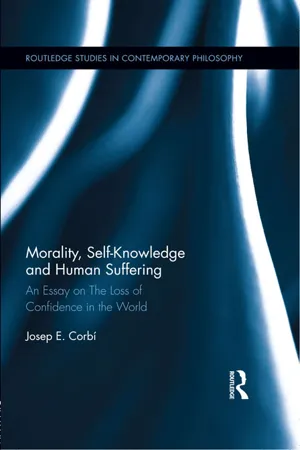
eBook - ePub
Morality, Self Knowledge and Human Suffering
An Essay on The Loss of Confidence in the World
- 254 pages
- English
- ePUB (mobile friendly)
- Available on iOS & Android
eBook - ePub
Morality, Self Knowledge and Human Suffering
An Essay on The Loss of Confidence in the World
About this book
In this wholly original study, Josep Corbi asks how one should relate to a certain kind of human suffering, namely, the harm that people cause one another. Relying upon real life examples of human suffering--including torture, genocide, and warfare--as opposed to thought experiments, Corbi proposes a novel approach to self-knowledge that runs counter to standard Kantian approaches to morality.
Trusted by 375,005 students
Access to over 1.5 million titles for a fair monthly price.
Study more efficiently using our study tools.
Information
Topic
PhilosophySubtopic
Ethics & Moral Philosophy1
Thought Experiments, Justice and Character
Thought experiments are of extended use in current debates about ethical and meta-ethical issues. In exploring such experiments, scholars engage in endless sequences of examples and counterexamples, where references to classic literary works, paintings or movies do not abound; psychological or sociological experiments are also rarely mentioned, except in the context of some specific debates.1 Examples in such thought experiments are generally sketched with two or three strokes where only a few features are mentioned. It is scarcely noticed, however, that by characterizing a situation in one way or another, we may be introducing a serious bias into the discussion.2 And, yet, a significant number of philosophers seem to assume that the study of thought experiments in light of a series of sketchy examples (and counterexamples) constitutes the best means to advance the philosophical debate. They seem to be convinced that, by persisting in this procedure, the essential features of our ethical practices will ultimately be apprehended and also the moral principles that lie at the core of a meaningful life. It is not my purpose to deny that thought experiments must play a role in philosophical reflection on moral issues, but to stress the need to complement this methodological resource with other means of understanding that may help us to discern the moral demands we may eventually confront. For, otherwise, one may unknowingly project onto the thought experiment itself a rather elementary comprehension of our moral practices, which may thereby seem confirmed.
Motivations of various sorts have encouraged the use of thought experiments as the main methodological resource in the examination of ethical and meta-ethical issues.3 Some of them are associated with a conception of practical rationality that emphasizes the relevance of principles and abstraction in our ability to lead a moral life. Such a conception is, indeed, central to the Kantian approach and also to a thought experiment of some significance in that tradition, namely, John Rawls’ original position. In this chapter, I plan to challenge the privileged function that Rawls ascribes to this thought experiment in his conception of political justice. Deliberation in the original position is supposed to abstract away from any specific features of character and, therefore, from any particular moral situations that one may actually have faced, since these are purely circumstantial elements to be discarded as both irrelevant and misleading for a proper deliberation on the principles of justice. The virtues of this deliberative procedure will be put in doubt when viewed from the perspective of a particular moral experience, namely, the shame that Primo Levi (as well as many other survivors) suffered after liberation from Auschwitz.
This challenge will in turn favor a certain style of philosophical reflection,4 a manifest feature of which will be that the study of particular, full-fledged experiences must permeate our philosophical reflection on the experience of harm and the kind of response that it may legitimately demand from us.5 The overall idea is that moral concepts cannot really be dissociated from the way we actually respond to some particular moral experiences, and how we actually project them onto other cases. For, ultimately, there are no other means of identifying the relevant similarity relations but through our actual practices of projection; as a result, the role of concepts and principles will not so much be to fix a content that may be exemplified in multiple cases, but to guide us through those practices of projection.6 This is why I will only exceptionally provide general, abstract characterizations of the conceptual distinctions I may eventually introduce. For, otherwise, the style itself might suggest that our understanding of the different views and conceptual distinctions can actually be detached from the experiences and situations that may have inspired them in the first place. I will thus try to associate any abstract distinctions and considerations with those particular issues and situations that may give rise to them. Still, if my analysis of the experience of harm is vaguely correct, stylistic maneuvers of this sort will turn out to be rather ineffective on some crucial occasions, given the power of some contrary psychological mechanisms.
Finally, let me mention that the study of Levi’s shame will serve to anticipate a number of substantive points to be developed and refined in the chapters to come. The moral significance of the asymmetries between the first-person and the third-person perspectives will thus be defended, as well as the need to revise the assumption that moral deliberation is necessarily distorted by one’s emotional attachments and favored instead by a detached view of the facts. I will derivatively stress the indispensability of a certain kind of necessity in moral deliberation. This sort of necessity may at first sound hard to accept insofar as it is alien both to rational necessity as it is conceived of within the Kantian approach, and to the sort of blind necessity to which our desires and natural dispositions are supposedly subject. The issue as to whether there is room for this alternative kind of necessity and how it may affect the way the Kantian approach construes the other two will be especially examined in Chapter 6. The present chapter will close, in any case, with a sketch of the Kantian approach as I see it, which is to be distinguished from Kant’s view insofar as that approach is meant to articulate a framework of distinctions and claims that lies behind a number of different philosophical views and also permeates the common understanding of our moral practices.
1.1 JOHN RAWLS: THE ORIGINAL POSITION
The original position is initially presented as a device of representation, as a thought experiment, designed to determine the fundamental principles of justice for the basic structure of society (Rawls 1999: 10–12, 506; 2001a: xvii; 2005: xviii). All this requires the assumption that we are dealing with a stable society “divided by reasonable though incompatible religious, political, and moral doctrines” (Rawls 2005: xviii). For it is this kind of society that gives rise to the problem of political liberalism, namely, of how it is possible that in such circumstances “there may exist over time a stable and just society of free and equal citizens” (Rawls 2005: xviii). From this perspective, the plurality of reasonable comprehensive doctrines is not regarded so much as a regrettable accident, but as “the normal result of the exercise of human reason within the framework of the free institutions of a constitutional democratic regime” (Rawls 2005: xvii).
The principles that the original position may eventually deliver, as well as the particular judgments that may follow from them, must meet the demands of reflective equilibrium, that is, they must match “our considered judgments once they have been pruned and adjusted” (Rawls 1999: 18. See Goodman 1983: 63–4). There is, however, a distinction Rawls does not explicitly mention but seems essential to his project, namely, the distinction between
A Hypothetical C-Judgment: An agent’s considered judgment about a particular moral situation S, such that she has not actually faced either S itself or any other particular situation S* relevantly similar to S,
and
An Actual C-Judgment: An agent’s considered judgment about a particular moral situation S once she has actually faced S or some other particular situation S* relevantly similar to S,
where ‘’c-judgment’ stands for ‘considered judgment’. The first kind of judgment may be regarded as hypothetical insofar as the agent is not evaluating a situation S she has actually experienced, but a situation that she (or someone else) might eventually face; by contrast, the second kind of judgment appears as actual insofar as the agent is (or has been) faced with the situation (or a relevantly similar one) that she is trying to assess. In view of this distinction, the sorts of judgments that the original position might deliver will certainly qualify as hypothetical, even though of a specific kind. In any case, it seems clear that, if the original position is to pass the reflective equilibrium test, the following assumption must be made:
If agents deliberate flawlessly, there will be no mismatch between their hypothetical c-judgments and their actual c-judgments.
For, otherwise, there would be no reason to think that our judgments in the original position will be able to reasonably track both our hypothetical c-judgments and our actual c-judgments, as reflective equilibrium seems to demand. I will argue, however, that there are some cases of mismatch that a certain kind of flaw cannot explain away, namely, a flaw that agents could reasonably be expected to overcome from within their own respective stances, either hypothetical or actual. Moreover, I defend the view that in some such cases it is the actual c-judgment that must prevail. Trivially, this line of reasoning does not call into question the previous assumption as it stands, since one or another sort of deliberative mistake will still be involved in the cases of mismatch I intend to highlight. There is, however, a stronger assumption that the original position must grant, namely:
The Matching Assumption: if agents deliberate in such a way that they make no mistake that could reasonably have been prevented from within their respective deliberative stances (either hypothetical or actual), there is no room for a mismatch between their hypothetical c-judgments and their actual c-judgments.
Still, I will argue that, insofar as the original position is to be construed as a device of representation, the modality of ‘could’ must be constrained in such a way that the Matching Assumption turns out to be false. To develop my case, I will mainly rely on Primo Levi’s description of his experience of shame as a survivor of Auschwitz in his last book, The Drowned and the Saved (Levi 1986). More specifically, I will focus on his experience of shame to conclude that his actual c-judgments on that experience must prevail over what would have been his hypothetical c-judgment about it, and also that this mismatch could not reasonably have been surmounted by further hypothetical deliberation. This will put the Matching Assumption under some pressure, as we shall see, and consequently invite the thought that the deliverances of the original position may not always prevail over an agent’s actual c-judgments. Of course, one could doubt the relevance of Levi’s c-judgments themselves: firstly, because a reflection on shame is apparently foreign to issues in political justice and, secondly, because it is unclear why Levi’s views on shame should be particularly authoritative. I will address the first worry in due course but, regarding the second, let me just mention that The Drowned and the Saved is usually regarded as a central contribution to our understanding of the survivor’s experience. Hence, it seems that his considered judgment on this matter has thoroughly been recognized as particularly significant and, consequently, any relevant worries about any given judgment of his ought to be grounded on some specific reasons and not on the overall idea that he could be wrong; for, otherwise, the demand that the original position must pass the reflective equilibrium test would become empty.7 Let’s now have a look at the details.
1.1.1 Reasoning behind the Veil of Ignorance
Rawls proposes the original position as “an expository device” (Rawls 1999: 19; see 2005: 28, 75), as “a device of representation or, alternatively, a thought-experiment for the purpose of public- and self-clarification” (Rawls 2001a: 17. See 2005: 9, 45–6) that may help us to establish the principles of justice in a society. It is clear, however, that this might serve that purpose only insofar as it may appropriately model our convictions about “fair conditions of agreement between citizens as free and equal” (Rawls 2001a: 17. See 2005: 8–9, 28, 45–6, 119) by placing some constraints as to the kind of reasons that can legitimately be provided in that context (Rawls 2002: 129–80; 2005: xix, 9).
The original position is not to be construed as a historical situation, but as a hypothetical one where agents are asked to deliberate, under certain conditions O, about the principles that must articulate the basic structure of society, that is, its main political and social institutions (Rawls 1999: 11, 14; 2001a: 10, 16; 2005: 11, 28, 274). In so doing, agents hypothesize about the principles of justice upon which everyone in those conditions would agree. What are, though, conditions O and how are agents supposed to hypothesize? People under conditions O are supposed
(1) to deliberate behind a veil of ignorance, which involves: (a) lack of knowledge about one’s place in society and one’s specific biological endowment; but also (b) lack of knowledge about one’s own conception of the good (Rawls 1999: 11; 2001a: 15, 18; 2005: 23–6).
(2) to be equal in three respects: (a) they are rational, that is, they are able to choose “the most effective means to given ends” (Rawls 1999: 12. See 1999: 124; 2005: 25, 49–55); (b) they should count on two moral powers: (i) the capacity for a sense of justice, which ensures that the principles agreed upon will be honored (Rawls 1999: 125; 2001a: 18–9; 2005: 19); (ii) the capacity for a conception of the good, even though agents must indeed abstract away in their deliberations from the specific conception of the good that they may respectively endorse (Rawls 2001a: 19; 2005: 19); and (c) they all have the same rights in the procedure by means of which the principles of justice are to be determined (Rawls 1999: 17; 2005: 52–3).
Deliberation behind the veil of ignorance is fundamentally deductive or rational;8 and this political geometry applies both to the determination of the principles of justice and the transition from such principles to those particular judgments that they may eventually support.9 We may thus characterize the sort of particular judgments that may be deductively justified in the original position as follows:
An Original C-Judgment: An agent’s judgment under conditions O about what judgment regarding a particular situation S everyone under such conditions would ultimately agree upon insofar as issues of political justice are concerned.
Some might object that my characterization of the sort of deliberation that agents behind the veil of ignorance are supposed to engage in owes too much to A Theory of Justice (Rawls 1999) and neglects the central role that the distinction between the rational and the reasonable plays in Rawls’ later writings (Rawls 2005: 48–9). But, firstly, these two notions are presented as complementary in such writings and, secondly, Rawls stresses that reasonableness is guaranteed by the conditions under which agents are to deliberate in the original position,10 but does not play any significant role in a deliberation under such conditions, which is claimed to be merely constrained by the rational and, in this respect, fundamentally deductive:
Political constructivism is a view about the structure and content of a political conception. It says that once, if ever, reflective equilibrium is attained, the principles of political justice (content) may be represented as the outcome of a certain procedure of construction … In this procedure, as modeled by the original position, rational agents, as representatives of citizens and subject to reasonable conditions, select the public principles of justice to regulate the basic structure of society. (Rawls 2005: 89–90)
Be that as it may, it is clear that original c-judgments are hypothetical. For agents in the original position are assumed to deliberate behind the veil of ignorance, whereby they must, among other things, abstract away from the fact that they may have actually faced one or another particular situation. Moreover, it is important to stress that, even though deliberation in the original position may be regarded as merely deductive, the match between our original c-judgments and our actual c-judgments cannot be deductively guaranteed. For such a match concerns the ability of the original position to pass the reflective equilibrium test, and the satisfaction of this constraint is a fact agents under conditions O cannot deductively infer. To put it another way, even though the original position is to be construed as a sort of deductive device where agents deliberate behind the veil of ignorance and see what can be deduced about the principles of justice under such conditions, the question remains as to whether the principles that may thus be deduced do match “our considered judgments duly pruned and adjusted” (Rawls 1999: 18).
Moreover, the original position is introduced as an actual device to determine the principles of justice in a society, whereby some specifications are needed regarding its operating conditions. Following up from Wittgenstein, we may distinguish between a device as a mere set of instructions and a device as an actual mechanism that can be used by some people in normal circumstances (Wittgenstein 1953: § 193–96). Wittgenstein was convinced that, in the end, both senses collapse into one insofar as the content of a set of instructions is parasitic upon the way the mechanism is actually used by normal agents.11 This is not a claim I intend to discuss here, though; for I woul...
Table of contents
- Cover
- Title
- Copyright
- Dedication
- Contents
- Acknowledgments
- Introduction
- 1 Thought Experiments, Justice and Character
- 2 The Loss of Confidence in the World
- 3 The Real and the Imaginary in the Soldier’s Experience
- 4 The Reality of Moral Features
- 5 Moral Principles and the Divided Conception of the Self
- 6 Self-Knowledge in the Light of a Dance
- 7 Conclusion
- Notes
- References
- Index
Frequently asked questions
Yes, you can cancel anytime from the Subscription tab in your account settings on the Perlego website. Your subscription will stay active until the end of your current billing period. Learn how to cancel your subscription
No, books cannot be downloaded as external files, such as PDFs, for use outside of Perlego. However, you can download books within the Perlego app for offline reading on mobile or tablet. Learn how to download books offline
Perlego offers two plans: Essential and Complete
- Essential is ideal for learners and professionals who enjoy exploring a wide range of subjects. Access the Essential Library with 800,000+ trusted titles and best-sellers across business, personal growth, and the humanities. Includes unlimited reading time and Standard Read Aloud voice.
- Complete: Perfect for advanced learners and researchers needing full, unrestricted access. Unlock 1.5M+ books across hundreds of subjects, including academic and specialized titles. The Complete Plan also includes advanced features like Premium Read Aloud and Research Assistant.
We are an online textbook subscription service, where you can get access to an entire online library for less than the price of a single book per month. With over 1.5 million books across 990+ topics, we’ve got you covered! Learn about our mission
Look out for the read-aloud symbol on your next book to see if you can listen to it. The read-aloud tool reads text aloud for you, highlighting the text as it is being read. You can pause it, speed it up and slow it down. Learn more about Read Aloud
Yes! You can use the Perlego app on both iOS and Android devices to read anytime, anywhere — even offline. Perfect for commutes or when you’re on the go.
Please note we cannot support devices running on iOS 13 and Android 7 or earlier. Learn more about using the app
Please note we cannot support devices running on iOS 13 and Android 7 or earlier. Learn more about using the app
Yes, you can access Morality, Self Knowledge and Human Suffering by Josep Corbí in PDF and/or ePUB format, as well as other popular books in Philosophy & Ethics & Moral Philosophy. We have over 1.5 million books available in our catalogue for you to explore.