eBook - ePub
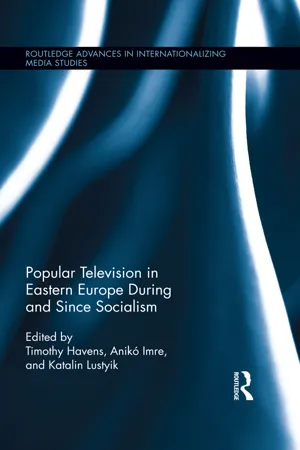
Popular Television in Eastern Europe During and Since Socialism
- 286 pages
- English
- ePUB (mobile friendly)
- Available on iOS & Android
eBook - ePub
Popular Television in Eastern Europe During and Since Socialism
About this book
This collection of essays responds to the recent surge of interest in popular television in Eastern Europe. This is a region where television's transformation has been especially spectacular, shifting from a state-controlled broadcast system delivering national, regional, and heavily filtered Western programming to a deregulated, multi-platform, transnational system delivering predominantly American and Western European entertainment programming. Consequently, the nations of Eastern Europe provide opportunities to examine the complex interactions among economic and funding systems, regulatory policies, globalization, imperialism, popular culture, and cultural identity.This collection will be the first volume to gather the best writing, by scholars across and outside the region, on socialist and postsocialist entertainment television as a medium, technology, and institution.
Trusted by 375,005 students
Access to over 1.5 million titles for a fair monthly price.
Study more efficiently using our study tools.
Information
Popular Television in Socialist Times
1
Television Entertainment in Socialist Eastern Europe
Between Cold War Politics and Global Developments
Moments of abrupt transformation provide convenient frameworks for interpretation and understanding. They allow us to organize our thinking into neatly separated compartments of ‘before’ and ‘after,’ and invite us to identify and explain the patterns that distinguish one from the other. The sudden collapse of socialist regimes in Eastern Europe provided just such a framework. As the bipolar division of the world passed into history, scholars, journalists and casual observers were left grasping for clues that could help make sense of the momentous transformation. The Cold War vocabulary established in the West, often reminiscent of foreign policy slogans promoted by successive American administrations—such as the ‘global democratic revolution,’ used by Ronald Reagan in his State of the Union address in 1987—provided a vast pool of readymade formulas. The end of the Cold War, went the argument, spelled the demise of communist totalitarianism and cultural isolation, and signalled the triumph of liberal democracy, individual freedom and capitalist economy.
It soon became clear that such formulas provided little insight into the actual processes of transformation occurring in the region. Many of the countries seemed unable to progress beyond the ‘transitional’ phase, and were plagued by corruption and low levels of political participation and public confidence. Faced with this outcome, several analysts abandoned the initial transition paradigm, and instead acknowledged the existence of multiple transformations, historical legacies and continuities (Stark 1992; Carothers 2002). Debates about post-socialist media followed a similar pattern. Communication scholars approached the changing media landscapes armed with concepts derived from democratization, civil society and public sphere theory, only to find that the reality fell short of established ideals and thresholds (Splichal 1994; Gross 2002; Jakubowicz 2007). Across the region, the news media remained highly politicized and partisan, unable to sustain an independent professional culture and strongly influenced by the ruling political elites. While the accelerated commercialization of the media sector triggered an explosion of new publications, these frequently failed to contribute to a more democratic and diverse public debate, and instead served as vehicles for private gain and personal promotion.
To account for these changes, some media analysts sought to develop alternative interpretive models—based, for instance, on the idea of elite continuity rather than transition (Sparks 2008). Others focused on building a more empirically accurate account of media democratization, one that would be capable of encompassing the diverse outcomes of change in the region (Jakubowicz 2007). Several authors also pointed out that the challenges encountered in post-socialist Eastern Europe are not unique to the region, nor reducible solely to the historical legacies of socialist politics and journalistic culture. The persistent partisanship and politicization of post-socialist media, for instance, is shared by several countries in Southern Europe—most notably Italy, but also Greece, Spain and Portugal—that have never experienced communism, and have long abandoned totalitarian rule (e.g. Splichal 1994). Such similarities with media systems beyond Eastern Europe, as well as the need to account for the diversity of media in the region itself, have prompted several researchers to adopt a comparative approach, and engage in empirical comparisons within and beyond the region (Dobek-Ostrowska et al. 2010; Downey and Mihelj forthcoming).
The body of work surveyed so far has little to say about developments in the realm of popular media and television entertainment. In line with the hierarchy of attention inherited from the Cold War, and guided by the most pressing demands of media reform after 1989, research on post-socialist media has so far been largely concerned with media policies, news genres, journalistic cultures and media ownership. Nonetheless, this literature offers valuable lessons that are worth keeping in mind when examining the transformation of television entertainment. First, it is evident that a simple before-and-after framework will not take us far. While the landscape of popular television in the region changed dramatically over the past two decades, any account of this transformation needs to be mindful not only of discontinuities, but also of continuities with the socialist period. Second, media systems in the region were internally diverse. While some countries entered communism with a well-developed broadcasting infrastructure and entertainment industry, others had to build both virtually from scratch. Local appropriations of the socialist media model differed as well. And third, an adequate interpretation of popular television in Eastern Europe, both before and after 1989, needs to situate regional developments within the broader, international framework of television history.
Building on these points, the following pages set out to chart some of the characteristics of television entertainment in Eastern Europe before 1989. The first part addresses the issue of continuities and discontinuities, focusing on the role of Western imports and entertainment programming. While it is true that the collapse of communism brought significant shifts in both areas, important changes took place long before the end of the Cold War was even remotely in sight. To understand why this was the case, we need to set aside the notion of the Cold War as a bi-polar divide, and take into account structural similarities between television cultures on both sides of the Iron Curtain. Some of these structural similarities are outlined in the second part of the chapter. Particular attention is paid to the institutionalization of television as a mass medium with a public service mission, the rift between elite and popular tastes, dilemmas surrounding the relationship between entertainment and education and responses to foreign television programs. Viewed from the perspective of these developments, the history of television entertainment in Eastern Europe was not shaped solely by the ups and downs of Cold War politics, but formed part of broader developments that straddled the East–West divide.
CONTINUITIES AND DISCONTINUITIES
There is little doubt that the availability of Western television programs in Eastern Europe increased after 1989. The fall of socialist regimes removed the remaining ideological obstacles that made Western television politically suspicious. The curiosity about things Western, fuelled by decades of heavily restricted and politically loaded cultural exchanges, made local audiences and broadcasters alike particularly open to cultural imports from the West. At the same time, the proliferation of cable and satellite television originating from the West, and the rise of privately owned television channels domestically—often fuelled by foreign investment—were undermining long-established monopolies in the broadcasting sector. Faced with competition, public broadcasters looked for quick and cheap solutions to their new predicament, and Western television series seemed to provide a perfect fit. Across the region, audiences of public television channels were tuning in for weekly installments of American soap operas and drama series, ranging from Dallas and Dynasty to E.R. and Beverly Hills 90210 (Štětka forthcoming).
Yet this is not to say that Western television entertainment was unknown in earlier periods, or that its prominence after 1989 can be explained solely by reference to the end of the Cold War. Of course, the situation varied considerably from country to country, as well as from period to period. Soviet television was far more impervious to Western imports—and in fact to any imports—than televisions elsewhere in the region. The first large-scale comparative study of international television flows, conducted in the early 1970s, revealed that Central Television 1—the main national television channel in the Soviet Union at the time—imported a mere 5% of its program (Nordenstreng and Varis 1974, 24). In contrast, the proportion of foreign programs in the rest of Eastern Europe ranged from 17% in Poland to 45% in Bulgaria. A survey conducted a decade later arrived at a similar conclusion: in the Soviet Union, imported programs amounted to a total of 8%, while the figures elsewhere in the region varied from 24% in Czechoslovakia to 30% in the German Democratic Republic (Varis 1985, 34). Although a significant part of foreign programming came from the Soviet Union and from other Eastern European countries, the share of Western imports was far from negligible. In the early 1970s, 12% of all imported programming on Hungarian television came from the UK, 10% from France, and 10% from Western Germany. In the case of TV Belgrade in Yugoslavia, as much as 80% of all imported programs came from outside of the socialist bloc and 40% from the U.S. alone (Nordenstreng and Varis 1974, 25). In the early 1980s, an average of 43% of imported programming in Eastern Europe came from Western Europe, and only slightly more—45%—from the Soviet Union and other Eastern European countries (Varis 1985, 35).
Precise figures for individual genres are difficult to collate, but available evidence indicates that much of the material imported from the West consisted of entertainment—principally cartoons and children variety programs, but also television films and series. In 1959, the small but rapidly growing television audience in Yugoslavia could follow the adventures of the female rough collie Lassie—ubiquitous on television screens around Western Europe at the time—as well as a handful of other commercially produced television programs from the U.S.1 American programming remained a regular feature in the following years. In 1964, for instance, TV Ljubljana treated its young audience to a season of Dennis the Menace,2 while female viewers across the country were purportedly swept off their feet by the charms of Dr. Kildare.3 A similar craze was sparked by the broadcasting of Peyton Place in the late 1960s and the early 1970s. In the Yugoslav Republic of Serbia, the series attracted an estimated 94% of all television viewers.4
While Yugoslavia’s peculiar geopolitical position and relative independence from the Soviet bloc made its media system particularly open to Western programs, Yugoslav television was not alone in relying on imports from capitalist countries. Across much of Eastern Europe, the easing of censorship and the partial opening to the West following Khrushchev’s denunciation of Stalin in 1956 made East–West trade and cultural exchange much easier than they were in the immediate post-World War II years. Over the course of the late 1960s and the early 1970s, Romanian audiences could follow the adventures of the blue dolphin Flipper and his friends in southern Florida, marvel at the ingenuity of the American private investigator Joe Mannix, or tremble for the lives of agents Eliot Ness and Oscar Fraley fighting crime in 1930s Chicago—all characters in American television series distributed worldwide at the time (cf. Paulu 1974, 426). By the early 1970s, even Soviet television became more open to Western entertainment, and broadcast BBC’s Forsythe Saga and David Copperfield (Lapin and Alexandrov 1976, 12). Bulgaria was, in this sense, something of an exception, and remained heavily dependent on Soviet imports throughout. Yet even here, Western popular culture was occasionally allowed into the mainstream—as for instance in the case of the popular song contest Golden Orpheus, broadcast on TV, which featured performers from the West, including some from the U.S. (Taylor 2006, 125).
Polish openness to television imports from the West—explored in detail in Dorota Ostrowska’s chapter—seems particularly remarkable. A study conducted by a Polish sociologist between 1959 and 1962 revealed that local children frequently watched American and British action and adventure series such as Zorro and The Adventures of Sir Lancelot, and were also rather fond of Walt Disney’s cartoons and variety shows, in particular the Mickey Mouse Club and Disneyland (Komorowska 1964). Adult audiences in Poland also became accustomed to Western popular entertainment. In 1964, a Polish radio and television magazine listed six “most interesting serials appearing on Polish TV,” all of which were of American origin.5 In 1968, a U.S. foreign diplomat working for the consulate in Poznan reported watching the American Western series Bonanza and the comic series Bewitched, the British musical film The Beatles and Others and the American film Jumbo starring Doris Day—all broadcast in a single day. In an ironic message sent to the U.S. Department of State, he suggested that Polish authorities were using such “bourgeois Western escapist television fare” to keep the population from attending traditional religious celebrations.6
Socialist fondness for Western popular culture may well have been occasionally facilitated by ideological motives of this kind, but ideology and politics alone cannot fully explain this unprecedented openness to Western imports. Another, perhaps more decisive reason, lay in the lack of domestic production. At the time, television was a novelty, experienced technical and creative staffwas in short supply and funding was limited. Acquiring a television series or a children’s program from abroad was, quite simply, the only feasible solution. By the 1970s, however, the situation had changed. Clumsy experimentation and sudden interruptions of transmission were giving way ...
Table of contents
- Cover Page
- Half Title Page
- Series Page
- Title Page
- Copyright Page
- Contents
- List of Figures and Tables
- Introduction
- Part I Popular Television in Socialist Times
- Part II Commercial Globalization and Eastern European TV
- Part III Television and National Identity on Europe's Edges
- Contributors
- Index
Frequently asked questions
Yes, you can cancel anytime from the Subscription tab in your account settings on the Perlego website. Your subscription will stay active until the end of your current billing period. Learn how to cancel your subscription
No, books cannot be downloaded as external files, such as PDFs, for use outside of Perlego. However, you can download books within the Perlego app for offline reading on mobile or tablet. Learn how to download books offline
Perlego offers two plans: Essential and Complete
- Essential is ideal for learners and professionals who enjoy exploring a wide range of subjects. Access the Essential Library with 800,000+ trusted titles and best-sellers across business, personal growth, and the humanities. Includes unlimited reading time and Standard Read Aloud voice.
- Complete: Perfect for advanced learners and researchers needing full, unrestricted access. Unlock 1.5M+ books across hundreds of subjects, including academic and specialized titles. The Complete Plan also includes advanced features like Premium Read Aloud and Research Assistant.
We are an online textbook subscription service, where you can get access to an entire online library for less than the price of a single book per month. With over 1.5 million books across 990+ topics, we’ve got you covered! Learn about our mission
Look out for the read-aloud symbol on your next book to see if you can listen to it. The read-aloud tool reads text aloud for you, highlighting the text as it is being read. You can pause it, speed it up and slow it down. Learn more about Read Aloud
Yes! You can use the Perlego app on both iOS and Android devices to read anytime, anywhere — even offline. Perfect for commutes or when you’re on the go.
Please note we cannot support devices running on iOS 13 and Android 7 or earlier. Learn more about using the app
Please note we cannot support devices running on iOS 13 and Android 7 or earlier. Learn more about using the app
Yes, you can access Popular Television in Eastern Europe During and Since Socialism by Timothy Havens,Anikó Imre,Katalin Lustyik in PDF and/or ePUB format, as well as other popular books in Social Sciences & Media Studies. We have over 1.5 million books available in our catalogue for you to explore.