This collection of essays emerged out of intense conversations on multi-sited ethnography, prompted by a workshop held at the University of Sussex that brought together researchers from different institutional backgrounds and affiliations in Europe, the United States and Africa – including George Marcus himself, the person most associated with the term and the method. These researchers were brought together not only to discuss the shifting meaning of the concept in anthropology, but also to see how it has influenced actual research projects that have spanned the world. The volume that has resulted is not meant to be read as a program but as an extended provocation, an argument that multi-sitedness can be good not only to think, but also to act, both with and through. Arguably, this creation of a dynamic, shifting perspective is not so different from anthropology itself – a discipline dependent on the cultivation of aesthetic, embodied and intellectual sensibilities in relation to the world at large.
eBook - ePub
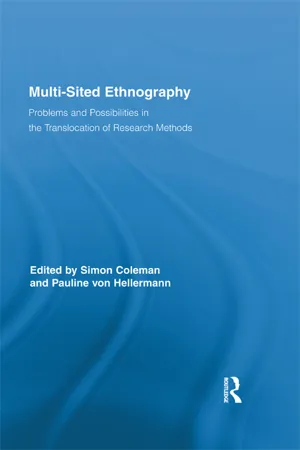
Multi-Sited Ethnography
Problems and Possibilities in the Translocation of Research Methods
- 220 pages
- English
- ePUB (mobile friendly)
- Available on iOS & Android
eBook - ePub
Multi-Sited Ethnography
Problems and Possibilities in the Translocation of Research Methods
About this book
Information
1 Introduction
Queries, Collaborations, Calibrations
Any collection of essays reflecting on the contribution of George Marcus to multi-sited ethnography must deal with a potential irony. As Kaushik Sunder Rajan notes in his contribution to our volume, an academic system that transforms Marcus into an iconic or canonical figure inverts the open-ended sensibility that Marcus attempts to create in his work. If multi-sitedness is not about a specific methodological program but is rather concerned with the (shifting) cultivation of a conceptual topology, and if our ideas relating to that topology should ideally emerge through the vagaries of both conversation and fieldwork experience, we are unlikely to perform any kind of a service by laying out a set of ethnographic theses intended definitively to re-‘form’ the field.
Happily, such is not our intention. Indeed, the collection of essays gathered here emerged out of intense and multi-stranded sets of conversations, prompted by a workshop held at the University of Sussex1 that brought together people of different institutional backgrounds and affiliations in Europe, the United States, and Africa. With the exception of Sunder Rajan himself, none of the contributors has been part of Marcus’s ‘school’ (symposium?) of anthropology as he and others have developed it over his many years at Rice and, more recently, at Irvine. Marcus was present at the workshop, but while he contributed in a lively fashion to conversations during coffee breaks, he said much less during sessions themselves, allowing them to take their own intellectual course. In the same vein, Marcus frames his own contribution to this volume in the spirit of Carlo Ginzburg (1993) on micro-history—as a somewhat detached, even ironic commentator on a topic and set of debates that he would not claim to ‘own’.
Our chapters have been developed in response to the presentations and conversations of the workshop, but they do not provide a single perspective on multi-sitedness. The point of bringing researchers together involved the decidedly inductive aim of seeing how ‘multi-sitedness’ has itself become a methodological trope: Which aspects of the idea have been taken up, and which ignored or not noticed? But we also have a more positive agenda, realized through asking contributors to explain what have been especially fertile paths to follow in their work. Overall, our chapters should provide an ethnographically-informed calibration of a shifting concept, an indication of how scholars have instantiated ‘multi-sitedness’ while in the process reconstituting it in the image of their own interests and needs. Given the salience of the multi-sited approach in forming anthropologists as well as fields of study, we include here scholars not only from different intellectual traditions but also from different stages in their career. We present their experiences in a volume that is not meant to be read as a program but as an extended provocation, an argument that multi-sitedness can be good not only to think, but also to act, both with and through. In Marcus’s terms, we are working at the level of meta-method, examining the ways in which aesthetics and forms of practice might produce useful ethnography. Arguably, this creation of a dynamic, shifting perspective is not so different from anthropology itself—a discipline dependent on the cultivation of aesthetic, embodied, and intellectual sensibilities in relation to the world at large.
FROM ‘FOLLOWING’ TO ‘COLLABORATING’
If our contributors are anything to go by (and we think that they are), it is nevertheless clear that Marcus’s (1995) ‘summary’ article in the Annual Review of Anthropology remains foundational to many scholars’ understanding of multi-sitedness, despite the fact that Marcus himself has moved on in certain respects from the position articulated in that article. In his piece for us, Marcus notes that the kind of research he discussed in the 1995 review can be seen as operating in a formal mode, emerging from the objective following of ‘sites’ such as commodity chains/productive processes, migration networks, plots/narratives, metaphors, or circulations of ideas. We can see how this strategy is picked up and assessed by a number of our contributors. Kanwal Mand talks of attempting to capture the complexity of transnational Sikh households by following the biographies of informants, collecting life histories and narratives in order to map the ways in which movement across places intersects with gender identities and stages in the life course. Kathryn Tomlinson’s discussion of researching rights processes is an account of the vicissitudes—experienced in relation to researchers in Venezuela as well as PhD examiners in the UK—of choosing not to dwell in a single village but to move between places and institutions in order to gather data. Dinah Rajak’s tracing of the discourse of Corporate Social Responsibility within a mining company2 takes her from plush board rooms in London to rather less prosperous dwellings in Rustenberg, South Africa, and her journeys contain some parallels with those of Ingie Hovland, who pursues discourses of ‘the heathen’ and of ‘renewal’ within a missionary organization operating in both Norway and Madagascar.
These are just some of the ways in which we can witness ‘lone’ ethnographers literally ‘following’ themes or topics across space, although even among these cases the differences are very significant: Rajak and Hovland are still working to a large extent within the ethnographic trope of a single institution, whereas Tomlinson’s pathway is more circuitous—and, we note, distinctly liminal in relation to conventional understandings of the field. Mand occupies a strategic space somewhere in between the two. Despite these differences of framing, we see how the core metaphor of ‘following’ can be problematic if it implies that ethnographers are simply submitting themselves to a track laid out for them rather than actively choosing and constituting their ethnographic path. In his short commentary for our volume, James Fairhead remarks that it is only correct to say that ‘the field’ shapes the ethnography if we mean one of an infinite variety of pathways that could be taken, so that it is misleading to envisage ‘the field’ as agentive outside of our own engagement with it. This is a point implicit within other writings on multi-sitedness, including at times those of Marcus. In this volume, for instance, he talks of challenging the habit, inherited from ‘Malinowskian ethnography’, of assuming that subjects can be found in ‘natural’ units of difference such as cultures and communities, as opposed to those that can be perceived to be in development3—displaced, recombined, and hybrid (though we should note Cornwall’s note of caution, in her introduction to Part B, concerning the presentation of too static a picture of Malinowski’s work).
In an earlier piece (1999:6–7), Marcus also refers to the ‘obvious’ and ‘non-obvious’ applications of multi-sited strategies. Examples of ‘obvious’ cases might involve tracing movements of migrant transnationalism in diaspora (see also Bruno Riccio’s discussion of migration research in this volume), or the history of the circulation of objects and techniques, or studying the relations of dispersed communities that define macro-processes in the global flow of capital and expertise. Such observable social processes generally remain overtly ‘trackable’. On the other hand, different challenges are faced ‘in those cases where the metaphors of tracking or following a material process do not work as well in constituting multi-sited objects of ethnographic study, where the relationships or connections between sites are indeed not clear, the discovery and discussion of which are, in fact, the main problem of ethnographic analysis’ (Marcus 1999:7). Such contexts are likely to involve the question of how to discern the relationships between sites of activities that are disjunctive in space or time and perhaps also in terms of social category. One of the examples that Marcus gives, that of Crapanzano’s (2000) analysis of the course of fundamentalist Christian imagery through various media and social institutions in the United States, has certain parallels with the ‘peripatetic’ case described by Tomlinson, though one major difference between the accounts—as Marcus would appreciate—is the political and academic position of the fieldworker in trying to bring together these ‘non-obvious’ strands.4 We might be tempted instead to use the term ‘fieldmaker’ here, but we need to bear in mind again that fields are always made, are never ‘natural’, as also discussed in Roy Dilley’s (1999:xi) account of the ‘performative’ character of the act of contextualizing in ethnography (see also Coleman and Collins 2007).
The physical practice of following different sites that are disjunctive in spatial, if not social or ideological terms, has dominated much discussion of multi-sitedness and perhaps reflects the literal-mindedness of anthropologists. And yet it is important to note that there is much more potential within the term.5 As Falzon notes (2009:1), behind Marcus’s 1995 piece was the desire to shift from previous anthropological positions that the ‘world system’ could be seen as a framework within which the local was contextualized or compared; rather, that system was to be seen as always-already embedded within the object of study, and thus an integral part of ‘local’ situations analyzed in juxtaposition with each other (ibid.:2).6
Part of what is at stake here is the way in which scale itself is conceptualized as part of the fieldwork process (see also Fortun 2009). Eric Sheppard (2002:315) refers to how conventional assumptions regarding the existence of contiguous geographic scales with fairly well-defined boundaries, and with smaller scale units nesting within larger scale units, are challenged by different scalar forms of the fuzzy and non-contiguous spaces of geographic networks. Or, closer to our disciplinary home, we might (along with Rajak) invoke Jean and John Comaroff’s (2003:151) considerations of ‘Ethnography on an Awkward Scale’ where the tracing of the ‘occult economy’ (which they see as an empirically grounded ‘abstraction’) causes them to ask what ‘ethnographic means’ can capture ‘the material and moral conditions that animate such an economy, the new religious and social movements it spawns, the modes of producing wealth which it privileges’. Such processes and conditions are presented as inherently awkward of scale and thus not easily within reach of the ethnographer’s lens. While Marcus (n.d.) talks of the challenges faced by the low-tech, face-to-face phenomenology of ethnography in the context of an ‘ecology’ of changing scales and forms of enquiry, the Comaroffs (2003:153) describe as ‘fiction’ the notion that knowledge derived first-hand by proximity to ‘natives’ must have an a priori privilege. Both are likely to agree that working at such difficult-to-capture scales involves an imaginative sociology that seeks to understand indigenous views of the world but also requires an ability to discern processes mediated in virtual space alongside those visible in ‘real’ places-under-production (ibid.:166–9). Famously, Marcus (1998) has also proposed a pragmatic acceptance (pace Geertz) of ‘ethnography through thick and thin’,7 and in this volume he refers to a norm of incompleteness whereby a larger ethnographic ‘map’ is inferred and imagined on the same plane as the lived spaces of relations that are subjected to intense ethnography.8
Such ‘awkwardnesses’ of scale, combined with the disjunctions that ethnographers and people being studied traverse in moving between and constituting ‘sites’, indicate the inevitable partiality of cultural knowledge, while often at the same time making it an object of explicit reflection on the part of both anthropologist and informant. Dilley (1999:32), drawing on Strathern (1991), refers to how culture as an item of knowledge may become part of local native discourse as much as of anthropological discourse: when people shift contexts and move between different scales they are explicitly making knowledge for themselves. Strathern (1995:3) talks further of how bringing together separate orders of knowledge has traditionally been accomplished through concepts such as ‘level’ and ‘context’, ‘structure’ and ‘event’, but that these middle-range constructs no longer seem sufficient in the face of transformations attributed to world movements, cultural creolization, international consumerism, proliferating nationalisms, and so forth. Some fifteen years later, we see Marcus (this volume) engaged in a virtual conversation with Kim Fortun over whether the field can be seen to exist in a world of ‘distributed knowledge systems’— systems that can challenge the hegemony of culture as a concept. Or, as Fortun responds, we need to rethink not only scales but also ethnographic ‘subjects’, who are nodes in distributed knowledge systems, perceived as knowledge-makers and not merely holders, with the result that the object of ethnographic inquiry is itself always understood to be in motion.
These discussions, as Marcus notes, have certain resonances with the language of ‘assemblages’ and ‘emergent forms of life’ that have been developed in recent social studies of science, even if he finds himself searching for a still more generic language to encapsulate what he is trying to do. (Werner Krauss’s contribution to our volume takes us back in the direction of S.T.S. through assessing the parallels between multi-sited ethnography and actor-network theory.9) Here, however, the important point is the way in which discussions of knowledge-making move us towards a still more radical dimension of Marcus’s work, and one that remains rather less explored in the ethnographic record than more literal forms of ‘following’ sites of inquiry. For Marcus, distributed knowledge systems may provide a framing for what he sees as ‘para-ethnography’, where strategic collaboration with certain research subjects is cultivated, with—it is surely to be hoped—unpredictable results. The Malinowskian ideal of working through informants’ subject positions is retained yet is shifted into the construction of research spaces and fields of social action that emerge by working through a selected subject’s or group’s para-ethnographic take on a problem cognitively and epistemologically shared with the ethnographer. Such collaboration can help us to rethink—perhaps we might say ‘deliteralize’—what is meant by ‘following’, since for Marcus the object of such collaboration is to shift the focus on research to other places that are imagined but not necessarily physically visited by collaborators.
What is being suggested, then, is a shift in the social relations and modes of producing ethnography, even if such collaboration as a ‘method’ is not explicitly developed within our discipline. The anthropologist–other binary is challenged, with subjects in effect becoming counterparts of the researcher. As Marcus puts it in a slightly earlier formulation (2008:7): ‘The basic trope of fieldwork encounter shifts from, say, apprentice, or basic learner of culture in community life, to working with subjects of various situations in mutually interested concerns and projects with issues, ideas, etc.’10 We see here an interesting complement to the multi-perspectival or at least multiply-located stance inherent in ‘following’ tropes, as the ethnographic lens incorporates the views of subjects from the very beginning and then throughout the development of the research—perhaps there is even a hint of Michael Jackson’s notion of ‘intersubjectivity’ within anthropological projects, where fields of inter-experience, inter-action, and inter-locution are explored, without the assumption of completely shared experience (1998:3–4). Certainly, there is a resonance with Ingie Hovland’s argument, expressed here, that multi-sited ethnography is not just something that helps us to add together perspectives from multiple sites; rather it has the potential to force us to change perspective, not least in our attempts to understand the often transnational organizational strategies of those who are the ‘subjects’ of our work. For Marcus, this kind of collaborative research can also challenge the conventional ethnographic trope of ‘natural’ observation by stage managing connected events of dialogue, as well—we would argue—as raising intriguing questions as to who the wider audiences for ethnographic knowledge should be.
QUERIES AND CALIBRATIONS
In its published existence of fifteen years or more (despite its roots in earlier works, such as M...
Table of contents
- Cover
- Halftitle
- Title
- Copyright
- Contents
- Acknowledgments
- 1 Introduction: Queries, Collaborations, Calibrations
- 2 Multi-sited Ethnography: Five or Six Things I Know About It Now
- Part A: Spatialities of the Field
- Part B: Challenging Conventions? Multi-sited Ethnographies of Institutions and Processes
- Part C: Multiple Pathways and the Price of Liberation
- Contributors
- Index
Trusted by 375,005 students
Access to over 1.5 million titles for a fair monthly price.
Study more efficiently using our study tools.
Frequently asked questions
Yes, you can cancel anytime from the Subscription tab in your account settings on the Perlego website. Your subscription will stay active until the end of your current billing period. Learn how to cancel your subscription
No, books cannot be downloaded as external files, such as PDFs, for use outside of Perlego. However, you can download books within the Perlego app for offline reading on mobile or tablet. Learn how to download books offline
Perlego offers two plans: Essential and Complete
- Essential is ideal for learners and professionals who enjoy exploring a wide range of subjects. Access the Essential Library with 800,000+ trusted titles and best-sellers across business, personal growth, and the humanities. Includes unlimited reading time and Standard Read Aloud voice.
- Complete: Perfect for advanced learners and researchers needing full, unrestricted access. Unlock 1.5M+ books across hundreds of subjects, including academic and specialized titles. The Complete Plan also includes advanced features like Premium Read Aloud and Research Assistant.
We are an online textbook subscription service, where you can get access to an entire online library for less than the price of a single book per month. With over 1.5 million books across 990+ topics, we’ve got you covered! Learn about our mission
Look out for the read-aloud symbol on your next book to see if you can listen to it. The read-aloud tool reads text aloud for you, highlighting the text as it is being read. You can pause it, speed it up and slow it down. Learn more about Read Aloud
Yes! You can use the Perlego app on both iOS and Android devices to read anytime, anywhere — even offline. Perfect for commutes or when you’re on the go.
Please note we cannot support devices running on iOS 13 and Android 7 or earlier. Learn more about using the app
Please note we cannot support devices running on iOS 13 and Android 7 or earlier. Learn more about using the app
Yes, you can access Multi-Sited Ethnography by Simon Coleman,Pauline von Hellermann in PDF and/or ePUB format, as well as other popular books in Social Sciences & Anthropology. We have over 1.5 million books available in our catalogue for you to explore.