Working with Bengali mentors, especially his close friend A. B. Ghose, Sir John Woodroffe became the pseudonymous orientalist Arthur Avalon, famous for his tantric studies at the beginning of the twentieth century. Best known for The Serpent Power, the book which introduced 'Kundalini Yoga' to the western world, Avalon turned the image of Tantra around, from that of a despised magical and orgiastic cult into a refined philosophy which greatly enhanced the prestige of Hindu thought to later generations of westerners.
This biographical study is in two parts. The first focuses on Woodroffe's social identity in Calcutta against the background of colonialism and nationalism - the context in which he 'was' Arthur Avalon. To a very unusual degree for someone with a high position under the empire, Woodroffe the British High Court Judge absorbed the world of the Bengali intellectuals of his time, among whom his popularity was widely attested. His admirers were attracted by his Indian nationalism, to which his tantric studies and supposed learning formed an important adjunct.
Woodroffe's friend Ghose, however, was the chief source of the textual knowledge in which the 'orientalist' scholar appeared to be deeply versed. The second part of this study assesses Woodroffe's own relationship to Sanskrit and to the texts, and highlights his very extensive but gifted use of secondary sources and the knowledge of Ghose and other Indian people. It examines the apologetic themes by which he and his collaborators made Tantra first acceptable, then fashionable.
Partly because of his mysterious pseudonym, Woodroffe acquired a near legendary status for a time, and remains a fascinating figure. This book is written in a style that should appeal to the general reader as well as to students of Indian religions and early twentieth century Indian history, while being relevant to the ongoing debate about 'orientalism'.
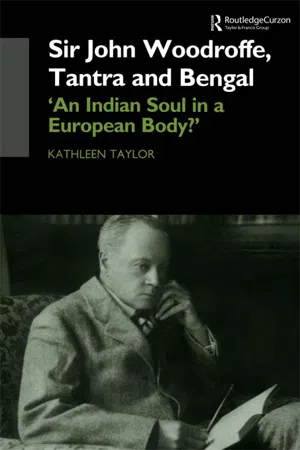
eBook - ePub
Sir John Woodroffe, Tantra and Bengal
'An Indian Soul in a European Body?'
- 332 pages
- English
- ePUB (mobile friendly)
- Available on iOS & Android
eBook - ePub
About this book
Information
Part One
SIR JOHN WOODROFFE
1865–1936
A biographical study
Chapter One
GLIMPSES OF A LIFE
Camera and pen
Sir John Woodroffe does not tell us much about himself. He left no (or at least no surviving) diaries, and his letters reveal few intimacies. His writings for the most part avoid self-reference. But we do have portraits of him in his many-faceted life – in both the literal and figurative sense: photographs, as well as pen-portraits showing how he was seen through the eyes of others, and actions revealing how he presented himself to the gaze of those others. There is the orientalist scholar lecturing on Tantra to an eminent audience; and the pseudonymous ‘Arthur Avalon’ proclaiming his identification with things Indian by his dress at a party (chapter 8); the popular figure at the High Court (chapter 3); the cultured scholar and art connoisseur (chapter 4); the defender of Hindu culture against its detractors (chapter 5); and the various pictures of Woodroffe as a Tantric – slightly eccentric in the eyes of some, the devoted disciple of the guru to others (chapter 6). In most of his photographs in the literal sense he appears enigmatic and unhappy, never looking at the camera but with eyes either down on the ground or gazing at something unseen in the distance. It is the face of a very sensitive, seemingly deeply introverted person [plate 1].
A family photograph of him as a young man shows him in riding clothes, standing in the entrance of what for a time was his parents’ home in England [plate 2]. The house was called Frensham Heights, near Farnham in Surrey, and the site is now a school. Though the original building the Woodroffes lived in has been demolished, the magnificent view from the top of the Heights can still be enjoyed today, and gives a glimpse of the wealth and privilege of the family who once owned the site. Writing on the back of the photograph states that this is “Jack”, taken by his younger brother Alban.
Jack was the eldest of a family of four sons and three daughters. He was born in Calcutta on 15 December 1865 and baptised in St Peter's Anglican Church there in January 1866.1 His father, James Tisdall Woodroffe, was a barrister of the High Court who became extremely successful in his profession. At the beginning of the twentieth century he was Advocate General of Bengal, and a member of the Viceroy's Council, until he resigned from it after a quarrel with Lord Curzon.2 The elder Woodroffe was one of the great figures at the Calcutta bar and amassed great wealth.3 The Calcutta Weekly Notes often refers to the high fees which barristers could command, something which made litigation a very expensive affair for the public.4
The Woodroffes were a family of Irish Protestant clergy and James Tisdall seems to have been the only member of the immediate family to work in India,5 but his wife, Florence Hume, came from a family who had lived there for several generations. She was born in India, the youngest child of James Hume, a cousin of Alan Octavian Hume who was among the founding members of the Indian National Congress, and one of a small group of British people who supported it in its early phase.6 James Hume was Presidency Magistrate of Calcutta. Someone of the same name founded the only Calcutta club in the 1850s which was open to both English and Indian members,7 and this might have been Florence's father. There was also a James Hume who was editor of the Star newspaper, but it is not clear if all three were the same person.
Alan Octavian Hume, like his cousin's grandson, not only supported Indians politically but was also drawn to Theosophy and Hinduism,8 but both John Woodroffe's parents converted to Roman Catholicism when he was still a child. His mother was probably the Mrs Woodroffe who visited Cardinal Newman in 1873 in the company of Lady Herbert of Lea,9 for her husband was soon afterwards giving generous donations to Catholic projects in Bengal. James Tisdall's conversion was said to have taken place in 1875,10 and led to a passionately-held devotion to his new faith.11 John and his next brother Francis were sent to Woburn Park, an attractively unconventional Catholic public school which opened in 1878. Its headmaster, Monsignor Lord Petre, had views on education which strongly emphasized the autonomy and freedom of the child. As we shall see in the next chapter, John Woodroffe may have felt himself particularly fortunate in being able to stay there throughout most of its seven brief years of existence. Afterwards he attended University College Oxford from 1884–8, where he was one of the first undergraduates to study for the Bachelor's Degree in Law. Training for a profession at Oxford was an innovation at the time, when the prevailing ideal of a ‘liberal education’ was opposed to specialisation.12 Although Catholics had been admitted to the university since the 1850s, in the 1880s they were still discouraged by their Church from going there. Woodroffe's progressive headmaster, however, held different views.13 The great Max Muller was a prominent personality at Oxford in the 1880s – although retired from his Chair in Comparative Philology – and he entertained people from all over the world, especially from India.14 Woodroffe would also have been present at Oxford when the university honoured the ninety year old Brian Houghton Hodgson (see below, chapter 7).15 But if Woodroffe was ever inspired by such famous figures of nineteenth century orientalism, there is nothing in his writings to suggest it: on the contrary he consciously ploughed a different furrow.
A more pertinent influence – although Woodroffe hardly ever expressly mentions them – would have been the British school of Idealist, or Neo-Hegelian philosophers. T.H. Green had just died when Woodroffe became an undergraduate but his influence was still paramount at Oxford in the 1880s. Overthrowing the dominance of Utilitarianism and Scientific Materialism, the Idealists posited the notion of the Absolute or what was termed ‘the supra-relational unity of all reality’ – which they distinguished from our normal partial apprehension of truth. ‘There is no truth but the Whole’, they declared. Similarities to Hindu Vedanta attracted many Indians to this school.16 Woodroffe believed in the primacy of what he called ‘the Full or Whole Experience’ [WAP:16]17 as distinct from the partial and varied experiences of the world of ordinary perception. But he did not equate any of the Hindu systems with Idealism: on the contrary he emphasized their ‘realism’.18 The significance of Idealism perhaps lies not so much in its direct influence as in its atmosphere. Woodroffe's profound interest in metaphysical problems and their solutions is clearly manifest in his attraction both to Vedanta and Tantrism. Such metaphysical concern is not fashionable in modern Western culture (unless through the direct influence of non-Western gurus or teachers), and can even appear exotic. In the period between the late nineteenth century and the First World War, however, when the school of Idealism was dominant in Britain and Europe, metaphysical discourse in ‘West’ and ‘East’ would have seemed closer than it does today.19
Taking his BCL in 1888, John Woodroffe was called to the Bar at the Middle Temple in 1889, and joined his father at the Calcutta Bar the following year. He quickly established himself as an expert on Indian Law, his first two publications being his lectures as Tagore Law Professor of Calcutta University in 1897.20 He was promoted to the judiciary at the comparatively young age of thirty-nine in 1904. Whether or not the influence of his famous father played any part in this, the younger Woodroffe had produced another important book on Indian Law by this time in collaboration with a senior Indian judge, Sir Sayeed Ameer Ali. The Law of Evidence was regarded as an authoritative textbook and remained in print for a very long time.21
James Tisdall Woodroffe seems to have been a dominating personality, which helped to make him one of the famous figures at the Bar in his day, but it seems also to have made him a formidably authoritarian father. He banished his third son, Alban, both from the family and from the country for an incident involving a relationship with a girl while at his cadet school. His nephew James recounted Alban's story of what happened when as a young man he was summoned into the presence of his father, who had a map of the world spread out on a table in front of him. Alban was ordered to select a country from the map, and then was given some money for his passage and sent away He chose Argentina without knowing anything about it – he had just been drawn to its warm orange colour. Alban eventually did rather well in Argentina and was later on reconciled with his father and even inherited his father's estate instead of his elder brothers. But his nephew James described this uncle as an extremely unpleasant authoritarian character.
James Tisdall made arrangements in his Will for his second son, Francis, to lose his inheritance if he should enter a marriage that was not approved by the Catholic Church. Francis Woodroffe never married, and his Will reveals that he had a long friendship with a woman who was not a Catholic. His nephew described him as a failed actor and a rather restless and unsuccessful person.
James Tisdall Woodroffe's eldest son John seems to have retained his trust, for he was executor of his father's Will, and the father and son lived together at the Bengal Club and in various lodgings until 1900, though they did not share Chambers.22 This son, at least, did not appear cowed by his awesome father, for there is an amusing account of how the two Woodroffes once appeared on opposite sides of the same case and how the younger demolished the elder in court. O.C. Ganguly, at the time a young solicitor's clerk, describes a courtroom crowded with those eager to watch the battle between ‘bara’ and ‘chhoto’ Woodroffe. The younger man roundly accused his father of using dishonest arguments, and for some time afterwards the Bar lounge resounded to James Tisdall's outraged protest: ‘John calls me dishonest!’ His friends are reported as replying: ‘He has found you out at last!’23 This is strong evidence of John's independent spirit.
Despite his ability to hold his own with his father, it is nevertheless extremely unlikely that John Woodroffe could have gone so far as to openly display an interest in Tantra before James Tisdall's retirement from India in 1904, without losing his father's favour and his inheritance. He may well have been secretly drawn to it, however, much earlier. In 1894 his mother died at the age of only forty-eight. There is a cryptic reference by Woodroffe to ‘a man I know who had lost his mother,’ who was told by Varna Khappa – a Bengali Tantric saint of the last century – to seek out the Mother of the Universe.24 It is highly probable that Woodroffe, though he normally avoided personal references, was here writing about himself. His attraction towards ‘the Mother’ as divinity in Her own right is prominent in his books.
It may have been soon after his father's retirement, when the younger Woodroffe had just become a judge, that another tantric saint, Sivacandra Vidyarnava, initiated him into tantric rituals. The main source for this story is the Bengali biography of the saint discussed in chapter 6. No dates are given to the events in the account, but if Woodroffe met the guru soon after becoming a judge in 1904, this would fit in with reports of him practising tantric yoga with his friend the art historian E.B. Havell, who left India in 1906. In 1907, Woodroffe was one of several High Court judges who were among the founder members of the Indian Society of Oriental Art, in which he soon took a leading role. He was a close friend of Abanindranath and Gaganendranath Tagore, the artist nephews of Rabindranath. He may have started studying Sanskrit around this time, or a little later in 1911. 1912 might have been the year of a controversial photograph taken at Konarak temple where Woodroffe, Ghose and a European friend wore Indian dress [plate 6]. As we have seen, the first books of Arthur Avalon were published the following year, in 1913. Woodroffe was knighted in 1915. He retired from the High Court in 1922 and the following year returned to University College Oxford to lecture in Indian Law.25 He finally retired to the south of France in 1930 and died at Beausoleil, a suburb of Monte Carlo, in January 1936.
In 1902 John Woodroffe was married at the age of thirty-seven, to Ellen Elizabeth Grimson, then aged twenty-five.26 She was a concert pianist and belonged to an extremely talented family. Her father Samuel Grimson, a violinist, seems to have been very keen to promote the musical education of his large family, especially the girls. Three of Ellen's sisters pursued successful careers on the concert platform, having been trained by their father from an early age.27 James Woodroffe told me his parents met when hi...
Table of contents
- Front Cover
- Half Title Page
- Title Page
- Copyright
- Contents
- List of Illustrations
- Preface
- Acknowledgements
- Abbreviations
- Introduction
- PART 1 SIR JOHN WOODROFFE 1865–1936 A biographical study
- PART 2 ARTHUR AVALON The Creation of a Legendary Orientalist
- CONCLUSION
- Appendices
- Notes
- Bibliography
- Index
Trusted by 375,005 students
Access to over 1.5 million titles for a fair monthly price.
Study more efficiently using our study tools.
Frequently asked questions
Yes, you can cancel anytime from the Subscription tab in your account settings on the Perlego website. Your subscription will stay active until the end of your current billing period. Learn how to cancel your subscription
No, books cannot be downloaded as external files, such as PDFs, for use outside of Perlego. However, you can download books within the Perlego app for offline reading on mobile or tablet. Learn how to download books offline
Perlego offers two plans: Essential and Complete
- Essential is ideal for learners and professionals who enjoy exploring a wide range of subjects. Access the Essential Library with 800,000+ trusted titles and best-sellers across business, personal growth, and the humanities. Includes unlimited reading time and Standard Read Aloud voice.
- Complete: Perfect for advanced learners and researchers needing full, unrestricted access. Unlock 1.5M+ books across hundreds of subjects, including academic and specialized titles. The Complete Plan also includes advanced features like Premium Read Aloud and Research Assistant.
We are an online textbook subscription service, where you can get access to an entire online library for less than the price of a single book per month. With over 1.5 million books across 990+ topics, we’ve got you covered! Learn about our mission
Look out for the read-aloud symbol on your next book to see if you can listen to it. The read-aloud tool reads text aloud for you, highlighting the text as it is being read. You can pause it, speed it up and slow it down. Learn more about Read Aloud
Yes! You can use the Perlego app on both iOS and Android devices to read anytime, anywhere — even offline. Perfect for commutes or when you’re on the go.
Please note we cannot support devices running on iOS 13 and Android 7 or earlier. Learn more about using the app
Please note we cannot support devices running on iOS 13 and Android 7 or earlier. Learn more about using the app
Yes, you can access Sir John Woodroffe, Tantra and Bengal by Kathleen Taylor in PDF and/or ePUB format, as well as other popular books in Scienze sociali & Studi sull'etnia. We have over 1.5 million books available in our catalogue for you to explore.