- 208 pages
- English
- ePUB (mobile friendly)
- Available on iOS & Android
eBook - ePub
About this book
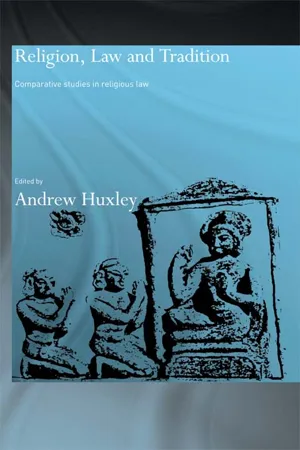
This book brings together two scholarly traditions: experts in Roman, Jewish and Islamic law, an area where scholars tend to be familiar with work in each area, and experts in the legal traditions of South and East Asia, which have tended to be less interdisciplinary. The resulting mix produces new ways of looking at comparative law and legal history from a global perspective, and these essays contribute both to our understanding of comparative religion as well as comparative law.
Information
1
INTRODUCTION
This volume started as one of the panels at the W.G. Hart Workshop, 2000.1 Lawyers from SOAS and the University of Glasgow jointly convened the workshop in order to commemorate the centenary of the International Congress of Comparative Law, Paris 1900. The International Congress, which was held as part of the Paris Exposition Universelle, is a significant event in Comparative Law's development. Richard Hyland sees it as a rite de passage, the culmination of ‘the initial phase of modern comparative scholarship’.2 Peter de Cruz sees it as the transition from dreamtime to modernity, when ‘the first serious attempts were made to formulate the functions and aims of comparative law’.3 A century later, how much has changed?
We can estimate the degree of change by comparing Comparative Law's buzzwords then and now. In 1900, the key concepts were unification, evolution and taxonomy. In 2000 they seem to be globalisation, transplants and incommensurability. In 1900 the young discipline was confident that the comparative method would transform our knowledge of law, as it had already transformed our knowledge of language and biology. In 2000 comparative lawyers are ‘shaken by deep theoretical malaise’.4 They need a ‘radical revision of [their] modes of thought’.5 The mainstream of academic comparative law scholarship ‘is an exhausted genre’.6 Starting from the bright, confident morning of Paris 1900, the discipline stumbled into London 2000 in a late night angst of failed aspirations. This volume focuses on one particular failed aspiration. Since 1900, Comparative Law has aspired to offer a world-wide picture of law through its taxonomy of families of law. Even though the bulk of twentieth-century work has focused on law in Europe and North America, the legal families’ approach has enabled the discipline to claim that it provides a full global coverage. Most of the taxonomies that Comparative Law still takes seriously invoke a family of religious laws. The general approach is that European law can be divided according to political ideology (Marxist or non-Marxist law) and dependence on Roman Law (civil or common law), while non-European law can be divided into written law (which is religious) or unwritten law (which is custom). The purpose of this volume is to examine the concept of a family of religious laws.
I invited two groups of specialists who otherwise rarely meet each other to discuss these issues together. One bundle of invitations went to experts on Judaism, Christianity and Islam who, if not enthusiastic about the label religious law, have at least grown used to it. Another bundle went to experts in the legal traditions of China, India and Southeast Asia, who find the label more problematic. In my call for papers I asked them to consider three questions:
1 Is it useful to classify the world's legal phenomena into families?
2 If so, should one of the families be labelled as religious systems?
3 If so, which of Eurasia's written legal cultures should be included with the religious systems’ family?
Familiar problems with timing and funding meant that some of the invitees were unable to attend the Workshop. I am delighted that, nevertheless, they have succumbed to my pestering and produced chapters for this volume.
Chapters 2–5 – Carmichael on the Old Testament, Jackson on the Jewish tradition, Ferrari on Canon law and Welchman on Islamic law – examine the law that has emerged out of the theistic religions of the Middle East. Bernard Weiss is surely right in his claim that these religions share a distinct relationship with law:
Law, it seems, is integral to monotheistic religion. The world's sole creator is necessarily by right its sole ultimate ruler, legislator, and judge. All law worthy of the name must therefore originate with him.7
Chapters 6–8 – Peerenboom on Chinese law, Menski on Hindu Law and Huxley on Buddhist law – concern the legal traditions of South and East Asia. I am implying a geographical distinction between Near and Far East, but it is not that Orient v. Occident division about which Edward Said has warned us.8 When discussing religions, we should look east and west from the 60°E line of longitude that descends from the Urals to the Iran–Afghanistan border. To the west the ‘religions of the book’ developed, with their common approaches to the divine and their common mythologies of Abraham and Moses. To the east developed several approaches to the sacred, different both from the Abrahamic religions and from each other. Whether Buddhism, Hinduism, Daoism and Confucianism should be labelled as a religion, rather than a philosophy, or a health programme, are controversial questions explored in the following chapters.
At the very least, I hope that twenty-first century taxonomists of law will pay more attention to this definitional problem than their predecessors did. This would encourage them to measure the respective contributions made by Christianity and Classicism to the civil and common law: Do European lawyers today descend more from Gratian and Aquinas, or more from Cicero and Ulpian? My next best hope is that twenty-first century comparatists should include taxa from either side of the Urals in their phyla and genera. ‘Eastern’ Chinese law and ‘Western’ Canon law, for example, share a positivist, hierarchical approach to legislative power. While ‘Western’ Islamic law and ‘Eastern’ Buddhist law share the belief that ultimate power over law lies with this generation's interpretive community. The concept of religion alone does not help us analyse these similarities. We need a more detailed examination of how the authors of the law-texts (the Brahmin exegetes, the Muslim ’ulama, the Chinese erudites, the Jewish rabbis, the Buddhist vinayadhara and the Christian canonists) related to political structures, and to their own tradition and to their own public. The first seven chapters provide thick descriptions of these issues. To encourage comparatists to read them, I shall abstain from the usual editorial practice of giving a half-page summary of each chapter. I am judging you by my own low standards: Whenever I come across such an introduction, I xerox it and leave the rest of the volume unread.
In Chapter 8, the Panel Discussion, the contributors talk informally about the methodological issues at the heart of this book. We who study classical legal traditions, whether written in Chinese, Sanskrit or Hebrew characters, acquire a professional deformation, a bashfulness about speculating in print on areas outside our expertise. Because we know all too well how easy it is to draw wrong conclusions about our own area, we avoid commenting on territories about which we know little. Yet we must overcome this reticence if we classicists are to make any contribution to Comparative Law's debates. When comparing the tradition we know with another, we step down from our podium of expertise into the floor-level debate. We do this regularly anyway – when asking questions at Law Faculty seminars, when dashing off emails to colleagues at the end of a long workday, when pontificating over a pint – but seldom in print. The Panel Discussion has been stitched together from such shreds and patches. I recommend it to readers who assume that specialists in our abstruse fields must inhabit a distant methodological planet. Mildly eccentric we may be, but the intellectual world we inhabit is much like yours: in order to understand law, we read the same people – Marx, Weber, Hart, Dworkin – as everybody else.
Chapters 9 and 10 have a different aim. Chapters 1–8, taken as a whole, offer a destructive analysis of the category religious legal systems. But none of us has our foot in your door, trying to sell you an alternative legal taxonomy as if it was cheap double-glazing. This is bad news for readers like myself, who can only construct their own schemes through criticising other peoples’. In Chapters 10 and 11, David Daube and Jacques Vanderlinden remedy this deficiency by offering their own approaches to the macro-comparison of religious legal systems. They have rather different sales techniques. Vanderlinden goes for the hard sell: after knocking the competition and flourishing a bit of logic, he shows us charts and examples that illustrate the subtleties of his scheme. Daube preferred to illuminate the big questions by shining a focused beam of intelligence on points of detail. His sales-pitch is so soft that we may wonder what he is selling until the moment we sign the cheque. Given these differences in approach, it may be helpful to introduce Chapters 9 and 10 with a paragraph apiece.
David Daube (1909–1999) taught at Cambridge, Aberdeen, Oxford, Constanz and Berkeley. Among his students were three of the present contributors. He was no stranger to SOAS, having delivered there some of his most important contributions on the common intellectual background to Roman and Jewish law.9 In 1983 he addressed an audience in Toronto on the Jewish and Roman philosophies of law. This hitherto unpublished lecture (which is included by kind permission of Daube's literary executor Calum Carmichael) fits the themes of this volume perfectly. That it is the first of his posthumous publications is a mixed blessing indeed. Like the other contributors, Daube belittles the ‘time-hallowed contrast between societies where law is a branch of religion and societies where it is independent’. But then he goes on to describe ‘fundamental down-to-earth dissimilarities’ between the world of the Talmud and that of the Corpus Iuris. I take this to be his double-glazing scheme: as an indispensable preliminary to confident taxonomising, we must make systematic comparisons, one on one, between Roman law and Jewish law, Canon law and Chinese law, Hindu law and Islamic law, and so on. The final sentence of his lecture draws a moral to which we must all strive to adhere: ‘Don't drive a camel with flax through a narrow street on Hanukkah.’ If I dare point a moral to Daube's moral, it is that, when we apply our heads to the nebulous questions of law worldwide, we must ensure that our feet don't lose contact with the muddy ground of legal detail.
Jacques Vanderlinden's friendship with SOAS Law Department goes back to the 1960s when he, Tony Allott and Jim Read succeeded for a while in making African law into a glamorous, cutting edge discipline. For an all-too brief term in 1974 he joined us in the Department. During the 1980s he steered Europe's leading inter-disciplinary comparative forum, the Jean Bodin Society for the Comparative Study of Institutions, away from Eurocentricity towards serious intellectual engagement with the rest of the world. For the last decade he has been attached to the world's only Centre for the study of common law in the french language. I am indebted to him for various kindnesses that far exceed the normal academic courtesies. I regard Chapter 10, in which he blends points made by the panellists into a palatable dish, as another personal kindness. He, in turn, wishes to acknowledge some editorial assistance ‘in rendering my Belgian por...
Table of contents
- Front Cover
- Title Page
- Copyright
- Dedication
- Contents
- List of contributors
- Acknowledgements
- 1 Introduction
- 2 Religious claims about biblical law
- 3 Judaism as a religious legal system
- 4 Canon law as a religious legal system
- 5 Islamic law: stuck with the state?
- 6 Law and religion in early China
- 7 Hindu law as a ‘religious’ system
- 8 Buddhist law as a religious system?
- 9 Religious law: a discussion
- 10 Jewish and Roman philosophies of law
- 11 Religious laws as systems of law – a comparatist's view
- Index
Trusted by 375,005 students
Access to over 1.5 million titles for a fair monthly price.
Study more efficiently using our study tools.
Frequently asked questions
Yes, you can cancel anytime from the Subscription tab in your account settings on the Perlego website. Your subscription will stay active until the end of your current billing period. Learn how to cancel your subscription
No, books cannot be downloaded as external files, such as PDFs, for use outside of Perlego. However, you can download books within the Perlego app for offline reading on mobile or tablet. Learn how to download books offline
Perlego offers two plans: Essential and Complete
- Essential is ideal for learners and professionals who enjoy exploring a wide range of subjects. Access the Essential Library with 800,000+ trusted titles and best-sellers across business, personal growth, and the humanities. Includes unlimited reading time and Standard Read Aloud voice.
- Complete: Perfect for advanced learners and researchers needing full, unrestricted access. Unlock 1.5M+ books across hundreds of subjects, including academic and specialized titles. The Complete Plan also includes advanced features like Premium Read Aloud and Research Assistant.
We are an online textbook subscription service, where you can get access to an entire online library for less than the price of a single book per month. With over 1.5 million books across 990+ topics, we’ve got you covered! Learn about our mission
Look out for the read-aloud symbol on your next book to see if you can listen to it. The read-aloud tool reads text aloud for you, highlighting the text as it is being read. You can pause it, speed it up and slow it down. Learn more about Read Aloud
Yes! You can use the Perlego app on both iOS and Android devices to read anytime, anywhere — even offline. Perfect for commutes or when you’re on the go.
Please note we cannot support devices running on iOS 13 and Android 7 or earlier. Learn more about using the app
Please note we cannot support devices running on iOS 13 and Android 7 or earlier. Learn more about using the app
Yes, you can access Religion, Law and Tradition by Andrew Huxley in PDF and/or ePUB format, as well as other popular books in Languages & Linguistics & Linguistics. We have over 1.5 million books available in our catalogue for you to explore.