- 86 pages
- English
- ePUB (mobile friendly)
- Available on iOS & Android
eBook - ePub
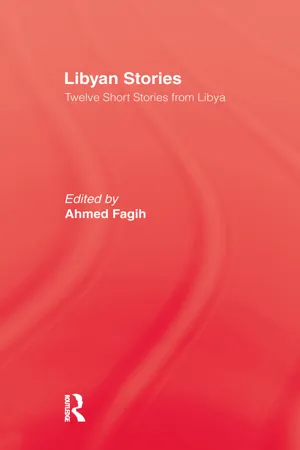
Libyan Stories
About this book
First Published in 2000. This is a collection of twelve short stories from Libya that Fagih edited during the seventies and eighties, initially published in a London magazine called Azure. Penned by prominent Libyan writers, these stories shed light on the human experience of people in the eastern world.
Information
3
An Extract from Mussolini’s Nail
Fara’as was in his shop, rather than seeing il Duce’s procession he wished a car would run over him or the earth would break and engulf him. And during those days of strife he used to get the bulletins and newspapers issue by Balbu’s bureau. He would call his children to come inside the house, and lock the doors and the window shutters.
Then he would spit on il Duce and the ruler’s pictures, tear them up and throw them in the fireplace.
He would then say to his children:
‘This is your enemy. Italy requisitioned our property, it set up nooses, and killed your grandfather and your cousin.’
Fara’as father fell victim in ‘Alhani’ battle, his brothers in that of ‘Al-Sahil’.
Fara’as wound was so deep it could not be healed. He would tell his sons, with tears welling up in his eyes, that the ritual of spitting on and burning of the pictures should be a secret, and that nothing of what he said at home should go outside the confines of the house.
One day his younger son came home to tell him about the latest song they had learned in school:
‘Rome, we shall be faithful to you.’ Impulsively he gave his son a smack, then, to make up for this cruel gesture he hurried to hug him, wipe away his tears and apologise:
‘My son, the Italians are our enemies, they killed your grandfather and with their bullets they wiped out your cousins.’
The son then memorised the original ballad of the strugglers with the encouragement of his father who eventually asked him to keep it for himself and not to sing it in public.
Fara’as then went to the doctor to ask him to give his son permission to stay home for medical reasons. This way his son would not take part in the procession celebrating the arrival of il Duce, along with thousands of other poor youngsters.
He was in his shop again, thinking how days run fast, as fast as snakes, the day il Duce is due to arrive is unbelievably near, a nightmare was depressing his heart.
Many times he thought of emigration, to follow in the steps of thousands of his own desert people. They managed to leave just before the Italians gained control of the borders. But what about his wife and children? Must he run away and leave them behind?
Many years of his life he spent in jail. Bitter and torturous years they were and when he was at last set free, he found that the Italians had expropriated his property and his means of livelihood.
He then decided to start afresh by making Arabic horse-saddles, but it was not all sweet and honey; he had his share of wretchedness and misery.
Fara’as was an artist who lavished all his skills on making elegant Arabic horse-saddles. He chose the best of leathers and thongs, and on a shelf in the shop he kept the saddle most dear to him. It was the saddle on which his father fought the jihad, a bullet-hole around which were dry spatters of glorious blood still there to remind him of the dear past.
The story of the saddle is folded deep in his heart. He recounts it only to the best of friends, and Fara’as used to look at it every day, sometimes daring to touch it gently, silently.
His sons he thought, when they grow up should go and live in another Arab country, to breathe air uncontaminated by the Fascists, their heavy boots and their hunting dogs.
He mastered making saddles and decorating them, through experience and by previously attending the Islamic Arts and Handiwork’s School. The saddles he loved to make, thinking of horsemen, those struggling desert-dwellers and their battles.
Unfortunately they are no more to be found.
The jihad battles were the end of them; their spring of chivalry and heroism is over. Instead it was the Fascists’ turn to admire his masterful elegant craftsmanship and artistic accomplishment.
Things turned sour, for he bitterly resented those Italians coming to his shop to admire his ornamented and perfect art.
But he had to accept selling saddles to them. Survival was at stake. Dark memories haunted him, and the only outlet of light and hope was a graceful sheikh who lectured in a mosque. Most of the evenings he went to the mosque to sit by and listen to what the glorious sheikh said. He was sweet-tongued, his clear eyes showed intelligence, his voice was mild and affectionate.
Sometimes, the sheikh would come to the shop, take a small seat in front of the shop. When the two felt there was no eye watching or ear eavesdropping they gave speech to their thoughts.
‘When shall their end come, the dark night is getting longer and longer.’
The sheikh would reply in his faithful and bright voice, a voice that was not allowed to be slackened by the years:
‘Their end will be the worst of all ends.’
‘They want to take Egypt and Tunisia as well.’
‘When shall the nightmare be over?’
Calmly the sheikh replied:
‘God gives time, but does not completely forget wrongdoers. The fate of il Duce and his followers of hunting dogs will be the worst of all.’
Fara’as then looked at the road and added:
‘Darkness is getting longer and heavier. My sons and the sons of my sons will have to grow up under the regime of the Fascist. What kind of life imposed by fate is this life?’
The sheikh replied:
‘God is all mercy and justice, states and empires flourished and then perished. Remember the Spaniards, the Vandals, the Maltese, and the despotic Walis. Remember that Tripoli has wiped out all of them. The martyrs’ blood will not be wasted.’
Fara’as would then fall silent, at least he felt more content as long as there was a shimmer of light – the light of faith coming in from the window. But it was not long before he said:
‘I wish to live just one day in which I would witness the enemy broken and his eviction from the country.’
‘Trust in God,’ the sheikh replied.
‘II Duce’s faith will be the worst of all fates. The end of every traitor will be telling in its consequences. Darkness will lead to light, my son.’
Fara’as was bewildered. At the doorstep of his shop stood one of those gloomy faces he so much hated and never wished to see; it was the face of one of those detectives, who through hypocrisy, managed to be included in Balbu’s and Badilo’s entourage. He went to Rome several times and accompanied il Duce’s procession, licking the tyrants’ shoes.
Fara’as had always tried to stop his eyes from meeting those detective’s eyes. But here he was, right in front of his shop, walking slowly and brandishing his coloured and ornamented whip, wearing his Roman hat; the renegade speaks Arabic, but he showed off his Italian which he speaks with many flaws and an accent. Seeing him standing there made Fara’as pray in silence.
He then entered the shop and saluted Fara’as coldly through the nose.
Fara’as could not help noticing that his mouth was like the seat of a dog ridden with scabies. The detective then took his time contemplating some of the crafts on display.
He then pointed to one of the saddles and asked:
‘Is this one of your making?’
The answer was as brief as possible.
‘Yes.’
The answer was obviously not to the liking of the detective; he felt outraged by this workman, who showed no hospitality or respect. What is this dry and dull behaviour, the dull detective thought. He then put up his head, the same head he keeps low when he meets his master and said:
‘Are you Fara’as?’
‘Yes.’
‘I thought I knew you. We have a file in the name of your father. He was one of the strugglers. He was an Arab who stood against Italians. Is that not true?’
These words sent a shiver down Fara’as’ spine. He saw immediately in his mind’s eye his children, then the noose and the jail. Are the Italians still after him? Was it not enough for them that they had already put him in jail and requisitioned his property? But he managed to keep his composure. Heavy moments of silence before the detective added:
‘It seems to me that you are still lucky. A golden chance is ahead for you … ‘
Fara’as was impatiently waiting with the bodkin in his hand ready to pierce the bloodshot eyes of this idiot.
Again he managed to control himself.
‘You know that il Duce is going to visit Libya.’
Fara’as was recommended to do the saddle for il Duce’s horse. His Excellency the Wali was to present il Duce with the saddle. And Fara’as the best maker of Arabic saddles was chosen for the honour. You should rejoice then Fara’as, everybody is happy. But Fara’as could not bring himself to say anything, a whirlwind was storming in his head.
‘You are lucky, Fara’as,’ the detective said, ‘the present will be made by your own hands. It is a great honour for you.’
He looked at the chameleon-faced detective. Should he spit on him, thus letting off some steam from his boiling chest? His heart- beat quickened as he tried with difficulty to keep himself under control. When shall this nightmare end?
The detective then looked around the shop’s walls and asked:
‘Where is il Duce’s picture? Why do you not hang up il Duce’s picture?’
The detective seemed to have discovered the noose-rope by which he will hang Fara’as. He shouted and shouted again:
‘How come that you do not put up il Duce’s picture – il Duce, the leader and the hero of Rome?’
At this point, Fara’as broke his silence, always afraid that his tongue might wrongly translate his inner feelings. He squeezed his hands, looked at the detective and said:
‘Every night we celebrate il Duce’s picture at home. His picture and that of God are in our heart… ‘
Luckily the detective did not know how they celebrated il Duce’s picture at home. It is one of God’s blessings that the detective did not know. ‘Yes, il Duce’s picture is in our heart, but it is grooved with hate, and anger.’ Fara’as was thinking to himself, ‘a picture the strugglers and freedom-fighters will not leave in peace.’
The detective thought that Fara’as’ answer was no different from the answers given by the mercenaries and the dupes. He was pleased and nodded his empty head. Meanwhile, Fara’as wished the earth would engulf him rather than leave him alive to witness such an encounter with a person, asking him to make with his own fingers a saddle for a Fascist and a butcher.
The detective then continued:
‘You are lucky Fara’as, you have a golden chance.’
He wanted to evade the issue, to run away, but how?
He brooded a while, then an idea came to him:
‘Your Excellency might not know that I suffer from some paralysis in my fingers. I cannot, really, do stitching or embroidery.’
‘You make me wonder who did all these beautifully ornamented saddles. Everybody is talking about you, the country over, and how come you open the shop day and night if you have paralysis? You must have a grudge in your heart; you still have in you some Arab blood, just like those groups who fled to Tunis and Egypt.’
Fara’as then picked himself up and interrupted the spate of contemptuous words.
‘My fingers cannot make a great and beautiful saddle worthy of il Duce, the leader of Italy.’
The detective was not pleased:
‘O gracious God, how come that you cannot? The celebrations committee have chosen you for this grand mission. You might not know that even His Highness the Wali and the general registrar have a good mention of your saddles – admired your crafts very much and they were very well received everywhere they were exhibited, in Rome, Milan and Paris. How can you reject an honour bestowed on you? It seems to me that you are still a block-headed Arab.’
Fara’as replied:
‘Look, my fingers are trembling from some months now. I just sell saddles now; I am not making any. Moreover, I am looking for somebody to help me and here you come asking me to make a saddle for il Duce.’
At this point the detective’s tone of speech took on a threatening accent:
‘No excuses whatsoever! This is an order and we will come back tomorr...
Table of contents
- Cover
- Title Page
- Copyright
- Contents
- Background Notes on Modern Libyan Literature
- The Oil and the Dates
- Crying
- An Extract from Mussolini’s Nail
- Screams in our Village
- Dignity
- Come Let Me Whisper in Your Ear
- The Road
- She and the Dogs
- Signatures on Flesh
- The Choice
- The Mission
- The Last Station
Trusted by 375,005 students
Access to over 1.5 million titles for a fair monthly price.
Study more efficiently using our study tools.
Frequently asked questions
Yes, you can cancel anytime from the Subscription tab in your account settings on the Perlego website. Your subscription will stay active until the end of your current billing period. Learn how to cancel your subscription
No, books cannot be downloaded as external files, such as PDFs, for use outside of Perlego. However, you can download books within the Perlego app for offline reading on mobile or tablet. Learn how to download books offline
Perlego offers two plans: Essential and Complete
- Essential is ideal for learners and professionals who enjoy exploring a wide range of subjects. Access the Essential Library with 800,000+ trusted titles and best-sellers across business, personal growth, and the humanities. Includes unlimited reading time and Standard Read Aloud voice.
- Complete: Perfect for advanced learners and researchers needing full, unrestricted access. Unlock 1.5M+ books across hundreds of subjects, including academic and specialized titles. The Complete Plan also includes advanced features like Premium Read Aloud and Research Assistant.
We are an online textbook subscription service, where you can get access to an entire online library for less than the price of a single book per month. With over 1.5 million books across 990+ topics, we’ve got you covered! Learn about our mission
Look out for the read-aloud symbol on your next book to see if you can listen to it. The read-aloud tool reads text aloud for you, highlighting the text as it is being read. You can pause it, speed it up and slow it down. Learn more about Read Aloud
Yes! You can use the Perlego app on both iOS and Android devices to read anytime, anywhere — even offline. Perfect for commutes or when you’re on the go.
Please note we cannot support devices running on iOS 13 and Android 7 or earlier. Learn more about using the app
Please note we cannot support devices running on iOS 13 and Android 7 or earlier. Learn more about using the app
Yes, you can access Libyan Stories by Ahmed Fagih,Fagih in PDF and/or ePUB format, as well as other popular books in Social Sciences & Anthropology. We have over 1.5 million books available in our catalogue for you to explore.