eBook - ePub
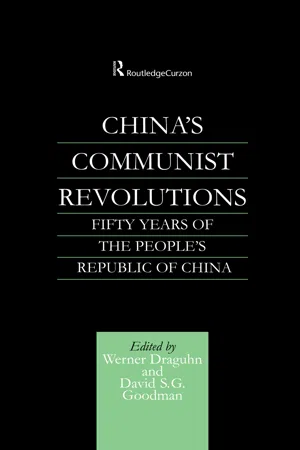
China's Communist Revolutions
Fifty Years of The People's Republic of China
- 288 pages
- English
- ePUB (mobile friendly)
- Available on iOS & Android
eBook - ePub
China's Communist Revolutions
Fifty Years of The People's Republic of China
About this book
During its fifty years of existence the People's Republic of China has seen dramatic changes, from the proclamation of the independent state through the period of the Communist Revolution, the Cultural Revolution, the Reform Period. These changes are analysed from the political, economic and social points of view, chllaenging accepted orthodoxy. Throughout, the emphasis is on change in the context of contemporary China, and as part of the Chinese Communist Party's search for paths to development.
1
Revolution and Economic Life in Republican China: From World War I until 1949
Ramon H. Myers
The collapse of the Qing dynasty in 1911 left a leadership vacuum that was not filled until Mao Zedong announced on October 1, 1949, at Beijing's Tiananmen Square the creation of a Chinese socialist state, thus unifying China. Different ideas for organizing China's political center had competed over this long period. But of all these competing ideas, only Mao Zedong's ‘thought’ successfully convinced a majority of Chinese elites that a CCP-led revolution could remove the grand obstacles – feudalism, capitalism, and imperialism – preventing China from building that ‘great commonwealth of harmony, virtue, and prosperity’, the datong. The power of ideas, particularly those of Mao, inspired enough Chinese from all backgrounds to participate in the revolution led by the Chinese Communist Party (CCP).
But ideas were not enough for this revolution to succeed. There had to be new policies and organizations that altered China's economic life to persuade the Chinese people to join that revolution and unify China under a new system of governance and way of economic life. How did China's economic life between World War I and the end of the civil war interact with revolution?
China's Three Economies
A society's economic life can be understood by examining how three types of economies have competed and coexisted with each other until modern times.1 Space does not allow a detailed account of China's economic history to describe these interactions. It is only important to mention their characteristics to better understand how they reflected economic life during the Republican era (1911–49). First, China's customary economy had always exceeded in size and activity two other economies, the command and market economies. In the customary economy, households exchanged resources and produced goods and services for direct household consumption. They typically did this without reference to the market-determined values of exchange of the market economy. In effect, custom or habit dictated family or lineage households, as well as village exchanges, which consisted of oral or written agreements-contracts, if you will. Because 90–95 per cent of China's population lived in rural communities and small towns, the majority of these people spent much of their daily economic life exchanging resources with each other for organizing the production of goods and services consumed within the household, village, or market town.
This customary economy merged with a market economy, where organizations produced goods and services for a profit. China's market economy had always expanded and contracted, yet inexorably growing with different scale and activities. By the eighteenth century, and perhaps for the first time, a national market economy distributed the empire's rice, cotton, silk, tea, etc. Some scholars have conceptualized this market economy as being ‘reticular.’2 That is to say, instead of firms organizing complex, large-scale economic activity in multiple markets like the ‘plexus’ market economy in premodern Western Europe and Tokugawa Japan, the Chinese reticular market economy was made up of family-organized organizations operating on a small scale, having few if any differentiated activities, not integrating with other market activities, and having brokers connect sellers to buyers. In China, the reticular market economy was more advanced in the three large core areas of the northern, east-central, and southeastern coastal provinces than in the interior, developing provinces.
Finally, there was the command economy administered by a political center and its bureaucracy, which extracted tax revenue, labor services, and resources at prices that bore no resemblance to market exchange prices. Various kinds of state bureaucracies had experimented with land tax systems, monopolies, and the taxing of the huge maritime industry. In the early Ming period, the command economy was unusually large and mobilized corvée labor, collected grain tribute, and operated a large salt monopoly. In early Qing, the command economy at first relied on corvée labor but later gave up that practice and downsized to extracting activities by tax farming.
As population grew and people migrated to the hinterland or abroad during the eighteenth century, the customary and market economies expanded in scale and activity. Their expansion slowed in the second quarter of the nineteenth century when severe deflation began enveloping many regions. A massive outflow of silver to countries like India and Europe caused the decline in commodity and service prices.
This price deflation devastated the market economy because it reduced household income, caused enormous unemployment, increased rents and taxes, and made for an acute sense of uncertainty. Markets did not clear, and their number declined, causing a national market failure. By the 1850s, rebellions swept across China and further reduced the quality of economic life.
From 1840 until 1911, when the Qing dynasty collapsed, the unequal treaties imposed by the foreign powers brought foreign investment and new trade to the port cities along the coast and the Yangtze River. These foreign funds, along with Chinese merchant wealth, financed a small-scale manufacturing and services sector to take off in this market economy. Along with railroads and Western-style ships, a new transportation system began, connecting the coastal provinces to the world economy and transforming China's market economy. New businesses engaged in flour milling, food processing, weaving cloth with imported, machine-made yarn, match making, indigo processing, and much more. These new activities upgraded the handicraft industry and commercialized the village customary economy.
More research will elucidate the impact of this new market economy on the customary economy. But this much can be conjectured: Where commercialization prospered, lineages and customary society very likely flourished, but not always, particularly if lineages sold their common land and property to commercial developers when commercial agriculture and handicraft, long the source of rural prosperity, were in decline. Whatever the complex outcomes between the new market economy and the entrenched customary economy, China's revolution began altering China's economic life after World War I.
Economic Life between World War I and the Conclusion of the Civil War
The traditional view of China's economic development during the interwar years is that the production of goods and services on a per capita basis rose by less than 10 per cent, thus, for all practical purposes, nearly stagnating.3 Agriculture contributed around 60 per cent to the nation's output and supported roughly 80 per cent of the population. China had traditionally produced enough foodgrain to feed itself, but now, when harvests failed, foodgrains had to be imported. Services and manufacturing, in this view, each contributed roughly 20 per cent of China's gross domestic product in 1933, with the traditional, labor-intensive organizations making up these two sectors contributing not only a larger share of value-added output but employing more labor than the modern sector. Although the small modern sector described above had expanded during and after World War I, it still contributed only a small share of gross domestic product. Most of China's population, which totaled nearly a half billion people by the mid-1930s, still farmed and had not experienced a modern seed/fertilizer revolution. This was the conventional view of how China's economy developed in the first three decades of the twentieth century.
In 1989 Thomas G. Rawski challenged this view (see Table 1.1). He provided new estimates of a higher growth of output per person for the interwar period. Rawski argued that traditional handicrafts and services grew more vigorously than believed and that agricultural output also had expanded more rapidly than population. He concluded that real per capita output grew by 22–24 per cent. His findings implied an annual rate of per capita growth of 1 per cent, a rate nearly comparable to Japan's annual growth rate of 1.3 per cent between 1917 and 1930. Two new developments tend to support Rawski's findings, and other studies appearing in recent years tend to validate Rawski's work.
Table 1.1: Estimates of mainland China's economic growth for select years, 1914/18–1952 (1914/18 = 100)

Source: Thomas G. Rawski, Economic Growth in Prewar China (Berkeley: University of California Press, 1989), p. 336.
First, the spread of commercialization by an expanding market economy made it possible for households to engage in greater specialization of production for industrial and food crops. That development in turn increased the returns to labor, thus contributing to the rise of labor productivity in agriculture. Second, there occurred a gradual spread of new technology and equipment into those areas surrounding the modernizing port cities, especially the three core areas of the coastal provinces, which helped to raise labor productivity in farming and handicraft. Loren Brandt, for example, concludes that ‘by the 1930s, more than 40 per cent of all farm households in Central and East China were using commercial fertilizers’.4
Although Rawski only estimated rates of growth for the robust economic activities for which he could find data, other research findings suggest that farm output grew more rapidly than population. Loren Brandt's estimates for agricultural output in central and east China between 1870 and 1937 suggest an annual increase of ‘more than two times the estimated rate of population growth of 0.6 per cent per annum, only modestly below the rates of output growth achieved in Japanese agriculture over the same period’.5 David Faure's study of Jiangsu and Guangdong provinces between 1870 and 1937 suggests that agricultural commercialization intensified in these provincial economies, positively altered tenant and landlord relations to increase land and labor productivity, and probably increased per capita output in agriculture over the period.6 Ramon H. Myers’ study of Hebei and Shandong provinces from 1890 to 1937 argues that an expanding commercialized agriculture enabled farming communities to have a stable per capita income and supply a larger market surplus to the urban sector, which then produced more goods and services for the domestic market and international economy.7
As China's market economy rapidly grew during the interwar period, a small subsector of that process I will call the ‘modern market economy’ also began to take off. By modern market economy I am referring to the small cluster of enterprises that operated modern factories, service companies, and transport while using electricity as power and applying modern science and technology to produce for a mass market. This subsector, always small during the period under discussion, declined after 1937.
By 1937, new forms of a command economy had emerged in the east-central region controlled by the Nationalist government, led by the Guomindang (GMD), and in the border areas of Shaanxi, Ningxia, and Gansu provinces governed by the CCP. The GMD established large bureaucracies to promote industrialization, whereas the CCP experimented with cooperatives to increase cultivated land and crop yields.
The Sino-Japanese war, which began on July 7, 1937, further altered the relationships between these three types of economies and radically changed economic life. The most important change was the decline in production of goods and services and per capita consumption. The war destroyed bridges, roads, harbors, mills, and factories and reduced market activity between the coastal cities and their marketing areas. Foreign trade declined, and inflation erupted.
In 1940, the market economy further fragmented because China now had three different political regimes: the Nationalist government, which controlled Sichuan and the southwest provinces; the CCP, which controlled the base areas in Northwest and North China; and the Japanese military and various collaborationist forces, which controlled the main coastal cities, their environs, and sections of the lower Yangtze River. Although these political authorities tried to revive markets, their appetites for war caused severe commodity, food, and raw material shortages.
According to Table 1.1, output sharply declined during 1937–1940, when Nationalist forces abandoned Wuhan, moved to the southwest region, and made Chungking the capital of Free China. The Nationalist, Communist, Japanese, and collaborationist authorities began controlling different territories of China, and China was no longer unified under the Nanjing regime. Each of these regimes tried to revive production and market exchange, aided by a lull in the military conflict. The 5–6 per cent decline in the production of goods and services and per capita consumption does not seem unreasonable, and households adjusted accordingly by devoting more resources to the customary and command economies.
When the war ended on August 15, 1945, the Nationalist government and the majority of the Chinese people believed that economic recovery would soon commence. The fall harvest improved, domestic trade increased, and consumer spending rose. By the spring of 1946, the population realized that the enlarged civil war would not be settled soon. Reactions to this realization were the following: Commodity hoarding increased, labor strikes ballooned, and student demonstrations broke out. As the civil war disrupted domestic trade, the large cities in the northeast and north had to import food and raw materials from within China or abroad in order to survive.
The large-scale fighting in North and Northeast China separated the northern and southern regional market economies. Prices of food and industrial materials were hi...
Table of contents
- Front Cover
- Half Title
- Title Page
- Copyright
- Contents
- Preface
- 1 Revolution and Economic Life in Republican China: From World War I until 1949
- 2 Collapse of the Old Order, Germination of the New: Chinese Society during the Civil War, 1945–1949
- 3 The Politics of the Civil War: Party Rule, Territorial Administration and Constitutional Government
- 4 The Political Economy of Socialist Transition: Restructuring Inequality
- 5 China in the Wake of the Communist Revolution: Social Transformations, 1949–1966
- 6 The Cultural Revolution as an Economic Phenomenon
- 7 Was the Cultural Revolution Really Necessary?
- 8 Economic Growth and Distributive Justice in the Post-Mao Reform Period
- 9 China's Foreign Relations, 1978–1999: Unleashed, the Tiger Feels Lonely
- 10 Centre and Periphery after Twenty Years of Reform: Redefining the Chinese Polity
- List of Contributors
Trusted by 375,005 students
Access to over 1.5 million titles for a fair monthly price.
Study more efficiently using our study tools.
Frequently asked questions
Yes, you can cancel anytime from the Subscription tab in your account settings on the Perlego website. Your subscription will stay active until the end of your current billing period. Learn how to cancel your subscription
No, books cannot be downloaded as external files, such as PDFs, for use outside of Perlego. However, you can download books within the Perlego app for offline reading on mobile or tablet. Learn how to download books offline
Perlego offers two plans: Essential and Complete
- Essential is ideal for learners and professionals who enjoy exploring a wide range of subjects. Access the Essential Library with 800,000+ trusted titles and best-sellers across business, personal growth, and the humanities. Includes unlimited reading time and Standard Read Aloud voice.
- Complete: Perfect for advanced learners and researchers needing full, unrestricted access. Unlock 1.5M+ books across hundreds of subjects, including academic and specialized titles. The Complete Plan also includes advanced features like Premium Read Aloud and Research Assistant.
We are an online textbook subscription service, where you can get access to an entire online library for less than the price of a single book per month. With over 1.5 million books across 990+ topics, we’ve got you covered! Learn about our mission
Look out for the read-aloud symbol on your next book to see if you can listen to it. The read-aloud tool reads text aloud for you, highlighting the text as it is being read. You can pause it, speed it up and slow it down. Learn more about Read Aloud
Yes! You can use the Perlego app on both iOS and Android devices to read anytime, anywhere — even offline. Perfect for commutes or when you’re on the go.
Please note we cannot support devices running on iOS 13 and Android 7 or earlier. Learn more about using the app
Please note we cannot support devices running on iOS 13 and Android 7 or earlier. Learn more about using the app
Yes, you can access China's Communist Revolutions by Werner Draguhn,David S.G. Goodman in PDF and/or ePUB format, as well as other popular books in History & Chinese History. We have over 1.5 million books available in our catalogue for you to explore.