- 248 pages
- English
- ePUB (mobile friendly)
- Available on iOS & Android
eBook - ePub
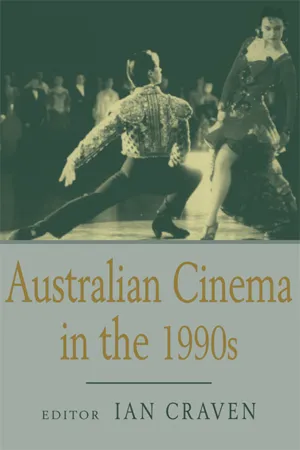
Australian Cinema in the 1990s
About this book
This study is a collection of critical and scholarly analyses of the organisation of the Australian Film Industry since 1990. Particular emphasis is put on globalisation, authorship, national narrative and film aesthetics.
1
Australian Cinema Towards the Millennium
IAN CRAVEN
The history of the ‘new’ Australian Cinema's revival since the 1970s often now feels like a relatively settled one. A range of studies chart the political cultures which talked the ‘renaissance’ into being, the institutional frameworks which guided production or formulated policy,1 and survey the eventual output of a growing number of state-backed and independent producers.2 Significant contributions, of course, to the revision of the critical literatures continue to be made, recognising shifts of commercial and aesthetic direction in the 1980s, and locating the various ‘hidden’ histories overlooked in the critical project of constructing a ‘national’ Australian cinema.3 Such work on the mainstream cinema has triggered research on more neglected areas such as the non-fiction film, the short film, and the experimental and avant-garde sectors. Scholarship across the board has helped stimulate a conspicuous intensification, since the 1980s, of attention to Australian television.4
The essays collected in this volume seek to extend this work with reference to the 1990s, by offering a series of overlapping but distinct perspectives on Australian cinema of the past decade, and sketching possible directions for its development beyond the coming Millennium. Attention is given to cinema at every stage of its movement from conception to consumption, and close readings of particular movies, or clusters of movies, are balanced by more contextual work on issues of industry, policy, criticism and reception. Taken together, the essays suggest something of the remarkable diversity of the feature output since 1990, and the challenges that this body of film poses to the critical and theoretical paradigms through which the work of Australian filmmakers has come to be understood both within and without the academy.
The sequencing of contributions aims to suggest the outlines of residual and emergent trends, and to clarify recurrent themes in the output. If the cinema of the 1970s has come to be understood broadly in terms of a national ‘project’ driven by intellectualist-managerialist impulses, and underwritten by a regime of formal regulation and public subsidy,5 and the 1980s has been characterised as an era of de-regulation, encroachment by the market, and a new commercialism aesthetics,6 the 1990s might well be viewed as a period marked by re-regulation at the levels of both text and context, and by structures and discourses fusing nostalgia for the heady days of the nationalist ‘renaissance’ with a futuristic open-ness to the possibilities of the global. Both impulses of course have their counter-tendencies; one need not look far through Australian cinema of the 1990s to identify evidences of scepticism around the once-confident articulation of cultural nationalism with political progressiveness, and of millennial anxiety generating more than a fair share of suitably apocalyptic narratives.
The conflicting trends are contextualised initially here by scrutiny of the film industry's performance and structure, which reveals dramatic shifts in fortune, and almost constantly changing patterns of ownership and control. The picture in terms of policy-making and implementation is equally dynamic. No national film industry on earth seems to have been subject to more constant surveillance, re-definition and re-direction than the Australian; reconstructions of the government film's instrumentality following consultancy reports, position papers and counter-manifestos became almost seasonal at times during the 1990s, and instabilities at these discursive levels played a crucial role in delineating the product eventually reaching movie theatres. Lisa French provides an informative account of the production sector since 1990, with reference to the key policy documents generated, the responses of filmmakers and financiers, and the performance of the industry which they helped to shape. As the hard statistical data indicates, Australian feature-filmmaking remained a fragile enterprise in the 1990s, and the conspicuousness of a small number of films at the international box office often concealed a production sector struggling to find a secure route through distribution to reach audiences still demonstrating a consumer preference for imported, usually American, movies.7 The few ‘breakthrough’ pictures of the decade, around which the history of the Australian cinema seems certain to be extended, efface numerous other works whose significance awaits assessment.8
The picture of the industry in the 1990s which French delineates does much to explain the unevenness of the output, which often seems to exhibit little consistency beyond its insistence upon the idiosyncratic, despite sporadic critical attempts to detect a unifying sensibility, preoccupation or aesthetic.9 Tom O'Regan however provides a useful starting-point for understanding this manifest diversity, when he suggests that: The history of Australian film is largely a history of the combinations of possible projects, and an indication of which of these are ascendant’, and remarks that the conditions generating these ‘combinations’ include:
the nature of state support offered, the policy framework for delivering it, the extent to which talented film workers concentrate in an area, the international opportunities available in commercial and critical terms through working in a film form, and the critical celebration of this or that film-making.10
In their various ways, the essays included here work to track such ‘combinations’, often in very localised contexts, and to indicate the relationship between such conjunctural forces and a wider socio-political culture unifiable at other levels.
Late-National Cinema?
By the late 1980s, a number of commentators were already speculating about the disintegration of the ‘project’ which had driven both national-cultural revivalism and national-commercial entrepreneurialism since the 1970s.11 In their essay here on ‘The Heterosexual Dynamic’, Nigel Spence and Leah McGirr track some of the thematic shifts which have accompanied this re-definition of Australian filmmaking, and focus in particular on the rise of a personal-relations cinema occupying a somewhat marginal space in the earlier output. As the emblematic landscapes of the 1970s and 1980s have given way to the more banal locales of the 1990s, the authors see the preoccupations of Australian narratives contracting towards a closer concern with inter-personal, especially inter-gender relations. Both a recognition of absence in the earlier output, and a desire to match the narrative standards of the international marketplace are seen as triggering the ‘turn’ in the 1980s, which develops and becomes more complicated in the 1990s. Starting with higher-profile movies such as The Year My Voice Broke (1987), the impulse is seen as finding expression in later works such as The Last Days of Chez Nous (1992), The Sum of Us (1994), Love Serenade (1995) and many others. The significance of the analysis in this context is that it begins to chart a fresh history of Australian cinema in terms of genres, and more specifically, views an exploration of the heterosexual dynamic as cutting across the more teleological trajectories of the rites-of-passage sub-texts which have so often underpinned the exploration of character in Australian cinema, to encourage new structures, styles and definitions of Australian filmmaking. This unhinging of self-formation from national-formation is explored across a range of exemplary movies which chart wider movements from ‘realist’ to ‘generic’ filmmaking apparent in the 1990s output. If Spence and McGirr reach fairly pessimistic conclusions about the possibilities for creative relations between the sexes suggested by Australian cinema in the 1990s (‘a relationship's deterioration [is] regarded as some kind of grim inevitability’), they also chart some fundamentally different preoccupations for a ‘late’ national cinema.
Creativity stands at the very centre of the works examined by Liz Ferrier in her essay on ‘Vulnerable Bodies’. Noting the conspicuousness within the output of movies such as Proof (1991), Bad Boy Bubby (1994), and Shine (1995), centred on embattled artists or performers struggling for recognition and excellence, Ferrier develops an analysis of such films in relation to Australian cultural traditions, which offers a suggestive commentary on contemporary economic conditions. Her study stresses the protagonists’ progression from isolation to recognition, and notes the generative axis constructed within the films between elements of the dysfunctional within the family, and their protagonists’ subsequent creativity and acceptance. Understood in these terms, the films offer little resistance to a reading as discourses on Australian cinema's own imaginary, and are readily distilled as promises of reconciliation between industrial and aesthetic imperatives largely antagonistic in the 1980s. Ferrier's essay however re-locates such contradictions on new ground, and its attention to the body as a site of discursive conflict re-introduces a discussion of performance in Australian cinema often neglected by a concern with narrative structure and visual style shown in the recent scholarship. Most of the films under analysis here function as enabling contexts for virtuoso performances, narratively motivated as eccentricity, disability, or less specific indexes of a de-stabilising personal history, but also suggesting, amongst other things, a continuing intimacy between Australian cinema and theatrical traditions that has received surprisingly little attention within accounts of Australian movie-making.12 Ferrier's attention to these performances is suggestive of the issues embedded within them, and of their sophisticated transcodings of socio-cultural concerns with market viability into discourses of aestheticism and creativity. Clearly her analysis of the faux-naive innocence seen as preoccupying Australian narrative in the 1990s, could be extended to incorporate a number of other movies not touched upon here, such as Stan and George's New Life (1992), Hotel Sorrento (1994) and Mr Reliable (1996).
Ferrier's characterisation of the ‘soft’ male body within 1990s cinema is clearly suggestive of profound re-definitions of male identity taking place in the output under consideration here. The stigmatisation of the male protagonist which she notes in Proof and Shine is also a common motif in the films examined by Philip Butterss’ essay on constructions of masculinity in recent Australian cinema, where it is linked expressly to a diminishing ‘will to power’ associated with shifts characteristic of a post-industrial and post-feminist society. What is striking about his analyses of The Big Steal (1990), Death in Brunswick (1991), Strictly Ballroom (1992) and The Heartbreak Kid (1993), is their revelation of the movies’ residual commitment to highly-mythologised gender definitions, alongside a tangible awareness of the social inter-texts which may compromise the effectivity of their representational preferences for actual cinema-goers. Butterss reveals suggestively the various ways in which the films work (via ludicrous comedy, an appeal to generic convention, narrative ‘sleights of hand’, or even an insistence on the very exceptionalism of their representations) to resolve these contradictions, and the aesthetic effects of such transcodings between the social and the textual. In the process the essay underlines the centrality of the oedipal trajectory noted elsewhere,13 which unifies their narratives, and indeed the more specific project of ‘re-masculinisation’ they develop in response to contemporary crises in gender identifies and roles. The framing of ‘mateship’ as a developmental stage necessarily renounced en route to adulthood perhaps suggests more specifically Australian ‘accents’ within narratives with clear counterparts in both British and American cinema of the same decade.14
Post-National Cinema?
Consensus seemed to exist amongst commentators on Australian cinema by the mid-1990s that even the residual elements of 1970s cultural nationalism had now finally dissolved. Charting a history of policy discourse which increasingly refuses to recognise the national as a basis for defence of the industry, or offer a justification for the subsidy of cultural-nationalist fiction-building, a growing body of writing constructed Australian cinema as distinctly post-national. Noting a tendency at more representational levels to address experience of the local or regional, rather than the national, this work suggested new divisions within constituencies once united in their polemic for national cinema. Some regretted the apparent dismissal of the national as a category and argued for its retention on the basis of its potential inclusiveness,15 others welcomed the dissolution of the category, as heralding a new pluralism, in keeping with the increasingly diverse composition of Australian society, traditionally unrecognised by a national tradition overly concerned with the fabrication of a metonymic Australian masculinity, an ethnic and racial exclusiveness, and an account of progressive politics limited by the assumptions around radicalism as authenticity.16
Anxieties about the serviceability of the national category are explored by essays here which examine the narrativisation of Australian anxieties at a variety of often overlapping levels. One of the most problematical connections established for example, almost incidentally, in Butterss’ essay is that between gender and ethnic identity made in movies such as Death in Brunswick or The Heartbreak Kid, which attribute particularly traditional definitions of masculinity to Hispano- and Graeco-Australian males, respectively. Patriarchal authority and sexual machismo often find their fullest embodiment in non-Anglo-Celtic characters on the Australian cinema screen. Whilst the tendency to conflate such definitions of ethnic and gender ‘authenticity’ is apparent on a wider scale across the 1990s output as a whole (‘new’ Australian men are often constructed as ‘preserving’ masculine behavioural conventions either discredited or under severe pressure in the wider culture), the films under specific scrutiny offer a particular distillation of ideological positions, which draws heavily upon their characterisations of ethnicity. Nirvana Street Murder (1991) and Aya (1991) offer just two of many other examinations of this ‘overlapping’ of differences which would repay exploration along these lines. In David Callahan's contribution here, a wider take is made on the cinema's figuring out of ethnic presence, in an essay which foregrounds a number of movies which have received very little critical attention, and triangulates between concerns with Aboriginality, whiteness and new ‘migrant’ ethnicities which rarely find connection.17
Callahan's essay provides a refreshingly functional analysis of ethnic presence in Australian film narrative, concentrating on questions of structural position rather then representational adequacy, and on presence as a an effective and simultaneous experience of activation/concealment, alluding to histories and memories, that maintains a principle of deniability crucial to the ideological management of Australian narratives of the nation in general, but with a particular pertinence to storytelling on film and television.18 Rather than noting again the apparent reluctance the Australian cinema has shown in acknowledging ethnic diversity within the nation, Callahan argues for the necessity of s...
Table of contents
- Front Cover
- Half Title
- Series
- Title Page
- Copyright
- Contents
- 1. Australian Cinema Towards the Millennium
- 2. Patterns of Production and Policy: The Australian Film Industry in the 1990s
- 3. Unhappy Endings: The Heterosexual Dynamic in Australian Film
- 4. Vulnerable Bodies: Creative Disabilities in Contemporary Australian Film
- 5. Becoming a Man in Australian Film in the Early 1990s: The Big Steal, Death in Brunswick, Strictly Ballroom and The Heartbreak Kid
- 6. His Natural Whiteness: Modes of Ethnic Presence and Absence in Some Recent Australian Films
- 7. All Quiet on the Western Front? Suburban Reverberations in Recent Australian Cinema
- 8. Romance and Sensation in The ‘Glitter’ Cycle
- 9. A Pig in Space? Babe and the Problem of Landscape
- 10. The Castle: 1997’s ‘Battlers’ and the Ir/Relevance of the Aesthetic
- 11. Idiot Box: Television, Urban Myths and Ethical Scenarios
- 12. Ernie Dingo: Reconciliation (A Love Story Forged Against the Odds?)
- Australian Cinema in the 1990s: Filmography
- Australian Cinema in the 1990s: A Select Bibliography
- Notes on Contributors
- Index
Trusted by 375,005 students
Access to over 1.5 million titles for a fair monthly price.
Study more efficiently using our study tools.
Frequently asked questions
Yes, you can cancel anytime from the Subscription tab in your account settings on the Perlego website. Your subscription will stay active until the end of your current billing period. Learn how to cancel your subscription
No, books cannot be downloaded as external files, such as PDFs, for use outside of Perlego. However, you can download books within the Perlego app for offline reading on mobile or tablet. Learn how to download books offline
Perlego offers two plans: Essential and Complete
- Essential is ideal for learners and professionals who enjoy exploring a wide range of subjects. Access the Essential Library with 800,000+ trusted titles and best-sellers across business, personal growth, and the humanities. Includes unlimited reading time and Standard Read Aloud voice.
- Complete: Perfect for advanced learners and researchers needing full, unrestricted access. Unlock 1.5M+ books across hundreds of subjects, including academic and specialized titles. The Complete Plan also includes advanced features like Premium Read Aloud and Research Assistant.
We are an online textbook subscription service, where you can get access to an entire online library for less than the price of a single book per month. With over 1.5 million books across 990+ topics, we’ve got you covered! Learn about our mission
Look out for the read-aloud symbol on your next book to see if you can listen to it. The read-aloud tool reads text aloud for you, highlighting the text as it is being read. You can pause it, speed it up and slow it down. Learn more about Read Aloud
Yes! You can use the Perlego app on both iOS and Android devices to read anytime, anywhere — even offline. Perfect for commutes or when you’re on the go.
Please note we cannot support devices running on iOS 13 and Android 7 or earlier. Learn more about using the app
Please note we cannot support devices running on iOS 13 and Android 7 or earlier. Learn more about using the app
Yes, you can access Australian Cinema in the 1990s by Ian Craven in PDF and/or ePUB format, as well as other popular books in History & World History. We have over 1.5 million books available in our catalogue for you to explore.