- 294 pages
- English
- ePUB (mobile friendly)
- Available on iOS & Android
eBook - ePub
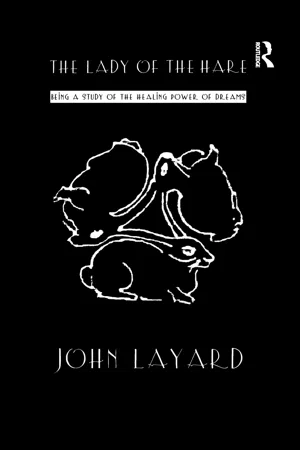
Lady Of The Hare
About this book
This work is the first document, relating to the practice of Jungian psychology, which records in detail the analyst's own past in the practice of analysis as well as the patients. John Layard sought to bring to psychology the illuminating study of all the humanities. This is an extraordinary and fundamental book.
Information
Part One
The Dream Analysis
Introductory
During the summer of 1940 the Vicar of a small village with whom I was acquainted told me of an extremely backward girl of 16,1 and asked whether anything could be done to help her. She was the only daughter of a superior labourer named Wright who had migrated from Northern Ireland to England in order to take up a situation as cowman for a neighbouring farmer. They were, he said, god-fearing people and he would point them out to me in church. At first sight, apart from a habit of holding her head down as if slightly shrunk into her shoulders, the girl appeared out-wardly normal, on the plump side and with ruddy cheeks. If there was anything specially noticeable about her it was per-haps a rather extreme quietness and circumspection, though this was in itself not necessarily out of keeping with the till recently feudal character of the village. The Vicar said, how-ever, that it was indeed but the outward and visible symptom of a nature so retiring that she would speak to no-one but her mother and consequently had no real friends in the village, spending her time doing nothing but odd jobs in and about her parents’ cottage and everlastingly reading any books she could lay hands on.
I said I had no idea whether I could do anything for her, but would, if the Vicar liked, see her mother.
After some time Mrs. Wright came to see me,2 and we had a short talk during which I formed a very good opinion of the simplicity and sincerity of the mother but could gather little information about her daughter Margaret apart from the fact that, when about three years old, she had suffered from convulsions, the origin of which was obscure, that she had left school before her time as she was considered too stupid to learn, and that the only folk she had any interest in outside the imme-diate family circle were old people, for whom she liked doing small services. Otherwise the only additions I could get to the Vicar’s account were that she was a ‘good girl’. though utterly lacking in initiative, combined with his yet further emphasis on her voracious reading. I told Mrs. Wright, as I had told the Vicar, that I had no idea whether anything could be done, but that if the girl liked, and only if she did so, I would see her. Mrs. Wright said that, owing to some obscure physical ailment she had recently taken her daughter as an outpatient to a hos-pital in the neighbouring big town, but that the doctor had been so rude to her because she would not speak that it had up-set her very much and she had retired to bed with a high temperature. I said that, as making contact would in any case be a delicate matter and depended very much on the girl acting from her own free will, I would not arrange to see her till she had recovered from this shock and from the resistance it must have caused to anything she could conceivably regard as ‘treat-ment’, and that it would be better to wait till she was up and about again before any suggestion was made that she should see me.
Next day I happened to see both parents at a village gathering, but as they said nothing about the girl, I did not either. I then had to go away on business for a week, and when I came back the Vicar told me that the parents had on the morning before the village meeting taken her to another hospital where she had been detained ‘for observation’ and kept in bed while her temperature continued to rise and fall. There she stayed for some time not greatly affected one way or another, apart from not liking the strange food—so different from what her mother cooked—while the doctors failed to make any diagnosis what-ever.
Interview with the Daughter, 31st July 1940
Meanwhile I had myself moved into the neighbouring city, whither Mrs. Wright one day brought her daughter, who had now left the hospital, to see me. I had provided tea and coffee and chocolate biscuits so as to produce as homely an atmosphere as possible and, with these as my assistants, asked the mother to leave the daughter alone with me. For an hour I tried every device to amuse or interest the daughter, but failed to produce anything more than a monosyllabic ‘Yes’ or ‘No’, except on a single occasion when, asked what kinds of book she liked reading, she managed to whisper the words ‘Edgar Wallace’. When I inquired what any of the stories were about, dumbness once more enveloped her. She would look back with expressionless eyes, obviously harbouring terror behind an appearance of calm serenity which was the defence she had built up against any approach. Even attempts to make her more comfortable were fruitless. As an example of this, when I suggested that it might be more convenient for her if she put the half-filled cup she had been balancing for the past ten minutes on her immacu-lately clean dress down on to the small table by her side, she indeed put it down, though not to please herself but rather as a gesture of obedience to an imagined authority. Naturally, all this time, all her muscles were tense, but a whole hour failed to relax them. Worst of all, she was not even, on the face of it, confused, so that there was no possibility of putting her at her ease. Nor yet did she once smile, but throughout the whole interview sat like a statue, and even a wide range of pictures of various kinds failed to arouse so much as a twitter of response, either of approval or the reverse. At the end of an hour it was I who was beaten. Nothing seemed to have touched her, and in despair I went out to confess my utter failure to her mother.
1 When subsequently exempted from wartime National Service she was classed as a High Grade Mental Defective.
2 Mrs. Wright was 54 at the time of this interview.
First Interview with the Mother
31st July 1940 (continued)
As it was a beautiful summer’s day, warm and radiant, I had asked the mother to wait outside in the garden. I told her what had happened, saying that I had failed to get anything out of her daughter, and she said, ‘No, Margaret hardly ever speaks to anyone but me’. I was, however, struck by Mrs. Wright’s calmness and lack of any of those dominating qualities that one would normally have presumed in the mother of such a girl. I told her I was sorry I had not been able to achieve anything, saying that if I had a children’s clinic I might set her daughter down in it and try to observe her in that way, but that, not having one, I failed to see what I could do. I did mention, however, that her daughter was evidently in a state of constant terror, and that her automatic and sense-less obedience to any suggestion must cover a resentment that might very well lie at the root of her trouble. Seeking to find out the cause of her terror, I then asked Mrs. Wright whether she knew of anything that had happened during her daughter’s childhood that might have given rise to such a deep and all-pervading inhibition.
This did not at first lead to any response, nor yet did my in-quiries as to whether her daughter had ever had any sexual difficulties. Mrs. Wright said her daughter’s periods were quite regular, and that, except for a little constipation she knew of no physical trouble of that kind.
This did, however, finally stir memories, for, after a long pause, she said, ‘I have never told you about my sister.’ The mother then told me that she was herself formerly a nurse specializing in midwifery, necessitating frequent absences from home, for which reason her elder sister Bertha had had a large share in the baby’s upbringing, and for a considerable period had had the child in her sole charge. Mrs. Wright did not think that Bertha had been cruel to Margaret in any way, but said it was true that her sister was a very disappointed woman, never having married and having thrown over the only suitor she ever had owing to what Mrs. Wright described as ‘false pride’ over some peccadillo he had committed or was said to have com-mitted. This had soured her sister for life, so much so that now, in her old age, none of her relatives would put up with her except Mrs. Wright herself, with whom she was now living, and had lived for many years. Mrs. Wright then described how very difficult she was, ending up by saying, ‘Margaret cannot abide her. She never speaks when she is there, and always goes out of any room her aunt comes into.’ I pointed out that this could not be very good for Margaret, and she then said, ‘No, perhaps it’s not’, and went on to describe the loathing and contempt her sister Bertha had for her daughter, and how she never ceased criticizing her, saying her mother spoilt her and trying to make her do this and that, which made the family atmosphere far from pleasant. Asked how her husband liked it, Mrs. Wright said, ‘He doesn’t, but Bertha has no other home, and he agrees with me in saying we cannot possibly turn her out.’ When I again pointed out that her sister’s influence on Mar-garet might be very much worse than Mrs. Wright realized, she said, ‘Perhaps that is so, but nothing will make me turn her out. I am the only sister who can put up with her, and if I turned her out her death would be on my hands and I could not bear it. Besides, she is my sister, and I couldn’t do that, what-ever happened.’ I saw that, however bad the presence of the aunt might be for Margaret, there was a quality of loyalty and positive staunchness about Mrs. Wright that would be so damaged if she could ever have been persuaded to violate it—which was in itself very doubtful—that it would also injure her attitude towards her own daughter and so defeat its object. Moreover, anyone failing to perceive this would lose her confidence and forfeit the expression of a similar loyalty towards himself. So, in the interest of the very daughter to whose well-being the presence of the aunt was most harmful, it was quite clear that the aunt must stay. For this reason, after making quite clear to Mrs. Wright the probable effect on her daughter and after assuring myself that she was rather more fully aware than be-fore of this aspect of the problem, I wholeheartedly acquiesced, contenting myself only with suggesting that, even allowing for her feelings of staunch loyalty towards her sister, there must be something that we did not at the moment quite understand about Mrs. Wright’s own psychology that caused her to allow her good nature to be trespassed on so much to the detriment of her daughter.
Mrs. Wright, whose intelligence had become more and more apparent during this conversation, quite readily agreed, saying she could not herself make out why, having a husband she loved and having all her days striven to do her best, life should have proved so difficult for her. I said that, if we could find out why this was, we might be able to get at Margaret’s problem through hers, and that, so far as I could see, this was the only way we could. She said, ‘I’d do anything for Margaret. But what can I do?” I told her there was one way, and that was by somehow getting at the unconscious factors that seemed to nullify her own attempts at success. I said that dreams often showed us things about ourselves we did not consciously know, and asked whether she ever dreamt. She said, ‘No, I never dream. Except, of course, when I was pregnant, as all women do.’ I asked her whether she remembered any of the dreams she had had then, and she said, ‘Yes, I once dreamt that my husband had died. It was a terrible dream. How can a woman have a dream like that about a man she loves?’ I asked her whether she would like to have a talk about that some time. She said she would, and it was arranged that she should come next time without Margaret.
Second Interview
3rd August
There had been an unfortunate misunderstanding about the date of the interview, with the result that when Mrs. Wright arrived, I had only half an hour to spare. I was afraid that a first interview under such inauspicious cir-cumstances might be abortive and spoil the whole analysis. As it turned out, however, that half-hour laid the foundation for very rapid progress.
Mrs. Wright lost no time beating about the bush, and opened the conversation directly by telling me that she had once had a vision of an angel. She had told it to her sisters at the time, but they laughed at it so much that she had never mentioned it to anyone again until now. This incident occurred while on a visit to America to look after her brother, during or after which she had first learned the elements of professional nursing. I understood her to say at the time that the incident occurred when she was 14 years old, though in a later interview1 she said she must have been 19.
1. VISION (The Warning Angel)
‘The vision occurred when I was wide awake one evening at dusk, when there appeared to me an angel. The angel looked lovely, the most beautiful thing I had ever seen, and stood with right arm raised above her head, with her forefinger pointing upwards. Her raiment was of dazzling white linen. Her face seemed to be made of light. Her eyes were dark. Behind her head there was a shining golden light.’
Mrs. Wright knew somehow that the vision was a portent of evil. She thought it meant that some loved one had died, and for some time expected to receive letters from home to that effect. No such letters, however, arrived, but shortly afterwards she herself was almost killed by being run over by a tram, though by G...
Table of contents
- Cover
- Half Title
- Title Page
- Copyright
- Contents
- Introduction
- Part One: The Dream Analysis
- Part Two: The Mythology of the Hare
- Part Three: More Dreams about Hares and Rabbits
- Index
Trusted by 375,005 students
Access to over 1.5 million titles for a fair monthly price.
Study more efficiently using our study tools.
Frequently asked questions
Yes, you can cancel anytime from the Subscription tab in your account settings on the Perlego website. Your subscription will stay active until the end of your current billing period. Learn how to cancel your subscription
No, books cannot be downloaded as external files, such as PDFs, for use outside of Perlego. However, you can download books within the Perlego app for offline reading on mobile or tablet. Learn how to download books offline
Perlego offers two plans: Essential and Complete
- Essential is ideal for learners and professionals who enjoy exploring a wide range of subjects. Access the Essential Library with 800,000+ trusted titles and best-sellers across business, personal growth, and the humanities. Includes unlimited reading time and Standard Read Aloud voice.
- Complete: Perfect for advanced learners and researchers needing full, unrestricted access. Unlock 1.5M+ books across hundreds of subjects, including academic and specialized titles. The Complete Plan also includes advanced features like Premium Read Aloud and Research Assistant.
We are an online textbook subscription service, where you can get access to an entire online library for less than the price of a single book per month. With over 1.5 million books across 990+ topics, we’ve got you covered! Learn about our mission
Look out for the read-aloud symbol on your next book to see if you can listen to it. The read-aloud tool reads text aloud for you, highlighting the text as it is being read. You can pause it, speed it up and slow it down. Learn more about Read Aloud
Yes! You can use the Perlego app on both iOS and Android devices to read anytime, anywhere — even offline. Perfect for commutes or when you’re on the go.
Please note we cannot support devices running on iOS 13 and Android 7 or earlier. Learn more about using the app
Please note we cannot support devices running on iOS 13 and Android 7 or earlier. Learn more about using the app
Yes, you can access Lady Of The Hare by John Layard in PDF and/or ePUB format, as well as other popular books in Social Sciences & Anthropology. We have over 1.5 million books available in our catalogue for you to explore.