- 434 pages
- English
- ePUB (mobile friendly)
- Available on iOS & Android
eBook - ePub
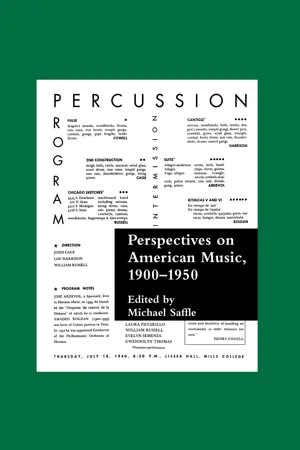
Perspectives on American Music, 1900-1950
About this book
The essays in this collection reflect the range and depth of musical life in the United States during the first half of the twentieth century. Contributions consider the rise and triumph of popular forms such as jazz, swing, and blues, as well as the contributions to art music of composers such as Ives, Cage, and Copland, among others. American contributions to music technology and dissemination, and the role of these forms in extending the audience for music, is also a focus.
Information
Chapter 1
Boston’s “French Connection” at the Turn of the Twentieth Century
Composer Arthur Shepherd once described musical Boston as “an outpost of German music culture,”1 a just observation looking back upon the late nineteenth century. German dominance in the repertory of American concert stages prior to the twentieth century is well known. That German dominance extended to original compositions of American composers, many of whom were trained in Germany or by those who had been, also has long been recognized. Furthermore, that national hostilities during World War I allowed the music of France (and other countries) a greater entree into American concerts at the time of the war also is well known, as is the emergence of Paris as a fashionable spot for composers to study after the war.
During the late 1910s, however, French music did not arrive in Boston as a complete stranger. Between 1880 and 1915 musical exchanges did pass between Boston and Paris, and before the war some musical figures in Boston had already ardently espoused the cause of French music, a cause they continued to champion during and after World War I.
In 1906 Edward Burlingame Hill wrote to Le Mercure musical that “Boston is certainly the most informed American city about modern French music.”2 Whatever the relationships between the music of France and other American cities (which lie outside the scope of this essay), Boston did have a distinct rapport with Paris through a circle of French and American musical figures in the city. Francophiles in Boston not only sought to introduce the music and musicians of France to America but also to inform the French about musical activities in America. Their views and reports doubtless influenced French perception of music not only in Boston but also in America in general.
Most of this activity occurred after 1880 when concert music in Boston came into full bloom simultaneously as instrumental music flourished in France. Before this time French music was not altogether unknown. Thomas Ryan, who arrived in Boston in 1845, remarked in regard to ballet music that during his early years in Boston “the best composers of the period” were “mostly French.”3 Yet most music in Boston was not associated with the opera or ballet, as Boston did not have a resident opera company until the twentieth century. In the realms of orchestral, chamber, and recital repertory, French music was rare.
As Boston developed its concert life throughout the nineteenth century and especially after 1865, German musicians and conductors, who came to theh United States in large numbers after the revolutions of 1848, took the lead. For example, Germans Carl Zerrahn and Bernard Listemann led orchestras in the city prior to the founding of the Boston Symphony Orchestra (BSO). The BSO itself was conducted by a series of Germans, who were in charge of so many German and German-trained musicians in that organization that they could conduct rehearsals in the German language. In chamber music, again, it was Germans such as Wulf Fries and Franz Kneisel who formed the premier ensembles and set standards for local musicians.
Not surprisingly, German musicians favored German composers and established the German sound and style as the core of the then-current concert repertory. This preference for German music extended into teaching studios and even into university education. The leading instructors and local composers of the nineteenth century in New England—John Knowles Paine and George Whitefield Chadwick, among others—were educated in Germany and passed on German traditions, helping to establish Boston, as Shepherd said, as a colony of German culture.4
As for the music of France, an unsigned article published in 1890 in the Boston Home Journal and titled “Boston’s Musical Bigotry” complained about the dearth of performances of French music. This writer wanted to hear Delibes, Massenet, Bizet, or “the many interesting works of others of the modern French school”:
They are not deemed worthy, however, of a place upon the Symphony programs or the dignity of evening dress; when they are played it is at a “Young People’s Popular” where they are performed almost with an apology and treated with frock-coated indifference. . . . We grope about in German mists, which have blown in upon us and settled at our own whistling; and we daily accustom ourselves to the thick, damp fog and say it is purer and healthier than clear air and a blue sky.5
When French music began to be imported, it encountered some resistance. The music was not simply by French composers; it was by modern French composers who, following the Franco-Prussian War, were deliberately searching for a distinct national identity, an ars gallica. They gave instrumental music new attention, producing a new repertory and a new style.
Boston traditionalists, by and large, were not interested in such innovation, distinct from the tradition with which they were familiar and upon which they had modeled their ideas of musical excellence. With the immigration of French musicians and francophiles, however, the serious introduction of French music began. Although French composition never supplanted the German repertory, within twenty years some others who wrote about French music performance, such as Hill and critic Philip Hale, were able to comment on Boston’s familiarity with French composers, in particular the modern French school.
The beginning of this change can surely be traced to the most active and influential champion of French music in Boston during the last two decades of the nineteenth century, Charles Martin Loeffler (1861–1935). Loeffler was assistant concertmaster of the BSO from 1882 to 1903, a chamber musician and recitalist, and a composer of music that his American colleagues deemed to be of the French School.
While most immigrant orchestral musicians were, like Loeffler, German by birth, most were not, like him, trained in France and enamored of all the French arts. While studying violin and composition in Paris and playing with Jules Étienne Pasdeloup’s orchestra, Loeffler had been completely overcome by Parisian modes. His francophilia lasted throughout his lifetime. After he settled in Boston, Loeffler revisited France (and other European capitals) and lived in Paris during the winter of 1904–1905. Each year he developed enthusiasms for even newer French music. He became acquainted with several French composers, including Vincent d’lndy, Edouard Lalo, and Gabriel Fauré, with conductors, and with performers. These French acquaintances often looked to Loeffler as a liaison and unofficial representative in America.
Loeffler’s first efforts to promote French music in Boston consisted primarily in performing it himself. He premiered works with the BSO such as Benjamin Godard’s Concerto romantique, Lalo’s Fantasie norégienne and Symphonie espagnole, and Camille Saint-Saëns’s first Violin Concerto. One critic wrote “we have to thank [Mr. Loeffler] for almost all the chances we get nowadays of hearing French music.”6 Loeffler’s efforts extended to influencing others, such as BSO conductors and the Kneisel Quartette, to select French compositions for performance. After returning from Paris in 1905, for example, he persuaded the BSO to perform Ernest Chausson’s Symphony, Op. 10. He also induced Schirmer’s to publish some French music, including works by Fauré.
Not all welcomed this new music. Conservatives John Sullivan Dwight and Otto Dresel, who had exerted profound influence over musical society’s tastes during the nineteenth century stood solidly behind the traditional repertory. Clara Rogers reported that Otto Dresel’s response to the news that Loeffler would play at her soiree was a weary, hopeless “He—will—play something by Lalo!”7
Opportunities for hearing French music increased as more French musicians, especially Georges Longy (1868–1930), arrived in the city. Longy, who quickly became Loeffler’s great good friend, was a conductor as well as an oboist and composer. A native of Abbeville, France, he was a student at the Paris Conservatoire and a member of the Lamoureux and Colonne orchestras. From 1898 until 1925, when he returned to France, Longy was principal oboist with the BSO.
After arriving in Boston, Longy soon set about conducting an orchestra and a chamber ensemble similar to La Société de Musique de Chambre pour Instruments a Vent, which he had reestablished in France in 1895. With his ensembles he introduced yet more French composers to Boston audiences. With the Longy Club, active from 1900 to 1917, for example, Longy performed compositions by Emile Bernard, Andre Caplet, Leland Cossart, Fauré, Edouard Flament, Charles Gounod, Théodore Gouvy, Reynaldo Hahn, Jean Huré, d’lndy, Charles Lefebvre, Alberic Magnard, Edmond Malherbe, Andre Maquarre, Léon Moreau, Jules Moquet, A. Perilhou, Gabriel Pierné, Paul Florimond Quef, and Paul de Wailly.
From 1899 to 1911 Longy conducted the Orchestral Club of Boston. Under the direction of Listemann and Chadwick, the group played principally the works of familiar German composers. For example, in one 1891 concert, the Club performed compositions by Mendelssohn, Schubert, Bruch, Raff, and Spohr. At Longy’s first concert, however, they played works by Gounod, Jules Massanet, Saint-Saëns, Emile Pessard, and Théodore Dubois.
Over the years, while not fashioning exclusively French programs, Longy selected primarily French compositions for this ensemble. The orchestra also premiered a number of works in America. Some composers whose works he chose to perform also were taken up by other conductors and are now familiar names, including Hector Berlioz, Georges Bizet, Claude Debussy, Léo Delibes, Emmanuel Chabrier, d’lndy, Paul Dukas, Lalo, Maurice Ravel, Erik Satie, and Charles-Marie Widor. The names of other composers, however, may be as unfamiliar now as when first placed on Longy’s programs. These included L. A. Bourgault-Ducoudray, Caplet, Camille Chevillard, Georges Hüe, Silvio Lazzari (a naturalized Frenchman), Lefebvre, Guillaume Lekeu, Léon Moreau, Emile Pessard, Gabriel Pierné, E. Tavan, Julien Tiersot, and Henri Woollett.
Longy conducted other ensembles, including the MacDowell Club and the Boston Musical Association. The latter was formed, according to a statement in its program book, “for the purpose of stimulating the development of young musicians and composers of talent by giving them frequent opportunities of appearing under favorable auspices before the public.” At each concert a new work by an American composer was performed “and if the work has an unusual success there will be opportunity for its performance by the Société Nationale de Musique de Paris.”8
The programs for concerts presented by the Association were more varied than those of the Orchestral Society, mixing works by American, French, Spanish, British, and Russian composers. Still, French compositions were prominant. During the Association’s first season, in addition to choosing works by Debussy, Fauré, Chausson, and Saint-Saëns, Longy led the group in the first American performances of Ravel’s Trois Pémes de Mallaré, Salzedo’s 3 Poems by Sara Yarrow; and Louis Thirion’s String Quartet, Op. 10. In the second season the Association gave either the Boston or American premiere of Charles Bordes’ Rapsodie Basque, Alfred Bruneau’s Pentésiée, Maurice Delage’s Quatre pémes Hindous, Ravel’s Alborada del Gracioso, and Florent Schmitt’s Chant de Guerre. Thirion’s Quartet was performed at the second Musical Association Concert by a guest ensemble that itself had the distinction of performing and premiering French works, not surprisingly since the ensemble was formed by Loeffler. This was the American String Quartette.9
Although Loeffler himself performed less and less in public after his retirement from the BSO in 1903, in 1908 he founded a quartet made up of his women students. This ensemble continued his custom of including French works among those of the standard repertory. When the chamber group first debuted, in 1909, one of their attractions was the Debussy Quartet. In New York in 1918, when the group playe...
Table of contents
- Cover
- Half Title
- Title Page
- Copyright
- Contents
- Series Editor’s Foreword
- Introduction
- Chapter 1: Boston’s “French Connection” at the Turn of the Twentieth Century
- Chapter 2: Ticklers’ Secrets: Ragtime Performance Practices, 1900–1920—A Bibliographic Essay
- Chapter 3: Mapping the Blues Genes: Technological, Economic, and Social Strands—A Spectral Analysis
- Chapter 4: Some American Firms and Their Contributions to the Development of the Reproducing Piano
- Chapter 5: Dances, Frolics, and Orchestra Wars: The Territory Bands and Ballrooms of Kansas City, Missouri, 1925–1935
- Chapter 6: Thomas A. Dorsey and the Development and Diffusion of Traditional Black Gospel Piano
- Chapter 7: Western Swing: Working-Class Southwestern Jazz of the 1930s and 1940s
- Chapter 8: The Art of Noise: John Cage, Lou Harrison, and the West Coast Percussion Ensemble
- Chapter 9: Melville Smith: Organist, Educator, Early Music Pioneer, and American Composer
- Chapter 10: Toscanini and the NBC Symphony Orchestra: High, Middle, and Low Culture, 1937–1954
- Chapter 11: Cinema Music of Distinction: Virgil Thomson, Aaron Copland, and Gail Kubik
- Chapter 12: The New Tin Pan Alley: 1940s Hollywood Looks at American Popular Songwriters
- Contributors
- Index
Trusted by 375,005 students
Access to over 1.5 million titles for a fair monthly price.
Study more efficiently using our study tools.
Frequently asked questions
Yes, you can cancel anytime from the Subscription tab in your account settings on the Perlego website. Your subscription will stay active until the end of your current billing period. Learn how to cancel your subscription
No, books cannot be downloaded as external files, such as PDFs, for use outside of Perlego. However, you can download books within the Perlego app for offline reading on mobile or tablet. Learn how to download books offline
We are an online textbook subscription service, where you can get access to an entire online library for less than the price of a single book per month. With over 1.5 million books across 990+ topics, we’ve got you covered! Learn about our mission
Look out for the read-aloud symbol on your next book to see if you can listen to it. The read-aloud tool reads text aloud for you, highlighting the text as it is being read. You can pause it, speed it up and slow it down. Learn more about Read Aloud
Yes! You can use the Perlego app on both iOS and Android devices to read anytime, anywhere — even offline. Perfect for commutes or when you’re on the go.
Please note we cannot support devices running on iOS 13 and Android 7 or earlier. Learn more about using the app
Please note we cannot support devices running on iOS 13 and Android 7 or earlier. Learn more about using the app
Yes, you can access Perspectives on American Music, 1900-1950 by Michael Saffle in PDF and/or ePUB format, as well as other popular books in Media & Performing Arts & Music. We have over 1.5 million books available in our catalogue for you to explore.